

TL;DR:
- Structured IT reviews enhance compliance and operational efficiency for Brisbane SMEs.
- Frameworks like SMB1001 and Essential Eight guide scalable, risk-based security improvements.
- Regular quarterly reviews and documented processes are key to ongoing IT security success.
Most Brisbane business owners know they should be on top of their IT compliance, but when the time comes to actually do something about it, the sheer volume of frameworks, checklists, and requirements can feel paralysing. The good news is that a structured IT review process does not have to be complicated. When done right, it drives both compliance and genuine operational efficiency. This guide walks you through the leading frameworks used by Brisbane small and medium businesses, a step-by-step review process, and practical habits that make regular reviews feel manageable rather than overwhelming. The IT security assessment steps for Brisbane SMEs are more accessible than most people assume.
Table of Contents
- Why IT review matters for Brisbane businesses
- Core IT review frameworks: SMB1001 and Essential Eight explained
- Step-by-step guide to the business IT review process
- Practical tips to make IT reviews efficient and ongoing
- What most guides miss about IT reviews for Brisbane SMBs
- Get expert support for your Brisbane IT review process
- Frequently asked questions
Key Takeaways
| Point | Details |
|---|---|
| Quarterly reviews matter | Regular, scheduled IT reviews drive the best compliance and efficiency outcomes. |
| Choose the right framework | Select an IT framework that matches your business size, resources and compliance needs. |
| Focus on process discipline | It’s not just the framework, but consistently following structured review steps that creates results. |
| Managed support boosts outcomes | Partnering with expert IT service providers ensures you stay on top of process and compliance. |
Why IT review matters for Brisbane businesses
Compliance is often treated as a box-ticking exercise, but for Brisbane small and medium enterprises (SMEs), the stakes are far more concrete. A poorly managed IT environment creates real exposure: regulatory penalties, data breaches, lost productivity, and lasting damage to your business reputation. The good news is that a disciplined review process addresses all of these at once.
The operational benefits alone make the effort worthwhile. Regular IT reviews reduce unexpected downtime, catch vulnerabilities before they become incidents, and give decision-makers accurate information about the state of their systems. When you know what you have and how it is performing, you can plan better and spend smarter.
Brisbane businesses navigating security frameworks for Brisbane SMBs often find that lighter, scalable frameworks suit them far better than the heavy-duty standards designed for large enterprises. SMB1001 was built with exactly this in mind. It uses a maturity-based approach with tiered levels, so you are not expected to achieve enterprise-grade security overnight. You progress at a pace that reflects your business size and risk profile.
Here is a quick look at the risks that make IT reviews non-negotiable:
- Regulatory penalties for non-compliance with Australian privacy and data laws
- Data breaches resulting from unpatched software or weak access controls
- Lost productivity caused by system downtime and unresolved technical debt
- Reputational damage when clients or partners discover security failings
- Failed audits due to poor documentation and inconsistent processes
When you build IT review into your regular operations, these risks shrink considerably. It also becomes easier to demonstrate compliance to clients and partners, which is increasingly a requirement in sectors like finance, legal, and healthcare.
“For Brisbane SMBs, SMB1001 provides scalable review process enhancing efficiency via maturity tiers and compliance proof, ideal over heavier frameworks.”
The IT compliance best practices for SMEs consistently point in the same direction: start structured, stay consistent, and document everything. With the landscape set, let’s explore what best-practice review frameworks look like.
Core IT review frameworks: SMB1001 and Essential Eight explained
The primary IT review process for Brisbane SMBs centres on two frameworks: SMB1001 and the Essential Eight. Understanding what each one covers, and where they differ, helps you choose the right starting point for your business.
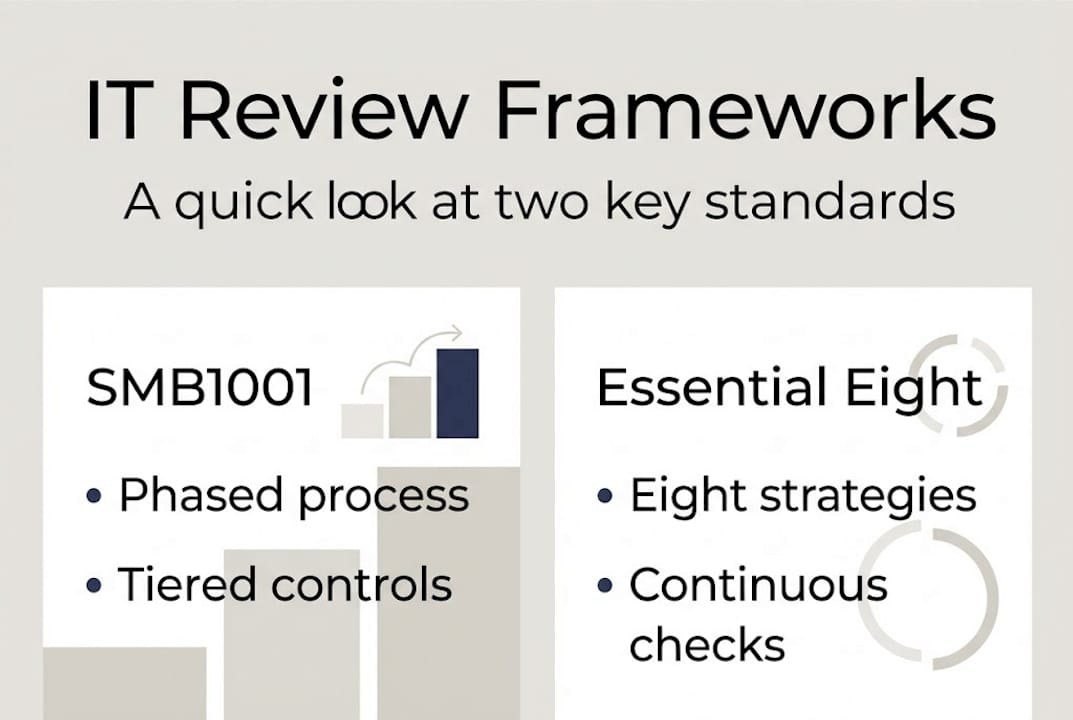
SMB1001 is a maturity-based, scalable standard developed specifically for smaller businesses. It is structured around tiers, meaning you can start at a lower maturity level and build upward as your controls improve. It covers areas like access management, patching, backups, and incident response, and it is designed to provide verifiable compliance proof that you can show to clients, insurers, and regulators.
Essential Eight is an Australian Signals Directorate (ASD) framework covering eight mitigation strategies such as multi-factor authentication (MFA), application patching, and regular backups. It uses four maturity levels (0 through 3), making it easy to benchmark your current position and track progress.
| Feature | SMB1001 | Essential Eight |
|---|---|---|
| Focus | Business compliance and trust | Cyber threat mitigation |
| Structure | Maturity tiers, scalable | 8 strategies, 4 maturity levels |
| Business fit | SMBs wanting compliance proof | Any business, ASD-aligned |
| Review frequency | Phased, 6 to 24 months | Quarterly recommended |
| Main benefit | Demonstrable certification | Practical risk reduction |
Top reasons Brisbane SMBs choose each security framework for Brisbane:
- SMB1001: Preferred when seeking formal certification to share with clients or meet contract requirements
- Essential Eight: Preferred when the primary goal is reducing exposure to common cyber threats quickly
- SMB1001: Suits businesses in regulated sectors like healthcare, legal, and financial services
- Essential Eight: Works well as a starting point for businesses with no existing framework in place
Pro Tip: Do not overcomplicate your starting point. Pick the framework that best matches your current maturity level and existing controls. You can always layer in additional requirements as your processes mature.
Understanding frameworks is vital. So, how do you actually run an effective IT review?
Step-by-step guide to the business IT review process
A well-run IT review follows a consistent sequence. The general IT review steps used by Brisbane SMEs can be broken into five clear phases, each with defined actions and responsibilities.
- Define scope and assets: Identify which systems, devices, software, and data are in scope. Be specific. Vague scope leads to missed risks.
- Inventory and assess controls: Document what security controls are currently in place and evaluate how well they are working.
- Identify vulnerabilities and risks: Look for gaps in patching, access control, backup coverage, and other critical areas.
- Remediate: Prioritise and fix identified issues, starting with the highest-risk items. Assign ownership for each action.
- Verify and document: Confirm that fixes are working and record everything. Documentation is your evidence for audits and future reviews.
| Review phase | Key actions | Timeframe | Responsible party |
|---|---|---|---|
| Define scope | List assets, set boundaries | Week 1 | IT lead or manager |
| Assess controls | Audit current protections | Weeks 2 to 3 | IT team or provider |
| Identify risks | Gap analysis, risk scoring | Week 4 | IT team or provider |
| Remediate | Fix issues, apply patches | Weeks 5 to 8 | IT team or provider |
| Verify and document | Test fixes, log outcomes | Ongoing | IT lead or manager |
For most Brisbane SMEs, the full cycle runs over a phased 6 to 24-month period, with quarterly check-ins to keep momentum. If you are using Essential Eight, quarterly reviews and 90-day baselines offer the fastest path to efficiency gains.

You can read more about what this looks like in practice in our compliance explained for Brisbane businesses guide.
Pro Tip: Build a simple template for each review phase. Even a shared spreadsheet with standard fields saves hours and keeps your team aligned when review time comes around.
Knowing the process is one thing. What about making it efficient and sustainable for your business?
Practical tips to make IT reviews efficient and ongoing
The biggest challenge for most Brisbane SMBs is not understanding what to do. It is actually doing it consistently. IT reviews tend to fall off the calendar when business picks up, and that is exactly when risk exposure increases.
Scheduling is everything. Block IT review activities into your business calendar the same way you would financial reporting or team meetings. Assign a responsible owner, not just a department. When one person is accountable, things actually get done.
Documentation matters more than most businesses realise. Document management best practices emphasise that a change log is not just good housekeeping. It is your audit trail. If a regulator or client asks how you manage your IT security, a well-maintained log is your fastest and most credible answer.
Common pitfalls Brisbane SMBs run into:
- Skipping steps to save time, then missing critical vulnerabilities
- Never following up on remediation items, leaving known risks unaddressed
- Poor documentation making it impossible to demonstrate compliance later
- Ignoring frameworks and relying on ad hoc fixes that do not scale
- One-off reviews with no plan for ongoing monitoring or reassessment
For businesses without dedicated IT staff, the managed IT support Brisbane model is often the most practical solution. Managed IT services are recommended for Brisbane SMBs lacking in-house expertise, ensuring ongoing process adherence rather than sporadic fixes.
The proactive IT support advantages are significant. A proactive provider monitors your environment continuously, flags issues before they escalate, and keeps your review documentation current.
Pro Tip: Assign IT review ownership to a named individual with calendar reminders set 30 days before each quarterly review. Accountability without a prompt rarely survives a busy quarter.
Let’s step back and consider a broader expert perspective on what makes IT reviews truly work for Brisbane SMBs.
What most guides miss about IT reviews for Brisbane SMBs
Most IT review guides focus on frameworks and checklists, and while those matter, they gloss over the real reason reviews fail: discipline, not knowledge. In our experience working with Brisbane SMBs, businesses that get the best results are not always the ones using the most sophisticated framework. They are the ones that actually show up every quarter and do the work.
Conventional wisdom says to do an annual IT review. That advice is outdated. Annual reviews are snapshots of a system that changes daily. Threats evolve, staff change, software updates, and cloud configurations drift. By the time you review, the snapshot is already stale.
Over-investing in heavyweight tools or expensive consultants without building internal habits is also a common trap. Quarterly reviews and 90-day baselines offer the fastest path to meaningful compliance and operational gains, and they do not require a big budget, just consistency.
What we have seen work is simple: a committed owner, a repeatable process, and genuine buy-in from leadership. The IT support benefits explained often come down to this exact combination. The framework is the vehicle. Discipline is the fuel.
Get expert support for your Brisbane IT review process
If you have read this far, you understand what a strong IT review process looks like. The harder part is building and sustaining it alongside everything else your business demands. That is where IT Start comes in. We work with Brisbane SMBs to implement structured, ongoing IT reviews that align with SMB1001 and Essential Eight, so compliance does not fall through the cracks. Our cyber security services and business cloud services are designed to support the full review lifecycle, from initial assessment through to ongoing managed support. Reach out today to book a free IT review consultation and find out where your business stands.
Frequently asked questions
How often should a Brisbane SMB conduct an IT review?
Quarterly IT reviews are recommended for most Brisbane SMEs, particularly when using the Essential Eight framework, as they allow businesses to catch emerging risks before they become serious problems.
What is the difference between SMB1001 and Essential Eight?
SMB1001 is a scalable, tiered certification framework suited to businesses seeking formal compliance proof, while Essential Eight focuses on eight core cyber threat mitigation strategies across four maturity levels, making it a strong practical starting point for risk reduction.
What are the main steps in a typical IT review process?
The five core IT review steps are: define scope and assets, assess current controls, identify vulnerabilities and risks, remediate issues, and verify and document outcomes for compliance evidence.
When should a business use managed IT services for reviews?
Managed IT services are ideal when your business lacks the in-house expertise or consistent time to perform structured reviews, ensuring that compliance and security standards are maintained without placing the burden on internal staff.
Recommended
- Boost operational efficiency and security with IT compliance – IT Start
- Boost your IT compliance and security with certifications – IT Start
- Understanding IT’s role in compliance for Queensland SMBs – IT Start
- IT Compliance Best Practices for Brisbane Firms – IT Start
- IT-advies checklist mkb: gids voor veilige keuzes
- Security audit checklist guide for asset protection – Safes and Security Direct