TL;DR:
- Managed IT services deliver proactive, around-the-clock management, reducing system downtime significantly.
- They improve cybersecurity compliance and support flexible, cloud-based operations at predictable costs.
- Choosing a local, certified provider ensures effective support, transparency, and alignment with Australian security standards.
Most Brisbane small businesses know they need better IT. What they don’t know is that 79% of SMBs attacked experience consequences that could have been prevented with the right support in place. Managed IT services remain one of the most misunderstood tools available to local business owners. Too many assume it’s expensive, complicated, or only for large corporations. This guide cuts through that confusion. We’ll explain exactly what managed IT is, how it works, which services matter most for Brisbane businesses, the real numbers behind its benefits, and how to choose a provider you can actually trust.
Table of Contents
- What is managed IT and how does it work?
- Key managed IT services for Brisbane businesses
- Business benefits: efficiency, savings, and compliance
- Choosing the right managed IT provider in Brisbane
- Our perspective: Brisbane SMBs shouldn’t settle for reactive IT
- Secure your Brisbane business with the right IT partnership
- Frequently asked questions
Key Takeaways
| Point | Details |
|---|---|
| Proactive support cuts risk | Managed IT slashes downtime and cyber threats for Brisbane SMBs. |
| Efficiency plus cost savings | Switching to managed IT boosts productivity and saves up to 40 percent on IT budgets. |
| Compliance protects reputation | Meeting Essential Eight and SMB1001 standards keeps your business data safe and legally compliant. |
| Pick the right partner | Choose a provider with local experience, clear agreements, and proven compliance capabilities. |
What is managed IT and how does it work?
Managed IT is simply outsourced IT management delivered for a fixed monthly fee. Instead of calling someone when something breaks, you have a dedicated team proactively managing your entire technology environment around the clock. Think of it less like hiring a plumber and more like having a building manager who prevents leaks before they flood your office.
The managed IT guide for Brisbane explains that this model covers a broad range of responsibilities, including:
- Proactive monitoring of your servers, devices, and network
- Cybersecurity protection including threat detection and incident response
- Automated patching to close software vulnerabilities before attackers exploit them
- Cloud management for hosted applications and storage
- Data back-ups with tested recovery processes
- Helpdesk support for your staff when issues arise
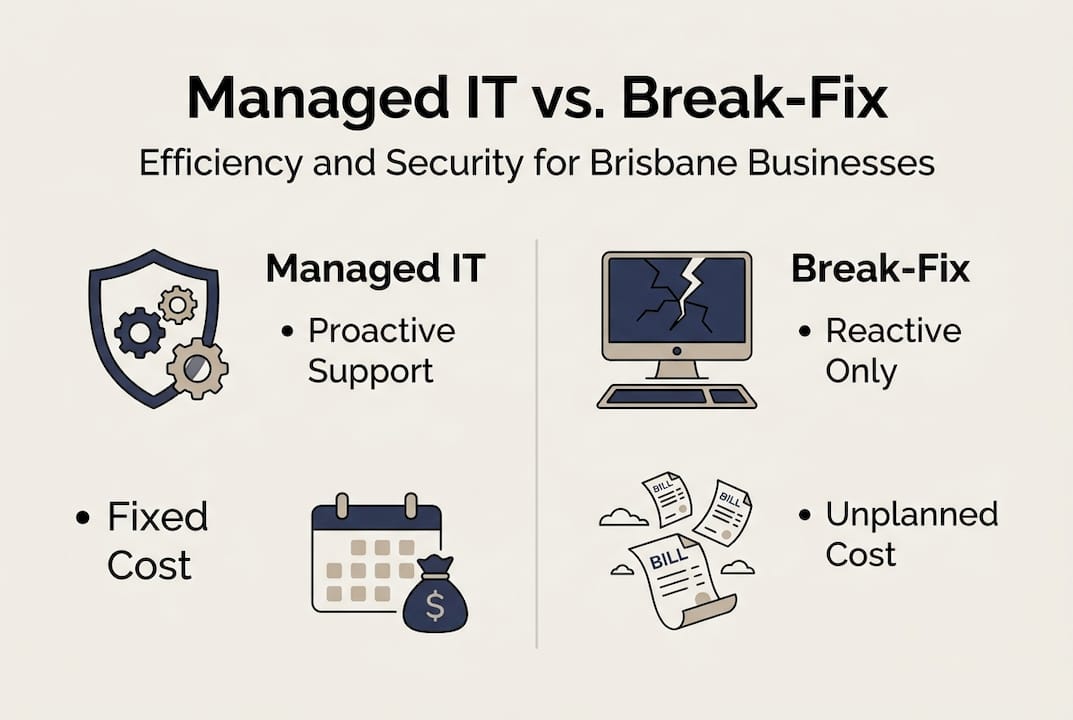
The key difference from traditional break-fix IT is intent. Break-fix is reactive. You pay when something goes wrong, and the provider has little incentive to prevent problems. Managed IT flips that model entirely. Your provider succeeds when your systems run smoothly, which means their goals align with yours.
Service-level agreements, commonly called SLAs, are the backbone of this model. An SLA is a formal commitment that defines response times, uptime guarantees, and support availability. A reputable provider will offer clear SLAs so you know exactly what you’re getting. Core IT management services delivered under a solid SLA give you predictability that reactive IT simply cannot match.
“Managed IT services for Brisbane SMBs employ proactive monitoring, 24/7 security oversight, automated patching, cloud management, and helpdesk support with SLAs.”
Pro Tip: When evaluating any provider, treat 24/7 security monitoring as non-negotiable. Cyberattacks don’t follow business hours, and a provider who only monitors during the day leaves you exposed every evening and weekend.
Key managed IT services for Brisbane businesses
Not all managed IT packages are equal. Understanding which services deliver the most value helps you ask better questions and avoid paying for things you don’t need.
Managed IT security for Brisbane SMEs is increasingly centred on compliance with the Australian Cyber Security Centre’s Essential Eight framework. This is a set of eight baseline controls including multi-factor authentication, application patching, and restricted admin privileges. The SMB1001 standard aligns with Essential Eight and adds governance requirements, giving businesses a tiered certification path from Bronze through to Gold.
Here’s a breakdown of the essential IT management offerings Brisbane businesses should expect:
| Service | What it does | Why it matters |
|---|---|---|
| Continuous monitoring | Watches your network 24/7 for anomalies | Catches threats before they cause damage |
| Cybersecurity management | Implements Essential Eight controls | Keeps you compliant and protected |
| Cloud services | Manages hosted apps and storage | Supports flexible and remote work |
| Automated back-ups | Schedules and tests data recovery | Protects against ransomware and data loss |
| Helpdesk support | Resolves staff IT issues quickly | Reduces productivity loss from tech problems |
| Patch management | Updates software automatically | Closes vulnerabilities attackers target |
Pricing for these services typically falls between $90 and $180 per user per month, depending on your service inclusions and business complexity. That predictable monthly cost is one of the biggest advantages over reactive IT, where a single server failure can generate an unexpected invoice in the thousands.
For industries like healthcare, legal, and financial services operating in Brisbane, compliance is not optional. Regulators expect documented controls, and managed IT providers who understand local requirements can make that process far less painful.
Business benefits: efficiency, savings, and compliance
The business case for managed IT is built on real numbers, not vague promises. Let’s look at what the data actually shows.
Downtime is the most visible cost of poor IT management. Proactive managed IT reduces downtime from 40 to 80 hours per year down to just 5 to 15 hours, representing a 70 to 80 per cent reduction. For a team of 10 people earning average wages, that difference can represent tens of thousands of dollars in recovered productivity annually.

Cost savings are equally compelling. Businesses that switch from in-house or break-fix IT to a managed model typically save 25 to 40 per cent on IT costs overall, while also seeing 30 to 50 per cent efficiency gains across their operations.
Here’s how managed IT compares to the alternatives:
| Factor | Managed IT | Break-fix | In-house IT |
|---|---|---|---|
| Monthly cost | Fixed, predictable | Variable, unpredictable | High (salary + tools) |
| Downtime risk | Low (proactive) | High (reactive) | Medium |
| Compliance support | Included | Rarely included | Depends on staff skills |
| 24/7 coverage | Standard | Not typical | Rarely feasible |
| Scalability | Easy | Difficult | Expensive |
The managed IT versus in-house comparison consistently favours managed services for businesses under 50 staff, where hiring a full IT team is cost-prohibitive.
Here’s how the managed IT process actually delivers these outcomes:
- Onboarding assessment maps your current environment and identifies risk areas
- Baseline security controls are implemented immediately, including patching and MFA
- Continuous monitoring begins, with alerts triaged by the provider’s team
- Monthly reporting gives you visibility into incidents, uptime, and resolved issues
- Quarterly reviews adjust the service as your business grows or changes
This structured approach is why managed IT services outperform reactive models over time. The compounding effect of prevention adds up quickly.
Choosing the right managed IT provider in Brisbane
Selecting a provider is where many Brisbane businesses make costly mistakes. The wrong choice can leave you locked into a poor contract with hidden fees and no real compliance support.
Start by checking these criteria:
- Local Brisbane experience: Providers who understand Queensland’s regulatory environment and can respond on-site when needed
- Essential Eight alignment: Ask specifically how they implement each of the eight controls
- Clear SLAs: Response times, escalation paths, and uptime guarantees must be in writing
- 24/7 support: Confirm whether this is genuine round-the-clock coverage or just an after-hours answering service
- Transparent pricing: No surprise fees for after-hours calls or additional users
When evaluating choosing IT managed services, ask providers these direct questions: How do you handle a ransomware incident at 2am? What’s your average response time for critical issues? Can you show me a sample SLA?
Compliance focus matters enormously. Providers should align with Essential Eight and demonstrate governance practices, not just claim they do. Ask for documentation.
Pro Tip: Look specifically for providers holding SMB1001 Bronze, Silver, or Gold certification. This independently verified standard confirms they meet Australian best-practice requirements for small business IT security, and it gives you a benchmark that generic IT providers simply cannot match.
Managing the transition from your current setup doesn’t have to be disruptive. A quality provider will conduct a full audit, develop a migration plan, and phase in changes to minimise any impact on your daily operations.
Our perspective: Brisbane SMBs shouldn’t settle for reactive IT
After working with businesses across Brisbane, we’ve seen a consistent pattern. Business owners treat IT like insurance they hope they never need, spending as little as possible and only engaging when something breaks. That mindset is genuinely risky in 2026.
Cybercriminals actively target small businesses precisely because they assume their defences are weak. And often, they’re right. Managed IT transforms IT from a cost centre into a genuine efficiency driver, but only when businesses commit to a proactive model rather than a reactive one.
We’ve seen Brisbane firms in professional services and healthcare completely change their operational confidence after switching to managed IT. Fewer incidents. Faster staff. Better client trust. The businesses thriving are the ones who stopped viewing IT as an expense and started treating it as infrastructure.
Don’t settle for a provider who just fixes things when they break. Demand transparency, documented compliance, and a partner who understands what’s at stake for your business. The real managed IT success stories come from businesses that made this shift deliberately.
Secure your Brisbane business with the right IT partnership
If you’re ready to move beyond reactive IT and build a technology foundation that actually supports your business goals, IT Start is here to help. We provide business IT support tailored specifically for Brisbane SMBs, with transparent pricing, genuine 24/7 coverage, and SMB1001 Gold certification. Our cyber security solutions align with the ACSC Essential Eight to keep your business compliant and protected. We also offer cloud services for SMBs that support flexible, modern workplaces. Reach out for a free assessment and see exactly where your IT stands today.
Frequently asked questions
What does a managed IT provider actually do for my business?
They take responsibility for your IT infrastructure, covering monitoring, security, back-ups, and helpdesk so your team can focus on work rather than tech problems. Proactive monitoring and 24/7 security are standard inclusions with a quality provider.
How much should Brisbane SMBs budget for managed IT per user?
Expect to pay between $90 and $180 per user each month, with the final figure depending on your service level, number of users, and specific inclusions like advanced security or cloud management.
How does managed IT help with cybersecurity compliance?
A good provider implements the ACSC Essential Eight controls and supports SMB1001 certification, ensuring your business meets Australian standards for data security and governance.
Is switching to managed IT disruptive for daily business operations?
A reputable provider designs a phased transition plan to minimise disruption, and with proactive managed IT reducing downtime by 70 to 80 per cent, most businesses experience far fewer interruptions after the switch than before it.