

TL;DR:
- Proactive monitoring detects issues early, reducing downtime and fixing problems before they escalate.
- It enhances cybersecurity by identifying threats through behaviour analytics and threat intelligence.
- Successful proactive monitoring requires proper configuration, ongoing culture shift, and a hybrid approach.
Most Brisbane business owners assume IT support means calling someone when things break. That assumption is costly. Unplanned downtime can cost small businesses thousands of dollars per hour, and cyber threats rarely announce themselves before striking. Waiting for something to go wrong is no longer a viable strategy in 2026. Proactive monitoring flips this model entirely, watching your systems around the clock and catching problems before they spiral into crises. In this article, we’ll walk through what proactive monitoring is, how it works, why it outperforms reactive approaches, and how it strengthens your cybersecurity posture.
Table of Contents
- What is proactive monitoring?
- How proactive monitoring works: Key features and technologies
- Proactive vs reactive monitoring: What’s at stake for businesses?
- Proactive monitoring and cybersecurity: Protecting your business from unseen threats
- Why achieving true proactivity is about more than just buying tools
- Connect with expert IT support for true proactive monitoring
- Frequently asked questions
Key Takeaways
| Point | Details |
|---|---|
| Early risk detection | Proactive monitoring spots IT and security problems before they disrupt your business. |
| Reduced downtime | Continuous monitoring and predictive analytics help keep systems running smoothly and limit costly outages. |
| Stronger cybersecurity | Behavioural analytics and threat intelligence make it easier to detect and block cyber attacks early. |
| Smarter business decisions | Using real-time data means more informed IT and operational planning for Brisbane businesses. |
What is proactive monitoring?
Proactive monitoring is the ongoing practice of watching your IT systems for early warning signs before those signs become full-blown problems. Think of it like a smoke detector rather than a fire brigade. You’re not waiting for the building to catch fire before you act.
At its core, proactive monitoring involves several interconnected components. According to Paessler, key methodologies include continuous real-time data collection on metrics like CPU usage, memory, disk space, and network bandwidth, paired with automated alerts for anomalies, predictive analytics using baselines and machine learning, preventive maintenance such as patching, and coverage across servers, networks, applications, endpoints, and cloud environments.
This is fundamentally different from reactive monitoring, which only kicks in after something has already failed. Here’s a quick comparison:
| Feature | Proactive monitoring | Reactive monitoring |
|---|---|---|
| When it acts | Before problems occur | After problems occur |
| Downtime impact | Minimal | High |
| Cost over time | Lower | Higher |
| Threat detection | Early | Late or missed |
| Business disruption | Rare | Frequent |
For Brisbane SMBs, the difference between these two approaches can mean the difference between a five-minute fix and a five-hour outage. Proactive monitoring gives your IT team or managed service provider the visibility they need to act before your staff even notices something is wrong.
Key components of a proactive monitoring setup include:
- Real-time performance tracking across all devices and systems
- Automated threshold alerts that flag unusual behaviour immediately
- Predictive analytics to spot trends before they become failures
- Scheduled preventive maintenance including patching and updates
- Broad coverage spanning cloud, on-premises, and hybrid environments
Our proactive monitoring guide covers how Brisbane SMBs can structure this for their specific environments. You can also explore the proactive support advantages that come with shifting away from a break-fix mindset.
Pro Tip: If your current IT setup only generates tickets after users complain, you’re operating reactively. Ask your provider how many issues they caught and resolved before you noticed them last month.
How proactive monitoring works: Key features and technologies
Understanding what proactive monitoring is gives you the foundation. Now let’s look at the actual mechanics, because knowing how it works helps you ask better questions when evaluating IT providers.
The engine of proactive monitoring is continuous data collection. Your systems constantly generate performance data, and real-time metrics collection across CPU load, memory usage, disk space, and network bandwidth gives your IT team a live picture of system health at all times. When a server starts using 95% of its disk space, the system flags it automatically, long before it crashes.
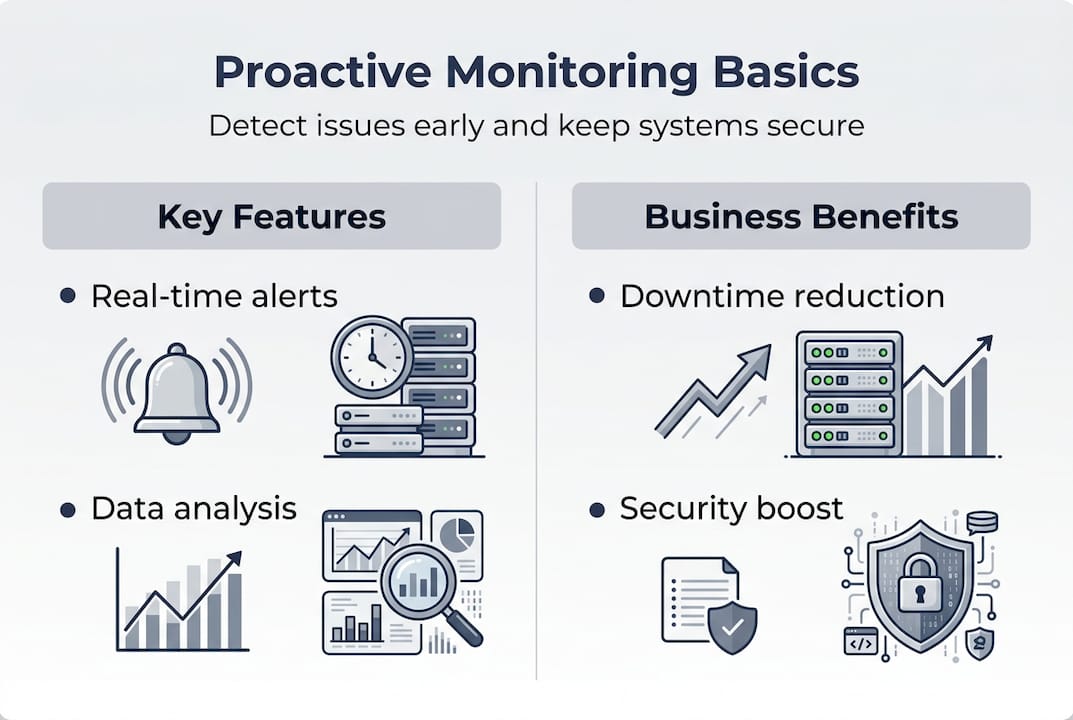
Automated alerts are the next layer. These aren’t just simple notifications. Modern monitoring platforms use intelligent thresholds, meaning alerts fire based on context, not just raw numbers. A CPU spike at 2am on a Sunday is treated differently from the same spike during a busy Monday morning.
Predictive analytics takes this further. By analysing historical data and comparing it against established baselines, machine learning models can forecast when a component is likely to fail. This shifts maintenance from reactive to scheduled, which is far less disruptive.
Here’s how the key technologies stack up in practice:
| Technology | What it does | Business benefit |
|---|---|---|
| Real-time metrics | Tracks system performance live | Immediate visibility |
| Automated alerts | Flags threshold breaches instantly | Fast response times |
| Predictive analytics | Forecasts failures before they happen | Planned, not panicked maintenance |
| Preventive patching | Closes vulnerabilities on schedule | Reduced security risk |
| Endpoint monitoring | Watches every device on your network | No blind spots |
Preventive maintenance, particularly patching, is one of the most underrated aspects of proactive monitoring. Many breaches exploit known vulnerabilities that had patches available for months. Staying on top of updates automatically removes a significant attack surface.

For businesses exploring managed IT and support options, understanding these technologies helps you evaluate whether a provider is truly proactive or simply reactive with better branding. Our overview of IT management services in Brisbane outlines what genuine proactive coverage looks like in practice.
Pro Tip: Ask any IT provider to show you a sample monitoring dashboard. If they can’t show you live performance data for your systems, they may not be monitoring as closely as they claim.
Proactive vs reactive monitoring: What’s at stake for businesses?
The stakes here are real and measurable. Reactive monitoring, which only responds after issues occur, leads to higher downtime, costs, and risks, and experts strongly recommend proactive or hybrid approaches for SMBs, noting that reactive monitoring only suits low-risk, resource-limited cases.
Let’s be direct about what reactive monitoring actually costs. When a server goes down unexpectedly, you’re not just paying for the repair. You’re paying for lost productivity across every staff member who can’t work, potential data loss, customer trust erosion, and sometimes regulatory penalties if sensitive data is affected.
“Reactive monitoring is like only checking your car’s oil when the engine warning light comes on. By then, the damage is often already done.”
Proactive monitoring delivers measurable advantages:
- Fewer incidents overall because problems are resolved before they escalate
- Earlier threat detection giving your team time to respond before damage spreads
- Lower long-term costs from reduced emergency callouts and unplanned downtime
- Improved staff productivity since systems run more reliably and consistently
- Better compliance posture because monitoring logs provide audit trails
For industries like financial services, the proactive support in financial sector context is particularly relevant, where system availability and data integrity are non-negotiable. Similarly, operational efficiency with proactive IT is a measurable outcome, not just a talking point.
That said, reactive monitoring isn’t entirely without a place. In very low-risk, non-critical environments with tight budgets, a purely reactive approach might be acceptable. But for any Brisbane business handling customer data, financial records, or time-sensitive operations, reactive alone is simply not enough. Our complete proactive IT support guide outlines how to build a hybrid model that covers both bases.
Proactive monitoring and cybersecurity: Protecting your business from unseen threats
Downtime is painful. A data breach is catastrophic. Proactive monitoring plays a critical role in cybersecurity that goes well beyond keeping servers online.
Modern cyber threats don’t always announce themselves with obvious attacks. Sophisticated adversaries move slowly and quietly, blending into normal network traffic. This is where behavioural analytics becomes essential. By establishing a baseline of normal behaviour across your network, behavioural analytics detect anomalies and threats early, including insider threats, low-noise lateral movement, and unknown attack patterns that traditional signature-based tools miss entirely.
Threat intelligence integration adds another layer. Your monitoring platform can pull in live feeds of known malicious IP addresses, domains, and attack signatures, cross-referencing them against your own traffic in real time. This means you benefit from global threat data, not just what’s happening on your own network.
For Brisbane SMBs, the practical cybersecurity benefits of proactive monitoring include:
- Early detection of compromised accounts through unusual login patterns or access times
- Identification of data exfiltration attempts before sensitive files leave your network
- Spotting ransomware behaviour such as mass file encryption before it completes
- Flagging unauthorised device connections that could indicate a breach in progress
- Continuous vulnerability scanning to identify weaknesses before attackers do
The connection between operational continuity and security is direct. A business that can detect and contain a threat in minutes rather than days suffers far less damage. Explore our cyber security solutions to understand how monitoring integrates with a broader security strategy, and our cyber threat intelligence guide for a deeper look at how threat data is used in practice.
Pro Tip: Ask your IT provider whether your monitoring platform includes user behaviour analytics. If they only monitor network traffic and not user activity, you have a significant blind spot for insider threats.
Why achieving true proactivity is about more than just buying tools
Here’s what most guides won’t tell you: buying a monitoring platform doesn’t make you proactive. We’ve seen businesses invest in sophisticated tools and still experience frequent outages, because the tools were poorly configured, the wrong metrics were being tracked, or nobody was acting on the alerts.
Success hinges on right metrics and baselines, avoiding alert fatigue through intelligent filtering, and treating proactive monitoring as a culture and process shift, not just a technology purchase. Alert fatigue is real. When a system generates hundreds of low-priority notifications daily, teams start ignoring them, and the critical ones get missed.
The businesses that get the most from proactive monitoring are those where leadership understands that prevention is everyone’s responsibility. IT doesn’t operate in isolation. Staff who report unusual system behaviour, managers who approve timely patching windows, and owners who invest in proper coverage all contribute to a genuinely proactive environment.
Our honest view: proactive monitoring works best as a hybrid model. It reduces the frequency and severity of incidents dramatically, but no system eliminates all problems. Having a solid reactive response plan alongside your proactive monitoring is the mark of a mature IT strategy. Explore the proactive IT support advantages that come with getting both sides of this equation right.
Connect with expert IT support for true proactive monitoring
If this article has made one thing clear, it’s that proactive monitoring is not a set-and-forget tool. It requires the right expertise, the right configuration, and an ongoing commitment to improvement. That’s exactly what IT Start delivers to Brisbane businesses every day.
Our team provides business IT support built around genuine proactive monitoring, not reactive fire-fighting dressed up with better branding. From cyber security services that integrate threat intelligence into your monitoring environment, to cloud services that extend visibility across your entire infrastructure, we help Brisbane SMBs stay ahead of problems rather than scrambling to recover from them. Get in touch with IT Start today for a tailored assessment.
Frequently asked questions
What are the main benefits of proactive monitoring for small businesses?
Proactive monitoring helps prevent downtime, detects threats early, and reduces maintenance costs. Experts recommend proactive or hybrid approaches for SMBs because reactive monitoring consistently leads to higher costs and greater risk.
How does proactive monitoring improve cybersecurity?
It uses behavioural analytics and threat intelligence to detect anomalies and threats far earlier than traditional signature-based security tools, including hard-to-spot insider threats and lateral movement attacks.
Is proactive monitoring expensive to implement?
When you compare the cost of proactive monitoring against the financial impact of unplanned downtime or a data breach, it becomes highly cost-effective. Reactive monitoring leads to higher downtime and costs that far exceed the investment in prevention.
Can proactive monitoring prevent all IT problems?
No approach eliminates every IT problem, but proactive monitoring significantly reduces their frequency and severity. As noted by Paessler, success complements reactive response, making a hybrid model the most resilient strategy for growing businesses.
Recommended
- Proactive IT Monitoring Guide: Boost Security for Brisbane SMEs – IT Start
- Cyber Security – IT Start
- Unlock operational efficiency with proactive IT support in 2026 – IT Start
- Threat monitoring: why Queensland SMBs can’t ignore it – IT Start
- Τι είναι έξυπνο home security και πώς προστατεύει το σπίτι – Asknik