

TL;DR:
- Small to medium-sized businesses in Queensland face frequent cyberattacks, with many lacking adequate security measures. Threat monitoring offers continuous, proactive detection of threats beyond traditional antivirus tools, significantly reducing risk. Engaging managed services can improve security, compliance, and reduce costs related to cyber incidents.
Every six minutes, an Australian business faces a cyberattack, and nearly half of those attacks hit small to medium-sized businesses (SMBs). If you’re running a business in Queensland and you think your size makes you invisible to cybercriminals, that assumption could cost you everything. This article explains what threat monitoring actually is, why it’s become non-negotiable for SMBs across Brisbane and regional Queensland, and what practical steps you can take right now to shift from a reactive posture to a proactive one. By the end, you’ll have a clear picture of the tools, the trade-offs, and the real business case for investing in proper monitoring.
Table of Contents
- Why SMBs are targets: The changing cyber threat landscape
- Threat monitoring defined: Beyond antivirus and reactive measures
- Key threat monitoring solutions: Methods, managed services, and compliance
- Why threat monitoring is an investment: Business impact and ROI
- Our take: The uncomfortable truth about threat monitoring for SMBs
- How IT Start can help Queensland SMBs protect their business
- Frequently asked questions
Key Takeaways
| Point | Details |
|---|---|
| SMBs are prime targets | Queensland small to medium businesses face frequent cyber threats due to limited defences. |
| Monitoring is proactive protection | Threat monitoring detects advanced attacks that antivirus alone cannot catch. |
| Managed solutions boost compliance | MDR and managed services help meet ACSC and NIST requirements while reducing alert fatigue. |
| ROI outweighs costs | Investing in monitoring saves money by reducing downtime, breach expenses, and insurance compliance hurdles. |
Why SMBs are targets: The changing cyber threat landscape
There’s a persistent myth that cybercriminals only go after big corporations. The reality is far more uncomfortable. SMBs are now the preferred targets precisely because they hold valuable data but typically lack the security resources of larger organisations. Think of it like a burglar choosing between a house with a security system and one with a basic lock. The choice is obvious.
Cyber threats for Brisbane SMEs have evolved significantly over the past few years. Ransomware, phishing campaigns, and business email compromise are now commonplace, and Queensland businesses are firmly in the crosshairs. The SMB cybersecurity importance cannot be overstated when you consider that 43% of SMBs experienced a cyber incident, with slower threat detection making them preferred targets.
Here’s what makes SMBs particularly vulnerable:
- Limited IT budgets that leave gaps in security coverage
- Valuable data including customer records, financial information, and intellectual property
- Slower detection times meaning attackers can operate undetected for weeks or months
- Fewer dedicated security staff to monitor systems around the clock
- Outdated software and unpatched systems that create easy entry points
“Small businesses often believe they’re too small to be worth targeting. Cybercriminals know otherwise. An SMB with weak defences is far easier to breach than a hardened enterprise, and the data is just as sellable.”
The table below shows the most common attack types hitting Queensland SMBs and their typical impact:
| Attack type | Frequency | Average impact |
|---|---|---|
| Phishing | Very high | Credential theft, data breach |
| Ransomware | High | Operational shutdown, financial loss |
| Business email compromise | High | Fraudulent transfers, reputational damage |
| Malware infection | Medium | Data theft, system damage |
| Supply chain attacks | Growing | Wide-scale compromise |
The uncomfortable truth is that most SMBs discover a breach only after significant damage has already occurred. Reactive security simply cannot keep pace with the speed and sophistication of modern attacks.
Threat monitoring defined: Beyond antivirus and reactive measures
So what exactly is threat monitoring? In plain terms, it’s the continuous process of watching your IT environment for suspicious activity, detecting potential threats early, and responding before damage escalates. It’s not a single product you install and forget. It’s an ongoing discipline.
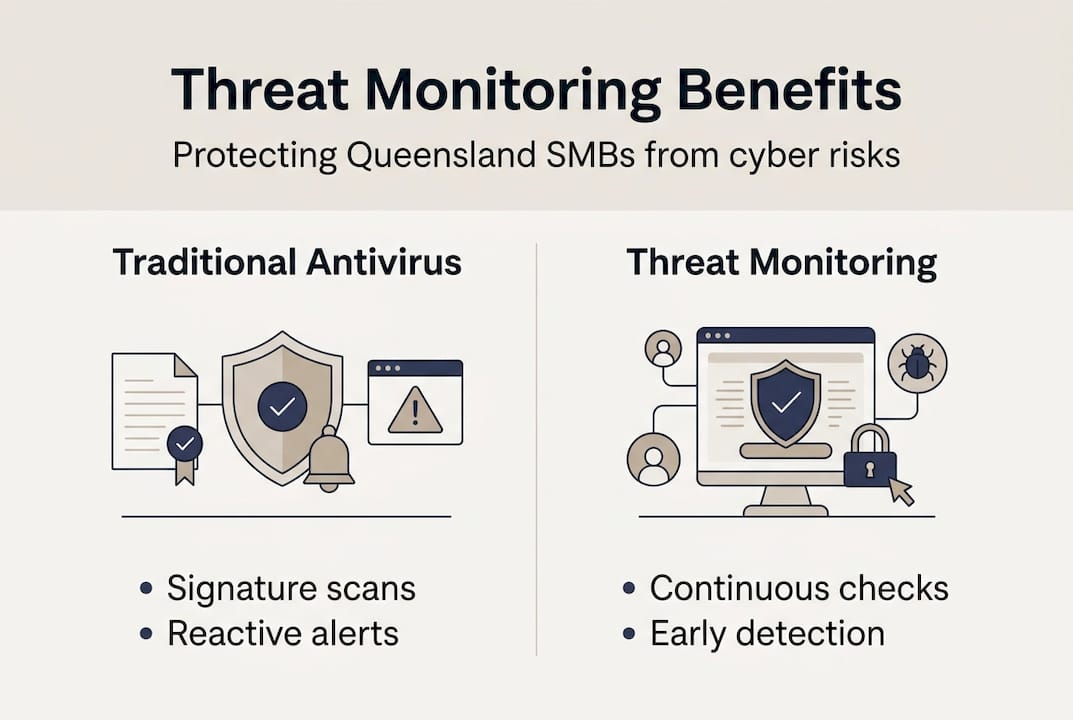
Traditional antivirus software works by comparing files against a known list of malicious signatures. If the threat is on the list, it gets blocked. If it’s not, it passes through. That model worked reasonably well in the early days of computing, but modern attacks have outpaced it entirely. Proactive monitoring for SMBs now covers fileless attacks, AI-driven intrusion methods, and lateral movement inside your network, all of which antivirus tools routinely miss.

Here’s a direct comparison:
| Feature | Antivirus | Threat monitoring |
|---|---|---|
| Detection method | Signature-based | Behavioural and anomaly-based |
| Coverage | Known threats only | Known and unknown threats |
| Response | Automated block | Detect, alert, and respond |
| Visibility | Endpoint only | Network, cloud, and endpoints |
| Monitoring frequency | Periodic scans | Continuous, 24/7 |
Modern threat monitoring typically includes these core components:
- Security information and event management (SIEM): Aggregates logs from across your environment to spot patterns.
- Endpoint detection and response (EDR): Monitors individual devices for unusual behaviour.
- Network traffic analysis: Watches data flows for signs of intrusion or data exfiltration.
- Vulnerability scanning: Regularly checks for cybersecurity vulnerabilities for Brisbane SMEs before attackers exploit them.
- Incident response planning: Ensures there’s a clear process when a threat is detected.
Monitoring provides proactive detection of threats missed by antivirus, including fileless and AI-driven attacks, which is why it’s become the baseline expectation for any serious security posture. You can also explore cybersecurity best practices to complement your monitoring approach.
Pro Tip: You don’t need an in-house security team to benefit from threat monitoring. Managed services can deliver enterprise-grade visibility at a fraction of the cost, shifting your business from reactive firefighting to proactive protection.
Key threat monitoring solutions: Methods, managed services, and compliance
For most Queensland SMBs, the practical question isn’t whether to implement threat monitoring but how to do it without blowing the budget or drowning in alerts. There are two broad approaches: building an internal capability or engaging a managed service.
Building internally requires dedicated staff, specialised tools, and around-the-clock availability. For most SMBs, that’s simply not feasible. Managed Security Services (MSS) and Managed Detection and Response (MDR) providers fill that gap. The role of managed services is to act as your outsourced security team, monitoring your environment continuously and responding to threats on your behalf.
The numbers back this up. MSS and MDR can reduce risk by up to 60%, which is critical for SMBs without 24/7 security staff. That’s not a marginal improvement. That’s a fundamental shift in your risk profile.
Key benefits of managed threat monitoring for SMBs:
- 24/7 coverage without the cost of hiring a full security team
- Faster detection and response measured in minutes rather than days
- Access to specialist expertise that would be unaffordable in-house
- Scalability as your business grows or your risk profile changes
- Compliance support aligned with frameworks like ACSC Essential Eight
Speaking of compliance, ACSC Essential Eight compliance is increasingly relevant for Queensland businesses, particularly those working with government clients or handling sensitive data. MDR for SMBs integrates directly with compliance frameworks like NIST and ACSC Essential Eight, making it far easier to demonstrate your security posture to clients, insurers, and regulators.
One critical factor that’s often overlooked is tuning. A poorly configured monitoring system generates so many alerts that your team becomes overwhelmed and starts ignoring them. This is called alert fatigue, and it’s a genuine risk. Effective monitoring requires ongoing calibration to ensure you’re catching real threats without burying your team in false positives.
Pro Tip: When evaluating an MDR provider, ask specifically how they handle alert tuning and what their average response time is. A provider that can’t answer those questions clearly isn’t ready to protect your business.
Stat to note: MSS reduces organisational risk by up to 60%, making it one of the highest-ROI security investments available to resource-limited SMBs.
Why threat monitoring is an investment: Business impact and ROI
The most common objection we hear from SMB owners is straightforward: “We can’t afford it.” It’s worth flipping that question around. Can you afford not to have it?
The cyber risks for Brisbane businesses are real and measurable. A single ransomware incident can cost tens of thousands of dollars in downtime, recovery, and reputational damage. For many SMBs, that’s enough to threaten the viability of the entire business. The cybersecurity risks examples for Queensland businesses show that the average cost of a breach far exceeds the annual cost of managed monitoring.
Cyber insurance is also changing the equation. Cyber insurance increasingly requires threat monitoring as a baseline condition for coverage, and businesses that can demonstrate active monitoring often qualify for lower premiums. This means monitoring isn’t just a security cost. It’s a cost that actively reduces other costs.
Here’s a summary of the tangible business benefits:
- Reduced breach costs through early detection and faster containment
- Lower downtime because threats are caught before they escalate to full incidents
- Insurance eligibility as providers tighten minimum security requirements
- Regulatory compliance across ACSC Essential Eight, NIST, and industry-specific standards
- Client confidence particularly for businesses in healthcare, legal, and financial services
| Benefit area | Without monitoring | With monitoring |
|---|---|---|
| Breach detection time | Days to weeks | Minutes to hours |
| Average breach cost | High | Significantly reduced |
| Insurance premium | Higher or ineligible | Lower, compliant |
| Compliance status | At risk | Supported and documented |
| Business continuity | Vulnerable | Protected |
The investment in monitoring pays for itself many times over when you factor in avoided breach costs, insurance savings, and the operational stability that comes from knowing your environment is being watched.
Our take: The uncomfortable truth about threat monitoring for SMBs
Here’s something most cybersecurity articles won’t tell you. The biggest risk for Queensland SMBs isn’t that they have no security. It’s that they have just enough security to feel comfortable while remaining genuinely exposed.
A basic antivirus subscription and a firewall create a false sense of protection. Business owners tick the box, assume they’re covered, and move on. Meanwhile, attackers are using methods that bypass those tools entirely. We’ve seen this pattern repeatedly, and the cost of that misplaced confidence is always higher than the cost of doing it properly from the start.
The managed service insight that matters most here is this: monitoring is not a set-and-forget solution. It requires ongoing attention, tuning, and expertise. SMBs that treat it as a one-time purchase miss the point entirely. The value comes from continuity, from having eyes on your environment every single day.
Investing early in proper threat monitoring is almost always cheaper than reacting to a breach. The maths are straightforward, even if the decision feels difficult.
How IT Start can help Queensland SMBs protect their business
At IT Start, we work with Queensland SMBs every day to build security postures that are practical, affordable, and genuinely effective. Our cyber security solutions are designed specifically for businesses that need enterprise-grade protection without the enterprise price tag. We handle the complexity of threat monitoring, compliance alignment, and incident response so you can focus on running your business. Whether you need managed monitoring, cloud services for SMBs, or a full security review, we tailor our approach to your specific risk profile. Ready to move from reactive to proactive? Get in touch with our team for a no-obligation assessment.
Frequently asked questions
How often are Queensland SMBs targeted by cyber threats?
Australian SMBs are targeted roughly every six minutes, which makes proactive monitoring an operational necessity rather than a nice-to-have.
Is threat monitoring expensive for small businesses?
Managed monitoring is scalable and the cost is consistently outweighed by reduced breach expenses and downtime. MSS and MDR reduce risks by up to 60%, making them a strong investment for SMBs.
Can threat monitoring help with compliance?
Yes. Managed monitoring directly supports ACSC Essential Eight and NIST compliance, which is increasingly required for government contracts and regulated industries.
What’s the difference between antivirus and threat monitoring?
Antivirus relies on known threat signatures, while threat monitoring detects advanced threats proactively, including fileless and AI-driven attacks that antivirus tools routinely miss.
Do insurance companies now require threat monitoring?
Yes. Cyber insurance providers increasingly set active threat monitoring as a minimum requirement for coverage, and businesses with monitoring in place often pay lower premiums.
Recommended
- Types of cyberattacks: how Queensland owners can spot them – IT Start
- Cyber Security Threats: Vital Risks for Brisbane SMEs – IT Start
- Cyber Threat Response Guide for Brisbane SMBs – IT Start
- Cyber Security Threats – What Brisbane Businesses Face – IT Start
- Why website security matters: protect clients and grow revenue