

Traditional IT support waits for problems to strike, but many financial services firms in Brisbane need more than crisis response. Staying ahead of system failures and cyber threats is vital for maintaining trust and continuity in Australian banking and payments. Proactive IT support uses established processes and constant monitoring to prevent costly disruptions before they happen, enabling smoother operations and stronger security across your business.
Table of Contents: Proactive IT Support in Brisbane’s Financial Sector
- Defining Proactive IT Support For Business
- How Proactive Support Prevents Downtime
- Variations: Managed, Cloud, And Security Support
- Proactive IT And Compliance In Financial Services
- Cost Risks Of Reactive Vs Proactive Support
Key Takeaways
| Point | Details |
|---|---|
| Proactive IT Support Benefits | This approach predicts and mitigates potential technological challenges, enhancing operational efficiency and reducing downtime. |
| Compliance Integration | Proactive IT support embeds compliance within technological frameworks, enabling financial institutions to navigate regulatory landscapes effectively. |
| Cost Effectiveness | Investing in proactive support models reduces unexpected expenses associated with reactive responses, promoting financial stability. |
| Holistic Support Strategy | Integrating managed, cloud, and cybersecurity support creates a comprehensive defence mechanism against potential vulnerabilities. |
Defining Proactive IT Support for Business
Proactive IT support represents a strategic approach to managing technology infrastructure that goes far beyond traditional reactive problem-solving. Unlike traditional support models that respond after issues emerge, proactive IT support anticipates potential challenges and implements preventative measures to maintain seamless business operations.
At its core, proactive IT support involves anticipating potential problems through systematic monitoring, comprehensive analysis, and strategic intervention. This approach transforms IT support from a reactive service desk into a forward-thinking business enabler that minimises technological disruptions.
Key characteristics of proactive IT support include:
- Continuous system monitoring and performance tracking
- Predictive maintenance and early warning detection
- Regular security vulnerability assessments
- Systematic documentation of potential risk areas
- Proactive system updates and patch management
The methodology leverages advanced diagnostic tools and frameworks to identify potential vulnerabilities before they escalate into significant operational challenges. By understanding system behaviours and potential failure points, IT support teams can develop targeted strategies that prevent disruptions rather than simply responding to them.
Proactive IT support isn’t just about preventing technical issues – it’s about creating a resilient technological ecosystem that supports business growth and innovation.
Business Benefits of this approach include reduced downtime, lower long-term technology costs, enhanced cybersecurity, and improved operational efficiency. Financial services organisations in Brisbane particularly benefit from proactive support models that protect sensitive transactional data and maintain regulatory compliance.

Pro tip: Schedule quarterly comprehensive IT infrastructure reviews to stay ahead of potential technological challenges and maintain optimal system performance.
How Proactive Support Prevents Downtime
In the high-stakes world of financial services, preventing technological disruptions is not just a technical requirement but a critical business imperative. Downtime can translate directly into substantial financial losses, reputational damage, and compromised customer trust. Proactive IT support emerges as a strategic shield against these potential catastrophes.
Financial institutions in Brisbane are increasingly recognising the importance of operational risk management strategies that anticipate and neutralise potential system failures before they occur. This approach involves comprehensive monitoring, predictive diagnostics, and rapid intervention mechanisms designed to maintain continuous operational integrity.
Key strategies for preventing downtime include:
- Continuous system health monitoring
- Predictive maintenance scheduling
- Real-time performance analytics
- Automated threat detection systems
- Redundant infrastructure configurations
- Rapid incident response protocols
The financial sector’s reliance on complex technological ecosystems demands a multifaceted approach to maintaining system reliability. By implementing advanced diagnostic tools and comprehensive monitoring frameworks, organisations can identify potential vulnerabilities long before they escalate into critical failures.
Proactive support isn’t just about preventing problems – it’s about creating a resilient technological infrastructure that ensures uninterrupted business operations.
Beyond technical interventions, proactive support involves developing robust business continuity plans that provide systematic responses to potential disruptions. These plans incorporate redundancy strategies, backup systems, and clearly defined escalation protocols that enable financial organisations to maintain service levels even during unexpected technological challenges.
By investing in sophisticated proactive support models, Brisbane’s financial services can significantly reduce the risk of costly downtime, protect sensitive transactional data, and maintain the high standards of reliability that customers expect in today’s digital banking environment.
Pro tip: Implement automated monitoring tools that provide real-time alerts and predictive analytics to identify potential system vulnerabilities before they cause operational disruptions.
Variations: Managed, Cloud, and Security Support
In the complex landscape of financial technology, proactive IT support has evolved into sophisticated service models that address diverse organisational needs. Managed support, cloud solutions, and security services represent critical variations designed to provide comprehensive technological protection for Brisbane’s financial institutions.
Financial organisations are increasingly adopting comprehensive cyber security approaches that integrate multiple support strategies to create robust technological ecosystems. These approaches go beyond traditional reactive models, offering integrated solutions that anticipate and neutralise potential technological vulnerabilities.
Key variations in proactive IT support include:
-
Managed IT Support
- Continuous system monitoring
- Comprehensive infrastructure management
- Predictive maintenance and troubleshooting
- Compliance and regulatory alignment
-
Cloud Support
- Scalable infrastructure deployment
- Remote resource management
- Multi-tenant environment security
- Flexible and adaptive computing solutions
-
Cybersecurity Support
- Advanced threat detection
- Identity and access management
- Regular security vulnerability assessments
- Incident response and mitigation strategies
Each support variation addresses unique technological challenges while maintaining a holistic approach to organisational IT resilience. Managed services provide end-to-end support, cloud solutions offer scalable and flexible infrastructure, and security services ensure comprehensive protection against evolving cyber threats.
To clarify the business impact of different proactive IT support types, see the table below:
| Support Type | Main Focus | Business Impact |
|---|---|---|
| Managed IT Support | Full infrastructure oversight | Ensures stable operations and compliance |
| Cloud Support | Scalable, remote infrastructure | Enables flexibility and rapid scaling |
| Cybersecurity Support | Threat prevention and detection | Reduces data breach and regulatory risk |
Effective proactive support isn’t about choosing one approach, but integrating multiple strategies to create a comprehensive technological defence mechanism.
For Brisbane’s financial sector, these support variations represent more than technical solutions – they are strategic investments in operational continuity, data protection, and technological innovation. By leveraging these sophisticated support models, financial institutions can maintain competitive advantage, protect sensitive information, and adapt quickly to changing technological landscapes.
Pro tip: Conduct periodic comprehensive IT support assessments to determine the most appropriate mix of managed, cloud, and security support strategies for your specific organisational needs.
Proactive IT and Compliance in Financial Services
Compliance in the financial sector represents far more than a regulatory checkbox – it’s a critical strategic imperative that demands sophisticated, forward-thinking technological approaches. Proactive IT support has emerged as a pivotal mechanism for Brisbane’s financial institutions to navigate complex regulatory landscapes while maintaining operational excellence.
Financial organisations are now required to implement robust compliance frameworks that integrate technological governance with legal requirements. These frameworks go beyond traditional risk management, embedding compliance directly into technological infrastructure and organisational processes.
Key compliance considerations in proactive IT support include:
-
Regulatory Alignment
- Continuous monitoring of legislative changes
- Automated compliance tracking systems
- Regular internal audits and assessments
- Comprehensive documentation practices
-
Data Protection
- Advanced encryption protocols
- Secure data handling procedures
- Access control and authentication mechanisms
- Privacy regulation compliance
-
Risk Management
- Predictive threat detection
- Comprehensive incident response strategies
- Third-party vendor risk assessments
- Ongoing staff training programs
The intersection of technology and compliance requires a holistic approach that anticipates potential risks while maintaining operational flexibility. Financial institutions must develop dynamic technological ecosystems that can rapidly adapt to evolving regulatory requirements.
Effective compliance is not about rigid adherence, but about creating adaptable systems that protect both organisational and customer interests.
By integrating proactive IT support with compliance strategies, Brisbane’s financial services can transform regulatory requirements from potential obstacles into opportunities for technological innovation and enhanced customer trust. This approach ensures not just legal adherence, but a competitive advantage in an increasingly complex digital landscape.
Pro tip: Implement a quarterly compliance and technology review process that systematically evaluates your IT infrastructure against the latest regulatory standards.
Cost Risks of Reactive vs Proactive Support
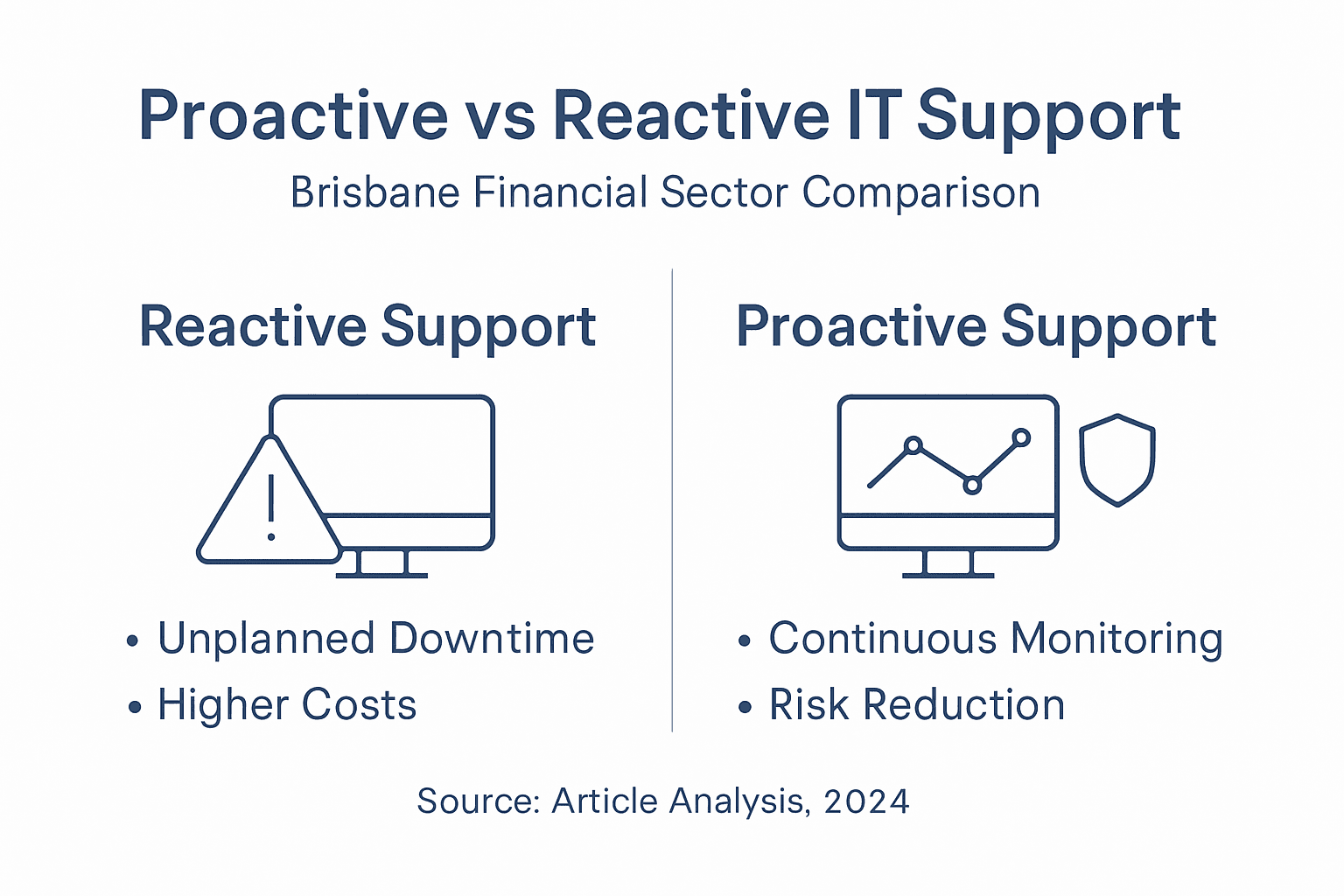
In the high-stakes environment of financial services, the cost differential between reactive and proactive IT support can represent a critical strategic consideration. Reactive support models typically create unpredictable financial risks that far exceed the investment required for proactive technological management.
Financial institutions are increasingly recognising the significant economic implications of operational risk management strategies that prioritise prevention over remediation. The potential financial consequences of reactive approaches extend well beyond immediate technical repair costs.
Comparative cost risks between reactive and proactive support include:
Reactive Support Costs:
- Unexpected system downtime
- Emergency repair expenses
- Potential regulatory penalties
- Loss of customer confidence
- Extended service interruption periods
Proactive Support Costs:
- Predictable infrastructure investments
- Regular maintenance expenses
- Continuous system optimization
- Minimal unexpected disruption costs
- Enhanced operational efficiency
The financial impact of reactive support can be catastrophic. A single unresolved technological failure can trigger cascading economic consequences that far outweigh the consistent, manageable expenses associated with proactive technological management.
Reactive support is not a cost-saving strategy – it’s a financial risk management approach that frequently results in higher long-term expenses.
Beyond direct monetary considerations, reactive support introduces substantial reputational risks for financial institutions. Prolonged system failures can erode customer trust, potentially causing long-term brand damage that cannot be easily quantified or remediated.
Here’s a comparison of reactive versus proactive IT support costs and risks for financial organisations:
| Aspect | Reactive Support | Proactive Support |
|---|---|---|
| Cost Predictability | Highly variable, unpredictable | Consistent, planned outlay |
| Risk of Downtime | High; frequent and prolonged | Low; brief and rare |
| Regulatory Exposure | Greater penalty risk | Robust compliance reduces penalties |
| Reputation Impact | Erodes customer trust | Reinforces reliability and confidence |
Pro tip: Conduct an annual comprehensive cost-benefit analysis comparing your current IT support model’s total expense against potential proactive support investment strategies.
Unlock Seamless IT Resilience for Brisbane’s Financial Sector
The article highlights the critical challenge of managing technological risks proactively to prevent costly downtime and ensure compliance within Brisbane’s financial services. You understand that traditional reactive support leads to unpredictable failures, operational disruptions, and regulatory penalties. The goal is clear — to build a robust, forward-thinking IT environment that anticipates threats, enforces compliance, and safeguards sensitive data.
At IT Start, we deliver precisely that proactive IT support tailored for Queensland’s financial institutions. Our managed IT support, cloud solutions, and cybersecurity services work together to provide continuous monitoring, predictive maintenance, and advanced threat detection. This approach minimises downtime, strengthens regulatory adherence, and enhances operational efficiency, giving your business the strategic advantage it deserves.
Ready to take control of your IT risks with a trusted Brisbane partner? Discover how our proactive support can transform your technology landscape by contacting us today for a free assessment. Start your journey towards uninterrupted business operations and compliance confidence now by visiting Contact IT Start. Learn more about our Managed IT Support and explore tailored solutions designed specifically for financial services in Brisbane.
Frequently Asked Questions
What is proactive IT support?
Proactive IT support is a strategic approach focused on anticipating potential technological issues and implementing preventive measures, rather than just reacting to problems after they arise.
How does proactive support prevent downtime in financial institutions?
Proactive support helps prevent downtime through measures such as continuous system monitoring, predictive maintenance, and rapid incident response strategies, ensuring operational integrity and minimizing disruptions.
What are the key benefits of implementing proactive IT support in the financial sector?
The key benefits include reduced downtime, lower long-term technology costs, enhanced cybersecurity, and improved operational efficiency, all of which contribute to better compliance and customer trust.
Why is compliance important in proactive IT support for financial services?
Compliance is crucial as it ensures that financial institutions adhere to regulations while optimizing their technology infrastructure. Proactive IT support integrates compliance tracking and risk management, making it easier to navigate regulatory landscapes.