

TL;DR:
- Most Australian SMEs underestimate their compliance obligations, risking costly fines and operational disruptions. Implementing proportionate, risk-based processes and continuous monitoring can simplify adherence and turn compliance into a competitive advantage. Proper IT systems, documented controls, and proactive management are essential for avoiding penalties and securing business growth.
Most Australian small business owners think of compliance as something that applies to big companies with legal teams and dedicated HR staff. That assumption is costing them. Federal regulation compliance costs Australia around $160 billion annually, equivalent to 5.8% of GDP, up from $65 billion in 2013. That burden does not fall evenly. SMEs absorb a disproportionate share of it, with fewer staff to spread the load and less cash to absorb the consequences of getting it wrong. Understanding why compliance for SMEs matters is the first step toward managing it without it managing you.
Table of Contents
- Key takeaways
- Why compliance for SMEs is not optional
- The real financial and operational risks
- Challenges SMEs face with compliance
- Practical strategies to manage compliance well
- What we actually see in practice
- My honest take on compliance for SMEs
- How IT Start supports SME compliance
- FAQ
Key takeaways
| Point | Details |
|---|---|
| Compliance costs are rising fast | Federal regulatory costs have nearly tripled since 2013, hitting SMEs hardest with limited resources. |
| Non-compliance has real financial teeth | ASIC and WHS penalties can reach hundreds of thousands of dollars, plus reputational and contract losses. |
| Manual compliance is a time drain | Nearly 39% of small businesses spend more than 6 hours weekly on compliance tasks alone. |
| Risk-based approaches work better for SMEs | Proportionate, fit-for-purpose compliance programmes outperform copying large enterprise frameworks. |
| Continuous effort beats last-minute scrambles | Ongoing compliance reduces the costly backfill work that follows a breach or regulator contact. |
Why compliance for SMEs is not optional
Compliance means meeting the legal, regulatory, and contractual obligations that apply to your business. For Australian SMEs, that list is longer than most owners realise. You are navigating Fair Work requirements, workplace health and safety obligations, ASIC reporting rules, the Privacy Act, state-based licensing, and increasingly, cyber security expectations from clients, insurers, and government contracts.
The regulatory environment is genuinely complex. Federal rules overlap with state regulations, and then there is what practitioners call “white tape.” That is the layer of extra compliance obligations imposed on SMEs by larger clients or partners. A law firm wanting you to complete a supplier security questionnaire before signing a contract, or a health network requiring ISO 27001 alignment before onboarding your services. White tape compliance burdens add real administrative weight, often with no clear proportionality to actual risk.
There is also the “bunching” effect, which is worth understanding. Some SMEs deliberately stay small to avoid triggering higher regulatory thresholds. When compliance obligations jump significantly at a certain headcount or revenue point, it creates a genuine disincentive to grow. That is not paranoia. It is a rational response to a system that was largely designed around enterprise-scale operations.
The importance of compliance for SMEs goes beyond avoiding fines. It affects your ability to win contracts, hold insurance, retain staff, and keep customer data safe. Think of it as the foundation under the business, not a box to tick.
The real financial and operational risks
Let’s be honest about what non-compliance actually costs, because most people underestimate it badly.
On the enforcement side, the numbers are serious. ASIC issued infringement notices totalling over $2.2 million in fines targeting companies that failed to file annual financial reports, with individual notices exceeding $187,800. These are not rare edge cases. ASIC now uses data analytics to flag breaches proactively, so the days of quietly missing a deadline without consequence are over.
Workplace health and safety is another area that catches SMEs off guard. WHS penalties in NSW can exceed $223,000 for Category 2 offences, and these do not require proof of reckless conduct. You can be prosecuted simply for failing to take reasonable precautions. Category 2 is the most commonly prosecuted tier.

| Risk area | Potential consequence | Who is liable |
|---|---|---|
| ASIC annual reporting | Fines exceeding $187,800 per notice | Company and officers |
| WHS Category 2 offence | Up to $223,000+ penalty | Business and individual directors |
| Privacy Act breach | Regulatory action, reputational loss | Business entity |
| Cyber security incident | Contract loss, client claims, data penalties | Business and IT staff |
Beyond the fines, the hidden costs stack up fast. Lost contracts when a client does their due diligence. Higher insurance premiums once you have a compliance history. The staff time burned reconstructing records after an incident. And directors face personal prosecution under the WHS Act even when the company itself is not charged, which changes the stakes considerably for business owners who assumed the corporate structure protected them.
Pro Tip: Set a calendar reminder every quarter to review your current compliance obligations. Regulations evolve rapidly, and staying across changes continuously is far less painful than discovering a gap during an audit or after a breach.
Challenges SMEs face with compliance
The challenges of compliance for SMEs are not primarily about intent. Most business owners want to do the right thing. The problem is structural.
-
Time and cost of manual processes. 42% of small Australian businesses report that compliance negatively impacts their operations. When nearly four in ten spend six or more hours weekly on compliance tasks, that is a substantial drain on a team where everyone already wears multiple hats.
-
Overlapping and evolving regulations. Federal, state, and local rules change at different rates. A change to the Privacy Act, a new WHS code of practice, and an updated ATO reporting requirement can all land in the same quarter without coordination. Keeping track requires a system, not just good intentions.
-
White tape from larger clients. If you supply services to government agencies, banks, or large corporations, you often inherit their compliance frameworks on top of your legal obligations. This is often disproportionate to your actual risk profile and comes with no extra revenue to fund the overhead.
-
Treating compliance as a one-off project. This is the most common mistake we see. A business spends three weeks getting compliant for a new contract, then lets the documentation go stale. When the next audit or incident arrives, they are scrambling to reconstruct six months of evidence.
-
Waiting for a breach before acting. Some owners only realise they have a compliance gap when a regulator contacts them or a customer raises a concern. By that point, the cost of remediation is significantly higher than proactive management would have been.
Pro Tip: Compliance does not need to mirror what a 500-person enterprise does. Risk-based compliance programmes scaled to your actual risk profile are more practical, proportionate, and actually more effective for SMEs.
Practical strategies to manage compliance well
The good news is that how SMEs can ensure compliance does not have to be complicated or expensive. What it does require is a deliberate approach rather than a reactive one.
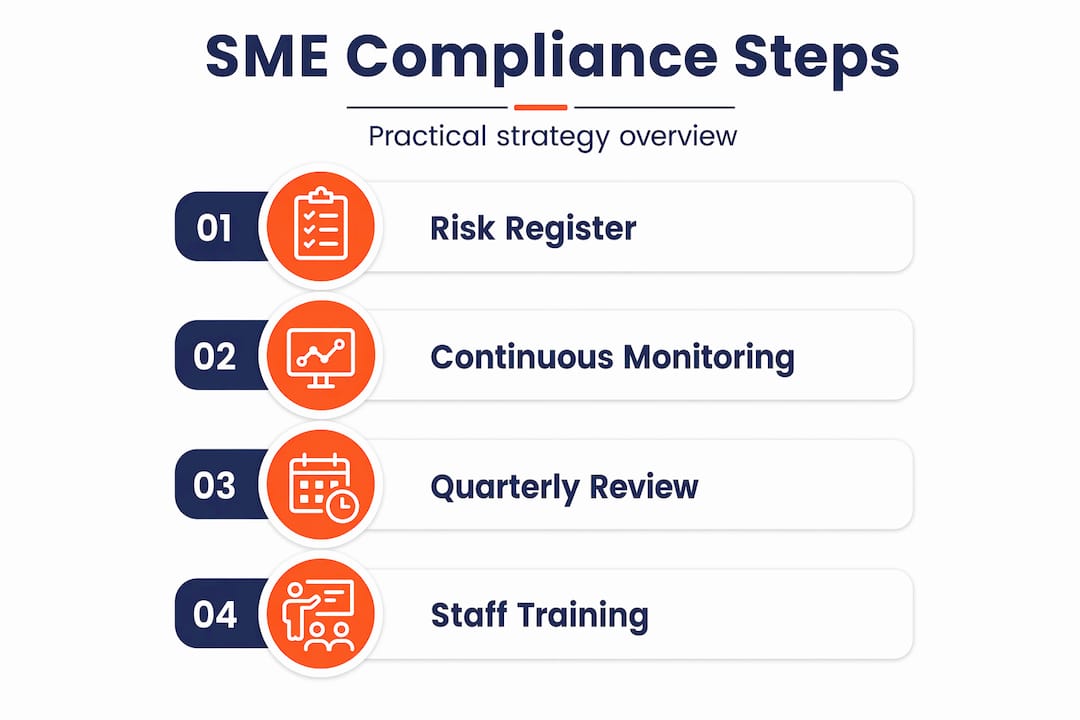
Start with a risk register. That means identifying which areas of your business carry the most regulatory exposure, assessing the likelihood and impact of something going wrong, and documenting controls you have in place. It does not need to be a 40-page enterprise document. A well-maintained spreadsheet works if it is kept current.
From there, the compliance benefits for small businesses become clearest when you build continuous monitoring into your operations rather than treating compliance as a quarterly fire drill. Continuous compliance efforts reduce the backfill work that follows a breach and keep your documentation audit-ready at any point. Think of it like bookkeeping. You would not wait until tax time to record every transaction for the year. The same logic applies here.
Automation helps significantly. Whether it is automated reminders for licence renewals, cloud-based document management with version control, or an MSP monitoring your cyber security posture against a framework like Essential Eight, technology reduces the manual load without adding headcount.
Some practical compliance controls that make a real difference for SMEs:
- A clear data retention and disposal policy that your team actually follows
- Multi-factor authentication across all business systems (this is now a baseline expectation in most regulatory and client frameworks)
- Regular backups with documented testing, not just assumed backups
- Staff training records for WHS, privacy, and cyber security topics
- A defined process for responding to a privacy breach or security incident
The comparison below illustrates how a risk-based approach differs from a checklist-style one in practice:
| Compliance approach | How it works | Best suited to |
|---|---|---|
| Checklist compliance | Tick boxes annually, minimal documentation | Very low-risk, minimal regulatory exposure |
| Risk-based compliance | Ongoing controls matched to identified risks | Most Australian SMEs |
| Enterprise framework copy | Full ISO or SOC 2 implementation | Businesses with major contract requirements |
The IT compliance standards relevant to Queensland SMEs cover much of this in practical terms, and it is worth reading if you have not already.
What we actually see in practice
We work with SMEs across Brisbane and Queensland, mostly in professional services, healthcare, and financial services. And honestly, the gap between what business owners assume about their compliance status and the reality we find is significant.
Here is what we see regularly:
- Businesses with no MFA on Microsoft 365, despite having signed client contracts that require it
- Backup systems that have not been tested in over a year, often not working as assumed
- No documented incident response process, meaning the first time staff know what to do is during an actual incident
- Privacy policies that were set up once years ago and have not been reviewed since the Privacy Act amendments
The lack of basic IT controls is one of the most common compliance failures we encounter, and it is rarely because the business owner does not care. It is because nobody has made it their explicit responsibility and given them the tools to manage it. Adopting technology-supported workflows can remove a significant portion of that manual burden.
The impact of compliance on SMEs who get it right is worth noting too. Businesses with documented, current compliance practices win more government tenders, get through client due diligence faster, and negotiate better insurance terms. Compliance becomes a commercial advantage, not just an overhead.
My honest take on compliance for SMEs
I’ve worked with enough SMEs to say this plainly: the businesses that treat compliance as someone else’s problem eventually pay for it, often at the worst possible time.
What frustrates me is the assumption that compliance is a large-business concern. It is not. The regulator does not discount your fine because you only have 15 staff. The client who pulls their contract after a data breach does not care about your headcount either.
What I’ve seen work is business owners who stop treating compliance as a project and start treating it as an operational rhythm. Not a big annual review, but ongoing, embedded, documented activity that your team actually understands. That shift in mindset is more valuable than any single tool or framework.
I also think the expectation that SMEs should adopt enterprise-scale compliance frameworks is unrealistic and counterproductive. A proportionate, risk-based approach that reflects your actual risk exposure is not cutting corners. It is the appropriate response to your business context. Regulators increasingly recognise this too.
The SMEs I see thriving are not the ones with the most compliance documentation. They are the ones where compliance is genuinely understood by the people responsible for it, supported by good IT systems, and reviewed regularly rather than in a panic.
— Matt
How IT Start supports SME compliance
Managing compliance manually is time-consuming and error-prone for most SMEs. IT Start helps Brisbane and Queensland businesses reduce that burden through managed cyber security services and cloud solutions designed for SME scale and budget. That means MFA across your systems, monitored backups you can actually trust, documented security controls aligned to frameworks like Essential Eight, and clear reporting so you always know where you stand. We also help with the practical IT compliance steps that sit behind most regulatory and client requirements. If you want a clear picture of your current compliance posture, get in touch for a no-obligation assessment.
FAQ
What does compliance mean for a small business in Australia?
Compliance for Australian small businesses means meeting all legal, regulatory, and contractual obligations including Fair Work, WHS, ASIC reporting, and privacy laws. It also includes obligations imposed by clients and insurers that go beyond minimum legal requirements.
What are the biggest compliance risks for Australian SMEs?
The most significant risks include WHS penalties that can exceed $223,000, ASIC fines for late financial reporting, Privacy Act breaches, and cyber security incidents that trigger both regulatory and contractual consequences.
How many hours do SMEs spend on compliance each week?
39% of small Australian businesses spend more than six hours per week on compliance-related tasks, representing a substantial operational cost for businesses with limited staff.
Can directors be personally liable for company compliance failures?
Yes. Under the WHS Act, officers face personal prosecution for due diligence failures even if the company itself is not charged, which makes proactive compliance oversight a personal responsibility for business owners and directors.
What is the simplest way for an SME to start improving compliance?
Start with a basic risk register identifying your top regulatory exposures, then implement continuous controls like MFA, tested backups, and documented policies. A risk-based compliance programme scaled to your business size is more effective than copying an enterprise framework.