

TL;DR:
- An IT support team lead manages daily operations, technical escalations, and team development to ensure smooth support functions. Hiring an internal lead becomes cost-effective only in organizations with 100 to 150 staff, with hybrid models offering practical risk management for smaller businesses. Building documentation and tracking metrics help leaders drive operational efficiency and reduce recurring issues over time.
An IT support team lead is the frontline manager responsible for keeping daily support operations running, escalating complex technical issues, and developing the people on the team. In Australian small and medium businesses, this role sits at the intersection of hands-on technical work and people management. Most IT managers underestimate how much the role demands until they are already in the middle of a staffing crisis. Getting the structure right from the start, whether through an internal hire, a hybrid model, or a managed services arrangement, determines how well your IT support leadership holds up under pressure.
What are the core responsibilities of an IT support team lead?
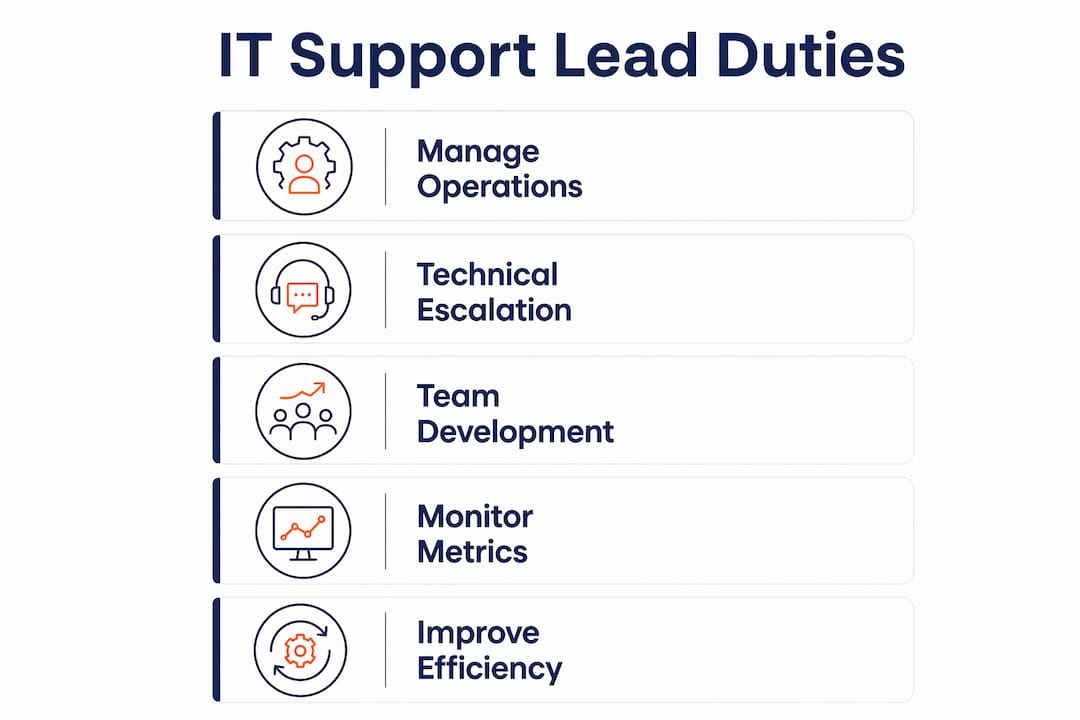
An IT support team lead owns three things: daily operations, technical escalation, and team development. These are not separate jobs. They happen simultaneously, and the best leads switch between them without losing grip on any one.

On the operations side, the lead manages ticket queues, enforces SLA adherence, and makes sure the right issues get prioritised. Without this discipline, backlogs grow fast and end users lose confidence in the support function. SLA compliance and incident response times are the primary metrics that reveal whether a lead is actually managing or just reacting.
Technical escalation is where many leads earn their credibility. When a tier-one technician hits a wall, the lead steps in using logs, traces, and observability tools to resolve the issue independently. Resolving complex issues independently matters because waiting on an external vendor for every hard problem stalls the whole team and erodes trust with the business.
Staff development rounds out the role. A lead who only fixes tickets and never coaches the team is a bottleneck, not a leader. Mentoring junior technicians, running post-incident reviews, and setting clear expectations for how investigations should be conducted all build a team that gets better over time.
- Manage ticket queues and enforce priority triage
- Monitor SLA compliance and incident response times
- Provide hands-on technical escalation for complex issues
- Mentor and coach junior support staff
- Build and maintain runbooks and process documentation
- Identify recurring issues and drive root cause fixes
- Report on team performance to IT management
Pro Tip: Track the ratio of recurring tickets to new tickets each month. If the same issues keep appearing, your team is firefighting rather than fixing. That ratio tells you more about team health than any satisfaction score.
When does it make financial sense to hire an internal IT support team lead?
The honest answer is: later than most businesses think. Hiring an internal IT lead becomes economically competitive in Australian SMEs once they reach around 100 to 150 staff. Below that threshold, the numbers rarely stack up.
A loaded internal hire costs between $70,000 and $100,000 annually in Australia, and that figure excludes recruitment fees, training time, and the risk of losing continuity when that person takes leave or resigns. An MSP engagement for a small business typically runs $1,200 to $2,500 per month. That is a meaningful cost difference, and the MSP brings a full team of specialists rather than one generalist.
| Business size | Recommended model | Reason |
|---|---|---|
| Under 50 staff | MSP only | Internal hire cost exceeds value delivered |
| 50–100 staff | Hybrid: internal coordinator + MSP | Balances cost, coverage, and specialist depth |
| 100–150 staff | Internal lead + MSP for specialist work | Internal hire becomes cost-competitive |
| Over 150 staff | Internal team with defined MSP scope | Scale justifies full internal IT structure |
The single-point failure risk is real and underappreciated. One internal hire means one person holds all the institutional knowledge. When they leave, and eventually they do, the business scrambles. A hybrid model combining internal coordination with MSP specialist depth is the most practical option for businesses between 50 and 150 staff. It avoids the skill gap problem without the full cost of a senior internal team.
Pro Tip: Before hiring an internal IT lead, map every IT function your business needs covered. If the list includes cybersecurity, cloud infrastructure, and compliance, one person cannot cover all of it well. That gap is where MSPs earn their keep.
How can IT support team leads drive operational efficiency?
The biggest shift a good IT service desk lead makes is moving from firefighting to building. Fixing the same problem twelve times is not support. It is a documentation failure.
Building and maintaining runbooks is the most impactful thing a lead can do for long-term team efficiency. A runbook turns a complex, repeatable task into a checklist that any technician can follow. It reduces resolution time, lowers the risk of errors, and means the lead does not have to personally handle every escalation.
“Leads caught constantly fixing issues fail to improve team efficiency, regardless of technical skill. The longest-lasting impact of a team lead is reducing operational toil through internal documentation and automated runbooks.”
Here is a practical sequence for building operational efficiency from the ground up:
- Audit the ticket backlog and identify the top ten recurring issue types.
- Write a runbook for each of those ten issues, including steps, tools, and expected resolution time.
- Automate any step in those runbooks that does not require human judgement.
- Review the runbooks quarterly and update them when processes change.
- Use the freed-up time to tackle the next layer of recurring issues.
This cycle does not happen overnight, but teams that commit to it see measurable reductions in average handle time within a few months. The lead’s job is to protect time for this work, even when the ticket queue is screaming for attention. That balance between hands-on support and leadership responsibilities is where most IT leads struggle most.
What are best practices for managing IT support teams in Australian SMEs?
Managing an IT support team in an Australian SME is different from managing one in a large enterprise. Resources are tighter, the team is smaller, and the lead often carries a personal ticket load alongside management duties. The practices that work here are practical, not theoretical.
Recruitment needs to match the actual environment. Hiring a candidate with enterprise-only experience into a 30-person business often ends badly. They expect dedicated tooling, clear escalation paths, and a team around them. SME environments require people who are comfortable with ambiguity and can work across multiple domains without deep specialisation in any one.
Onboarding sets the tone. A new technician who spends their first two weeks without a clear checklist, access to documentation, or a structured introduction to the environment will take months longer to become productive. A one-week structured onboarding plan with clear milestones fixes this.
- Set clear performance expectations from day one, including SLA targets and ticket quality standards
- Run weekly one-on-ones with each team member, focused on blockers and development, not just status updates
- Create a shared knowledge base that the whole team contributes to and maintains
- Celebrate root cause fixes, not just fast resolutions, to build a culture of improvement
- Invest in at least one vendor-recognised certification per technician per year to maintain technical currency
- Communicate IT performance metrics to business stakeholders monthly, in plain language
Setting high standards for technical investigation and communication is what separates teams that scale from teams that plateau. The lead’s job is to model those standards, not just enforce them. Effective IT support leadership in an SME context also means knowing when to escalate to external specialists rather than burning internal time on problems outside the team’s depth.
What role do tools and metrics play in IT support leadership?
Metrics are only useful if the lead acts on them. Tracking ticket volume without analysing what is driving it is just data collection. The goal is to use metrics to make decisions about training, tooling, and process change.
Key help desk metrics for team leads include ticket volume, backlog size, average handle time, and SLA compliance rate. Each one points to a different type of problem. High backlog with low volume suggests a staffing or skill gap. High volume with good SLA compliance suggests the team is well-structured but may be approaching capacity.
| Metric | What it reveals | Action trigger |
|---|---|---|
| Ticket backlog | Capacity and prioritisation health | Rising backlog over two weeks signals a structural problem |
| Average handle time | Efficiency and skill level | High handle time on common issues points to training gaps |
| SLA compliance rate | Process and prioritisation discipline | Below 90% requires immediate queue review |
| Recurring ticket ratio | Documentation and root cause effectiveness | High ratio means runbooks are missing or ignored |
Automation and AI-powered tools reduce response times, handle simultaneous tickets, and provide 24/7 availability for common request types. They do not replace the lead’s judgement, but they do free up the team to focus on issues that actually require human problem-solving. A lead who ignores these tools in 2026 is choosing to carry a heavier workload than necessary.
Effective IT support management also means aligning metrics with what the business actually cares about. Finance teams care about downtime cost. Operations teams care about resolution speed. Framing IT performance in those terms builds credibility with stakeholders and makes the case for investment in tooling and headcount far easier.
Key takeaways
An IT support team lead delivers lasting value by building documentation, enforcing SLA discipline, and developing the team, not just by fixing tickets faster.
| Point | Details |
|---|---|
| Hire at the right scale | Internal IT leads become cost-effective at around 100–150 staff; below that, an MSP delivers more value per dollar. |
| Hybrid models reduce risk | Combining an internal coordinator with MSP specialist depth prevents single-point failure and skill gaps. |
| Documentation drives efficiency | Runbooks and process documentation reduce recurring tickets and free the team from constant firefighting. |
| Metrics must drive decisions | Track ticket backlog, handle time, and SLA compliance, then act on what the data shows. |
| Leadership means developing people | Coaching, structured onboarding, and clear performance standards build teams that improve over time. |
What I have seen go wrong with IT support leadership in SMEs
Honestly, the most common mistake I see is businesses hiring an internal IT lead too early, before the workload justifies it, and then being surprised when that person burns out or leaves within 18 months. They hired one person to do the job of three, paid them a mid-range salary, and gave them no documentation, no tooling budget, and no escalation path. That is not a staffing model. That is a slow-motion failure.
The hybrid model gets dismissed too quickly. Business owners hear “MSP” and assume it means handing over control. What it actually means, done well, is that your internal coordinator handles the day-to-day and the MSP handles the things that require depth: security incidents, cloud architecture changes, compliance reviews. That combination outperforms a single internal hire almost every time at the 50 to 100 staff mark.
The mindset shift from firefighting to proactive leadership is the hardest part of the role. I have worked with IT leads who were technically brilliant but spent every day in reactive mode. They never built a runbook, never ran a post-incident review, never coached a junior technician. Their teams were entirely dependent on them, which meant the business was entirely dependent on them. When they left, the business had nothing to show for years of IT investment.
What most IT managers overlook is the tooling and documentation budget. They will spend $15,000 on a new server without blinking, but baulk at $3,000 for a proper ticketing system or a day of structured documentation work. The server depreciates. Good documentation compounds.
— Matt
How IT Start supports IT team leads in Australian SMEs
IT Start works with Brisbane SMEs that are building or refining their internal IT support structure. Whether your business has one IT person or a small team, the gap between what they can cover and what the business actually needs is usually wider than it looks. IT Start’s managed cybersecurity services fill that gap directly, covering threat monitoring, incident response, and compliance work that most internal leads do not have the time or specialist depth to handle alone. For businesses moving workloads to the cloud, IT Start’s cloud infrastructure services give internal teams a reliable foundation to build on. Contact IT Start to discuss what a hybrid support model could look like for your business.
FAQ
What does an IT support team lead do day to day?
An IT support team lead manages ticket queues, handles technical escalations, monitors SLA compliance, and coaches team members. The role combines hands-on technical work with team management responsibilities.
How many staff does a business need before hiring an IT support lead internally?
Internal IT leads become cost-competitive in Australian SMEs at around 100 to 150 staff. Below that threshold, an MSP or hybrid model typically delivers better value and broader specialist coverage.
What is the difference between an IT support team lead and an IT support manager?
An IT support team lead focuses on day-to-day operations, technical escalation, and direct team supervision. An IT support manager typically holds broader responsibility for budgets, vendor relationships, and IT strategy.
What metrics should an IT service desk lead track?
The core metrics are ticket volume, backlog size, average handle time, and SLA compliance rate. Each metric points to a different operational problem and guides decisions about training, staffing, or process change.
What is a hybrid IT support model?
A hybrid model pairs an internal IT coordinator with an MSP that provides specialist depth in areas like cybersecurity, cloud, and compliance. This structure suits Australian SMEs between 50 and 150 staff and reduces single-point failure risk.