

TL;DR:
- An IT support lead manages a technical support team and ensures IT services align with business goals. They focus on tracking KPIs, handling escalations, maintaining documentation, and developing team skills. Building a proactive support culture and managing time effectively are key to success in SMB environments.
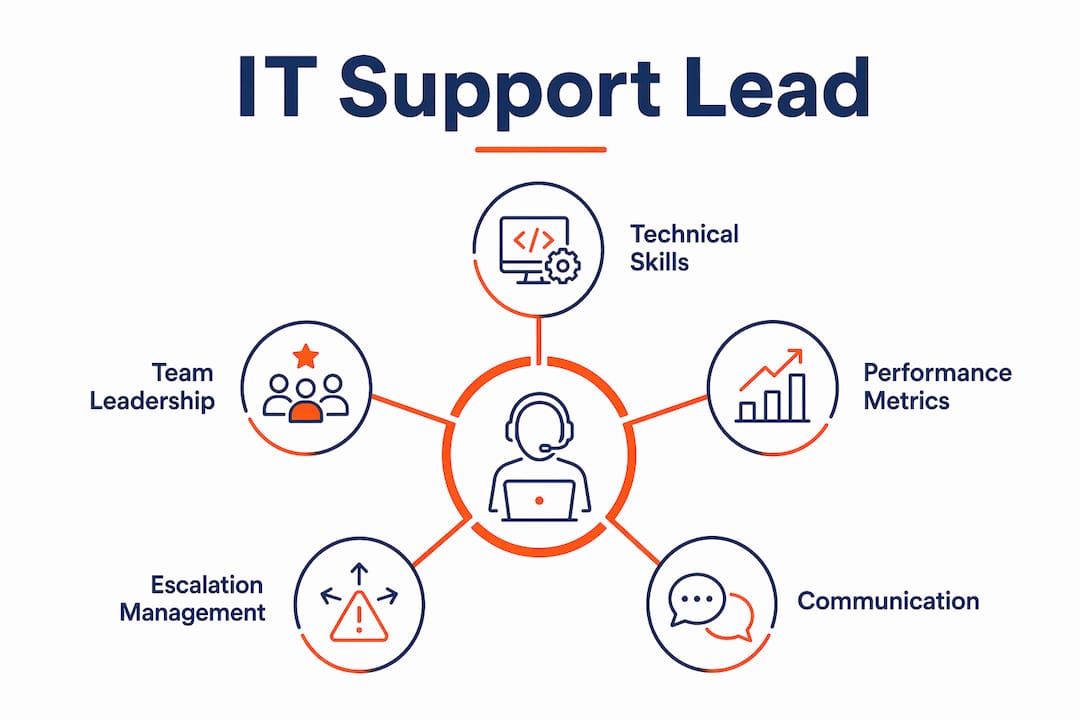
An IT support lead is the person responsible for managing an IT support team while ensuring technology services align with business goals. The role sits between hands-on technical work and people management. It is not just a senior technician title. A strong IT support lead defines KPIs, enforces SLAs, mentors junior staff, and manages ITSM platforms like ServiceNow or Jira. Most positions require 5–7 years of IT experience, with at least 1–3 years in a supervisory capacity. For SMBs in particular, this role often determines whether IT support is a cost centre or a genuine business asset.
What are the key responsibilities of an IT support lead?
The core job of a technical support lead is to keep IT support running reliably while developing the team around them. That sounds straightforward. In practice, it covers a wide range of daily tasks that most people outside the role do not fully appreciate.

Defining and tracking performance metrics
Tracking KPIs and SLAs is one of the most visible parts of the role. Metrics like first-call resolution rate, average handle time, and SLA compliance tell you whether the team is performing or just appearing busy. A good IT team leader does not just report these numbers. They use them to identify patterns, such as recurring ticket types that signal a training gap or a broken process.
Managing escalations and vendor relationships
Escalations land on the support lead’s desk when a technician hits their limit. The lead needs to resolve the issue and then work out why it escalated in the first place. Vendor management sits alongside this. Multi-vendor environments, which are common in SMBs running Microsoft 365, Cisco networking, and cloud platforms simultaneously, require someone who can hold vendors accountable without burning the relationship.
Maintaining documentation and knowledge bases
Keeping a knowledge base current is unglamorous work. It is also one of the highest-leverage activities a support lead can do. A well-maintained knowledge base reduces repeat tickets, speeds up onboarding, and gives technicians a reliable reference when they face unfamiliar issues.
Overseeing endpoint management
End-user support and endpoint management fall under the lead’s oversight. Tools like Microsoft Intune and Jamf handle device policy enforcement, but someone needs to own the configuration standards and review compliance regularly.
Pro Tip: Block two hours per week specifically for knowledge base reviews and ITSM workflow audits. These tasks get pushed aside when the queue is busy, but neglecting them creates compounding problems over time.
Which qualifications and skills distinguish successful IT support leads?
Technical skill gets you into the role. Leadership skill determines how far you go in it.
Technical qualifications
ITIL v3 or v4 certification is the most commonly required qualification for IT support leads at enterprise and mid-market level. ITIL gives a shared language for incident management, change control, and service improvement. Beyond certification, leads need solid working knowledge of Windows and macOS environments, networking fundamentals, and the SaaS platforms their business runs on.
Leadership and communication skills
Balancing technical expertise with clear communication to non-technical stakeholders is what separates a good technician from a good lead. Explaining a network outage to a CFO requires a completely different approach than explaining it to a systems engineer. Leads who cannot make that shift struggle to build credibility with the business.
| Skill area | What it looks like in practice |
|---|---|
| ITIL certification | Applying incident and change management frameworks to reduce repeat issues |
| ITSM platform proficiency | Configuring ServiceNow or Jira workflows to match team processes |
| Coaching and mentoring | Running structured one-on-ones and skill gap reviews with technicians |
| Stakeholder communication | Translating technical issues into business impact for non-IT managers |
| Endpoint management | Overseeing Intune or Jamf policies across a mixed device fleet |
Pro Tip: If you are new to the lead role, spend your first 30 days mapping every recurring ticket type. You will quickly see where the team’s knowledge gaps are and where documentation is missing.
How can IT support leads build and manage effective support teams in SMBs?
Building a good support team in an SMB is harder than it looks. You are usually working with a small group, limited budget, and staff who wear multiple hats. The IT help desk supervisor role in this context is less about managing a large team and more about getting the most out of a tight one.
Moving a team from reactive to proactive service delivery is the single biggest cultural shift a support lead can drive. Reactive teams wait for things to break. Proactive teams monitor, patch, and communicate before users notice a problem. That shift does not happen by accident.
Here is how to build toward it:
-
Set clear expectations from day one. Every technician should know what a good ticket looks like, what the SLA targets are, and how their performance will be reviewed. Ambiguity breeds inconsistency.
-
Run structured one-on-ones weekly. Not status updates. Actual conversations about skill development, blockers, and career goals. Technicians who feel invested in stay longer and perform better.
-
Build a team KPI dashboard everyone can see. Shared visibility creates accountability without micromanagement. Tools like Jira Service Management or ServiceNow have built-in reporting that makes this straightforward.
-
Rotate on-call and escalation responsibilities. Keeping escalations concentrated on one person, usually the lead, creates a bottleneck and burns people out. Rotating responsibility builds capability across the team.
-
Schedule regular knowledge-sharing sessions. A 30-minute fortnightly session where a technician walks through a tricky ticket they resolved builds collective knowledge fast. It also surfaces documentation gaps before they become problems.
-
Review remote and hybrid support processes separately. Managing a team that splits time between office and remote work requires deliberate communication norms. Response time expectations, handover processes, and tool access all need to be explicitly defined for hybrid environments.
Effective leads spend significant time on mentorship and ITSM workflow configuration, not just escalations. That is a mindset shift for technicians moving into leadership for the first time.
What practical challenges do IT support leads face?
Honestly, the hardest part of the role is not technical. It is time management and expectation setting.
Underestimating administrative load
Many newly appointed leads underestimate how much time goes into non-technical tasks. Knowledge base maintenance, vendor communications, performance reviews, and compliance reporting can easily consume half a working week. Leads who do not account for this end up either neglecting the team or neglecting the admin, and both outcomes hurt.
Over-reliance on ticket volume metrics
Focusing only on ticket volume KPIs without reviewing qualitative user feedback leads to declining service quality. A team can close 200 tickets a week and still have frustrated users if the resolutions are poor or the communication is dismissive. Satisfaction surveys, even simple ones, give you signal that raw numbers cannot.
Managing multi-vendor complexity and compliance
Enforcing governance across multi-vendor environments is a growing challenge as SMBs add cloud services, SaaS tools, and third-party integrations. Each vendor has its own update cycle, security posture, and support model. The lead needs to maintain a clear picture of the full environment and hold each vendor to agreed standards.
Handling escalations without burning out
Escalations are part of the job. Absorbing every escalation personally is not sustainable. Leads who do not build escalation pathways into their team structure end up as the single point of failure. That is bad for the lead and bad for the business.
- Audit your ticket queue monthly for patterns that signal process failures, not just individual errors.
- Use user satisfaction scores alongside SLA metrics to get a full picture of service quality.
- Document vendor SLAs and review them quarterly against actual performance.
- Build an escalation matrix so technicians know exactly when and how to escalate, without defaulting to the lead for everything.
- Protect time for strategic work by blocking calendar time that is not available for ad-hoc requests.
Pro Tip: Ask your team to flag any ticket that took longer than expected and explain why. That single habit surfaces more process improvement opportunities than any formal audit.
Key takeaways
An IT support lead succeeds by combining technical credibility with genuine people leadership, not by being the best technician in the room.
| Point | Details |
|---|---|
| Role definition | An IT support lead manages team performance, SLAs, and escalations while aligning IT with business goals. |
| Core qualifications | ITIL v3 or v4 certification and 5–7 years of IT experience with supervisory history are standard requirements. |
| Team culture shift | Moving from reactive to proactive support is the highest-impact change a support lead can drive. |
| Balanced metrics | Combining ticket KPIs with user satisfaction scores prevents quality decline despite high closure rates. |
| Time management | Administrative tasks like vendor management and knowledge base upkeep consume more time than most new leads expect. |
What I have learned leading IT support in SMB environments
The biggest mistake I see new IT support leads make is treating the role as a senior technician job with a few extra meetings. It is not. The moment you step into a lead position, your primary output is the team’s performance, not your own ticket count.
Owning the outcome of every support interaction, not just the ones you personally handle, is what separates leads who build great teams from those who become bottlenecks. I have seen leads who were technically brilliant but could not let go of hands-on work. Their teams stagnated because every hard problem came back to one person.
The other thing I would push back on is the obsession with SLA numbers. SLAs matter. But I have worked with teams that hit every SLA target and still had users who dreaded calling the help desk. The numbers were fine. The experience was not. Qualitative feedback is the part most leads skip because it is harder to report upward. Do not skip it.
For SMBs specifically, the proactive support model is not a luxury. It is the only way a small IT team can stay ahead of a growing business without burning out. Reactive support in a 30-person company is manageable. In a 60-person company, it becomes a crisis cycle. Build the habits early.
— Matt
How IT Start supports IT leads and their teams
IT Start works with Brisbane SMBs that need more than a break-fix service. For IT support leads managing lean teams, having a reliable partner for managed IT support means your team is not the last line of defence on every issue. IT Start handles the infrastructure layer, including cloud services and security, so your internal lead can focus on user experience and team development rather than firefighting. If your business is growing and your IT support structure needs to keep pace, IT Start offers a free assessment to identify where the gaps are.
FAQ
What does an IT support lead do?
An IT support lead manages a technical support team, defines KPIs and SLAs, handles escalations, and ensures IT services align with business goals. The role combines hands-on technical knowledge with people management and stakeholder communication.
What qualifications does an IT support lead need?
Most roles require 5–7 years of IT experience with 1–3 years in a supervisory position, along with ITIL v3 or v4 certification. Proficiency in ITSM platforms like ServiceNow or Jira is also commonly expected.
How is an IT support lead different from an IT support manager?
An IT support lead typically focuses on day-to-day team operations, ticket quality, and escalations, while an IT support manager takes a broader view covering budgets, vendor contracts, and departmental strategy. In SMBs, one person often covers both functions.
How do IT support leads measure team performance?
Effective leads track SLA compliance, first-call resolution rates, and ticket trends alongside qualitative user satisfaction scores. Relying on volume metrics alone misses service quality issues that numbers do not capture.
What is the biggest challenge for new IT support leads?
The most common challenge is underestimating the time required for administrative tasks like knowledge base maintenance, vendor management, and performance reviews, which can consume a significant portion of the working week.