

TL;DR:
- Strong IT compliance reduces cyber risks, improves operational efficiency, and opens market opportunities.
- Ongoing monitoring, staff training, and regular reviews are essential for effective long-term compliance.
- Partnering with MSPs streamlines compliance, enhances security, and ensures continuous, proactive management.
Most Queensland business owners think of IT compliance the same way they think of tax paperwork: a necessary evil that costs money, drains time, and delivers nothing back. That view is costing them. The reality is that businesses with strong IT compliance frameworks not only reduce their exposure to costly cyber incidents but also run leaner operations, win more contracts, and enter markets that remain closed to less-prepared competitors. This guide cuts through the confusion and gives you a practical, numbers-backed look at what IT compliance actually means for your business, what it costs, what it saves, and how to get started without getting overwhelmed.
Table of Contents
- What is IT compliance and why does it matter?
- What are the real costs and returns of IT compliance?
- Why DIY compliance fails and how MSPs make a difference
- First steps: A practical pathway for Queensland SMBs
- The uncomfortable truth about IT compliance (and what most guides miss)
- How to get IT compliance right for long-term growth
- Frequently asked questions
Key Takeaways
| Point | Details |
|---|---|
| Compliance saves more than it costs | Investing in IT compliance is up to 10 times less expensive than recovering from a data breach. |
| DIY approaches risk failure | Most in-house compliance projects fall short, making professional MSPs a smart choice for long-term success. |
| Quick wins with Essential Eight | Small changes like MFA and patching deliver outsized compliance benefits for Queensland businesses. |
| Regular reviews are critical | Annual audits help businesses stay ahead of new risks and shifting compliance standards. |
What is IT compliance and why does it matter?
IT compliance refers to the set of rules, standards, and practices your business must follow to protect data, secure systems, and meet legal obligations. For Queensland SMBs, this includes obligations under the Privacy Act 1988, the Australian Cyber Security Centre’s Essential Eight framework, and any industry-specific standards relevant to your sector, such as PCI DSS for businesses that process payments or HIPAA-adjacent rules for health-adjacent services.
It is easy to look at a compliance checklist and see nothing but administrative overhead. However, that framing ignores what those requirements actually protect. Compliance frameworks exist because real businesses suffer real losses when customer data is stolen, systems go offline, or a regulatory breach triggers a penalty. Following IT compliance best practices means you are building the operational foundations that prevent those losses before they happen.
“Some business owners see compliance as a costly burden, while others treat it as a strategic enabler. The difference in outcome between those two camps is not small. Businesses that integrate compliance into their operations, rather than treating it as a siloed task, consistently reduce their total cost of ownership and avoid the painful remediation cycles that follow a breach.” Business Queensland: Cybersecurity
Understanding IT’s role in compliance means recognising that your technology systems are not just tools. They are also the primary targets for bad actors and the primary mechanisms for keeping your business safe. When they are configured correctly and monitored consistently, compliance happens as a natural by-product of good IT management.
Here are the core compliance requirements most Queensland SMBs need to address:
- Privacy policies and data handling procedures that meet the requirements of the Privacy Act 1988
- Access controls ensuring only authorised staff can reach sensitive data or critical systems
- Basic cyber hygiene including regular software patching, strong password policies, and endpoint protection
- Multi-factor authentication (MFA) across all key business systems and remote access points
- Incident response planning so your team knows exactly what to do if a breach or outage occurs
- Secure data backup and recovery processes tested regularly and stored offsite or in secure cloud environments
- Vendor and supply chain risk awareness covering the third-party tools and services your business depends on
This Brisbane IT compliance guide outlines how each of these areas applies specifically to Queensland-based businesses and provides local regulatory context that generic national guides often miss.
What are the real costs and returns of IT compliance?
Understanding what IT compliance requires brings up a crucial question: is it worth the investment? The short answer is yes, and the numbers make that case clearly.
Initial compliance costs for Australian SMBs range from $2,000 to $50,000 AUD depending on business size, industry, and the current state of your IT environment. Ongoing compliance typically sits at 1 to 3 percent of annual revenue. Those figures sound significant until you compare them to the cost of a single data breach.
| Cost category | Typical spend |
|---|---|
| Initial compliance setup (small business) | $2,000 to $15,000 AUD |
| Initial compliance setup (medium business) | $15,000 to $50,000 AUD |
| Ongoing annual compliance (% of revenue) | 1% to 3% |
| Average cost of a data breach (SMB) | $46,000 to $200,000+ AUD |
| Regulatory penalty (Privacy Act breach) | Up to $50 million AUD (for serious/repeated) |
| Business downtime per incident (average) | 3 to 7 days |
The maths is stark. A business spending $5,000 per year on compliance is making a very reasonable bet against an event that could cost ten to forty times that figure in a single incident. Prevention is 5 to 10 times cheaper than remediation once you factor in forensics, legal costs, customer notification, and reputational damage.
There is also a positive return beyond cost avoidance. Compliance opens doors. According to benchmarking data, 67% of compliant firms report gaining access to new markets or winning contracts they would not have otherwise qualified for. Government tenders, enterprise supply chains, and regulated industries like financial services and healthcare often require vendors to demonstrate verified compliance before onboarding them. Without it, you are simply not in the room.

Reviewing IT compliance ROI through this lens, the question changes from “can we afford to do this?” to “can we afford not to?” The cyber security savings achieved through proactive compliance are measurable and consistent across business sizes.
Pro Tip: Start your compliance journey by implementing the Essential Eight Maturity Level 1 controls. Patching applications within 48 hours of a patch release and enabling MFA across your email and cloud platforms are both low-cost, fast-to-deploy actions that dramatically reduce your risk profile from day one.
Why DIY compliance fails and how MSPs make a difference
Knowing what you could save or earn by prioritising compliance, the next decision is how to get there: do it yourself or bring in professional support?
Many business owners start with the DIY approach. They download a checklist, assign a staff member to work through it, and consider the matter handled. The problem is not intention. It is sustainability. Compliance is not a project you complete and then archive. It is an ongoing operational discipline that requires continuous monitoring, regular updates as regulations and threats evolve, and consistent staff training. Without dedicated expertise, DIY compliance risks incomplete implementation and a false sense of security that may be worse than no framework at all.
| Factor | DIY compliance | Managed Service Provider (MSP) |
|---|---|---|
| Initial implementation quality | Variable, often incomplete | Structured and consistent |
| Ongoing monitoring | Reactive and irregular | Continuous and automated |
| Regulatory update response | Slow, easily missed | Proactive and timely |
| Staff training | Ad hoc | Scheduled and documented |
| Incident response capability | Limited | Tested and ready |
| Total long-term cost | Often higher due to rework | Lower through integration |
| Risk reduction | Partial | Substantially higher |
A Managed Service Provider integrates compliance into your day-to-day IT operations rather than treating it as a separate exercise. Here is how a good MSP actually streamlines your compliance posture:
- Continuous monitoring of your network, endpoints, and systems for signs of anomalous activity or policy violations, operating around the clock without placing any burden on your internal team.
- Faster implementation of new controls as part of regular maintenance cycles rather than costly one-off projects that disrupt operations.
- Regulatory update management where your MSP tracks changes to the Privacy Act, Essential Eight updates, and any industry-specific standards relevant to your sector and adjusts your environment accordingly.
- Staff awareness training conducted on a scheduled basis so your team understands phishing risks, password hygiene, and data handling responsibilities without you having to organise it yourself.
- Documented incident response procedures that are tested, reviewed, and ready to execute, reducing your response time and limiting damage in the event of an incident.
- Reporting and audit readiness so that when a client, regulator, or insurer asks for evidence of your compliance, you have it immediately and clearly documented.
Understanding the MSP role in compliance makes it clear that the value is not just in ticking boxes but in building an IT environment that operates efficiently and securely as your business scales.
First steps: A practical pathway for Queensland SMBs
Once you have made the decision to invest in IT compliance and know the options, the next question is: where should you actually begin?
The answer for most Queensland SMBs is the Essential Eight framework, developed by the Australian Cyber Security Centre. It is practical, locally relevant, and designed specifically for businesses without large in-house IT teams. Start with a gap analysis against Maturity Level 1. This means comparing your current environment against the baseline controls and identifying where you fall short.
Your gap analysis should assess:
- Whether your applications and operating systems are patched within a timely window after updates are released
- Whether MFA is active on email, cloud services, and remote access
- Whether you restrict administrative privileges to only those staff who genuinely require them
- Whether daily backups are in place and tested for recovery
- Whether you have disabled macros in Microsoft Office or equivalent productivity tools
- Whether your staff can identify and report phishing attempts
Once you have mapped your gaps, prioritise them by risk. Patching and MFA come first because they address the most common attack vectors at the lowest cost. Backups come second because they are your last line of defence against ransomware. These practical IT compliance steps are achievable within weeks for most SMBs working with a competent IT partner.
Here are the quick wins to prioritise:
- Enable MFA on all Microsoft 365, Google Workspace, and cloud storage accounts immediately
- Set automated patching for operating systems and business-critical applications
- Review user access and remove or downgrade accounts that hold more privilege than necessary
- Set up and test backups using the 3-2-1 rule: three copies, two different storage types, one offsite
- Block or restrict macros in productivity software unless there is a specific business need
For businesses in regulated industries, protecting business data requires additional layers including encryption, audit logging, and sometimes formal third-party certification. The gap analysis guided by Business Queensland’s cybersecurity advice ensures you are building against a framework that regulators and enterprise clients recognise and respect.
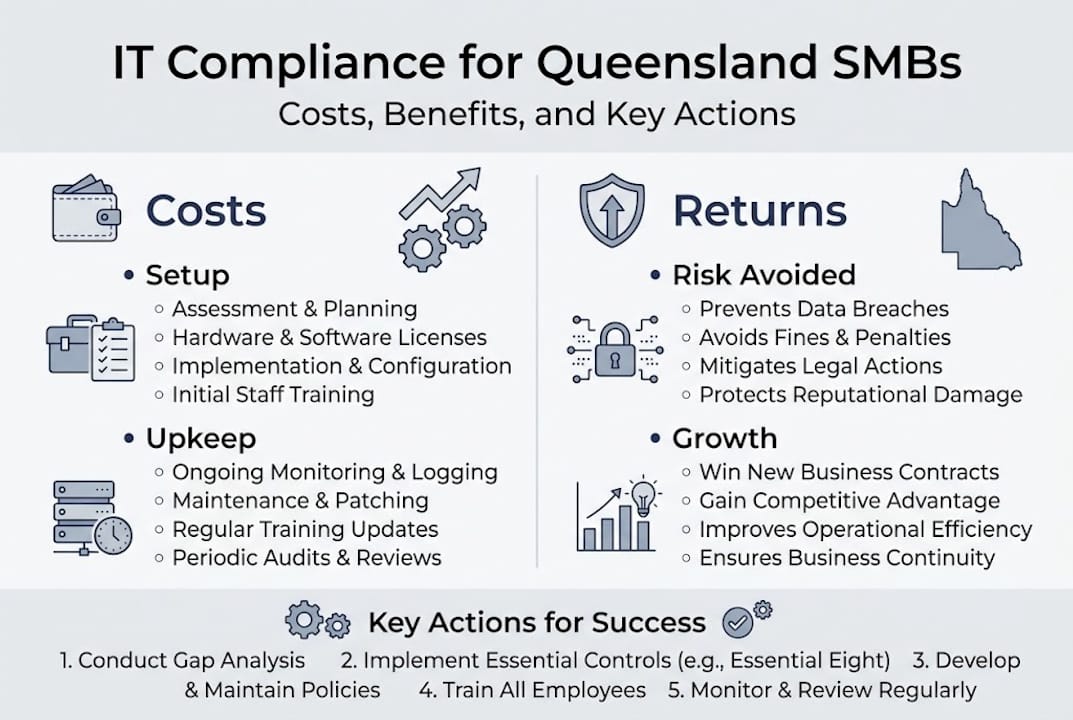
Pro Tip: Schedule an annual IT compliance audit, even if you work with an MSP. Documenting your posture at a specific point in time creates a baseline record that is invaluable for insurance claims, contract due diligence, and regulatory enquiries.
The uncomfortable truth about IT compliance (and what most guides miss)
Here is what we have observed working with Queensland businesses across professional services, healthcare, and finance: most businesses that “have compliance sorted” actually have a compliance document from two years ago, an MFA setup they half-deployed, and a backup policy no one has tested since it was written. That is not compliance. That is theatre.
Most guides treat IT compliance as a destination. Follow the steps, tick the boxes, and you are done. But compliance is a living process. Staff turn over. New applications get added without IT review. Regulations update. Threats evolve. A framework that was appropriate for your business eighteen months ago may leave significant gaps today.
The hidden danger in partial or outdated compliance is that it creates a false sense of security. A business with no framework at all knows it has exposure. A business with an incomplete or stale framework often believes it is protected right up until an incident proves otherwise. As Business Queensland consistently highlights, the real risk in DIY approaches is not the initial implementation but the failure to maintain it as your environment and threat landscape change.
The businesses that get genuine, lasting value from compliance are the ones that treat it the same way they treat their financials: reviewed regularly, adjusted when circumstances change, and owned at a leadership level rather than delegated entirely to a junior staff member or forgotten until audit time. Efficiency through compliance only comes when your framework reflects your actual operating environment, not the one you had when you first filled out the checklist.
The sustainable approach is to build compliance into your IT operations from the ground up, not bolt it on as an afterthought. That means selecting systems with security built in, partnering with providers who understand the regulatory landscape, and reviewing your posture at least annually against updated benchmarks.
How to get IT compliance right for long-term growth
If you are ready to turn compliance from a headache into a business advantage, here is how expert support accelerates your progress. At IT Start, we work with Queensland SMBs to assess their current compliance posture, implement the Essential Eight controls, and maintain a secure, audit-ready environment as their business grows.
Our cyber security services cover everything from threat monitoring and incident response to formal compliance assessments aligned with Australian regulatory standards. Our business IT support team integrates compliance management into your daily IT operations so it never falls behind. And our cloud solutions ensure that when you move to or expand in the cloud, your data handling and access controls meet the standards your clients and regulators expect.
Start with a free gap assessment and walk away with a clear picture of where you stand, what needs attention, and what it will take to get there. No jargon, no obligation, just clarity.
Frequently asked questions
What are the most important IT compliance standards for Queensland small businesses?
The most important standards are the Essential Eight cyber security framework, Privacy Act requirements, and industry-specific rules such as PCI DSS for businesses handling payments. Starting with an Essential Eight Maturity Level 1 gap analysis gives you the strongest risk-adjusted foundation.
How much does it typically cost a Queensland SMB to become compliant?
Initial compliance costs range from $2,000 to $50,000 AUD, with ongoing spending at 1 to 3 percent of annual revenue for most businesses. The actual figure depends on your industry, business size, and existing IT maturity.
What is a quick win for improving IT compliance on a budget?
Implementing MFA and regular patching are low-cost, high-impact actions that significantly reduce your attack surface without requiring major infrastructure investment.
Do all Queensland SMBs need an MSP or can some manage compliance themselves?
Small businesses with very limited tech needs may manage basic compliance internally, but most benefit from the efficiency and lower risk that experienced MSPs provide, particularly as their operations grow or they enter regulated markets.
How often should a business review or audit its IT compliance?
Annual audits are best practice to ensure ongoing efficiency and risk reduction as both the threat landscape and regulatory requirements change throughout the year.