

Compliance headaches can stall even the most diligent Brisbane financial services teams. With strict Australian regulations like the Privacy Act 1988, Cyber Security Act 2024, and APRA standards, meeting your obligations means more than basic data security. Clients depend on you to protect their information from criminal threats and costly breaches. This guide helps you understand IT compliance essentials and practical ways to safeguard your firm against operational, legal, and reputational risks.
Quick Navigation: IT Compliance Best Practices for Brisbane Firms
- What Is IT Compliance And Why It Matters
- Key Australian Laws And Compliance Standards
- Types Of Compliance: Privacy, Cyber, Financial
- Risks, Penalties And Common Pitfalls For SMBs
- Practical Steps To Strengthen Compliance Posture
Key Takeaways
| Point | Details |
|---|---|
| Importance of IT Compliance | IT compliance safeguards clients’ data, reduces legal risks, and builds trust. Firms must prioritise protecting sensitive information. |
| Focus on Key Compliance Areas | Brisbane financial firms should concentrate on data security, access controls, incident response, and staff training to ensure adherence to regulations. |
| Proactive Compliance | Continuous compliance efforts are essential; firms must regularly evaluate and update their practices to meet evolving regulations and threats. |
| Penalties for Non-Compliance | Breaching compliance can lead to significant fines, reputational damage, and operational disruptions, highlighting the need for diligent adherence to regulations. |
What Is IT Compliance And Why It Matters
IT compliance means following the laws, regulations, and standards that apply to your business’s technology systems. For Brisbane financial services firms, this includes rules around data protection, cybersecurity, and customer information handling.
Compliance isn’t just about ticking boxes. It protects your clients, reduces legal risk, and builds trust. When you handle sensitive financial data, stakeholders expect you to safeguard it properly.
Why IT Compliance Matters for Your Firm
Data protection obligations form the foundation of compliance for financial services. Your clients trust you with personal and financial information that criminals actively target.
Regulatory bodies in Australia have strict expectations. Breaching these rules can result in fines, licence suspension, or reputational damage that takes years to recover from.
Compliance reduces operational risk. When systems, processes, and staff follow compliance frameworks, fewer things fall through the cracks.
Your clients increasingly ask about your security practices. Demonstrating compliance gives them confidence you take their data seriously.
Key Compliance Areas for Brisbane Financial Firms
Focused compliance efforts address the areas that matter most:
- Data security and encryption – Protecting customer information from unauthorised access
- Access controls – Ensuring only authorised staff can view sensitive data
- Incident response procedures – Knowing what to do when something goes wrong
- Backup and recovery systems – Maintaining business continuity if systems fail
- Staff training and awareness – Making sure your team understands compliance obligations
- Audit trails and documentation – Keeping records that prove you follow the rules
Understanding GRC in Your Organisation
Governance, risk, and compliance frameworks integrate management processes across your organisation. This means your compliance efforts align with business goals rather than working against them.
Good governance establishes clear processes that guide how decisions get made. When compliance sits within this structure, everyone understands what’s expected.
Compliance requires awareness at multiple levels. Education and professional development help staff understand frameworks and stay current as regulations change.
Compliance isn’t a one-time project. It’s an ongoing responsibility that evolves as regulations change and threats emerge.
The Real Cost of Non-Compliance
Ignoring compliance creates serious problems. Regulatory investigations consume time and resources. Fines for Brisbane firms can reach thousands of dollars per violation.
Data breaches linked to compliance failures damage reputation permanently. Clients move to competitors they trust more. Staff morale suffers when they’re asked to work with outdated, risky systems.
Compliance gaps also create operational headaches. Without proper documentation and processes, your team wastes time fixing preventable problems.
Pro tip: Start by identifying which regulations actually apply to your firm, then prioritise the compliance areas that create the most risk if they fail. This focused approach gets results faster than trying to address everything at once.
Key Australian Laws And Compliance Standards
Australian businesses face a complex web of legal requirements. For Brisbane financial services firms, understanding which laws apply to your operations is the first step toward building a solid compliance programme.
These aren’t optional guidelines. They’re legal obligations backed by penalties for non-compliance. Getting them wrong can cost your business dearly.
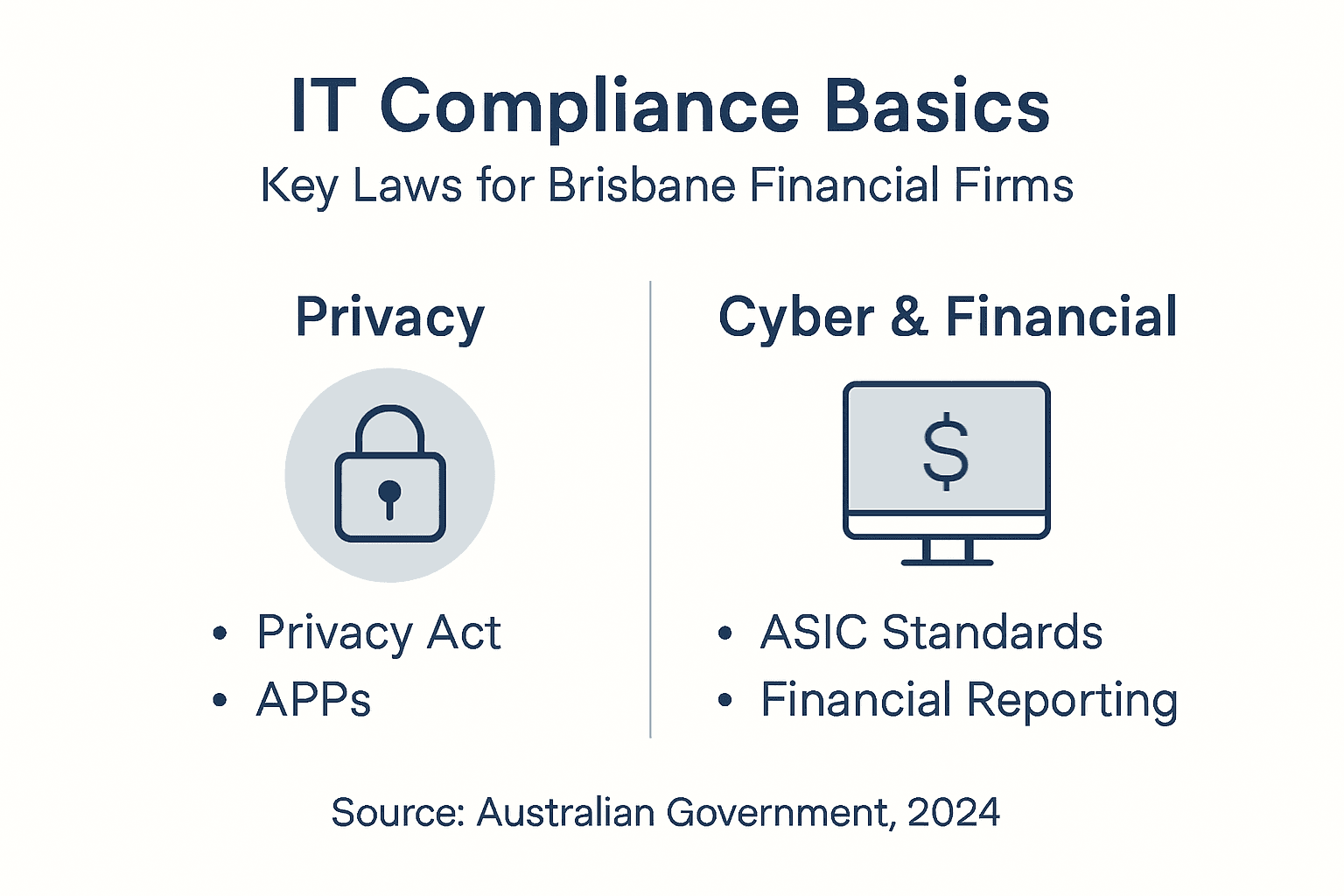
The Privacy Act 1988 And Australian Privacy Principles
The Privacy Act 1988 is Australia’s primary data protection law. It sets out how organisations must handle personal information.
The Australian Privacy Principles (APPs) form the core of this legislation. These 13 principles cover everything from collecting data to securing it and responding to breaches.
For financial services, the APPs matter because your clients’ data is sensitive. You must collect it fairly, store it securely, and only use it for the purpose stated.
Breach notification is mandatory under the Privacy Act. If you experience a data breach that’s likely to cause serious harm, you must tell affected individuals and the Privacy Commissioner within 30 days.
Here’s a concise overview of the main Australian compliance regulations affecting financial services firms:
| Regulation/Standard | Main Purpose | Business Impact | Penalty for Breach |
|---|---|---|---|
| Privacy Act 1988 & APPs | Protect client personal data | Requires secure storage & clear consent | Up to AUD $2.5 million or 30% turnover |
| ASIC Regulations | Ensures ethical financial conduct | Mandates disclosure and client protection | Licence suspension, civil penalties |
| Anti-Money Laundering Laws | Prevent financial crime & terrorism | Compulsory identification checks | Significant civil and criminal fines |
| Cyber Security Act 2024 | Safeguard IT systems & reporting | Mandatory incident reporting | Regulatory action on non-compliance |
| APRA Standards | Maintain financial system stability | Enforces risk management & audits | Reputational damage, fines |
Sector-Specific Compliance Requirements
Beyond the Privacy Act, financial services firms face additional rules. IT policies and procedures covering acceptable use, incident response, and data handling help you meet these obligations.
Your industry may require:
- ASIC regulations – Australian Securities and Investments Commission rules for financial conduct and disclosure
- Anti-Money Laundering laws – Preventing financial crime and terrorist financing
- Cybersecurity obligations – Protecting systems and data from unauthorised access
- Client record retention – Keeping required documentation for specified periods
- Audit and reporting requirements – Demonstrating compliance to regulators
Building Compliance Into Your Operations
Compliance works best when it’s built into daily operations, not bolted on afterwards. This means clear policies that staff understand and follow consistently.
Your IT systems need to support compliance. Encryption, access controls, and audit logging aren’t nice to have. They’re essential for meeting legal obligations.
Documentation proves you’re compliant. When regulators investigate, they want to see records showing you follow your policies and meet legal standards.
Australian regulators expect organisations to take proactive steps toward compliance, not just react when problems occur.
Common Compliance Gaps In Brisbane Firms
Small to medium financial services firms often struggle with the same issues. Staff don’t fully understand their data handling responsibilities. Systems lack proper security controls. Incident response procedures exist on paper but haven’t been tested.

These gaps create risk. When something goes wrong, inadequate systems or training become evidence of negligence.
Pro tip: Schedule a compliance audit with specialists who understand Australian financial services regulations. They’ll identify gaps specific to your firm and help you prioritise fixes that reduce the most risk first.
Types Of Compliance: Privacy, Cyber, Financial
IT compliance breaks down into three interconnected areas. Each demands different controls, but they overlap significantly. Failing in one area often creates problems in the others.
Brisbane financial services firms must address all three to stay legally compliant and operationally sound.
Privacy Compliance
Privacy compliance centres on how you collect, store, use, and protect personal information. The Privacy Act 1988 and Australian Privacy Principles set the rules here.
For financial services, privacy obligations include obtaining clear consent before collecting data. You must tell customers what data you’re gathering and why.
Data minimisation and consent management matter more than ever. Only collect data you genuinely need. Keep it only as long as necessary.
Your privacy obligations include:
- Transparent data collection and use statements
- Secure storage with encryption and access controls
- Quick response to customer access requests
- Notifying affected people if a data breach occurs
- Regular audits of how data is handled
Cyber Compliance
Cyber compliance focuses on protecting systems from unauthorised access, malware, and data theft. This involves technical controls, processes, and staff training.
Australia’s cyber compliance framework includes mandatory incident reporting under laws like the Cyber Security Act 2024. If you experience a significant cyber incident, you must report it to authorities within specific timeframes.
Cyber controls for financial services typically cover:
- Multi-factor authentication on critical systems
- Regular security patching and updates
- Endpoint protection and threat monitoring
- Firewall and intrusion detection systems
- Staff security awareness training
- Documented incident response procedures
Financial institutions face rising cyber threats daily. Having solid controls isn’t optional—it’s survival.
Financial Compliance
Financial compliance means following sector-specific rules about record-keeping, reporting, and conduct. For financial services firms, this includes APRA standards and industry codes.
Your obligations involve maintaining detailed records of transactions and decisions. Regulators expect you to produce audit trails proving you followed your policies.
Financial compliance requirements include:
- Accurate record-keeping for specified periods
- Regular compliance reporting to ASIC or APRA
- Anti-money laundering checks on clients
- Documentation of financial decisions and approvals
- Internal audit capabilities
How The Three Types Interconnect
These compliance areas aren’t separate silos. A privacy breach affects cyber compliance. Weak cyber controls create financial compliance failures.
Effective firms integrate all three into their operations. Your IT systems support compliance across all areas simultaneously.
The following table highlights key differences and overlap between privacy, cyber, and financial compliance for Brisbane firms:
| Compliance Area | Main Focus | Typical Controls | Regulatory Authority |
|---|---|---|---|
| Privacy | Personal data handling | Consent, data minimisation, encryption | OAIC (Office of the Australian Information Commissioner) |
| Cyber | Systems security & resilience | Patch management, MFA, monitoring | ASD, ASIC, APRA |
| Financial | Transaction records & conduct | Record-keeping, reporting, audits | ASIC, APRA |
| Overlap | Breach notification, access control | Incident response, audit trails | All above bodies |
Pro tip: Map your specific compliance obligations by sector and regulation, then identify which IT systems and controls address each requirement. This prevents overlap and gaps.
Risks, Penalties And Common Pitfalls For SMBs
Small to medium-sized Brisbane financial services firms face compliance challenges that larger organisations don’t encounter. Limited budgets, stretched IT teams, and complex regulations create a perfect storm for compliance failures.
Understanding the real risks helps you prioritise your efforts where they matter most.
Financial And Legal Penalties
Regulatory fines can devastate SMBs. A single breach notification failure can trigger penalties starting at thousands of dollars. Repeated or serious violations multiply costs rapidly.
Beyond fines, your business faces other consequences. Licence suspension stops you operating entirely. Director liability means senior staff face personal consequences. Reputational damage drives clients away.
Australia’s regulators increasingly enforce compliance aggressively. ASIC and APRA expect firms to demonstrate proactive compliance, not reactive responses after problems occur.
Common penalties include:
- Privacy Act breaches: up to AUD $2.5 million or 30% of adjusted turnover
- Anti-money laundering failures: substantial civil penalties
- Cybersecurity incident non-reporting: regulatory investigation and enforcement action
- Record-keeping failures: fines plus reputational damage
Common Pitfalls SMBs Fall Into
Underestimating complexity is the most dangerous mistake. SMBs often assume compliance is simple, then discover too late how many requirements apply to them.
SMBs struggle with IT compliance because they lack dedicated expertise and continuous monitoring. Staff wear multiple hats, compliance gets squeezed out, and gaps grow unnoticed.
Other common pitfalls include:
- No formal compliance framework or documentation
- Insufficient employee training on data handling
- Legacy systems that can’t meet current security standards
- Missing incident response procedures
- No regular risk assessments or compliance audits
- Assuming compliance once, not maintaining it continuously
The Cyber Threat Dimension
Cyber attacks target SMBs deliberately. Criminals know small firms have weaker defences and smaller budgets for recovery. One successful attack can trigger compliance failures across multiple areas.
Brisbane SMBs face specific cyber security risks including ransomware, phishing, and data theft. These aren’t theoretical risks—they’re happening to firms like yours regularly.
When cyber incidents occur without proper controls in place, compliance problems follow. You can’t respond to a breach if you don’t have incident procedures. You can’t notify customers if you don’t know what data was compromised.
SMBs that fail to address compliance often fail twice—first when the breach happens, then again when regulators investigate inadequate controls.
Business Continuity Risks
Compliance failures create operational chaos. Systems fail. Backups don’t work. Customer data gets lost. Staff don’t know what to do.
Recovery costs dwarf prevention costs. Rebuilding systems, restoring data, and managing customer notifications consume resources for months.
Many SMBs never recover. They close within 12 months of a major incident combined with compliance failure.
Pro tip: Conduct a compliance gap assessment focusing on your highest-risk areas first, then build controls incrementally rather than trying to fix everything at once. This approach delivers faster results with limited resources.
Practical Steps To Strengthen Compliance Posture
Building a strong compliance posture doesn’t happen overnight. It requires systematic steps, commitment from leadership, and sustained effort. The good news: you can start immediately with manageable actions.
These practical steps work for Brisbane financial services firms of any size.
Start With A Compliance Audit
Assess where you stand right now. Many firms don’t know which compliance gaps exist until they look systematically.
Conduct an internal audit covering privacy, cyber, and financial compliance areas. Document what controls exist, what’s missing, and which gaps pose the highest risk.
This audit becomes your roadmap. It shows you exactly where to invest resources first.
Your audit should cover:
- Current IT systems and their security capabilities
- Data handling processes and documentation
- Staff training and awareness levels
- Incident response procedures
- Backup and recovery systems
- Access controls and authentication methods
Implement The Essential Eight
ASIC recommends organisations adopt standardised frameworks for cyber resilience. The Australian Signals Directorate’s Essential Eight provides a proven approach.
The Essential Eight focuses on eight key security controls that prevent most cyber attacks:
- Application allowlisting
- Patch applications
- Configure Microsoft Office macro settings
- User application hardening
- Restrict administrative privileges
- Patch operating systems
- Multi-factor authentication
- Regular backups
Start with the top three. They deliver maximum risk reduction quickly.
Build Staff Awareness And Training
Your staff are your strongest defence or your biggest vulnerability. Comprehensive training creates a security culture where people understand their responsibilities.
Don’t assume knowledge. Regular training covers data handling, phishing recognition, password security, and incident reporting. Make it relevant to their daily work.
Test understanding through simulated phishing exercises. This shows what needs improvement without real risk.
Establish Clear Policies And Procedures
Document everything. Written policies prove you take compliance seriously when regulators investigate.
Key policies include acceptable use, data handling, incident response, access control, and breach notification. Each policy needs clear procedures staff can follow.
Review policies annually. Regulations change, threats evolve, and your policies must adapt.
Strong compliance doesn’t come from perfect systems. It comes from consistent effort, clear communication, and leadership commitment.
Create An Incident Response Plan
You need a tested incident response procedure. When something goes wrong, you won’t have time to figure out what to do.
Your plan should define roles, communication procedures, containment steps, and notification processes. Test it regularly through tabletop exercises.
This preparation means you respond faster, limit damage, and comply with notification requirements.
Pro tip: Assign one person as your compliance officer responsible for ongoing monitoring and updates. Even part-time, this single point of accountability ensures compliance doesn’t slip through the cracks.
Strengthen Your IT Compliance With Brisbane’s Trusted Experts
Brisbane financial services firms face complex challenges managing IT compliance across privacy, cyber security and financial regulations. Common issues like insufficient staff training, outdated systems and lack of clear incident response plans put your business at risk of costly fines and reputational harm. The detailed article highlights how integrated Governance, Risk, and Compliance (GRC) frameworks and practical steps such as adoption of the Essential Eight can significantly reduce these risks. Don’t let compliance gaps threaten your firm’s future.
At IT Start, we specialise in helping Brisbane small to medium businesses build robust IT compliance frameworks tailored to financial services requirements. Our proactive managed IT support, cloud solutions and cybersecurity services align directly with regulatory obligations like the Privacy Act, ASIC rules and the Cyber Security Act 2024. This means you gain peace of mind with certified expertise and local responsiveness on your side. Explore our tailored cybersecurity services and start your risk reduction journey today.
Ready to protect your clients and your business with a clear, actionable compliance strategy? Take the next step by scheduling a free compliance assessment with IT Start. Reach out via our contact page and let our Brisbane-based team guide you through practical solutions that keep your operations secure, efficient and fully compliant.
Frequently Asked Questions
What is IT compliance for financial services?
IT compliance involves adhering to laws, regulations, and standards that govern technology systems within financial services, ensuring the protection of customer data and security practices.
Why is IT compliance important for Brisbane financial firms?
IT compliance is crucial for protecting sensitive client information, reducing legal risks, and building trust with clients by demonstrating a commitment to data security and proper handling of personal information.
What are the key areas of IT compliance for financial firms?
Key compliance areas include data security and encryption, access controls, incident response procedures, backup and recovery systems, staff training, and maintaining audit trails and documentation.
How can firms build compliance into their daily operations?
Firms can integrate compliance by establishing clear policies, ensuring IT systems support compliance, documenting processes, providing ongoing staff training, and regularly assessing compliance gaps.