

Managing IT for a financial services firm in Brisbane often means juggling cost pressures, security demands, and strict compliance rules all at once. The right cloud solution promises real change, offering flexibility and efficiency without adding risk. By understanding how cloud solutions in financial services deliver scalability, agility, and advanced data analytics capabilities you can position your firm to adapt faster, stay compliant, and make your IT investments count where it matters most.
In This Guide: Cloud Solutions for Brisbane Financial Firms
- Defining Cloud Solutions For Financial Services
- Key Types And Deployment Models Explained
- Enhancing Operational Efficiency And Collaboration
- Compliance, Data Security, And Legal Requirements
- Risks, Costs, And Choosing The Right Provider
Key Takeaways
| Point | Details |
|---|---|
| Scalability and Cost Efficiency | Cloud solutions enable financial firms to scale resources on demand and convert fixed costs to variable expenses, enhancing financial flexibility. |
| Enhanced Collaboration | Cloud platforms foster collaboration by breaking down data silos, leading to faster decision-making and improved operational efficiency. |
| Compliance and Security | Firms must ensure compliance with regulatory frameworks when adopting cloud services, maintaining rigorous control over data residency and access. |
| Provider Selection Risks | Choosing the right cloud provider is critical; factors such as service continuity, data security, and clear contractual agreements can mitigate long-term operational risks. |
Defining Cloud Solutions For Financial Services
Cloud solutions in financial services represent a fundamental shift in how your firm manages data, applications, and infrastructure. Rather than maintaining expensive on-premises servers, you move critical workloads to remote environments managed by specialised providers. This approach offers tangible benefits that directly impact your bottom line and operational capacity.
At its core, cloud computing delivers three key capabilities your financial services firm needs.
- Scalability: Expand or reduce computing resources instantly based on demand without capital investment in new hardware
- Cost efficiency: Convert fixed infrastructure costs into variable operational expenses you control month-to-month
- Agility: Deploy new services and applications weeks faster than traditional IT infrastructure allows
For Brisbane financial firms, cloud solutions address real operational challenges. Cloud computing provides scalability, agility, cost-effectiveness, and data analytics capabilities that enable faster adaptation to market changes. You can innovate without waiting for hardware procurement cycles or managing complex IT infrastructure internally.
The technology behind cloud solutions operates simply. Your data and applications sit on secure, remote servers accessed through internet connections. Multiple layers of encryption, redundancy, and monitoring protect your information continuously. You maintain control over access permissions and operational settings whilst the provider handles maintenance, security updates, and hardware management.
Why Brisbane Financial Firms Are Adopting Cloud
Migration of critical workloads to public clouds requires strategic planning but delivers substantial benefits. Your firm gains access to enterprise-grade security infrastructure that rivals or exceeds what you could build independently. Compliance becomes easier when your provider maintains certifications aligned with Australian financial regulations.
Cloud solutions reduce your IT staff’s burden. Rather than spending weeks managing servers and handling routine maintenance, your team focuses on strategic initiatives that drive business growth. This shift matters significantly for small to medium-sized financial services firms competing for talent.
Your firm’s ability to adapt quickly in competitive markets increasingly depends on infrastructure flexibility cloud solutions provide.
Three critical outcomes emerge when Brisbane financial services firms adopt cloud correctly.
- Reduced capital expenditure on servers and networking equipment
- Faster deployment of new services and compliance features
- Improved disaster recovery and business continuity capabilities
Underlying all these benefits sits a simple truth: cloud solutions let you focus on your clients and compliance rather than managing technology. That’s particularly valuable when regulatory requirements consume significant IT resources.
Pro tip: Start with a cloud readiness assessment before migration to identify which applications benefit most from cloud deployment and which workloads require on-premises infrastructure for compliance reasons.
Key Types And Deployment Models Explained
Cloud solutions come in different flavours, each suited to different business needs. Understanding the distinction between cloud types and deployment models helps your Brisbane financial firm choose the right fit. The terminology sounds complex, but the concepts are straightforward once you break them down.
Three main cloud service types exist. Each represents a different level of responsibility you maintain versus what your provider manages.
Infrastructure as a Service (IaaS) gives you raw computing power. You control applications and data whilst the provider manages servers, storage, and networking. Think of it as renting empty office space where you bring your own furniture and equipment.
Platform as a Service (PaaS) provides development environments and tools. Developers build and deploy applications without managing underlying infrastructure. Your team focuses on coding rather than server management.
Software as a Service (SaaS) delivers ready-to-use applications accessed through web browsers. No installation required. No maintenance needed. You simply log in and use the software.
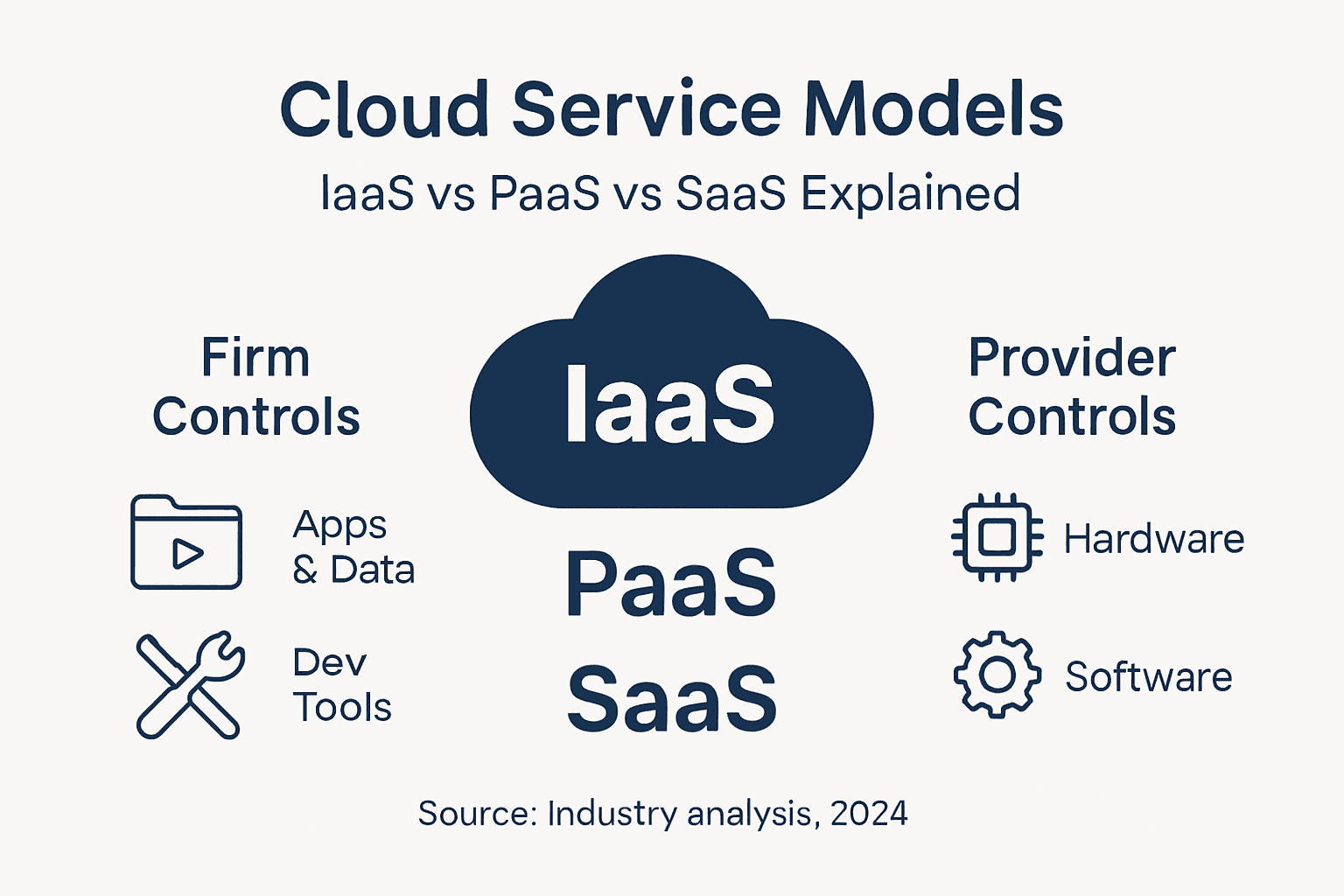
Here’s a handy comparison of main cloud service types and their business impact for financial firms:
| Service Type | Who Manages Infrastructure | Customisation Level | Typical Use Case |
|---|---|---|---|
| IaaS | Provider handles hardware | High control by firm | Hosting custom apps |
| PaaS | Provider manages platform | Moderate flexibility | Application development |
| SaaS | Provider manages everything | Minimal customisation | Software for daily operations |
Deployment Models For Financial Services
Beyond service types, deployment models such as public, private, and hybrid clouds affect how much control you maintain and what costs you incur. The right choice depends on your compliance requirements and security posture.
Public clouds offer maximum cost efficiency and scalability. Your data shares infrastructure with other organisations. For Brisbane firms handling less sensitive data, public clouds deliver excellent value. Regulatory restrictions often limit their use for core financial data.
Private clouds sit behind your firewall. Only your organisation accesses the infrastructure. Enhanced control and security come at higher cost. Compliance becomes simpler when you control the entire environment.
Hybrid clouds blend public and private resources. Financial institutions combine elements of both to meet complex operational and compliance needs. Your sensitive client data stays in private cloud whilst less sensitive workloads run on public infrastructure. This balanced approach suits most Brisbane financial services firms.
Reviewing major cloud deployment models highlights their suitability for compliance and cost control:
| Deployment Model | Access Control | Cost Predictability | Compliance Fit |
|---|---|---|---|
| Public Cloud | Shared among many users | Highly scalable, variable costs | Suits firms with lower sensitivity |
| Private Cloud | Exclusive to one firm | Higher, fixed costs | Simplifies compliance for sensitive data |
| Hybrid Cloud | Mix of public/private | Balanced cost and scalability | Meets complex regulatory needs |
The deployment model you choose directly determines your compliance effort, security overhead, and monthly costs.
Choosing your approach requires honest assessment of three factors.
- Which data requires strict access controls under regulatory requirements
- How much infrastructure management your IT team can sustainably handle
- What budget allocation your firm has for cloud infrastructure
Pro tip: Map your applications and data to deployment models before committing to any cloud provider; some workloads fit public clouds whilst others demand private infrastructure for regulatory compliance.
Enhancing Operational Efficiency And Collaboration
Cloud solutions break down the walls that traditionally separate your teams. Instead of departments working in isolation with fragmented data systems, cloud platforms create shared workspaces where collaboration happens naturally. This shift transforms how your Brisbane financial firm operates day-to-day.

When teams access the same data simultaneously through cloud platforms, decision-making accelerates. Your compliance team, risk managers, and operations staff work from identical information sources. No more conflicting reports or delayed communications waiting for email replies.
Cloud computing integrates business units and breaks down data silos that waste time and create errors. Real-time analytics replace end-of-month reports. Your team spots opportunities and risks immediately rather than discovering them weeks later through manual processes.
Three major operational improvements emerge from cloud-based collaboration.
- Faster decision cycles: Teams access current data instantly instead of waiting for report generation
- Reduced redundancy: Shared platforms eliminate duplicate data entry and conflicting records
- Improved accuracy: Single source of truth prevents calculation errors from multiple spreadsheet versions
Breaking Down Operational Silos
Your Brisbane financial firm likely operates with separate systems for client management, accounting, compliance monitoring, and reporting. Each system requires its own staff, training, and maintenance. Cloud platforms consolidate these functions into integrated ecosystems.
When developers need to modify client reporting, they no longer wait for infrastructure teams. When compliance needs urgent audit trails, they access them instantly rather than requesting exports from IT. This efficiency matters significantly when regulatory deadlines approach.
Cloud-based tools also enable remote work without sacrificing security or oversight. Your teams collaborate across Brisbane offices or from home using identical systems and controls. Staff retention improves when you offer flexibility without infrastructure complexity.
Collaboration thrives when teams access identical data through shared platforms without geographic or departmental boundaries.
Operational benefits extend beyond speed. Cost containment improves when you eliminate duplicate systems and manual processes. Consider these concrete gains.
- Reduced IT staff time spent maintaining separate applications
- Lower licensing costs through consolidated cloud subscriptions
- Fewer errors from manual data transfers between systems
- Faster onboarding when new staff access integrated platforms immediately
Pro tip: Start collaboration improvements by identifying your most time-consuming manual processes; move those workflows into cloud platforms first to demonstrate quick wins and build team confidence.
Compliance, Data Security, And Legal Requirements
Cloud adoption in financial services demands strict attention to regulatory frameworks. Your Brisbane firm cannot simply move data to the cloud and assume compliance happens automatically. Regulators expect explicit controls, continuous monitoring, and documented risk management addressing cloud-specific vulnerabilities.
Australian financial regulations impose specific requirements on how you handle cloud infrastructure. Your cloud provider becomes an extension of your regulatory obligations, not a replacement for them. You remain legally responsible for data security and compliance regardless of where servers physically sit.
Financial firms must manage robust risk management frameworks and compliance with data protection laws when adopting cloud services. This means documented processes, regular audits, and contractual protections with your cloud provider ensuring they maintain your compliance standards.
Three critical compliance areas demand your attention.
- Data residency: Regulatory frameworks specify where your client data must physically reside and which jurisdictions can access it
- Access controls: Documented proof that only authorised staff access sensitive information through defined approval processes
- Audit trails: Comprehensive logging of who accessed what data and when, retained for regulatory review periods
Managing Cloud-Specific Regulatory Risks
Cloud adoption comes with strict regulatory scrutiny focusing on outsourcing controls and data privacy. Your contracts with cloud providers must explicitly address your regulatory obligations. Vague service agreements expose your firm to compliance violations you cannot control.
Operational resilience matters significantly. Your cloud infrastructure must withstand outages, security breaches, and service disruptions without compromising client data or regulatory reporting. This requires redundancy, backup systems, and tested recovery procedures.
Sensitive data protection remains your responsibility. Encryption in transit and at rest, access logging, and regular security assessments form the foundation of compliant cloud operations.
Regulators hold your firm accountable for cloud security regardless of whether your provider made the mistake.
Key compliance requirements for Brisbane financial firms include:
- Signed Service Level Agreements specifying security standards and incident response timeframes
- Regular third-party audits confirming cloud provider compliance with Australian standards
- Data backup and disaster recovery procedures tested at least annually
- Incident response plans detailing immediate notification to regulators if data breaches occur
Pro tip: Request your cloud provider’s compliance certifications and audit reports before signing contracts; verify they maintain standards aligned with Australian Prudential Regulation Authority expectations for your specific financial services sector.
Risks, Costs, And Choosing The Right Provider
Cloud adoption brings genuine risks your Brisbane financial firm must understand before signing contracts. Vendor lock-in, escalating costs, and operational dependencies create long-term vulnerabilities. Poor provider selection decisions become expensive mistakes that constrain your options for years.
When you move data and applications to a cloud provider, switching becomes increasingly difficult. Your systems integrate deeply with their infrastructure. Your staff learns their tools and workflows. Extracting everything to migrate to another provider consumes months and substantial budget. Providers know this, and your negotiating leverage diminishes over time.
Financial firms face risks including vendor lock-in and escalating costs when signing long-term contracts without careful cost management. Contract terms that seemed reasonable in year one become problematic when your firm grows and usage skyrockets. Service failures from your provider suddenly become your regulatory problem.
Three major risk categories demand your attention during provider selection.
- Service continuity risks: Outages at your provider halt your operations and violate regulatory requirements
- Data security risks: Breaches expose client information and trigger investigation costs plus regulatory penalties
- Financial risks: Cost overruns from unexpected usage charges or locked-in price increases
Evaluating Provider Capabilities
Choosing the right cloud provider requires balancing scalability opportunities against challenges including data security and regulatory compliance. Price alone should never drive provider selection. The cheapest provider often delivers the poorest security, compliance support, and customer service.
Ask potential providers specific questions about their Australian operations. Where do they store your data physically? Which Australian data centres do they operate? Can they provide compliance certifications aligned with your regulatory requirements? Request references from other Brisbane financial firms using their services.
Service Level Agreements matter critically. Vague commitments like “best efforts” support provide no protection. Explicit guarantees about uptime, incident response times, and data recovery capabilities must appear in writing with financial penalties when they fail.
Poor provider selection decisions become expensive multi-year commitments that constrain your operational flexibility.
Evaluate these provider characteristics before committing.
- Australian data centre locations and physical security certifications
- Compliance certifications matching your regulatory requirements
- Incident response procedures with guaranteed response timeframes
- Clear exit strategies if you decide to switch providers
- References from Brisbane financial services firms currently using their services
Pro tip: Request a proof-of-concept deployment with your most non-critical application before full migration; this reveals hidden costs, integration challenges, and true support responsiveness without risking core operations.
Enhance Your Brisbane Financial Firm’s Cloud Strategy with IT Start
The article highlights critical challenges Brisbane financial firms face when adopting cloud solutions such as balancing regulatory compliance, managing data security risks, avoiding vendor lock-in, and achieving operational agility and cost efficiency. These pain points demand a strategic IT partner who understands the unique demands of your industry and local regulatory landscape. IT Start specialises in delivering tailored cloud solutions designed to reduce compliance burdens, improve collaboration, and safeguard sensitive financial data while optimising your IT costs.
With our proactive managed IT support and deep experience in cybersecurity compliance, IT Start empowers your team to focus on client service rather than infrastructure hurdles. We can conduct thorough cloud readiness assessments and design hybrid or private cloud architectures that meet your specific data residency and access control needs. Don’t risk costly mistakes with generic providers. Trust the Brisbane-based experts who hold SMB 1001 Gold certifications and prioritise transparent, customised service.
Ready to transform your cloud environment and strengthen your competitive edge? Discover how IT Start’s financial services IT solutions can help you navigate the complex cloud landscape today. Contact us for a free consultation at IT Start Contact and take the first step towards scalable, secure, and compliant cloud operations.
Frequently Asked Questions
What are the key benefits of cloud solutions for financial firms?
Cloud solutions provide scalability, cost efficiency, and agility. They allow financial firms to instantly adjust computing resources, convert fixed costs into variable expenses, and deploy new services much faster compared to traditional IT infrastructure.
How do different cloud service models (IaaS, PaaS, SaaS) differ?
IaaS offers raw computing power where the firm manages applications and data, PaaS provides environments for app development without managing infrastructure, and SaaS delivers ready-to-use applications directly to users over the internet.
What should financial firms consider when choosing a cloud deployment model?
Firms should evaluate their compliance requirements, the sensitivity of their data, the IT management capabilities of their team, and their budget for cloud infrastructure when selecting between public, private, and hybrid clouds.
How can cloud solutions enhance collaboration within financial firms?
Cloud solutions break down silos by providing shared platforms where teams can access the same data simultaneously. This leads to faster decision-making, reduces redundancy, and improves accuracy across departments.
Recommended
- Cloud Data Security – Protecting Financial Firms in Brisbane – IT Start
- Why Choose Cloud Solutions for Brisbane SMEs – IT Start
- Security Benefits of Cloud Computing for Brisbane SMEs – IT Start
- All Cloud Solutions: Compliance and Value for Brisbane SMEs – IT Start
- Back Office Cloud Technology – Samtouch Point of Sale