

Securing financial data is never simple when systems stretch beyond your office to the cloud. For Brisbane firms, managing sensitive information while meeting Australian compliance demands means tackling threats from multiple directions. With cloud computing, you must master concepts like robust identity management, data encryption, and continuous monitoring. This guide breaks down cloud security fundamentals tailored to the financial sector, showing how risk assessments and Australian frameworks can guard your business against evolving cyber risks.
Table of Contents
- Cloud Computing Security – Core Concepts
- Cloud Service Models And Protection Features
- Australian Compliance And Regulatory Frameworks
- Practical Security Controls For Financial Services
- Managing Risks And Ongoing Improvements
Key Takeaways
| Point | Details |
|---|---|
| Cloud Security Principles | Focus on confidentiality, integrity, and availability to safeguard digital assets across cloud platforms. |
| Cloud Service Models | Understand security responsibilities specific to IaaS, PaaS, and SaaS to choose appropriate solutions for your business. |
| Regulatory Compliance | Familiarise yourself with Australian frameworks and implement necessary security controls to ensure compliance. |
| Proactive Risk Management | Conduct regular security assessments and maintain continuous monitoring to identify and address vulnerabilities efficiently. |
Cloud computing security – core concepts
Cloud computing security represents a sophisticated approach to protecting digital assets and infrastructure in an increasingly networked business environment. At its core, cloud security involves implementing comprehensive strategies to safeguard data, applications, and systems hosted on cloud platforms. The Australian Government’s cyber security guidelines define cloud computing as a model enabling on-demand network access to shared computing resources.
Understanding cloud security requires recognising its fundamental architectural principles. These include robust identity and access management, network segmentation, encryption protocols, and continuous threat monitoring. Brisbane SMEs must implement multi-layered security approaches that protect against potential vulnerabilities across data storage, transmission, and processing stages. Key components involve controlling user permissions, implementing strong authentication mechanisms, and maintaining comprehensive audit trails of system interactions.
The primary objectives of cloud security centre on three critical dimensions: confidentiality, integrity, and availability. Confidentiality ensures that sensitive information remains accessible only to authorised personnel. Integrity guarantees that data remains unaltered during storage and transmission. Availability ensures that cloud resources remain accessible to legitimate users when required. These principles demand sophisticated technical controls, including advanced encryption, secure network configurations, and proactive threat detection mechanisms.
Pro tip: Conduct regular security assessments and penetration testing to identify and address potential vulnerabilities in your cloud infrastructure before they can be exploited by malicious actors.
Cloud service models and protection features
Cloud service models represent distinct architectural approaches to delivering computing resources, each with unique security implications for Brisbane businesses. The primary models include Infrastructure as a Service (IaaS), Platform as a Service (PaaS), and Software as a Service (SaaS), which progressively shift security responsibilities between cloud providers and clients. Security responsibilities across cloud models vary significantly, requiring organisations to understand their specific protective obligations.
In IaaS models, clients maintain maximum control, managing operating systems, applications, and data security while the provider secures underlying physical infrastructure. PaaS reduces client responsibilities by handling operating system management, allowing businesses to focus on application development and data protection. SaaS represents the most hands-off approach, with the provider managing nearly all security aspects, including infrastructure, platform, and application layers. This model demands rigorous vendor security assessments to ensure comprehensive protection.
Each cloud service model requires tailored security strategies addressing unique vulnerabilities. IaaS demands robust network configurations and stringent access controls. PaaS requires careful application security practices and runtime environment protections. SaaS necessitates detailed vendor security evaluations, strong authentication mechanisms, and continuous monitoring of data access and usage patterns. Brisbane SMEs must carefully evaluate their specific operational requirements and risk tolerance when selecting appropriate cloud service models.
Here is a comparison of cloud service models and their client responsibilities:
| Model | Client Security Responsibility | Business Use Case |
|---|---|---|
| IaaS | OS, apps, data, access controls | Flexible infrastructure for IT teams |
| PaaS | Apps, data protection | Application development and deployment |
| SaaS | User access, data usage | End-user productivity tools |
Pro tip: Develop a comprehensive cloud security matrix that clearly delineates security responsibilities across your chosen service model, ensuring no protective gaps exist between provider and client obligations.
Australian compliance and regulatory frameworks
Australian cloud computing regulatory frameworks represent a comprehensive approach to protecting digital infrastructure and sensitive business data. Cloud computing security guidance from the Australian Cyber Security Centre (ACSC) establishes critical standards for organisations seeking robust cybersecurity protection. The regulatory landscape encompasses multiple key frameworks, including the Essential Eight mitigation strategies, the Information Security Manual (ISM), and the Information Security Registered Assessors Program (IRAP), which collectively define comprehensive security expectations for businesses.

The Security of Critical Infrastructure Act 2018 represents a pivotal legislative instrument that mandates specific security requirements for cloud service providers. This legislation requires organisations to implement risk management programs, conduct regular security assessments, and maintain transparent reporting mechanisms. Regulatory compliance extends beyond mere technical controls, demanding holistic approaches that integrate governance, risk management, privacy protections, and continuous monitoring strategies tailored to specific industry sectors and organisational risk profiles.
For Brisbane SMEs, navigating these complex regulatory requirements demands a strategic approach. Businesses must understand their specific compliance obligations, which vary across industries such as finance, healthcare, and professional services. Key considerations include data sovereignty requirements, mandatory breach notification protocols, and adherence to Australian Privacy Principles. Organisations must also develop robust vendor assessment processes, ensuring cloud service providers meet stringent security and compliance standards established by national regulatory frameworks.
The following table summarises key Australian cloud security frameworks and their focus areas:
| Framework | Main Focus | Applicability |
|---|---|---|
| Essential Eight | Baseline mitigation strategies | All Australian organisations |
| ISM | Comprehensive security guidelines | Government and critical sectors |
| IRAP | Security assessment program | Vendor and provider assessment |
| SOCI Act | Infrastructure protection | Critical infrastructure sectors |
Pro tip: Conduct an annual comprehensive compliance audit that maps your cloud infrastructure against ACSC guidelines, identifying and addressing potential regulatory gaps before they become significant risks.
Practical security controls for financial services
Financial services organisations require robust and specialised security controls to protect sensitive financial data and maintain regulatory compliance. Cloud compliance rules for financial institutions establish comprehensive frameworks that mandate rigorous risk management and data protection strategies. These controls encompass multiple layers of security, including advanced authentication mechanisms, encryption protocols, and continuous monitoring systems designed to mitigate potential cybersecurity threats.
Key security controls for Brisbane financial firms centre on three critical dimensions: data protection, access management, and regulatory compliance. Multi-factor authentication becomes essential, requiring users to verify their identity through multiple independent credentials. Network segmentation techniques isolate sensitive financial information, preventing potential breaches from spreading across systems. Encryption protocols must be implemented at rest and in transit, ensuring that customer financial data remains protected from unauthorised access or interception.
Regulatory frameworks such as the Australian Prudential Regulation Authority (APRA) standards CPS 231, CPS 234, and CPS 220 impose stringent requirements on financial institutions. These standards mandate comprehensive risk management programs, regular security assessments, and transparent reporting mechanisms. Financial services organisations must develop robust vendor assessment processes, conduct periodic security audits, and maintain detailed documentation demonstrating compliance with these regulatory expectations. This approach ensures not just technical protection, but a holistic strategy that addresses governance, risk management, and operational resilience.
Pro tip: Implement a quarterly cybersecurity assessment process that comprehensively reviews your cloud infrastructure, validates existing security controls, and proactively identifies potential vulnerabilities before they can be exploited.
Managing risks and ongoing improvements
Cloud security risk management requires a proactive and dynamic approach, particularly for Brisbane businesses seeking to maintain robust digital infrastructure. Cloud security risk management practices emphasise continuous evaluation and strategic improvement of security controls. This involves comprehensive risk assessments that identify potential vulnerabilities, analyse threat landscapes, and develop adaptive strategies to mitigate emerging cybersecurity challenges.
Effective risk management strategies for SMEs encompass multiple critical components. Continuous monitoring stands as a cornerstone approach, involving real-time threat detection systems, regular security audits, and comprehensive vulnerability assessments. Organisations must implement robust access control mechanisms, including role-based permissions, multi-factor authentication, and stringent identity verification processes. Data encryption, network segmentation, and advanced threat detection technologies further strengthen the organisation’s security posture, creating multiple layers of defensive capabilities.
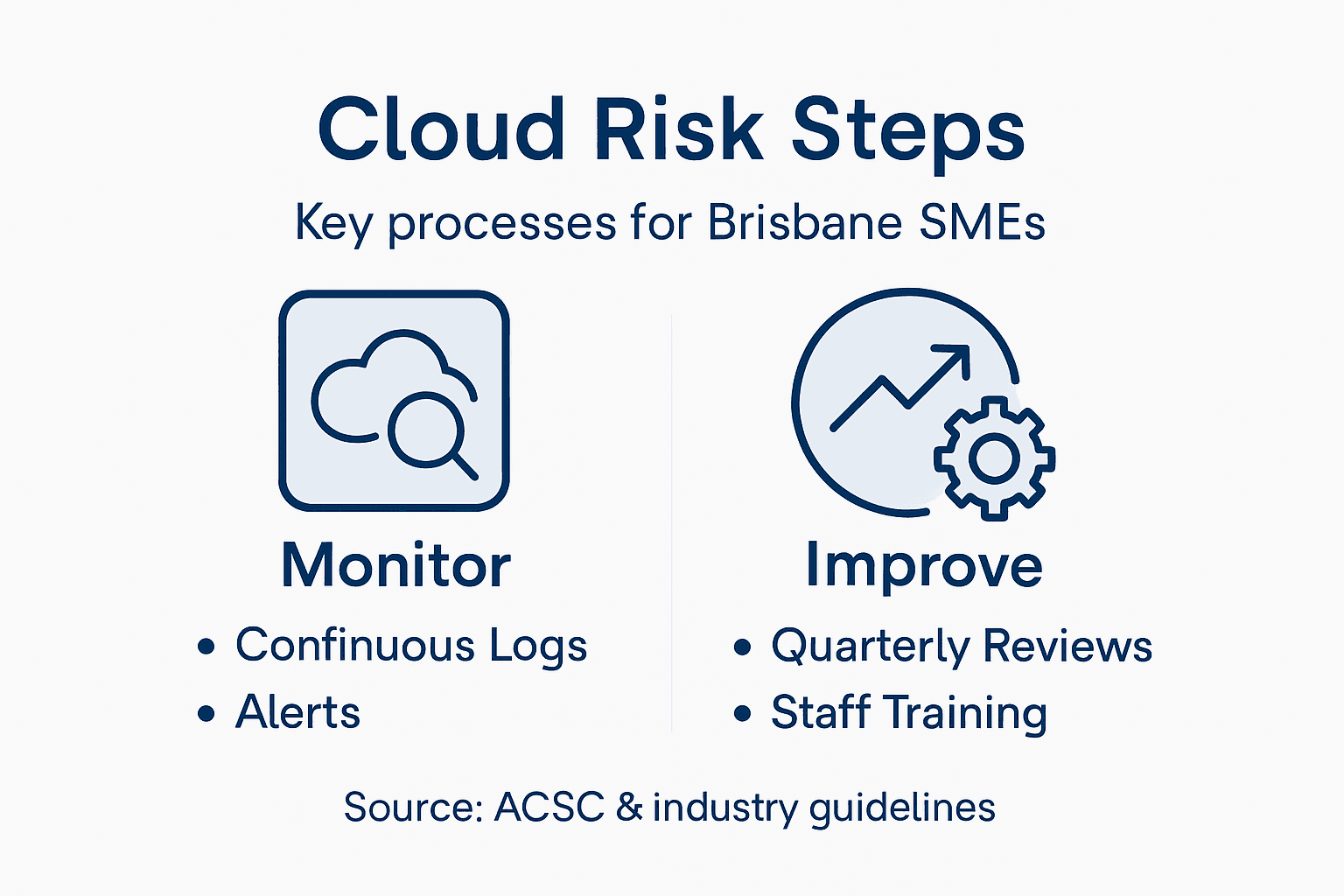
Ongoing improvements demand a structured and systematic approach to risk management. This includes periodic penetration testing, compliance audits aligned with frameworks like Essential Eight and ISO 27001, and maintaining detailed documentation of security incidents and response strategies. Brisbane businesses should prioritise working with locally owned cloud service providers or those operating within Australian jurisdictions, which can provide enhanced regulatory compliance and more responsive support. Regular training programs for staff, coupled with clear incident response protocols, ensure that the human element remains a strong component of the organisation’s overall security strategy.
Pro tip: Develop a quarterly security review process that includes comprehensive vulnerability scanning, staff security awareness training, and a detailed gap analysis to proactively identify and address potential security weaknesses.
Strengthen Your Brisbane SME’s Cloud Security with IT Start
The article highlights crucial challenges Brisbane SMEs face in securing cloud computing environments such as managing access controls, ensuring compliance with Australian regulations, and implementing ongoing risk management strategies. Key pain points include protecting sensitive data with multi-factor authentication, maintaining confidentiality, integrity, and availability, and navigating complex regulatory frameworks like the Essential Eight and SOCI Act.
At IT Start, we understand these unique security needs and provide tailored cloud solutions backed by local expertise and recognised industry certifications like SMB 1001 Gold. Our managed IT support helps your business build a robust security posture with proactive monitoring, comprehensive compliance auditing, and expert guidance on selecting the right cloud service models. We empower your team to confidently mitigate risks and uphold regulatory standards while focusing on growth.
Ready to secure your cloud infrastructure and boost operational efficiency? Discover how our Brisbane-based cybersecurity services can safeguard your financial or professional services business today. Book a free security assessment or consultation through our Contact Us page and take the first step towards resilient cloud security.
Learn more about how IT Start supports SMEs in navigating compliance and technology challenges by visiting our Contact Us page now. Your cloud security strategy starts here.
Frequently Asked Questions
What are the main security benefits of cloud computing for SMEs?
Cloud computing offers enhanced security benefits such as robust data protection, continuous monitoring, and advanced encryption protocols that safeguard sensitive information from potential breaches.
How does cloud security protect against data loss?
Cloud security provides data loss prevention through regular backups, redundancy, and disaster recovery solutions, ensuring that vital business data is preserved even in the event of system failures or cyberattacks.
What security measures should SMEs implement in their cloud systems?
SMEs should implement multi-factor authentication, robust access controls, continuous threat monitoring, and regular security assessments to detect and mitigate vulnerabilities within their cloud infrastructure.
How can businesses ensure compliance with regulatory standards when using cloud services?
Businesses can ensure compliance by understanding specific regulatory obligations applicable to their industry, conducting regular audits, and working with cloud providers that meet stringent security and compliance standards.