

Cyberattacks target 43% of small businesses, yet many Brisbane SMB owners still believe they’re too small to be at risk. Security frameworks provide structured, manageable approaches to cybersecurity that protect your business from evolving threats. This guide explains how Brisbane SMBs can choose and implement effective security frameworks to strengthen their defences, meet compliance requirements, and safeguard their operations.
Table of Contents
- Understanding Security Frameworks: What They Are And Why They Matter
- Core Components Of Leading Security Frameworks For Small Businesses
- Dispelling Common Misconceptions About Security Frameworks For SMBs
- Choosing The Right Security Framework For Your Brisbane SMB
- Step-By-Step Guide To Implementing Security Frameworks In SMBs
- Benefits Of A Framework-Driven Security Posture For SMBs
- Protect Your Brisbane SMB With Expert Cybersecurity Support
- Frequently Asked Questions
Key takeaways
| Point | Details |
|---|---|
| Frameworks structure risk management | Security frameworks provide repeatable controls that systematically protect business information and systems. |
| Essential Eight suits most SMBs | ASD Essential Eight offers cost-effective protection through eight prioritised controls requiring minimal resources. |
| Incremental implementation succeeds | Phased adoption prevents resource overwhelm whilst building robust cybersecurity capabilities over time. |
| Compliance becomes manageable | Frameworks align Brisbane SMBs with Privacy Act requirements and reduce legal liability exposure. |
| Financial benefits are significant | Framework adoption reduces incident costs by approximately AUD 50,000 annually for typical SMBs. |
Understanding security frameworks: what they are and why they matter
A security framework is structured guidance that helps businesses manage cybersecurity risks systematically. Think of it as a blueprint for protecting your information assets, systems, and customer data from cyber threats. Frameworks outline specific controls, processes, and best practices that create consistent, repeatable security across your organisation.
For Brisbane SMBs, frameworks serve three critical functions:
- They provide proven methods for identifying vulnerabilities and implementing appropriate safeguards
- They enable alignment with Australian data security compliance requirements
- They establish measurable baselines for continuous security improvement
Applying security frameworks helps SMBs meet requirements such as the Privacy Act 1988 and Notifiable Data Breaches scheme, reducing legal risks. Without frameworks, businesses often implement security controls inconsistently, leaving gaps that attackers exploit.
Frameworks improve resilience by creating standardised responses to incidents. When breaches occur, your team follows established procedures rather than improvising under pressure. This consistency significantly reduces recovery time and operational disruption.
Adopting frameworks also demonstrates due diligence to customers, partners, and insurers. Brisbane businesses that implement recognised frameworks gain competitive advantages through enhanced trust and reduced insurance premiums. Starting with network security practices in Brisbane builds the foundation for broader framework adoption.
The investment in frameworks pays dividends through prevented incidents, streamlined compliance, and operational efficiency. Even basic framework implementation transforms security from reactive firefighting to proactive risk management. This shift allows SMBs to focus on growth whilst maintaining robust cybersecurity best practices for Brisbane SMBs.
Understanding frameworks empowers you to make informed decisions about securing business data Brisbane SMEs need to protect.
Core components of leading security frameworks for small businesses
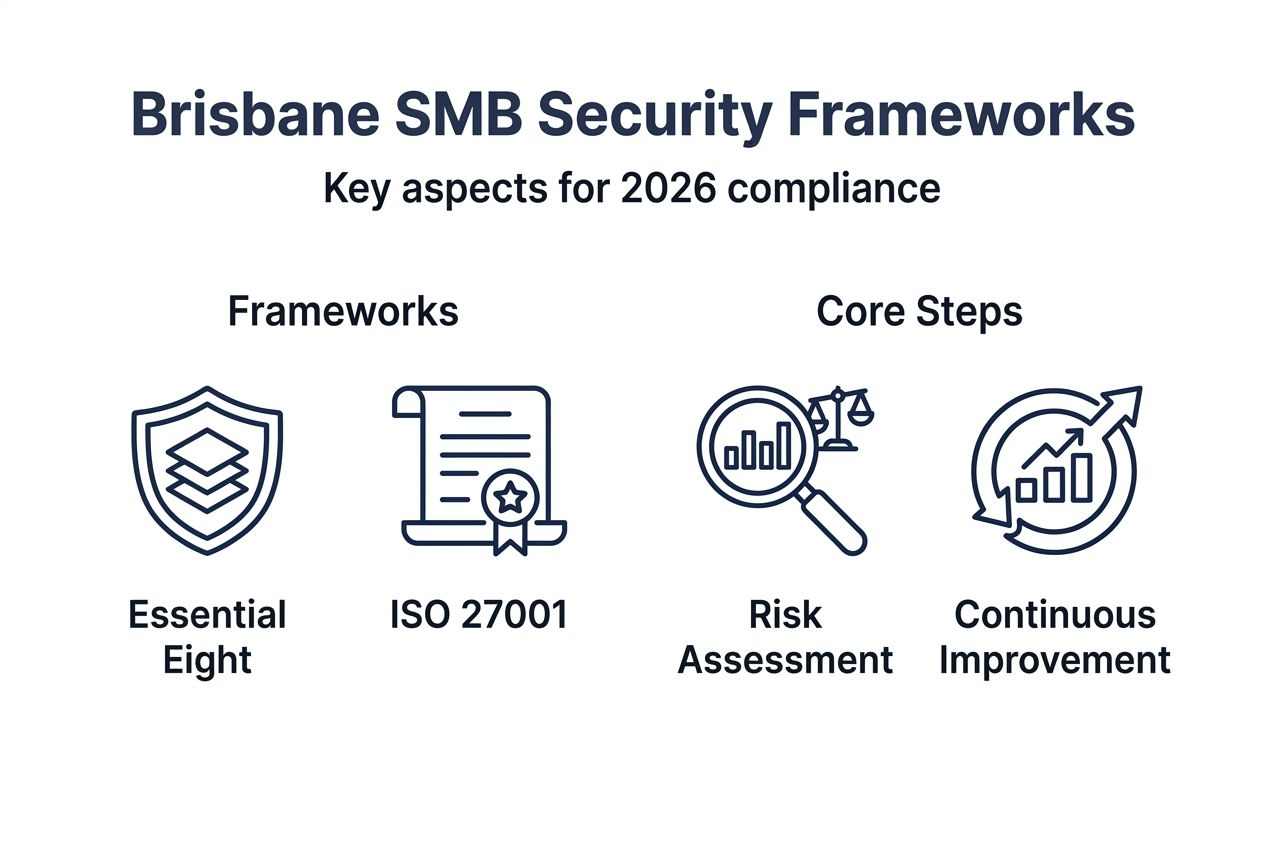
Brisbane SMBs typically choose between ASD Essential Eight and ISO 27001, though their resource requirements differ substantially. The Essential Eight focuses on eight prioritised security controls that deliver maximum impact with minimal complexity. These controls include application patching, multi-factor authentication, and application control, all designed for rapid implementation.

ISO 27001 requires more resources and expertise, making it less accessible for most SMBs versus the Essential Eight. ISO 27001 establishes a comprehensive information security management system requiring formal documentation, regular audits, and certification processes. Medium-sized enterprises with compliance mandates often pursue ISO 27001, whilst smaller businesses gain better value from Essential Eight.
| Framework | Scope | Implementation Cost | Certification Required | Best For |
|---|---|---|---|---|
| ASD Essential Eight | 8 prioritised controls | Low to moderate | No | Small Brisbane SMBs with limited IT resources |
| ISO 27001 | Comprehensive ISMS | High | Yes | Medium businesses requiring formal certification |
| NIST CSF | Flexible tiered approach | Moderate | No | SMBs seeking customisable framework |
Essential Eight’s core components include:
- Application control preventing unauthorised software execution
- Patch management ensuring systems remain updated against vulnerabilities
- Multi-factor authentication adding layers beyond passwords
- Regular backups enabling rapid recovery from ransomware
Both frameworks require ongoing risk assessment, control implementation, monitoring, and continuous improvement cycles. The difference lies in formality and resource intensity. Essential Eight provides practical security wins without bureaucratic overhead, making it ideal for resource-constrained Brisbane SMBs.
Pro Tip: Start with Essential Eight Maturity Level One to gain quick security improvements, then progressively advance to higher maturity levels as resources permit.
Implementing managed network security for Brisbane SMEs supports framework adoption by providing expert oversight. Partnering with network security administration Brisbane specialists ensures controls function correctly and adapt to emerging threats.
Frameworks aren’t static checklists but living systems requiring regular reviews. Cyber threats evolve constantly, so your controls must adapt accordingly. Monthly reviews of critical controls and quarterly comprehensive assessments maintain effectiveness. For detailed technical requirements, consult ISO 27001 framework details or Australian Signals Directorate guidance.
Dispelling common misconceptions about security frameworks for SMBs
Many Brisbane SMB owners hold misconceptions that prevent them from adopting effective security frameworks. Understanding reality versus myth enables better decision-making and implementation success.
Misconception one: frameworks guarantee complete security. No security framework guarantees total security, but they significantly reduce risk and improve recovery time. Frameworks minimise likelihood and impact of breaches rather than eliminating all possibility. This realistic expectation prevents disappointment and maintains long-term commitment.
Misconception two: SMBs are too small to be targeted. Attackers specifically target small businesses because they often lack robust defences whilst holding valuable data. Brisbane SMBs process customer information, financial records, and intellectual property that criminals monetise readily. Your size makes you accessible, not invisible.
Misconception three: frameworks are too complex and expensive for SMBs. Scalable frameworks like Essential Eight require modest investment whilst delivering substantial protection. Implementation costs vary based on existing security maturity, but phased approaches spread expenses over manageable timeframes. Many controls involve configuration changes rather than expensive technology purchases.
Common misconceptions include:
- Believing frameworks only suit large enterprises with dedicated security teams
- Thinking compliance frameworks and security frameworks are identical
- Assuming framework adoption is one-time effort rather than ongoing process
- Expecting immediate results without allowing implementation time
Misconception four: frameworks create bureaucratic overhead without practical benefit. Properly implemented frameworks streamline security operations by standardising processes and eliminating ad-hoc decision-making. Teams work more efficiently when following clear procedures rather than debating approaches during incidents.
Addressing these misconceptions through education improves adoption rates and outcomes. Brisbane SMBs that understand realistic expectations commit more successfully to framework implementation. Recognising that frameworks require ongoing effort but deliver measurable risk reduction helps set appropriate expectations.
For guidance on avoiding common cybersecurity misconceptions in Brisbane SMBs, consult local IT security experts who understand regional threat landscapes. Resources on realistic cybersecurity benefits for SMBs provide evidence-based perspectives on framework value.
Choosing the right security framework for your Brisbane SMB
Selecting an appropriate framework requires assessing multiple factors specific to your business context. Brisbane SMBs should evaluate size, industry, risk exposure, and compliance obligations before committing to particular frameworks.
-
Assess your current security maturity and IT capabilities. Businesses with minimal existing controls benefit from Essential Eight’s clear starting point. Those with established security practices might pursue more comprehensive frameworks. Honest assessment prevents overcommitting to frameworks exceeding your capacity.
-
Identify regulatory and compliance requirements affecting your industry. Framework application helps meet requirements including Privacy Act 1988 and Notifiable Data Breaches obligations. Healthcare providers face additional privacy regulations, whilst financial services encounter industry-specific standards. Understanding mandatory compliance guides framework selection.
-
Evaluate available budget and human resources for implementation. Essential Eight requires fewer resources than ISO 27001 certification. Consider both initial implementation costs and ongoing maintenance expenses. Realistic budgeting prevents abandoned projects and ensures sustainable security improvements.
-
Consider your risk profile based on data sensitivity and threat exposure. Businesses handling sensitive customer information or intellectual property face elevated risks requiring robust frameworks. Professional services firms processing confidential client data need stronger controls than businesses with minimal data holdings.
-
Plan for scalability as your business grows and threats evolve. Choose frameworks supporting progressive maturity increases. Essential Eight’s maturity model allows advancement from basic to advanced controls as resources permit. Frameworks should accommodate business expansion without requiring complete replacement.
Engaging network security improvement Brisbane SMEs specialists provides tailored recommendations matching your specific circumstances. Local expertise understands Brisbane’s business environment and regulatory landscape better than generic advice.
Your industry influences framework priorities. Legal firms emphasise confidentiality controls, whilst healthcare providers prioritise data integrity and availability. Manufacturing businesses focus on operational technology security. Understanding information security priorities for Brisbane SMBs in your sector guides appropriate control selection.
Consult Australian regulatory cybersecurity requirements documentation to ensure compliance alignment. Framework choice should satisfy both security needs and regulatory obligations efficiently.
Step-by-step guide to implementing security frameworks in SMBs
Successful framework implementation follows structured phases that prevent overwhelm whilst building robust security capabilities.
-
Conduct comprehensive risk and compliance assessment. Document your current security posture, identify vulnerabilities, and catalogue compliance obligations. This baseline reveals gaps between current state and framework requirements. Assessment informs prioritisation and resource allocation for maximum impact.
-
Select framework aligning with assessment findings and available resources. Choose Essential Eight for cost-effective risk reduction or ISO 27001 when certification is mandatory. Ensure selected framework addresses identified risks and satisfies compliance requirements. Alignment between framework and business needs determines implementation success.
-
Develop phased implementation plan prioritising highest-risk controls first. Address critical vulnerabilities immediately whilst scheduling lower-priority controls for later phases. Phasing spreads costs and prevents resource exhaustion. Quick wins from early phases build momentum and demonstrate value.
-
Implement controls systematically with thorough testing and validation. Deploy each control properly rather than rushing through checklists. Test effectiveness before marking controls complete. Proper implementation prevents false security confidence from poorly configured controls.
-
Establish continuous monitoring and regular review processes. Schedule monthly reviews of critical controls and quarterly comprehensive assessments. Monitoring detects control failures and emerging threats requiring response. Continuous monitoring maintains effectiveness as threats evolve.
-
Engage local cybersecurity experts for tailored support and ongoing optimisation. Brisbane-based specialists provide implementation assistance, staff training, and compliance guidance. Expert involvement accelerates deployment and improves control effectiveness through experience-based insights.
Pro Tip: Avoid implementing entire frameworks simultaneously, as this overwhelms resources and reduces success likelihood. Focus on three to five high-impact controls initially, then expand systematically.
Implementation requires executive commitment and staff engagement. Leadership must allocate adequate resources and communicate security importance. Staff need training on new procedures and understanding of their security responsibilities. Cultural change accompanies technical implementation.
Documentation proves essential for maintaining controls and demonstrating compliance. Record control configurations, policy decisions, and incident responses. Documentation enables consistency when staff change and satisfies auditor requirements.
Computer security implementation Brisbane SMBs undertake benefits from structured approaches preventing common pitfalls. Resources on cybersecurity framework implementation benefits demonstrate value proposition for executive stakeholders.
Benefits of a framework-driven security posture for SMBs
Adopting security frameworks delivers measurable advantages that justify investment and effort required for implementation.
Frameworks reduce both frequency and severity of cyber incidents through systematic risk management. Structured controls prevent many attacks whilst ensuring rapid response to successful breaches. This dual benefit minimises operational disruption and financial losses from security events.
Compliance with Australian regulations becomes streamlined when frameworks align with legal requirements. Meeting Privacy Act and Notifiable Data Breaches obligations through framework controls reduces penalty risks and reputational damage. Demonstrable compliance also satisfies customer due diligence requirements.
SMBs using frameworks save AUD 50,000 annually through reduced incident costs and improved efficiency. This figure accounts for prevented breaches, lower insurance premiums, and operational improvements from standardised processes. Return on investment typically manifests within 12 to 18 months.
Key benefits include:
- Faster incident detection through continuous monitoring and logging
- Reduced recovery time from documented response procedures
- Lower cyber insurance premiums from demonstrated risk management
- Enhanced customer trust through visible security commitment
- Improved operational efficiency from standardised security processes
- Better staff awareness and security culture
Frameworks foster business continuity by ensuring critical systems remain available during incidents. Backup controls and disaster recovery procedures enable rapid restoration of operations. This resilience protects revenue streams and customer relationships during disruptions.
Customer trust grows when businesses demonstrate security commitment through framework adoption. Clients increasingly evaluate supplier security before engaging services. Framework certification or attestation provides competitive advantages in tenders and partnerships.
For Brisbane SMBs, frameworks deliver peace of mind that security receives systematic attention rather than ad-hoc responses. Business owners can focus on growth knowing robust controls protect their operations. Understanding cybersecurity benefits for Brisbane SMBs motivates initial adoption.
Research on cost savings from cybersecurity frameworks quantifies financial advantages for budget-conscious SMBs.
Protect your Brisbane SMB with expert cybersecurity support
Implementing security frameworks requires expertise and resources that many Brisbane SMBs lack internally. IT Start provides tailored cybersecurity services helping businesses adopt frameworks like ASD Essential Eight efficiently. Their professional cyber security services include risk assessment, control implementation, and ongoing monitoring that maintains framework effectiveness.
IT Start’s business IT support services ensure continuous compliance whilst your team focuses on core operations. Their local Brisbane presence enables responsive support and deep understanding of regional regulatory requirements. Partnering with specialists relieves technical burdens and accelerates security improvements.
Secure infrastructure through cloud computing solutions enhances framework implementation by providing reliable, protected platforms. Cloud services offer scalability and built-in security features that complement framework controls. Engaging experts aligns security investments with business objectives for maximum return.
Frequently asked questions
What is a security framework?
A security framework is structured guidance providing systematic approaches to managing cybersecurity risks through proven controls and processes. Frameworks outline specific safeguards, implementation steps, and continuous improvement cycles that protect business information and systems. They enable consistent, repeatable security practices replacing ad-hoc responses with standardised procedures.
How do security frameworks help Brisbane SMBs comply with Australian regulations?
Frameworks align cybersecurity practices with Privacy Act 1988 and Notifiable Data Breaches scheme requirements through systematic data protection controls. Implementing frameworks reduces legal penalty risks by demonstrating due diligence and appropriate safeguards. Compliance becomes manageable when frameworks incorporate regulatory requirements into standard security processes.
Which security framework is best suited for small Brisbane businesses?
ASD Essential Eight suits most small Brisbane SMBs through eight prioritised controls delivering cost-effective protection with minimal resource requirements. Medium businesses requiring formal certification might consider ISO 27001 despite higher implementation costs. Framework choice depends on business size, industry compliance needs, and available IT capabilities.
How can I start implementing a security framework without overwhelming my resources?
Begin with comprehensive risk assessment identifying critical vulnerabilities requiring immediate attention. Implement frameworks in phases, focusing on three to five high-impact controls initially before expanding systematically. Engage local cybersecurity experts for tailored implementation support, staff training, and continuous review ensuring sustainable security improvements.
What ongoing effort do security frameworks require after initial implementation?
Frameworks require continuous monitoring through monthly critical control reviews and quarterly comprehensive assessments. Regular updates address emerging threats, technology changes, and business evolution. Budget for ongoing training, control maintenance, and periodic expert consultations ensuring framework effectiveness persists as your business grows.
Recommended
- Network Security Practices – Safeguarding Brisbane Firms – IT Start
- 7 Essential Cybersecurity Best Practices 2025 for Brisbane SMBs – IT Start
- Cybersecurity Best Practices for Brisbane SMBs – IT Start
- Managed Network Security: Why Brisbane SMEs Benefit – IT Start
- On-Premises IT Services | Nine Archs LLC