

Data breaches surged 25% in Australia, with small and medium businesses in Queensland bearing the brunt of sophisticated attacks. Many business owners still view IT compliance as a technical checkbox or costly burden, missing its transformative potential. The reality? Proper IT compliance frameworks don’t just protect your data. They streamline operations, reduce downtime, and turn security from a reactive cost into a strategic advantage that drives business growth and resilience.
Table of Contents
- Key takeaways
- Understanding IT compliance and its impact on Queensland SMBs
- How IT compliance enhances operational efficiency and cybersecurity
- Common challenges and strategic approaches to IT compliance for Queensland SMBs
- Emerging trends and the future role of IT compliance in Queensland business
- How IT Start can support your IT compliance journey
- Frequently asked questions
Key Takeaways
| Point | Details |
|---|---|
| Reduced breach risk and downtime | Proper IT compliance frameworks cut the chances of cyber breaches and minimise operational downtime, boosting resilience. |
| MSP engagement boosts compliance effectiveness | Partnering with managed service providers enhances the effectiveness of your compliance controls and ongoing governance. |
| Compliance as strategic enabler | When treated as a strategic capability IT compliance becomes a driver of growth and resilience. |
| Layered frameworks work together | The combination of IS18, the Essential Eight and ISO 27001 provides practical protection that meets legal obligations and strengthens security. |
Understanding IT compliance and its impact on Queensland SMBs
IT compliance means aligning your technology operations with legal requirements and industry standards to protect sensitive data and maintain business continuity. For Queensland businesses, this involves meeting obligations under the Privacy Act while implementing frameworks that create layered defence against cyber threats. Think of it as building a house: you need a solid foundation, strong walls, and a reliable roof working together.
Multi-layered implementation across executive, operational, and technical levels forms the backbone of effective compliance. Three key frameworks dominate the Australian landscape. IS18 provides the overarching cyber security principles tailored for our regulatory environment. The Essential Eight maturity model offers practical controls that organisations can implement progressively. ISO 27001 delivers internationally recognised information security management standards that demonstrate your commitment to clients and partners.
These frameworks work together to create comprehensive protection:
- IS18 establishes governance principles and risk management approaches aligned with Australian legal requirements
- Essential Eight provides eight specific mitigation strategies that address the most common attack vectors
- ISO 27001 creates systematic processes for identifying, assessing, and treating information security risks
- Combined implementation ensures both regulatory compliance and practical security outcomes
The Essential Eight blocks 85% of cyberattacks when properly implemented, making it particularly valuable for resource-conscious SMBs. This framework focuses on application control, patching applications and operating systems, restricting administrative privileges, and implementing multi-factor authentication. These aren’t abstract concepts. They’re practical controls that stop real threats before they become expensive breaches.
“Compliance isn’t about ticking boxes. It’s about building resilience into every layer of your business operations, from how staff handle passwords to how quickly you can recover from an incident.”
For Queensland businesses, the legal duties under the Privacy Act create baseline requirements for handling personal information. Failing to meet these obligations can result in regulatory penalties, reputational damage, and loss of client trust. More importantly, non-compliance leaves gaps that attackers exploit ruthlessly. When you understand IT compliance as both legal necessity and operational advantage, you shift from reactive firefighting to proactive business strengthening.
How IT compliance enhances operational efficiency and cybersecurity
Embedding security controls into daily IT processes transforms how your business operates. Instead of bolting security onto existing workflows as an afterthought, compliance frameworks integrate protection into everything from user access to data backup. This integration eliminates the friction between security and productivity that many business owners fear.
Regular assessments form the foundation of effective compliance. These aren’t annual checkbox exercises. They’re ongoing evaluations that identify vulnerabilities before attackers do. Staff training ensures everyone understands their role in maintaining security, turning your team from potential weak points into your first line of defence. Incident response planning means when something does go wrong, you have clear procedures that minimise damage and recovery time.
The operational benefits are measurable and significant. Organisations with proactive compliance support see 40% faster issue resolution and 70% less downtime compared to those taking reactive approaches. That’s not just better security. It’s more productive staff, fewer disruptions to client service, and reduced emergency spending on crisis management.
Here’s how compliance creates operational advantages:
- Smoother audits because documentation and controls are already in place
- Reduced operational chaos from breaches because prevention systems catch threats early
- Faster onboarding of new staff with clear security protocols and training materials
- Better vendor relationships when you can demonstrate robust security practices
- Lower insurance premiums as insurers recognise your reduced risk profile
Compliance also eliminates the hidden costs of poor security practices. When staff waste time working around poorly configured systems or IT teams spend hours investigating false alarms from inadequate monitoring, you’re bleeding productivity. Proper frameworks streamline these processes, letting everyone focus on actual business outcomes rather than security theatre.
The benefits extend beyond risk reduction to genuine competitive advantage. Clients increasingly demand evidence of security practices before signing contracts, particularly in sensitive sectors like finance, healthcare, and legal services. Demonstrating compliance with recognised frameworks like Essential Eight or ISO 27001 opens doors that remain closed to less diligent competitors.
Pro Tip: Don’t try to achieve perfect compliance overnight. Work with managed service providers to prioritise compliance levels based on your specific risk profile and budget. Reaching Essential Eight Maturity Level 2 delivers substantial protection at reasonable cost, while you can progress to Level 3 as resources allow. This staged approach maintains momentum without overwhelming your team or budget.
The 2026 IT risk and compliance benchmarks reveal that organisations treating compliance as strategic investment rather than grudging cost consistently outperform competitors in both security outcomes and operational efficiency. The question isn’t whether you can afford compliance. It’s whether you can afford the alternative.
Common challenges and strategic approaches to IT compliance for Queensland SMBs
Queensland SMBs face distinct obstacles when implementing IT compliance. Legacy systems running outdated software create vulnerabilities that modern threats exploit effortlessly. Resource limitations mean you’re competing for skilled IT staff against larger organisations with deeper pockets. Complex regulations feel overwhelming when you’re trying to run a business, not become a compliance expert. Hybrid work arrangements multiply your attack surface as staff access systems from home networks and personal devices.

Legacy system vulnerabilities, resource constraints, and hybrid work risks create gaps when IT is treated as purely technical rather than strategic. Executive teams often exclude IT compliance from strategic planning, viewing it as an operational detail rather than a business enabler. This disconnect means compliance initiatives lack the resources, authority, and organisational alignment needed to succeed.
| Challenge | Strategic Approach |
|---|---|
| Legacy systems with security gaps | Risk-based prioritisation: identify critical systems first, implement compensating controls while planning upgrades |
| Limited IT staff and budget | Partner with managed service providers for expertise and 24/7 monitoring at predictable monthly costs |
| Complex regulatory landscape | Focus on frameworks like Essential Eight that address multiple requirements simultaneously |
| Hybrid work security risks | Implement zero-trust principles: verify every access request regardless of location or device |
| Lack of executive buy-in | Present compliance as business enabler using metrics like reduced downtime and faster issue resolution |
The Information Security Manual framework provides a proven methodology for addressing these challenges systematically. It organises compliance into six functions: govern, identify, protect, detect, respond, and recover. This structure helps you tackle compliance in manageable pieces rather than as an overwhelming whole.
Governance establishes accountability and integrates security into business strategy. Identification means understanding what assets you have and what threats they face. Protection implements controls to prevent incidents. Detection ensures you spot problems quickly. Response provides clear procedures when incidents occur. Recovery gets you back to normal operations with minimal disruption.
MSP partnerships address multiple challenges simultaneously. You gain access to specialist expertise without hiring full-time staff. Continuous monitoring detects threats that would otherwise go unnoticed. Rapid incident response minimises damage when attacks occur. Regular assessments keep your security posture current as threats evolve. Predictable monthly costs make budgeting simpler than managing variable internal IT expenses.
Practical approaches that work for Queensland SMBs:
- Start with high-impact, low-cost controls like multi-factor authentication and application whitelisting
- Use cloud services to reduce on-premises infrastructure complexity and shift security responsibility to specialist providers
- Implement security awareness training that’s engaging rather than boring compliance videos staff ignore
- Schedule regular vulnerability assessments to identify problems before attackers do
- Document everything: policies, procedures, and incident responses become invaluable during audits or breaches
The best practices for IT compliance in Brisbane emphasise risk-based approaches over checkbox compliance. Not every system requires the same protection level. Your client database needs stronger controls than your lunch roster. Prioritising based on actual business risk ensures limited resources deliver maximum protection.
Pro Tip: Executive buy-in is critical. Compliance fails when excluded from strategic focus because it lacks resources, authority, and organisational support. Present IT compliance in business terms: reduced downtime means more productive staff, faster issue resolution means better client service, and robust security means competitive advantage when tendering for contracts. Make the business case, not just the technical case.
Risk management best practices in 2026 emphasise continuous improvement over one-time implementation. Threats evolve constantly. Your compliance approach must evolve too. Regular reviews, updated training, and progressive maturity advancement ensure your security posture remains relevant as your business and the threat landscape change.
Emerging trends and the future role of IT compliance in Queensland business
Artificial intelligence is revolutionising compliance management. 97% of organisations now use AI in governance, risk, and compliance functions, automating routine monitoring tasks that previously consumed hours of specialist time. AI tools continuously scan systems for vulnerabilities, analyse logs for suspicious patterns, and flag potential compliance gaps before they become problems. This shift frees your team to focus on strategic security decisions rather than manual checking.
The perception of compliance is fundamentally changing. Forward-thinking Queensland SMBs no longer view it as regulatory burden or necessary evil. They recognise compliance frameworks as efficiency drivers that streamline operations, reduce waste, and create competitive advantages. When security controls are embedded properly, they enable faster, safer business processes rather than slowing everything down.
Empirical data supports this shift. Organisations implementing robust compliance programs see 30-40% reductions in security incidents and 60% fewer successful attacks. The financial returns are equally compelling, with properly implemented frameworks delivering potential ROI of 429% over three years when you account for avoided breach costs, reduced downtime, and operational efficiencies.
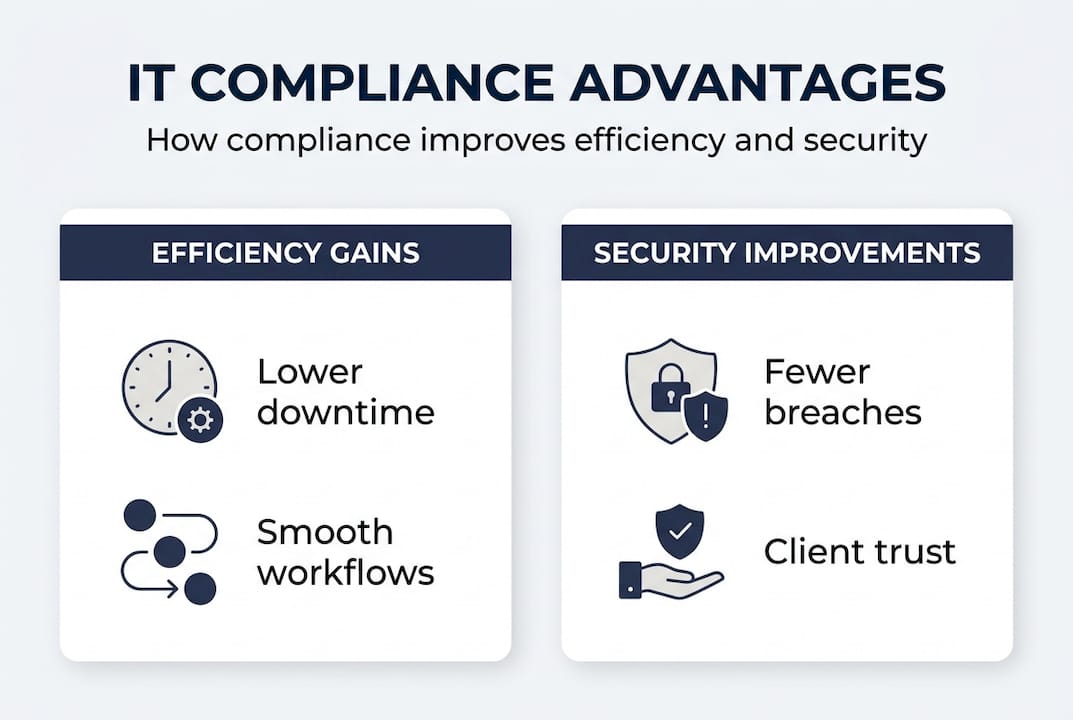
| Metric | Impact | Source Framework |
|---|---|---|
| Security incident reduction | 30-40% fewer incidents | Essential Eight + ISO 27001 |
| Successful attack prevention | 60% reduction in breaches | Comprehensive compliance programme |
| Issue resolution speed | 40% faster resolution | MSP-supported compliance |
| Operational downtime | 70% reduction | Proactive compliance approach |
| Return on investment | 429% over three years | Integrated compliance framework |
| Cyberattack prevention | 85% of common attacks blocked | Essential Eight implementation |
Continuous monitoring represents another major trend. Traditional annual audits create gaps where problems fester undetected for months. Modern compliance leverages automation to provide real-time visibility into your security posture. You spot configuration drift immediately, detect unauthorised changes as they happen, and maintain evidence of continuous compliance rather than point-in-time snapshots.
Queensland SMBs can leverage these trends for competitive advantage:
- Demonstrate continuous compliance to clients and partners rather than showing year-old audit reports
- Use AI-powered tools to achieve enterprise-grade security at SMB budgets through automation and efficiency
- Position security capabilities as business differentiators when competing for contracts in regulated industries
- Reduce cyber insurance premiums by providing evidence of robust, continuously monitored controls
- Attract and retain quality staff who prefer working for security-conscious organisations
The integration of AI into compliance strategy doesn’t replace human expertise. It amplifies it. AI handles repetitive monitoring and analysis, flagging issues that require human judgement. Your team focuses on strategic decisions, risk assessment, and business alignment rather than manual log reviews and checklist completion.
Regulatory expectations are rising too. Authorities increasingly expect organisations to demonstrate not just compliance at audit time, but continuous adherence to security standards. The Privacy Act obligations are expanding, and enforcement is becoming more rigorous. Proactive compliance positions you ahead of regulatory changes rather than scrambling to catch up when new requirements land.
For Queensland businesses, the IT compliance landscape is shifting from reactive obligation to proactive opportunity. Early adopters of comprehensive frameworks gain advantages that compound over time: stronger security posture, more efficient operations, better client relationships, and reduced risk exposure. The question isn’t whether to embrace these trends, but how quickly you can integrate them into your business strategy.
How IT Start can support your IT compliance journey
Navigating IT compliance doesn’t mean going it alone. IT Start delivers specialised cloud, cyber security, and IT support services designed specifically for Queensland SMBs facing the challenges we’ve discussed. Our partnership approach aligns with best practice frameworks like Essential Eight, helping you achieve meaningful protection without overwhelming your team or budget.
Our cloud services reduce infrastructure complexity while enhancing security through enterprise-grade controls managed by specialists. Cyber security solutions provide the layered defence that compliance frameworks require, from threat detection to incident response. Business IT support ensures your compliance posture remains current as threats evolve and your business grows.
We understand that Queensland businesses need practical solutions, not theoretical perfection. Our approach focuses on risk-based prioritisation, delivering maximum protection from available resources while building towards higher maturity levels progressively. The result? Enhanced operational efficiency, reduced downtime, and genuine security improvements that translate directly to business outcomes.
Frequently asked questions
What is the role of compliance in IT for Queensland businesses?
IT compliance ensures businesses safeguard sensitive data, meet legal obligations under the Privacy Act, and reduce cyber risks through structured frameworks. It creates layered protection by aligning executive governance, operational processes, and technical controls. Proper compliance transforms security from reactive cost into strategic advantage that enables business growth.
How does IT compliance improve operational efficiency?
Compliance integrates security controls into daily IT workflows, eliminating friction between protection and productivity. Organisations with proactive compliance see 40% faster issue resolution and 70% less downtime compared to reactive approaches. Embedded security enables smoother audits, reduces crisis management costs, and lets teams focus on business outcomes rather than firefighting.
What challenges do Queensland SMBs face with IT compliance?
Resource constraints limit access to specialist IT staff and security expertise. Legacy systems running outdated software create vulnerabilities that modern threats exploit easily. Missing executive engagement means compliance initiatives lack resources, authority, and strategic alignment needed to succeed. Hybrid work arrangements multiply attack surfaces as staff access systems from diverse locations and devices.
How can managed service providers help with IT compliance?
MSPs provide expert monitoring, rapid risk response, and specialist knowledge without requiring full-time hires. They deliver 24/7 threat detection that internal teams can’t match cost-effectively. MSP partnerships help organisations reach Essential Eight maturity levels through structured implementation and continuous improvement. Predictable monthly costs make budgeting simpler than managing variable internal IT expenses.