

Brisbane businesses face relentless cyber threats that can cripple operations overnight. A single breach can cost thousands in lost revenue, damage customer trust, and expose sensitive data to criminals. Yet many small to medium-sized enterprises lack a structured approach to identify vulnerabilities before attackers exploit them. This comprehensive guide walks you through a practical cybersecurity audit process tailored specifically for Brisbane SMEs, giving you the knowledge to protect your business systematically and confidently.
Table of Contents
- Key takeaways
- Preparing for your cybersecurity audit
- Step-by-step execution of a cybersecurity audit
- Identifying and addressing common cybersecurity audit challenges
- Verifying results and planning next steps
- Enhance your business cybersecurity with IT Start
- Frequently asked questions
Key Takeaways
| Point | Details |
|---|---|
| Structured SME audits | A formal, phased audit helps Brisbane businesses identify weaknesses before attackers exploit them. |
| Preparation and tools | Effective audits start with asset inventories, documented security policies, and the right analysers, scanners and checklists. |
| Stepwise audit process | The guide emphasises a stepwise process from asset inventory through vulnerability identification to verification. |
| Realistic timelines | Timelines depend on complexity, typically two to three weeks for simple setups and four to six weeks for larger or cloud heavy environments. |
| Pitfalls and verification | Regular verification checks align findings with organisational priorities and confirm controls function during peak periods. |
Preparing for your cybersecurity audit
Successful audits begin long before you scan a single system. Preparation is crucial to successful cybersecurity audits for Brisbane SMEs, setting the foundation for comprehensive vulnerability identification. Without proper groundwork, you risk missing critical security gaps that leave your business exposed.
Start by creating a complete inventory of your business assets. Document every device, application, database, and network component that stores or processes company data. Include employee workstations, mobile devices, cloud services, and third-party software platforms. This inventory becomes your audit roadmap, ensuring nothing escapes scrutiny during the assessment process.
Gather your existing security documentation before diving into technical assessments. Collect current security policies, access control lists, user permission records, incident response plans, and previous audit reports if available. Review your preparation steps for Brisbane SMEs to ensure you have covered all necessary documentation. These documents reveal your current security baseline and highlight areas requiring immediate attention.
Selecting appropriate audit tools depends on your business size and technical complexity. Essential tools include:
- Vulnerability scanners to identify system weaknesses
- Network analysers to monitor traffic patterns
- Compliance checklists aligned with industry standards
- Password strength testers to evaluate credential security
- Log analysis tools to review access histories
Assemble your audit team carefully, assigning clear roles and responsibilities. Designate a project lead to coordinate activities and maintain timeline accountability. Include IT staff who understand your systems intimately, plus representatives from departments handling sensitive data like finance, HR, and customer service. External perspectives from business leaders ensure audit findings align with organisational priorities.

| Team role | Primary responsibility | Required skills |
|---|---|---|
| Project lead | Coordinate audit activities and reporting | Project management, security knowledge |
| IT administrator | Technical system assessment | Network administration, system configuration |
| Department representative | Provide operational context | Business process understanding |
| Executive sponsor | Resource allocation and strategic oversight | Business leadership, risk assessment |
Pro Tip: Schedule your audit during a period of normal business operations rather than quiet times. This approach reveals how security measures perform under typical load conditions and exposes vulnerabilities that only emerge during peak activity.
Establish realistic timelines based on your business complexity. Small businesses with straightforward IT environments might complete audits in two to three weeks, while organisations with multiple locations or complex cloud integrations require four to six weeks. Build buffer time for unexpected discoveries that demand deeper investigation.
Step-by-step execution of a cybersecurity audit
With preparation complete, begin systematic audit execution following a structured audit process that reduces overlooked cyber risks in SMEs. This methodical approach ensures comprehensive coverage across all security domains.
-
Conduct network and system vulnerability scans across your entire infrastructure. Run automated scanning tools during off-peak hours to minimise business disruption while capturing comprehensive system data. Document every identified vulnerability with severity ratings and potential business impact.
-
Review access controls and user permissions meticulously. Verify that employees have appropriate access levels matching their job requirements, nothing more. Check for orphaned accounts from departed staff, shared credentials that bypass accountability, and administrative privileges granted unnecessarily.
-
Evaluate your incident response policies and procedures. Test whether your team knows how to respond when breaches occur. Review communication protocols, escalation paths, and recovery procedures. Simulate a minor security incident to observe real-world response effectiveness.
-
Interview key personnel about daily security practices. Speak with employees across departments to understand how they handle passwords, recognise phishing attempts, and report suspicious activity. These conversations reveal gaps between written policies and actual behaviour.
-
Document findings comprehensively throughout the audit process. Create detailed records of every vulnerability, policy weakness, and procedural gap discovered. Include screenshots, log excerpts, and specific examples that support your conclusions.
Your audit checklist for Brisbane firms should cover these critical security domains:
- Network security: Firewall configurations, intrusion detection systems, network segmentation
- Endpoint protection: Antivirus software, patch management, device encryption
- Data security: Backup procedures, encryption standards, data classification
- Access management: Authentication methods, password policies, multi-factor authentication
- Physical security: Server room access, device disposal procedures, visitor protocols
Pro Tip: Take photographs of physical security measures during facility walkthroughs. Visual documentation of unlocked server rooms, unsecured workstations, or visible passwords provides powerful evidence when presenting findings to leadership.
Pay special attention to cloud service configurations during your audit. Many Brisbane SMEs now rely heavily on cloud platforms for critical business functions, yet misconfigured cloud settings create significant vulnerabilities. Verify that cloud storage permissions prevent public access, encryption protects data in transit and at rest, and authentication requirements meet security standards.
| Audit area | Key checks | Common findings |
|---|---|---|
| User accounts | Active accounts, permission levels, password age | Orphaned accounts, excessive privileges |
| Software updates | Patch status, update schedules, legacy systems | Outdated applications, missing security patches |
| Data backups | Backup frequency, restoration testing, offsite storage | Untested backups, insufficient frequency |
| Email security | Spam filtering, phishing protection, attachment scanning | Weak filtering, inadequate user training |
Review your findings against established cybersecurity best practices for Brisbane SMBs to identify gaps between current state and recommended standards. This comparison provides clear direction for remediation priorities.
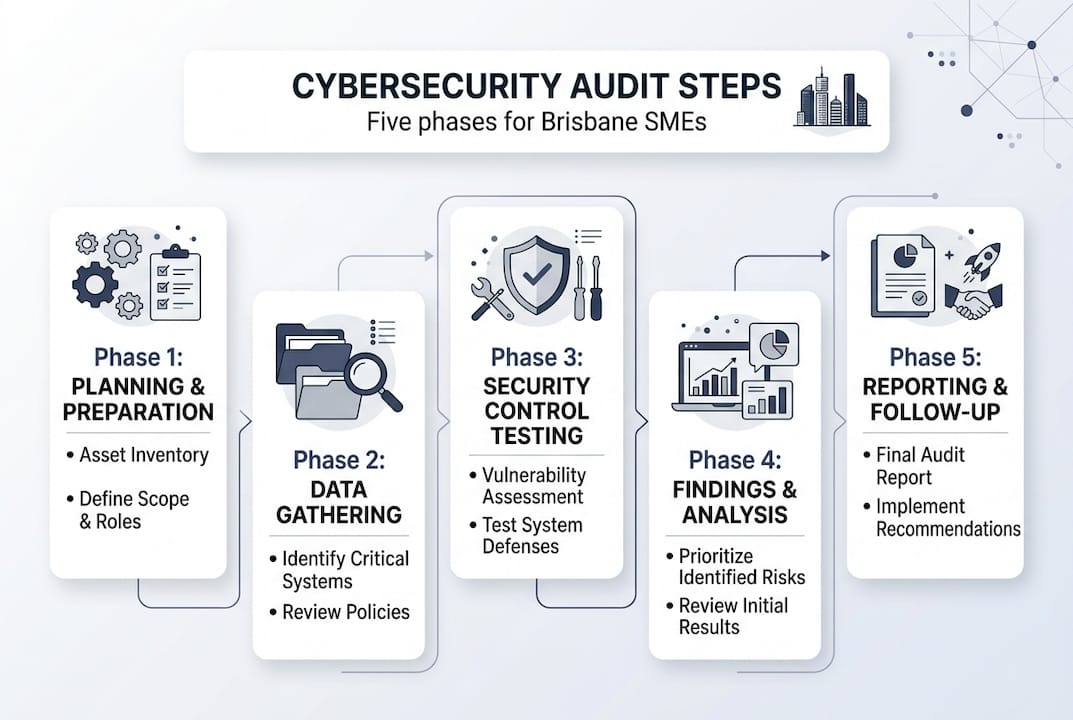
Test security controls actively rather than relying solely on configuration reviews. Attempt to access restricted resources using standard user credentials, send test phishing emails to evaluate employee awareness, and verify that backup restoration actually works. Active testing reveals whether security measures function effectively under real conditions.
Identifying and addressing common cybersecurity audit challenges
Even well-planned audits encounter obstacles that can compromise results if not addressed proactively. Common mistakes during cybersecurity audits can compromise results and leave risks unaddressed, undermining the entire assessment effort.
Outdated software and legacy systems present persistent challenges for Brisbane SMEs. Many businesses continue running older applications because they integrate with critical business processes, yet these systems often contain unpatched vulnerabilities that attackers exploit readily. Document all legacy systems during audits, noting specific versions, known vulnerabilities, and business justification for continued use. This documentation supports informed risk decisions about whether to upgrade, isolate, or replace problematic systems.
Inadequate documentation undermines audit value significantly. Rushing through findings without detailed records creates vague recommendations that teams struggle to implement effectively. Avoid these documentation pitfalls:
- Vague descriptions lacking specific system names or locations
- Missing severity ratings that prevent proper prioritisation
- Absent remediation guidance leaving teams uncertain about next steps
- Incomplete evidence that fails to justify recommended changes
Human factors complicate audits more than technical issues in many cases. Employees often view security measures as obstacles to productivity rather than essential protections. During audits, you might discover widespread password sharing, disabled security software, or ignored security warnings. Address these behavioural issues through your audit recommendations, emphasising training and awareness programmes alongside technical controls.
Security audits reveal not just technical vulnerabilities but cultural weaknesses that enable breaches. The most sophisticated security tools fail when employees bypass them for convenience.
Pro Tip: When interviewing staff about security practices, frame questions neutrally to encourage honest responses. Asking “How do you typically handle password resets?” yields more truthful answers than “Do you follow our password policy?” which prompts defensive responses.
Scope creep derails audit timelines and exhausts resources quickly. As you uncover issues, the temptation to investigate every tangent grows strong. Maintain focus on your original audit scope while noting additional concerns for future assessment. Create a separate list of out-of-scope items that warrant attention but should not delay current audit completion.
Resource constraints force difficult trade-offs during audits. Small businesses rarely have dedicated security staff, requiring existing IT personnel to juggle audit responsibilities alongside daily support tasks. Plan audit activities around operational demands, breaking complex assessments into manageable chunks that fit within available time windows.
Resistance from leadership can stall audit progress when business owners perceive security investments as unnecessary expenses. Combat this resistance by quantifying risks in business terms rather than technical jargon. Translate vulnerabilities into potential financial losses, regulatory penalties, and reputational damage that resonate with business priorities.
Third-party dependencies complicate audit scope boundaries. Your business likely relies on external vendors for cloud hosting, payment processing, or specialised software. While you cannot audit vendor systems directly, evaluate how your organisation manages these relationships. Review vendor security certifications, data processing agreements, and incident notification procedures to improve cyber security strategies across your entire business ecosystem.
Verifying results and planning next steps
Audit completion marks the beginning of real security improvement, not the end. Verification and follow-up after audits are critical to strengthening business cybersecurity posture and ensuring audit investments deliver lasting value.
Evaluate audit findings systematically using a consistent risk rating framework. Assign each discovered vulnerability a severity level based on likelihood of exploitation and potential business impact. Critical vulnerabilities that expose customer data or enable system compromise demand immediate attention, while lower-severity issues can follow planned remediation schedules.
Prepare a clear, actionable report for business leaders that translates technical findings into business language. Executive stakeholders need to understand security risks without wading through technical details. Structure your report around these key elements:
- Executive summary highlighting critical risks and recommended investments
- Detailed findings organised by severity with specific remediation steps
- Risk assessment explaining potential business consequences of inaction
- Implementation roadmap with realistic timelines and resource requirements
- Compliance status addressing regulatory obligations and industry standards
Prioritise remediation tasks using a risk-based approach that addresses the most dangerous vulnerabilities first. Create a phased implementation plan that balances security improvements against operational constraints and budget realities. Quick wins that close significant security gaps with minimal effort should take priority over complex projects requiring extensive resources.
-
Address critical vulnerabilities within 30 days, implementing temporary mitigations if permanent fixes require longer timeframes.
-
Resolve high-severity issues within 90 days through planned remediation projects with assigned ownership and milestones.
-
Schedule medium-severity improvements within six months as part of regular IT maintenance and upgrade cycles.
-
Document low-severity findings for future consideration, revisiting during annual planning processes.
Establish regular audit schedules that maintain security posture over time. Annual comprehensive audits provide thorough assessments, while quarterly focused reviews target high-risk areas or recent changes. Schedule additional audits after major IT changes like cloud migrations, system upgrades, or business acquisitions that alter your risk landscape.
Develop ongoing training programmes that address behavioural issues identified during audits. Security awareness training should be engaging and relevant rather than generic compliance exercises. Use real examples from your audit findings to illustrate risks in familiar business contexts. Regular phishing simulations reinforce training lessons and identify employees requiring additional support.
- Monthly security awareness tips addressing common threats
- Quarterly interactive training sessions on evolving attack methods
- Annual comprehensive security training covering policies and procedures
- Immediate targeted training following security incidents or near-misses
Monitor remediation progress actively rather than assuming tasks complete on schedule. Assign clear ownership for each remediation item with specific deadlines and accountability measures. Conduct follow-up verification testing to confirm that implemented fixes actually resolve identified vulnerabilities without creating new problems.
Integrate audit findings into your broader business continuity and cyber security planning. Security improvements should align with business objectives, supporting operational resilience and competitive advantage. Position cybersecurity as an enabler of business growth rather than purely a cost centre.
Track security metrics over time to measure improvement and justify ongoing investments. Monitor indicators like vulnerability closure rates, incident response times, employee training completion, and security tool effectiveness. These metrics demonstrate security programme maturity to stakeholders and highlight areas requiring additional attention.
Enhance your business cybersecurity with IT Start
Conducting thorough cybersecurity audits requires expertise, time, and specialised tools that many Brisbane SMEs struggle to maintain internally. IT Start delivers professional cyber security services designed specifically for small to medium-sized businesses facing complex security challenges. Our experienced team helps implement audit recommendations systematically, transforming findings into actionable security improvements that protect your business effectively.
Beyond audit support, our comprehensive business it support solutions provide ongoing security monitoring and proactive threat management. We become your trusted technology partner, handling security complexities while you focus on core business activities. Our cloud services for businesses deliver scalable, secure infrastructure that complements your security strategy with enterprise-grade protections.
Frequently asked questions
What is a cybersecurity audit and why is it important?
A cybersecurity audit systematically reviews your business’s IT security measures to identify vulnerabilities before attackers exploit them. It examines technical controls, policies, procedures, and employee practices to reveal security gaps. For Brisbane SMEs, audits are vital for protecting sensitive customer data, maintaining business continuity, and preserving the trust that underpins customer relationships.
How often should Brisbane SMEs conduct a cybersecurity audit?
Security experts recommend comprehensive audits at least annually, with more frequent targeted assessments after major IT changes, security incidents, or regulatory updates. Quarterly reviews of high-risk areas like access controls and vulnerability management help maintain security between full audits. Businesses handling sensitive data or operating in regulated industries should consider semi-annual comprehensive audits.
What tools do I need to perform a cybersecurity audit?
Essential audit tools include vulnerability scanners to identify system weaknesses, network analysers to monitor traffic patterns, and compliance checklists aligned with industry standards. Password strength testers, log analysis platforms, and penetration testing tools provide deeper insights. Tool selection depends on your business size, technical complexity, and specific compliance requirements. Many effective tools offer free versions suitable for small business audits.
Can I do a cybersecurity audit myself or should I hire professionals?
Small businesses with straightforward IT environments can perform basic audits using structured guidelines and readily available tools. However, complex networks, cloud integrations, or compliance requirements benefit significantly from professional audit services. Professional auditors bring specialised expertise, advanced tools, and objective perspectives that internal teams often lack. Consider hybrid approaches where internal staff handle routine assessments while professionals conduct annual comprehensive audits.