

Cyber attacks cost australian businesses more than $33 billion every year, putting sensitive patient data at risk across Brisbane’s healthcare sector. With new digital regulations and compliance requirements, protecting your organisation goes far beyond basic antivirus software. This guide unpacks five critical steps tailored for your SME, helping you effectively assess vulnerabilities, strengthen defences, and foster staff accountability while meeting national cybersecurity standards.
Table of Contents
- Step 1: Assess Current Security Risks and Compliance Needs
- Step 2: Implement Layered Protection Using Advanced Tools
- Step 3: Train Staff on Cyber Security Best Practices
- Step 4: Monitor Systems Continuously for Suspicious Activity
- Step 5: Verify Controls and Review Incident Response Plans
Contents: 5 Critical Cybersecurity Steps for Brisbane SMEs
| Key Point | Explanation |
|---|---|
| 1. Assess Cybersecurity Risks | Conduct a detailed security risk assessment to identify vulnerabilities and compliance gaps in your organisation. |
| 2. Implement Layered Protection | Use advanced security tools like firewalls and multi-factor authentication to create multiple defensive layers. |
| 3. Train Staff on Best Practices | Provide ongoing cybersecurity training to help employees become proactive defenders of your digital assets. |
| 4. Monitor Systems Continuously | Establish real-time monitoring with alerts for unusual activity to promptly detect potential security incidents. |
| 5. Regularly Review Incident Plans | Regularly validate and update incident response plans by conducting simulated exercises and assessments. |
Step 1: Assess Current Security Risks and Compliance Needs
Effectively assessing cybersecurity risks starts with understanding your Brisbane SME’s unique vulnerabilities. The process requires a comprehensive examination of your current technology infrastructure, human factors, and potential compliance gaps.
Begin by conducting a thorough security risk assessment following the Australian Cyber Security Centre guidelines. This involves systematically mapping your digital assets, identifying potential entry points for cyber threats, and evaluating how well your current systems align with national cybersecurity standards. Specifically, focus on examining your network configurations, access controls, data storage practices, and employee technology usage patterns.
Your assessment should include reviewing existing security policies, conducting vulnerability scans, and performing a gap analysis against Queensland Government Information and Cyber Security standards. Prioritise identifying weaknesses in your technology systems, employee training protocols, and data management processes. Pay special attention to areas like user access management, password policies, software update practices, and incident response capabilities.
Hot Tip: Document every vulnerability you discover and rank them by potential business impact to create a strategic remediation roadmap.
Step 2: Implement Layered Protection Using Advanced Tools
Protecting your Brisbane SME requires a strategic and comprehensive approach to cybersecurity that goes beyond simple point solutions. Implementing a robust layered protection strategy means creating multiple defensive barriers that work together to prevent, detect, and respond to potential cyber threats.
Start by adopting multi-layered security controls recommended by the Australian Cyber Security Centre. This involves integrating advanced tools such as next-generation firewalls, endpoint protection platforms, intrusion detection systems, and multi-factor authentication mechanisms. Each layer should address different potential vulnerability points within your technology ecosystem, ensuring that even if one defensive mechanism fails, others remain active to prevent potential breaches.
Your layered protection strategy should combine technical controls with human processes. This means not only deploying sophisticated security tools but also implementing comprehensive user access management, regular security awareness training, and well-defined incident response protocols. Focus on creating overlapping security measures that provide comprehensive protection across your network, cloud services, employee devices, and critical data infrastructure.
Here’s a summary of major cyber security layers and their business benefits:
| Protection Layer | Example Tool | Key Business Benefit |
|---|---|---|
| Network Security | Next-gen firewall | Blocks unauthorised access |
| Endpoint Protection | Antivirus software | Prevents device-based threats |
| Identity Management | Multi-factor authentication | Reduces risk from stolen logins |
| Threat Detection & Response | SIEM system | Enables rapid incident response |
| Staff Training | Security awareness programme | Minimises human error risk |
Hot Tip: Regularly test and update your layered security approach to ensure it remains effective against emerging cyber threats.
Step 3: Train Staff on Cyber Security Best Practices
Building a strong cyber security culture within your Brisbane SME starts with comprehensive staff training. Educating your team is crucial to transforming employees from potential security vulnerabilities into active defenders of your organisation’s digital assets.

Begin by implementing comprehensive security awareness training that covers critical topics such as identifying phishing attempts, understanding social engineering tactics, and maintaining proper data handling protocols. Your training program should include practical workshops, interactive simulations, and real world scenarios specific to your industry. Focus on teaching staff to recognise suspicious email patterns, understand the importance of strong password management, and develop a proactive approach to reporting potential security incidents.
Ensure your training is ongoing and adaptive. This means regularly updating your educational materials to reflect the latest cyber threats, conducting periodic assessment tests, and creating a supportive environment where employees feel comfortable asking questions about cyber security. Develop clear, accessible guidelines that outline expected behaviours, provide easy to understand reference materials, and establish a reporting mechanism for potential security concerns.
Use this comparison to help choose staff cyber security training approaches:
| Approach | Typical Method | Best For | Limitation |
|---|---|---|---|
| Workshops | Instructor-led in person | Practical skills, engagement | Time intensive, higher cost |
| Online Modules | Self-paced e-learning | Flexible, scalable | Less interactive |
| Gamification | Points & rewards | Motivation, retention | Setup complexity |
Hot Tip: Consider gamifying your cyber security training to increase staff engagement and knowledge retention.
Step 4: Monitor Systems Continuously for Suspicious Activity
Continuous system monitoring is your organisation’s digital early warning system against potential cyber threats. By implementing robust monitoring strategies, your Brisbane SME can detect and respond to security incidents before they escalate into significant breaches.
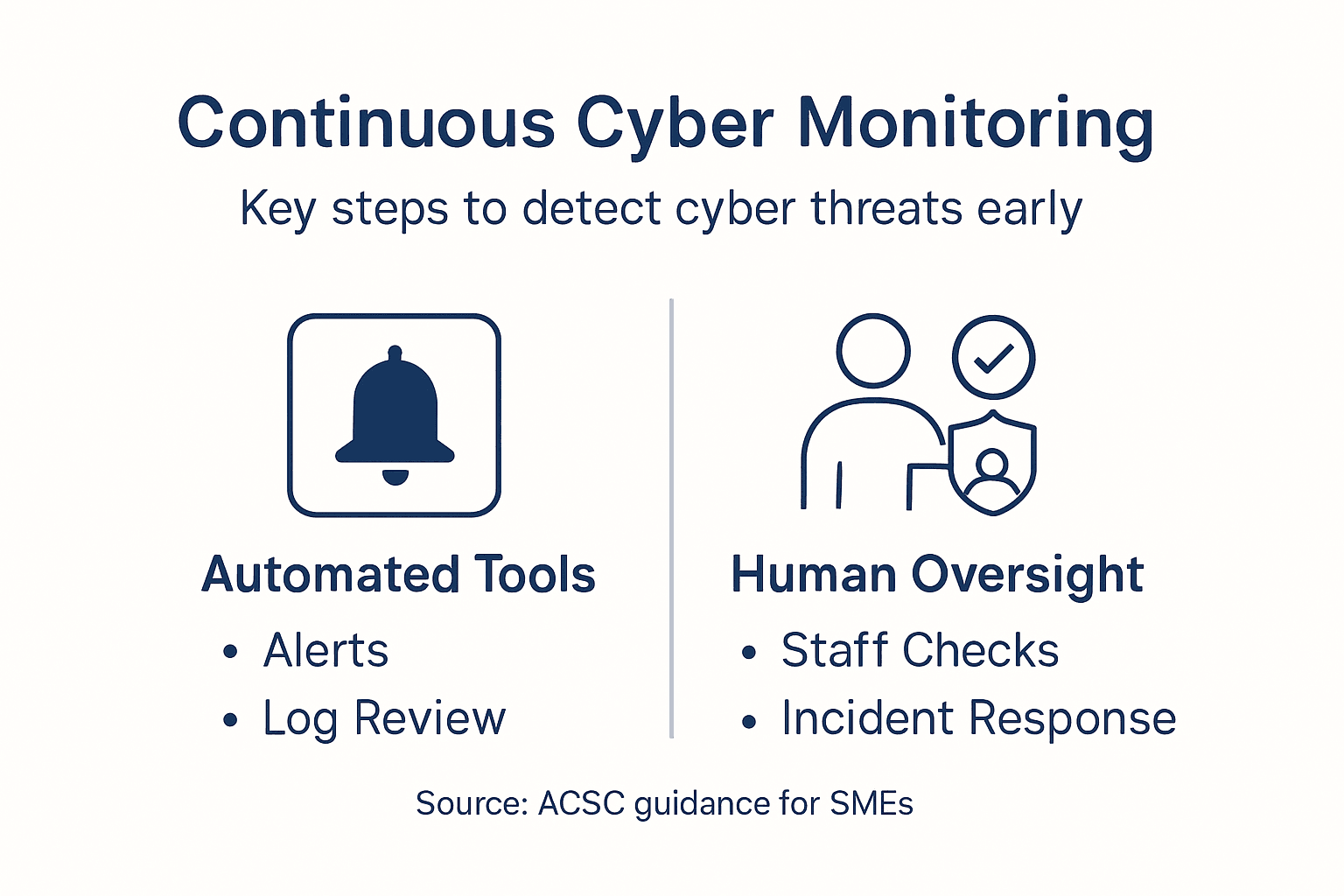
Implement comprehensive cyber incident monitoring that combines automated tools with strategic human oversight. This involves deploying advanced security information and event management (SIEM) systems that track network traffic, user activities, and system logs in real time. Configure your monitoring tools to generate immediate alerts for unusual patterns such as multiple failed login attempts, unexpected data transfers, or access from unfamiliar geographic locations. Ensure these systems integrate seamlessly across your entire digital infrastructure including servers, cloud services, employee devices, and network endpoints.
Establish clear incident response protocols that define exactly how your team will investigate and address potential security events. This means creating a step by step playbook that outlines communication channels, escalation procedures, and specific actions for different threat scenarios. Train designated staff members to understand these protocols and conduct regular simulated incident response exercises to keep skills sharp and identify potential gaps in your monitoring approach.
Hot Tip: Schedule monthly review sessions to analyse monitoring logs and refine your detection strategies.
Step 5: Verify Controls and Review Incident Response Plans
Regular validation of your cybersecurity controls is critical to ensuring your Brisbane SME remains resilient against evolving digital threats. This verification process goes beyond theoretical planning and demands practical testing and continuous improvement of your security mechanisms.
Conduct systematic security control assessments that comprehensively evaluate the effectiveness of your existing security measures. This involves performing detailed penetration testing, vulnerability scans, and simulated cyber incident exercises that challenge your current defensive strategies. Focus on identifying potential weaknesses across your technology infrastructure, examining how different security controls interact, and determining potential blind spots in your current approach.
Develop a structured review process for your incident response plans that includes regular tabletop simulations and scenario based training. Engage key staff members in these exercises to ensure everyone understands their specific roles and responsibilities during a potential cyber incident. Create documentation that clearly outlines step by step response protocols, communication channels, and escalation procedures. Update these plans quarterly to reflect emerging threat landscapes and incorporate lessons learned from recent security assessments.
Hot Tip: Document and analyse the outcomes of each security assessment to track your organisation’s ongoing security maturity.
Strengthen Your Brisbane SME Cyber Security with IT Start
Improving cyber security for Brisbane SMEs is not just about technology it is about building a resilient defence that protects your business from evolving threats while ensuring regulatory compliance. This article highlights critical steps like assessing security risks implementing layered protection training staff and continuously monitoring your systems — all essential to safeguarding your digital assets and maintaining operational confidence.
At IT Start we understand these pain points and challenges deeply Our expert team specialises in delivering managed IT support cloud solutions and tailored cybersecurity services that align perfectly with your business needs. We help you implement robust multi-layered defences reduce human error through engaging staff training and provide proactive system monitoring so you can detect and respond rapidly to threats. Start strengthening your cyber resilience by getting a free cybersecurity assessment today and discover how our Brisbane-based experts can transform your security posture with practical actionable solutions.
Take control of your SME’s cybersecurity now by contacting IT Start for a personalised consultation. Don’t wait until vulnerabilities become breaches ensure your business is protected by trusted local professionals committed to your success. Reach out to us via our contact page and make cybersecurity a competitive advantage.
Frequently Asked Questions
How can I identify my SME’s cybersecurity risks?
Start by conducting a thorough security risk assessment to pinpoint vulnerabilities. Evaluate your technology infrastructure, employee practices, and compliance gaps, and prioritise identifying weaknesses for remediation.
What layered protection should my SME implement?
Implement a multi-layered security strategy that includes various defensive mechanisms. For example, use next-generation firewalls and multi-factor authentication to create multiple barriers against cyber threats.
What topics should I include in staff cybersecurity training?
Focus on critical areas such as identifying phishing attempts, password management, and reporting suspicious activities. Regularly update training materials to reflect current cyber threats and ensure your staff understands their role in cybersecurity.
How can I monitor my SME’s systems for suspicious activity?
Deploy comprehensive monitoring tools that track network and user activity in real time. Set up alerts for unusual patterns and integrate these systems across your digital infrastructure to catch potential threats early.
How often should I review my cybersecurity incident response plan?
Regularly review your incident response plan at least quarterly. Conduct tabletop simulations and update response protocols based on recent assessments to ensure your plan remains relevant and effective against emerging threats.
What actions should I take to validate my cybersecurity controls?
Conduct systematic security control assessments and penetration testing to evaluate your measures’ effectiveness. Aim to identify weaknesses and improve on them, documenting outcomes to track your security maturity over time.