

Cyber threats grow more sophisticated every year, leaving many Brisbane financial services firms searching for effective ways to protect sensitive client data. For IT managers, ensuring robust defences and keeping pace with Australian regulatory demands has become a daily challenge. A well-executed cyber security audit offers a systematic path to uncover weaknesses, strengthen resilience, and achieve true compliance—helping your business stay ahead of evolving digital risks.
Table of Contents
- What Is A Cyber Security Audit?
- Audit Types For Financial Services Firms
- Australian Laws And SMB 1001 Requirements
- How A Cyber Security Audit Works
- Risk Management And Common Pitfalls
- Building Ongoing Security And Compliance
Cyber Security Audit Guide: Key Topics & Sections
| Point | Details |
|---|---|
| Cyber Security Audits are Essential | Conduct regular cyber security audits to identify vulnerabilities and enhance your organisation’s digital defences. |
| Different Audit Types Serve Unique Purposes | Employ various audit types, such as vulnerability assessments and penetration testing, to create a comprehensive security strategy. |
| Compliance with Australian Regulations is Crucial | Stay informed about national laws like the Privacy Act 1988 to ensure your organisation meets regulatory requirements. |
| Proactive Risk Management is Key | Adopt a holistic risk management approach that includes regular training and continuous monitoring to mitigate potential threats. |
What Is a Cyber Security Audit?
A cyber security audit is a systematic examination of an organisation’s information technology infrastructure designed to assess and strengthen digital defences. This comprehensive process involves methodically reviewing security controls to protect sensitive data and systems from potential cyber threats.
At its core, a cyber security audit evaluates multiple dimensions of an organisation’s digital ecosystem. This includes assessing hardware configurations, software applications, network infrastructure, data management protocols, and human interaction points. Auditors conduct detailed analyses to identify vulnerabilities, measure compliance with regulatory standards, and recommend strategic improvements for robust cyber protection.
The audit process typically involves several key stages. First, auditors conduct preliminary assessments to understand the organisation’s existing security landscape. They then develop a structured review of system records and activities to uncover potential weaknesses. This might include examining access controls, reviewing security policies, testing network defences, and evaluating employee cybersecurity awareness and practices.
Pro tip: Schedule regular cyber security audits at least annually to stay ahead of emerging digital threats and maintain a proactive security posture.
Audit Types for Financial Services Firms
Financial services firms in Brisbane must deploy multiple specialised cyber security audit types to comprehensively protect their digital infrastructure. Cyber risk landscapes demand strategic audit approaches that address the complex challenges of modern technological environments.
The primary audit types include:
- Vulnerability Assessment: A systematic evaluation of potential security weaknesses across network infrastructure, software applications, and hardware systems
- Penetration Testing: Simulated cyber attacks designed to identify and exploit potential security gaps before malicious actors can do so
- Compliance Review: Detailed examination of existing security protocols to ensure alignment with industry regulations like Australian Signals Directorate (ASD) guidelines
- Incident Response Audit: Analysis of an organisation’s preparedness and reaction mechanisms for potential cyber security breaches
Each audit type serves a unique purpose in creating a multi-layered defence strategy. Vulnerability assessments provide a comprehensive map of potential risks, while penetration testing validates the effectiveness of existing security measures. Compliance reviews ensure regulatory adherence, and incident response audits confirm an organisation’s readiness to manage and mitigate potential security threats.

The following table compares the main cyber security audit types deployed by financial services firms in Brisbane and highlights their distinct business impacts:
| Audit Type | Primary Focus | Sample Business Impact | Frequency Recommended |
|---|---|---|---|
| Vulnerability Assessment | System-wide risk identification | Reveals IT weaknesses before exploitation | Quarterly |
| Penetration Testing | Simulate real-world attacks | Validates existing defences, uncovers gaps | Annually |
| Compliance Review | Regulation and standards | Ensures legal conformity, reduces fines | Annually |
| Incident Response Audit | Breach response readiness | Minimises disruption from security incidents | Biannually |
Pro tip: Rotate between different audit types throughout the year to maintain a dynamic and comprehensive cyber security approach.
Australian Laws and SMB 1001 Requirements
Navigating the complex landscape of cyber security regulations is crucial for Brisbane financial firms. SMB 1001 certification provides a comprehensive framework for understanding and implementing robust cyber security protocols in the Australian business environment.
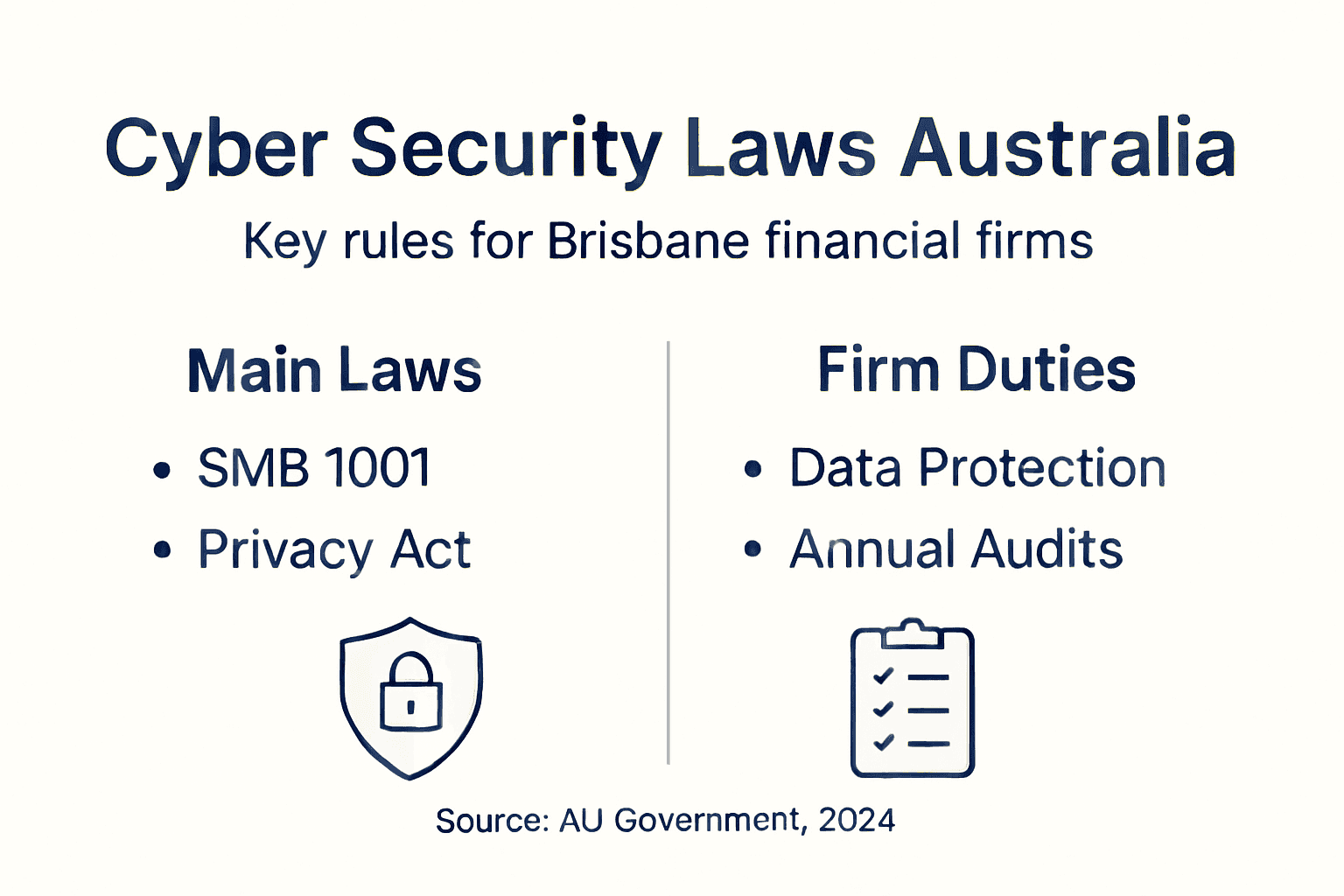
The Australian cyber security legal landscape is governed by several key regulations that financial services firms must adhere to. These include the Privacy Act 1988, which mandates strict data protection standards, and the Notifiable Data Breaches (NDB) scheme, requiring organisations to report significant cyber security incidents. The Australian Securities and Investments Commission (ASIC) also provides specific guidelines for financial institutions regarding digital security and risk management.
SMB 1001 certification represents a critical standard for small and medium businesses seeking to demonstrate their commitment to cyber security best practices. This certification involves a comprehensive assessment of an organisation’s security infrastructure, including:
- Risk management processes
- Information security controls
- Incident response capabilities
- Data protection mechanisms
- Compliance with national security standards
Financial firms in Brisbane must not only understand these requirements but actively implement them to protect sensitive financial data and maintain client trust. The certification process helps organisations identify vulnerabilities, strengthen their digital defences, and demonstrate a proactive approach to cyber security management.
To assist firms with regulatory adherence, here’s a summary of key Australian cyber security laws and SMB 1001 requirements for financial services:
| Regulatory Requirement | Applies to | Business Importance | SMB 1001 Alignment |
|---|---|---|---|
| Privacy Act 1988 | All organisations | Protects client data | Mandatory data controls |
| Notifiable Data Breaches | Financial firms | Enforces breach reporting | Incident response protocols |
| ASIC Cyber Guidelines | Financial services | Guides risk management | Ongoing compliance review |
Pro tip: Engage a certified cyber security professional to guide your SMB 1001 certification process and ensure comprehensive compliance with Australian regulations.
How a Cyber Security Audit Works
A comprehensive cyber security audit follows a systematic approach designed to thoroughly evaluate an organisation’s digital defence mechanisms. Auditors assess cyber risk impacts through a structured methodology that examines every critical aspect of an organisation’s information security infrastructure.
The audit process typically unfolds across several key stages:
-
Scoping and Planning
- Define audit objectives
- Identify systems and assets to be examined
- Establish assessment boundaries
- Determine specific compliance requirements
-
Risk Assessment
- Identify potential vulnerabilities
- Evaluate existing security controls
- Analyse potential threat landscapes
- Prioritise risk areas specific to financial services
-
Evidence Gathering
- Conduct document reviews
- Perform technical testing
- Interview key personnel
- Analyse system configurations
- Review access management protocols
-
Detailed Analysis
- Correlate gathered evidence
- Assess control effectiveness
- Identify security gaps
- Develop comprehensive risk recommendations
Financial firms must understand that a cyber security audit is not a one-time event but a continuous process of improvement. The goal is to create a proactive security posture that adapts to evolving digital threats and protects sensitive financial information from potential breaches.
Pro tip: Treat your cyber security audit as a strategic investment, not just a compliance requirement, by using insights to continuously enhance your organisation’s digital resilience.
Risk Management and Common Pitfalls
Effective cyber security risk management requires a strategic and comprehensive approach for Brisbane financial firms. Managing evolving cybersecurity threats demands constant vigilance and proactive planning to protect sensitive financial data and maintain organisational resilience.
Financial institutions commonly encounter several critical risk management pitfalls that can compromise their digital security:
- Underestimating Threat Complexity: Assuming current security measures are sufficient
- Inadequate Cyber Hygiene: Neglecting routine security updates and patches
- Insufficient Staff Training: Failing to educate employees about potential security risks
- Poor Incident Response Planning: Lacking a coordinated approach to potential breaches
- Regulatory Non-Compliance: Overlooking emerging cybersecurity regulations
Successful risk management requires a holistic approach that integrates technological solutions with human expertise. This involves developing a robust cybersecurity framework that continuously adapts to emerging threats, leverages advanced monitoring tools, and creates a culture of security awareness within the organisation. Financial firms must move beyond reactive strategies and embrace proactive risk mitigation techniques that anticipate and neutralise potential security vulnerabilities.
A comprehensive risk management strategy should include regular vulnerability assessments, ongoing staff training, real-time threat monitoring, and agile incident response protocols. By adopting a multi-layered defence approach, Brisbane financial firms can significantly reduce their exposure to potential cyber threats and protect their critical financial infrastructure.
Pro tip: Implement a quarterly comprehensive review of your cybersecurity risk management strategy to ensure continuous improvement and adaptability.
Building Ongoing Security and Compliance
Cybersecurity for Brisbane financial firms requires a dynamic, proactive approach that extends far beyond initial audit processes. Financial regulators promote collaborative cyber resilience through strategic frameworks designed to continuously adapt and respond to emerging digital threats.
Successful ongoing security and compliance strategies incorporate several critical components:
- Continuous Monitoring: Implementing real-time threat detection systems
- Regular Risk Assessments: Conducting periodic comprehensive security evaluations
- Adaptive Training Programs: Developing evolving cybersecurity awareness initiatives
- Incident Response Planning: Maintaining robust, flexible breach management protocols
- Regulatory Alignment: Staying current with changing Australian cybersecurity regulations
Financial organisations must develop a holistic approach that integrates technological solutions with human expertise. This means creating a security culture that views compliance as a dynamic, ongoing process rather than a static checklist. By fostering collaboration between IT teams, management, and external regulatory bodies, firms can build a more resilient and responsive cybersecurity infrastructure.
Key strategies include establishing clear communication channels, investing in advanced threat intelligence platforms, and developing agile response mechanisms that can quickly adapt to new vulnerabilities. Brisbane financial firms should prioritise creating a proactive security ecosystem that anticipates potential risks and develops sophisticated mitigation strategies.
Pro tip: Implement a monthly interdepartmental cybersecurity review to ensure continuous alignment between technological capabilities and organisational risk management objectives.
Strengthen Your Brisbane Financial Firm With Proactive Cyber Security Support
The challenge of maintaining robust cyber security in Brisbane’s financial sector cannot be overstated. As the article highlights, managing complex regulatory requirements like SMB 1001 certification and navigating evolving cyber threats demand continuous vigilance and expert risk management. At IT Start, we understand the urgency of protecting your sensitive financial data through thorough cyber security audits, compliance alignment, and ongoing monitoring.
Our tailored IT services focus on bridging the gaps commonly seen in audit processes such as vulnerability assessments, penetration testing, and incident response readiness. With local Brisbane expertise and a commitment to transparency, we act as your strategic partner to transform cybersecurity from a costly obligation into a clear business advantage. Don’t wait for a security breach to disrupt your operations or damage client trust.
Secure your firm today by scheduling a free cyber security consultation with our certified professionals. Explore how our managed IT support and cybersecurity solutions align with Australian standards and can be customised for your needs. Visit Contact Us now to take the next crucial step towards resilient cyber defence. Learn more about our Cybersecurity Services and let IT Start help you build confidence and compliance in your digital infrastructure.
Frequently Asked Questions
What is a cyber security audit?
A cyber security audit is a systematic examination of an organisation’s IT infrastructure to assess and improve digital defences against cyber threats. It involves reviewing security controls, identifying vulnerabilities, and ensuring compliance with regulatory standards.
What are the different types of cyber security audits?
The primary types of cyber security audits include vulnerability assessments, penetration testing, compliance reviews, and incident response audits. Each type focuses on different aspects of security and serves a unique purpose in protecting an organisation’s digital assets.
How often should financial firms conduct cyber security audits?
Financial firms should conduct cyber security audits at least annually. Additionally, they are encouraged to perform specific audits, such as vulnerability assessments, quarterly to stay ahead of emerging threats.
What are the key regulations that financial services firms need to comply with?
Financial services firms must adhere to several key regulations including the Privacy Act 1988, the Notifiable Data Breaches scheme, and the Australian Securities and Investments Commission (ASIC) Cyber Guidelines. Compliance with these regulations is crucial for protecting sensitive data and maintaining client trust.
Recommended
- Cyber Security Explained – Safeguarding Brisbane Legal Firms – IT Start
- How to Improve Cyber Security for Brisbane SMEs Easily – IT Start
- What Cyber Security Protects for Brisbane Businesses – IT Start
- Understanding Information Technology Security Audit: A Guide – IT Start
- Save Your Company from Suspicious Email with Proven Steps | NineArchs