

Cyber attacks on australian legal firms surged by over 30 percent last year, putting confidential client data at serious risk. For IT managers and business owners in Brisbane, this reality underscores just how attractive law firms are to cybercriminals searching for high-value information. This article breaks down practical steps and critical strategies australian legal practices need to reduce their exposure and defend sensitive client materials against ever-evolving digital threats.
Table of Contents
- What Cyber Security Means For Legal Firms
- Types Of Cyber Threats Facing Brisbane Law Firms
- How Cyber Attacks Happen: A Real-World Example
- Steps Legal Firms Can Take To Stay Safe
- Regulatory And Insurance Requirements In Queensland
- Risks Of Non-Compliance And Common Pitfalls
Key Cybersecurity Topics for Brisbane Legal Firms
| Point | Details |
|---|---|
| Importance of Cyber Security | Legal firms must adopt a holistic cyber security management approach to safeguard sensitive client information and maintain compliance with regulations. |
| Vulnerabilities to Cyber Threats | Brisbane law firms face specific threats such as phishing, ransomware, and data breaches, requiring ongoing vigilance and proactive measures. |
| Regulatory Compliance | Compliance with Queensland’s Information Security Policy and mandatory data breach notifications is critical to avoid significant penalties and reputational damage. |
| Ongoing Training and Assessment | Regular staff training and cybersecurity audits are essential to mitigate human error and adapt to evolving cyber threats effectively. |
What Cyber Security Means For Legal Firms
Cyber security for legal firms represents a comprehensive strategy to protect sensitive client information, legal documents, and organisational data from digital threats. Unlike standard business operations, law firms handle extraordinarily confidential materials that make them prime targets for cybercriminals seeking valuable intellectual property and privileged communications.
Legal firms must understand that cyber security management is more than just technical protection—it involves a holistic approach to cybersecurity governance and risk mitigation. This means developing robust systems that safeguard confidentiality, maintain data integrity, and ensure continuous availability of critical information systems.
The core elements of cyber security for legal practices include:
- Protecting client data and case files
- Securing communication channels
- Implementing rigorous access controls
- Maintaining compliance with legal and regulatory standards
- Developing incident response protocols
Professional legal practices must recognise that cyber threats are dynamic and constantly evolving. Comprehensive cybersecurity management requires ongoing assessment, training, and adaptive technological solutions to protect against external and internal risks.
Pro tip: Conduct quarterly cybersecurity audits and maintain regular staff training to stay ahead of emerging digital threats.
Types Of Cyber Threats Facing Brisbane Law Firms
Brisbane law firms are increasingly vulnerable to sophisticated cyber threats that target the unique information landscape of legal practices. Cyber threats targeting professional organisations range from targeted phishing attacks to complex ransomware campaigns designed to exploit the sensitive nature of legal documentation and client communications.
The most prevalent cyber threats facing Brisbane legal practices include:
- Phishing Attacks: Sophisticated email scams attempting to trick staff into revealing login credentials
- Business Email Compromise: Criminals impersonating senior partners to initiate fraudulent financial transactions
- Ransomware: Malicious software encrypting critical case files and client documents
- Data Breaches: Unauthorised access to confidential legal and client information
- Social Engineering: Psychological manipulation to bypass security protocols
Legal firms must recognise that cybercriminals specifically target their practices due to the high-value information they manage. Cybercrime techniques used against organisations such as remote access trojans, keyloggers, and man-in-the-middle attacks are increasingly sophisticated, making ongoing vigilance critical for protecting sensitive legal data.

Understanding these threats is only the first step. Legal practices must develop comprehensive cybersecurity strategies that combine technological defences, staff training, and robust incident response protocols to mitigate potential risks effectively.
Pro tip: Implement mandatory quarterly cybersecurity awareness training for all staff to reduce human error vulnerability.
Here’s a comparison of common cyber threats faced by Brisbane law firms and how each can impact business operations:
| Cyber Threat Type | Main Attack Strategy | Typical Impact on Law Firms |
|---|---|---|
| Phishing | Deceptive emails | Compromised login details |
| Ransomware | Data encryption | Loss of access to case files |
| Business Email Compromise | Impersonation tactics | Fraudulent financial transactions |
| Data Breach | Unauthorised access | Exposure of confidential data |
| Social Engineering | Psychological tricks | Circumvention of security policies |
How Cyber Attacks Happen: A Real-World Example
In the complex world of cybersecurity, understanding how attacks unfold requires examining actual incidents that demonstrate the sophisticated methods employed by cybercriminals. Cybersecurity case studies from professional environments reveal a pattern of vulnerability that can devastate legal practices unprepared for modern digital threats.
Consider a typical cyber attack scenario targeting a Brisbane law firm. The attack might begin with a seemingly innocuous phishing email sent to a junior staff member, carefully crafted to appear like a legitimate communication from a senior partner or client. This email could contain:
- A malicious attachment disguised as a case document
- A link to a fake login page mimicking the firm’s internal system
- A request for urgent action that triggers an emotional response
Cyber research on organisational vulnerabilities demonstrates that most successful attacks exploit human psychology rather than purely technical weaknesses. Cybercriminals understand that even the most sophisticated technical defences can be bypassed through careful social engineering, manipulating staff into making critical security mistakes.
The consequences of such an attack can be catastrophic. A single compromised login could provide attackers complete access to sensitive client files, financial records, and confidential communications. Legal firms face not just financial losses, but potential legal liability, reputational damage, and potential breach of professional conduct requirements.
Pro tip: Implement a strict two-factor authentication protocol and conduct regular simulated phishing training to build staff resilience against social engineering tactics.
Steps Legal Firms Can Take To Stay Safe
Cybersecurity for legal firms requires a multifaceted approach that goes beyond simple technological solutions. Comprehensive cyber security incident response planning demands a strategic framework that addresses both technical and human elements of digital protection.
Key steps for Brisbane legal practices include:
- Implement Multi-Factor Authentication: Require multiple verification methods for system access
- Develop Robust Encryption Protocols: Protect sensitive client communications and documents
- Conduct Regular Staff Training: Educate team members about potential cyber threats
- Create Comprehensive Incident Response Plans: Establish clear procedures for potential breaches
- Perform Regular Security Audits: Continuously assess and update cybersecurity measures
Cybersecurity management strategies emphasise the importance of creating a layered defence approach. This means combining technical controls like advanced encryption and access management with organisational policies that prioritise ongoing staff education and awareness.
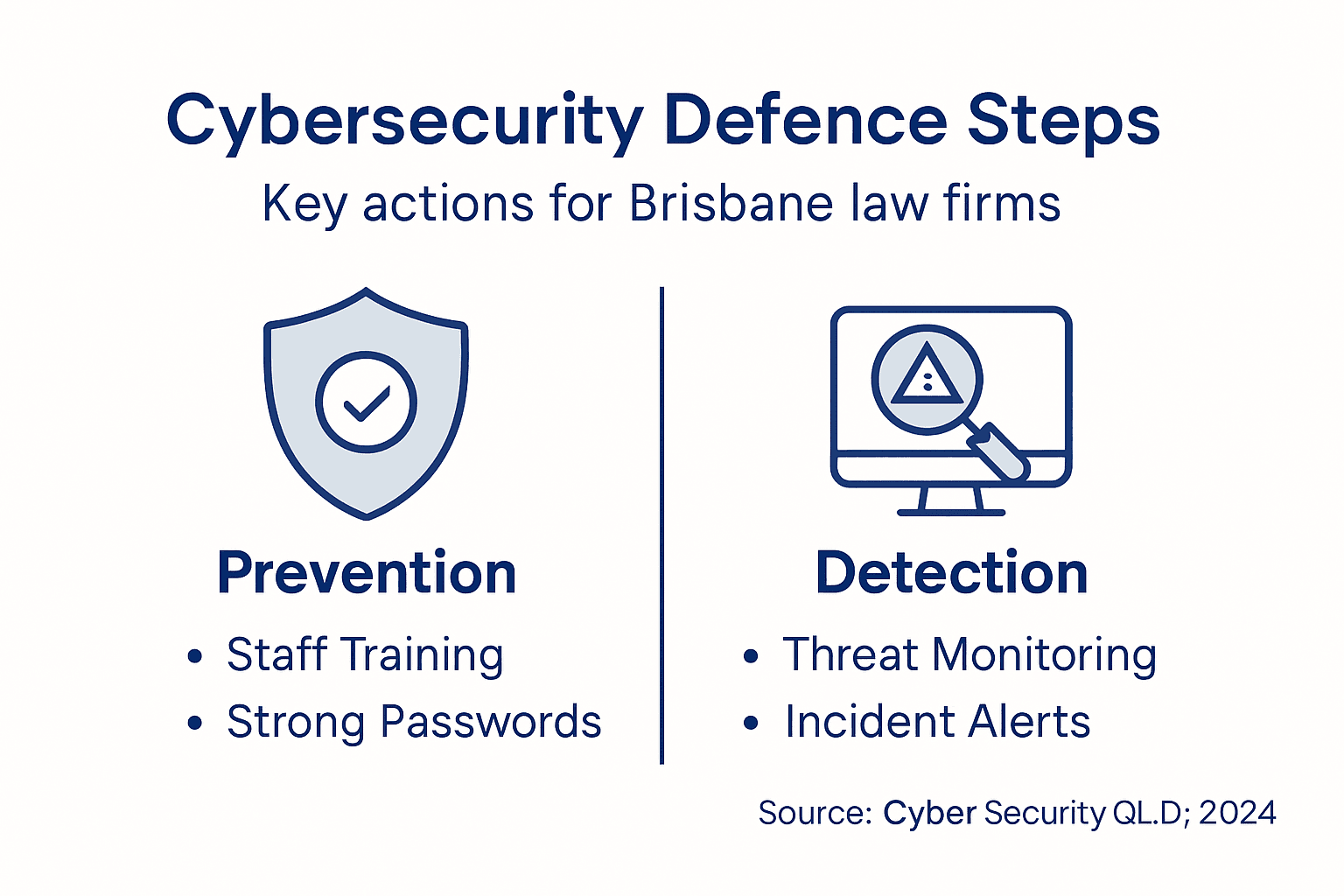
Legal firms must also invest in continuous monitoring and threat detection systems. By staying proactive and maintaining a dynamic approach to cybersecurity, Brisbane legal practices can significantly reduce their vulnerability to sophisticated digital attacks and protect their most valuable asset: client trust.
Pro tip: Establish a quarterly cybersecurity review process that includes technical assessments and staff training updates to maintain a robust defence strategy.
Regulatory And Insurance Requirements In Queensland
Queensland legal firms face a complex landscape of regulatory compliance and cybersecurity obligations that extend far beyond basic technological protections. Cyber security obligations for Queensland organisations require a comprehensive, risk-based approach that integrates technical controls with strategic governance frameworks.
Key regulatory requirements for legal practices include:
- Compliance with Queensland Government’s Information Security Policy (IS18)
- Implementation of an Information Security Management System (ISMS)
- Adherence to Australian Signals Directorate’s Essential Eight mitigation strategies
- Mandatory reporting of data breaches
- Maintaining robust information protection protocols
Mandatory data breach notification requirements under the Information Privacy Act 2009 are particularly critical. Legal firms must be prepared to immediately notify the Office of the Information Commissioner and affected individuals in the event of a significant data breach, with potential legal and financial consequences for non-compliance.
Cyber liability insurance has become an essential component of risk management for legal practices. This specialised insurance helps mitigate financial risks associated with potential data breaches, providing coverage for legal expenses, recovery costs, and potential regulatory penalties.
Pro tip: Engage a specialised cybersecurity consultant to conduct an annual compliance audit and review your cyber insurance coverage to ensure comprehensive protection.
This reference table outlines key Queensland regulatory requirements and the business rationale behind each obligation:
| Requirement | Regulator/Standard | Business Rationale |
|---|---|---|
| IS18 Information Security Policy | Queensland Government | Ensures baseline data protection |
| Mandatory Data Breach Notification | OIC, Information Privacy Act | Enhances transparency and accountability |
| Essential Eight Mitigation Strategies | Australian Signals Directorate | Reduces risk of common digital threats |
| Cyber Liability Insurance | Private insurers | Mitigates financial breach consequences |
Risks Of Non-Compliance And Common Pitfalls
Legal firms in Brisbane face substantial risks when failing to maintain robust cybersecurity compliance. Data breach notification consequences extend far beyond immediate financial penalties, potentially undermining an entire firm’s professional reputation and client relationships.
Common compliance pitfalls for legal practices include:
- Inadequate third-party vendor security assessments
- Outdated cybersecurity policies
- Inconsistent staff training protocols
- Delayed or incomplete data breach reporting
- Weak authentication and access management systems
Cybersecurity non-compliance consequences can be catastrophic for legal firms. Beyond financial fines, organisations risk operational disruptions, potential legal action from clients, and long-term damage to professional credibility. Regulatory bodies increasingly view cybersecurity as a fundamental aspect of professional responsibility.
The potential financial impact is significant. A single data breach could result in penalties ranging from $50,000 to $2.2 million, depending on the severity and scope of the incident. Moreover, the indirect costs of reputation damage and client trust erosion can far exceed direct financial penalties.
Pro tip: Develop a comprehensive compliance checklist and conduct biannual internal audits to proactively identify and address potential cybersecurity vulnerabilities.
Strengthen Your Legal Firm’s Defence Against Cyber Threats Today
Brisbane legal firms face ever-evolving cyber risks that threaten sensitive client information, business continuity, and regulatory compliance. From phishing attacks to ransomware incidents, protecting your practice demands more than basic IT measures. It requires a strategic partner who understands the specific challenges of legal cybersecurity governance and risk mitigation outlined in this article.
At IT Start, we specialise in delivering tailored cybersecurity solutions for legal practices across Queensland. Our proactive managed IT support includes advanced multi-factor authentication, continuous security monitoring, comprehensive incident response planning, and ongoing staff training to reduce human vulnerabilities. By partnering with us, you ensure your legal firm complies with essential regulatory requirements such as Queensland’s IS18 Information Security Policy and data breach notification laws while safeguarding your reputation and client trust.
Don’t wait until a cyber incident disrupts your operations. Get expert advice and a free cybersecurity assessment tailored to your legal firm’s needs today at IT Start Contact Us. Protect your practice with trusted local Brisbane IT experts who put your business first. Reach out now to build your resilient defence strategy and stay ahead of cyber threats.
Frequently Asked Questions
What is cyber security for legal firms?
Cyber security for legal firms involves a comprehensive strategy to protect sensitive client information and legal documents from digital threats. It includes safeguarding confidentiality, maintaining data integrity, and ensuring the availability of critical information systems.
What are the main types of cyber threats that legal practices face?
Legal practices commonly face threats such as phishing attacks, ransomware, business email compromise, data breaches, and social engineering tactics that exploit human psychology to access confidential information.
How can legal firms protect themselves against cyber attacks?
Legal firms can implement multi-factor authentication, develop robust encryption protocols, conduct regular staff training, create comprehensive incident response plans, and perform regular security audits to improve their cyber security posture.
What are the regulatory requirements for cyber security in legal firms?
Legal firms must comply with various regulations, including Queensland’s Information Security Policy, mandatory data breach notification under the Information Privacy Act, and implementation of the Australian Signals Directorate’s Essential Eight mitigation strategies.
Recommended
- What Cyber Security Protects for Brisbane Businesses – IT Start
- Cyber Security Advice – Protecting Brisbane Businesses – IT Start
- Cybersecurity Best Practices: Protecting Client Data Locally – IT Start
- How to Improve Cyber Security for Brisbane SMEs Easily – IT Start
- Why Cybersecurity Matters | TECHTRON