
Queensland SMEs face a growing threat landscape where 60% of small businesses close within six months of a significant cyberattack. The financial and reputational damage from breaches can be catastrophic, yet many business owners lack a clear roadmap to assess and strengthen their defences. This guide provides a practical, framework-driven approach to conducting cybersecurity assessments tailored for Queensland enterprises. You’ll learn how to systematically identify vulnerabilities, prioritise risks, and implement controls using trusted methodologies like the ACSC Essential Eight and SMB1001, ensuring your business stays protected and compliant in 2026.
Table of Contents
- Understanding Your Cybersecurity Landscape: What You Need Before Starting
- Conducting The Step-By-Step Cybersecurity Assessment
- Common Challenges And Expert Tips For A Successful Cybersecurity Assessment
- Interpreting Assessment Results And Planning Next Steps
- How IT Start Can Help Your Cybersecurity Journey
- Frequently Asked Questions
Key takeaways
| Point | Details |
|---|---|
| Structured assessment process | Follow a clear sequence from asset identification through threat analysis to control implementation and regular review cycles. |
| Framework-driven approach | Leverage Essential Eight for technical controls and SMB1001 for comprehensive governance suited to SME resources and scale. |
| Regular monitoring essential | Schedule reassessments every 6-12 months to adapt to evolving threats and maintain effective security posture. |
| Queensland compliance focus | Address Cyber Security Act 2024 requirements including ransomware reporting and IS18 alignment for government-facing operations. |
| Practical risk prioritisation | Balance technical measures with staff training and policy governance to create defence in depth across your organisation. |
Understanding your cybersecurity landscape: what you need before starting
Before diving into a formal assessment, you need a clear picture of your current environment. Start by creating a comprehensive inventory of all digital and physical assets critical to your operations. This includes servers, workstations, mobile devices, cloud services, customer databases, and intellectual property. Don’t overlook shadow IT, where staff use unauthorised applications that create hidden vulnerabilities.
Queensland businesses must understand their regulatory obligations. The Cyber Security Act 2024 introduced mandatory ransomware reporting and IoT security requirements that affect how you design your assessment scope. If you work with government agencies, IS18 compliance becomes relevant, adding another layer of standards to consider. These frameworks aren’t just bureaucratic hurdles; they provide structured pathways to genuine protection.
Gather your existing documentation before starting the assessment proper. This includes current IT policies, network diagrams, access control lists, backup schedules, and incident response plans. If these don’t exist yet, that’s valuable information itself, it tells you where foundational gaps lie. Survey your staff to gauge their cybersecurity awareness levels. Understanding cyber security needs Queensland SMEs face helps you tailor the assessment to real-world conditions rather than theoretical scenarios.
The step-by-step cybersecurity assessment begins with identifying assets, threats, and vulnerabilities, followed by risk prioritisation and control implementation using frameworks like ACSC Essential Eight or SMB1001. This systematic approach ensures nothing critical falls through the cracks. Free Business Queensland cyber security resources provide baseline tools and checklists to kickstart your evaluation without significant upfront investment.
Pro Tip: Create a simple spreadsheet mapping each business asset to its criticality level (high, medium, low) and current protection status. This visual reference makes it easier to spot gaps and communicate risks to stakeholders who aren’t technically minded.
Choosing the right framework matters enormously. Understanding cybersecurity frameworks Queensland businesses can adopt helps you select an approach matching your resources, industry requirements, and growth trajectory. The assessment preparation phase sets the foundation for everything that follows, invest time here to avoid costly mistakes later.
Conducting the step-by-step cybersecurity assessment
Once you’ve completed your groundwork, follow these sequential steps to conduct a thorough assessment:
-
Asset identification and inventory creation: Document every system, application, and data repository across your organisation. Include hardware specifications, software versions, data classifications, and asset owners. This inventory becomes your reference point for all subsequent analysis.
-
Threat and vulnerability analysis: Identify realistic threats facing your specific business sector and size. Retail businesses face different attack vectors than professional services firms. Run vulnerability scans on your network infrastructure and applications to discover technical weaknesses. Review physical security controls for server rooms and sensitive workspaces.
-
Risk analysis and prioritisation: Evaluate each identified risk using likelihood and impact matrices. The ACSC Essential Eight Maturity Model provides levels 0-3 across eight critical strategies: multi-factor authentication, application control, patch management, application hardening, restricted administrative privileges, operating system patching, regular backups, and user application hardening. Alternatively, the SMB1001 tiered framework offers Bronze through Diamond tiers incorporating governance, access controls, and incident response tailored specifically for SME resource constraints.
-
Implement controls: Based on your prioritised risks, deploy protective measures systematically. Start with quick wins like enabling MFA and automating patch management. Develop or update your incident response plan with clear roles and communication protocols. Establish secure backup procedures with offsite or cloud-based redundancy. The ACSC Essential Eight guide provides detailed implementation steps for each technical control.
-
Establish monitoring and review cycles: Deploy security monitoring tools to detect anomalies and potential breaches in real time. Schedule formal reassessments every 6-12 months, with interim reviews triggered by significant business changes like mergers, new cloud services, or regulatory updates. Document everything to demonstrate due diligence and track improvement over time.
Pro Tip: Don’t try to achieve maturity level 3 or Diamond tier overnight. Start with foundational controls at Bronze or level 1, then progressively mature your capabilities as resources allow and staff competency grows.
The table below compares maturity progression for common controls:
| Control Area | Level 0/Bronze | Level 1/Silver | Level 2/Gold | Level 3/Diamond |
|---|---|---|---|---|
| Multi-factor authentication | Not implemented | Privileged users only | All users for remote access | All users for all access |
| Patch management | Ad hoc or none | Monthly critical patches | Fortnightly critical patches | Daily critical patches |
| Backups | Irregular or untested | Weekly full backups | Daily incremental backups | Continuous replication with tested recovery |
| Incident response | No formal plan | Basic documented plan | Tested plan with defined roles | Automated detection with 24/7 response capability |
Understanding SMB1001 certification and value helps you decide whether pursuing formal accreditation makes strategic sense for your business. Certification demonstrates commitment to clients and partners while providing structure for continuous improvement. Many Queensland SMEs find Bronze tier achievable within 3-6 months with focused effort.
Staff training deserves special attention during implementation. Even sophisticated technical controls fail when employees click phishing links or use weak passwords. Use this employee cybersecurity checklist to establish baseline awareness and conduct regular simulated phishing exercises to reinforce safe behaviours. Your people represent both your greatest vulnerability and your strongest defence layer.
Common challenges and expert tips for a successful cybersecurity assessment
Queensland SMEs consistently encounter predictable obstacles during assessments. Recognising these pitfalls early helps you navigate around them effectively.
The most frequent mistake is neglecting backup testing. Many businesses diligently create backups but never verify they can actually restore data when needed. Test your backup recovery procedures quarterly at minimum, documenting the process and time required. A backup you can’t restore is worthless during a ransomware attack. Another common error involves misunderstanding maturity levels. Your overall maturity equals your lowest control level, not your average. If you’ve achieved level 2 for six controls but remain at level 0 for two others, your organisation sits at level 0 overall.
Staff training often receives insufficient attention and budget. Technical controls alone won’t protect you if employees lack basic security awareness. Implement regular training sessions covering password hygiene, phishing recognition, and safe data handling. Supplement formal training with ongoing simulated attacks to keep security top of mind. Review phishing attack examples and defences to understand current tactics criminals use against Queensland businesses.
Pro Tip: Automate patching wherever possible and implement MFA immediately, even before completing your full assessment. These two controls provide outsized protection relative to their implementation effort and cost.
Queensland’s Cyber Security Act 2024 introduces specific compliance obligations including IoT device security standards and mandatory ransomware incident reporting to authorities. Factor these requirements into your assessment scope from the beginning. If you provide services to government agencies, IS18 alignment becomes necessary, adding governance and documentation standards beyond purely technical controls.
Balancing controls across technical measures, policy governance, and physical security creates defence in depth. Don’t pour all resources into firewalls while ignoring physical access to server rooms or failing to establish clear data classification policies. A holistic approach recognises that attackers exploit the weakest link, regardless of where it sits in your security architecture.
“The goal isn’t perfect security, which doesn’t exist. The goal is raising your defences high enough that attackers move to easier targets. Most cybercriminals are opportunists, not specialists targeting your business specifically.”
Following cybersecurity best practices Brisbane SMBs adopt helps you learn from others’ experiences rather than repeating common mistakes. Local business networks and industry associations often share threat intelligence and lessons learned that prove invaluable for resource-constrained organisations.
Key pitfalls to avoid:
- Treating assessment as a one-time project rather than an ongoing process
- Focusing exclusively on technical controls while neglecting governance and training
- Choosing frameworks based on popularity rather than fit for your specific context
- Underestimating the time required for proper implementation and testing
- Failing to secure executive buy-in and adequate budget for remediation activities
Interpreting assessment results and planning next steps
Once you’ve completed your assessment, interpreting the results accurately drives effective remediation planning. Compare your findings against both Essential Eight and SMB1001 to determine which framework aligns better with your business model and resources.
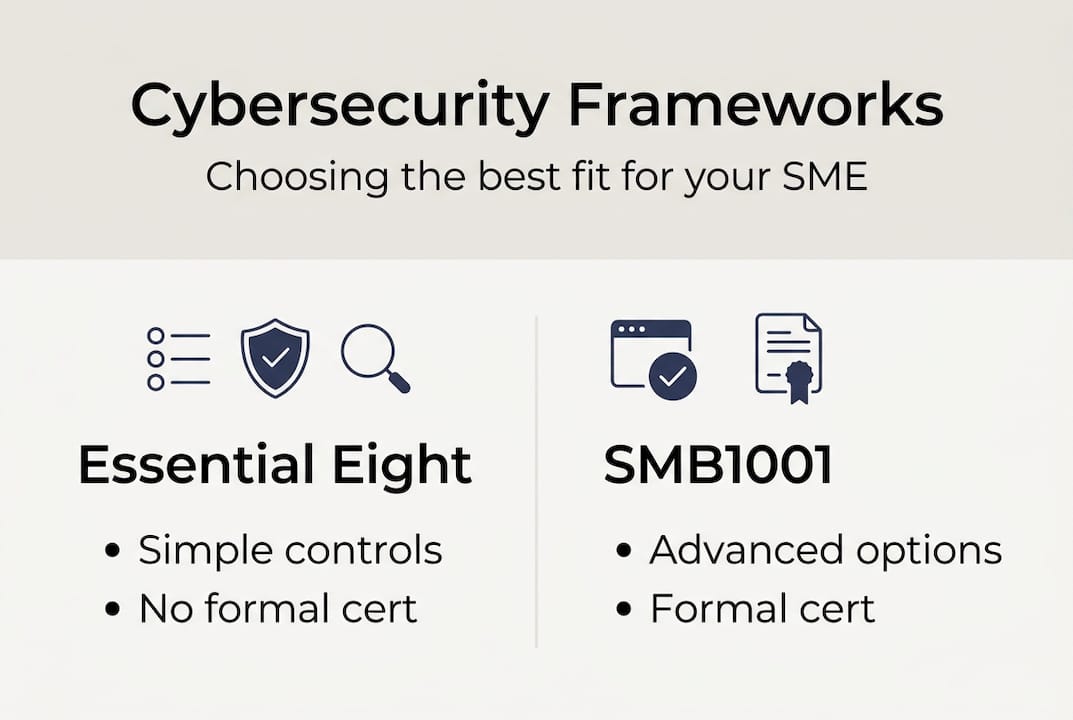
Essential Eight focuses on technical controls without offering formal certification, making it ideal for businesses prioritising baseline protection with government backing. It’s technical-focused and well-suited for organisations with strong IT capabilities. Conversely, SMB1001 provides broader coverage including governance and people controls with certifiable tiers specifically designed for SME constraints. Many Queensland businesses find value in using both frameworks together for comprehensive coverage.
| Comparison Factor | Essential Eight | SMB1001 |
|---|---|---|
| Primary focus | Eight technical mitigation strategies | Holistic governance, technical, and operational controls |
| Certification available | No formal certification | Tiered certification (Bronze to Diamond) |
| Maturity levels | 0-3 for each control | Bronze, Silver, Gold, Diamond tiers |
| Best suited for | Organisations prioritising technical baseline | SMEs seeking comprehensive framework with certification pathway |
| Government backing | ACSC endorsed | Industry-driven standard |
| Implementation complexity | Moderate, technical focus | Moderate to high, broader scope |
Prioritise remediation activities based on risk scores and available resources. Address critical vulnerabilities affecting high-value assets first, even if they’re harder to fix. Quick wins that significantly reduce risk with minimal effort should come next. Document your remediation roadmap with clear timelines, assigned responsibilities, and success metrics.
Schedule your next assessment for 6-12 months out, adjusting the interval based on your industry’s threat landscape and rate of business change. Organisations in highly targeted sectors like finance or healthcare may need quarterly reviews. Faster-growing businesses undergoing rapid digital transformation should assess more frequently than stable operations.
Consider whether pursuing formal certification makes strategic sense. SMB1001 Bronze tier represents an achievable first step that demonstrates commitment to security without the resource intensity of ISO27001. Certification provides competitive advantage when tendering for contracts and reassures clients about your data protection capabilities. It also creates accountability structures that help maintain security discipline over time.
Use assessment results to enhance specific capabilities:
- Strengthen governance through clear security policies and executive oversight
- Improve access controls with role-based permissions and regular access reviews
- Develop incident response capabilities with tested playbooks and communication protocols
- Enhance monitoring through security information and event management tools
- Build resilience with tested business continuity and disaster recovery plans
Understanding the IT role in Queensland SMB compliance helps you structure your technology function to support ongoing security and regulatory requirements. Whether you manage IT internally or partner with external providers, clear accountability and regular communication ensure security remains a business priority rather than a technical afterthought.
Your assessment results should inform budget planning for the next financial year. Security isn’t a one-time expense but an ongoing operational requirement. Factor in costs for tools, training, potential certifications, and external expertise where needed. Presenting findings to executives and boards requires translating technical risks into business impact language they understand.
How IT Start can help your cybersecurity journey
Navigating cybersecurity assessments and implementation can feel overwhelming when you’re focused on running your business. IT Start specialises in helping Queensland SMEs strengthen their security posture using proven frameworks like Essential Eight and SMB1001. Our team conducts thorough assessments tailored to your industry, size, and risk profile, delivering actionable roadmaps rather than generic reports.
We provide hands-on support for critical controls including patch management, MFA deployment, backup verification, and incident response planning. Our cyber security services address the complete spectrum from initial assessment through ongoing monitoring and compliance maintenance. As an SMB1001 Gold certified provider, we understand the practical challenges Queensland businesses face and design solutions that fit your resources and operational realities.
Our cloud services enhance security while improving business continuity and operational flexibility. Moving to secure cloud infrastructure often addresses multiple assessment findings simultaneously. Ready to strengthen your defences? Contact us for a consultation tailored to your specific cybersecurity needs and compliance obligations.
Frequently asked questions
How often should I conduct a cybersecurity assessment?
Conduct comprehensive assessments at least every 6-12 months to keep pace with evolving threats and business changes. More frequent reviews become necessary if you’re experiencing rapid growth, implementing new technologies, or operating in highly targeted industries. Regular assessment cycles ensure your controls remain effective and aligned with current compliance requirements, preventing security drift as your organisation evolves.
What is the difference between the Essential Eight and SMB1001 frameworks?
Essential Eight focuses on eight technical mitigation strategies without offering formal certification, making it suitable for establishing baseline protection with government backing. SMB1001 provides broader coverage including governance, people controls, and operational processes with tiered certification options (Bronze through Diamond) specifically tailored for SME resource constraints. Many Queensland businesses use both frameworks together, leveraging Essential Eight for technical controls and SMB1001 for comprehensive governance and certification pathways.
How can I test if my backups will protect my business?
Regularly restore backup files in isolated test environments to verify they’re complete, uncorrupted, and actually recoverable within acceptable timeframes. Document your testing procedures including who performs tests, what data sets are validated, and how long restoration takes. Quarterly testing represents the minimum frequency, with critical systems warranting monthly verification. This practice ensures your backups will function when you need them most during a ransomware attack or system failure.
Do I need to hire external experts for a cybersecurity assessment?
While internal teams can conduct basic assessments using free frameworks and tools, external experts bring objectivity, specialised knowledge, and experience across multiple organisations that internal staff typically lack. For initial assessments or when pursuing formal certification, external expertise often proves valuable for identifying blind spots and ensuring comprehensive coverage. As your security maturity grows, you can shift more assessment activities in-house while engaging specialists for periodic independent validation.
What should I do immediately after discovering a critical vulnerability?
Isolate affected systems if the vulnerability is actively exploited or poses imminent risk to operations. Assess whether the vulnerability requires immediate reporting under Queensland’s Cyber Security Act 2024, particularly for ransomware incidents. Implement temporary compensating controls while you develop and test a permanent fix. Document the vulnerability, your response actions, and lessons learned to improve future incident handling. Communicate transparently with affected stakeholders while avoiding unnecessary alarm that could damage business relationships or reputation.
Recommended
- What you need for cyber security in Queensland SMEs 2026 – IT Start
- Essential IT Security Assessment Steps for Brisbane SMEs – IT Start
- Practice Cyber Security for Brisbane SMEs: Step-by-Step Guide – IT Start
- What to learn for cyber security: a 2026 guide for Queensland SMEs – IT Start
- Cybersecurity checklist for employees to prevent breaches