

TL;DR:
- Many Queensland small businesses close within six months after a data breach.
- Implementing layered compliance frameworks like the ACSC Essential Eight and regular audits enhances cybersecurity resilience.
- Ongoing management and staff training are crucial to maintaining compliance and protecting business reputation.
A data breach does not just cost money. For many Queensland small businesses, it ends the business entirely. 60% of SMBs close within six months of a major breach, and reported incidents have risen by 25% in recent years. Yet many business owners still treat IT compliance as a box-ticking exercise rather than a business-critical function. This guide walks you through the full compliance journey: understanding your obligations, assessing where you stand, implementing the right controls, and verifying that everything holds up over time. If you want to protect your clients, win better contracts, and keep your business running, this is where to start.
Table of Contents
- Understanding IT compliance in Queensland
- Preparing for compliance: Self-assessment and baseline requirements
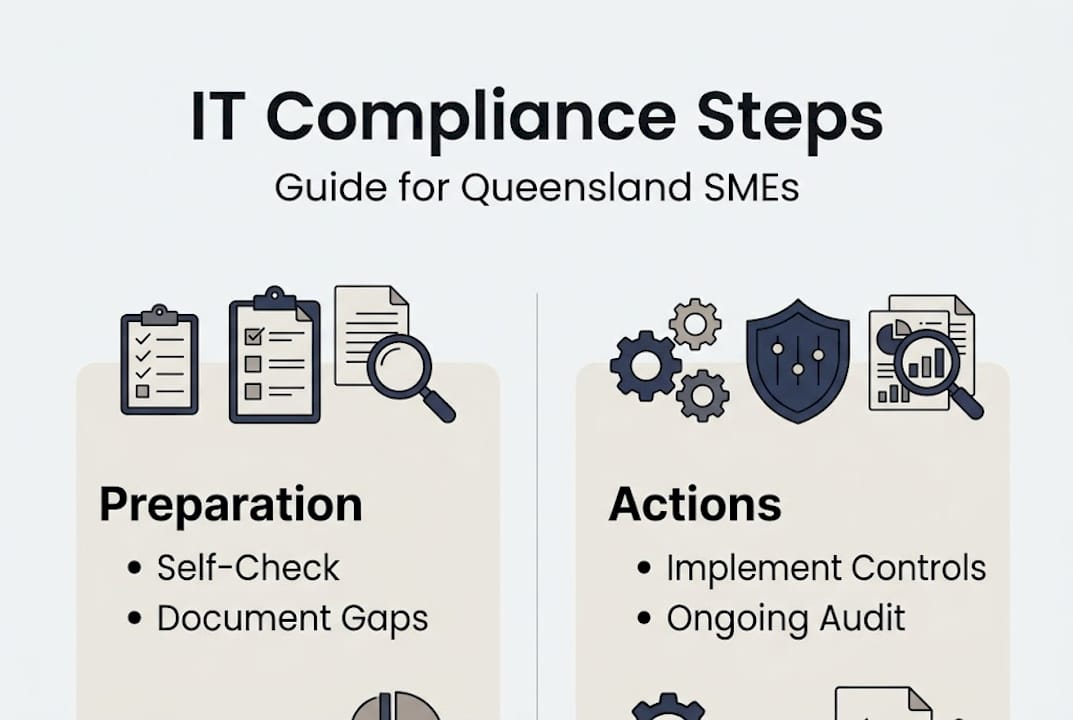
- Implementing IT compliance: Step-by-step actions
- Verifying compliance: Monitoring and audit cycles
- A fresh perspective: Why compliance is business survival, not a checkbox
- How IT Start can help you ensure compliance
- Frequently asked questions
Key Takeaways
| Point | Details |
|---|---|
| Start with the Essential Eight | The ACSC Essential Eight forms the minimum foundation for compliance and cyber safety in 2026. |
| Document and review regularly | Keep records of controls and check your compliance status at least every quarter. |
| Align with Queensland frameworks | Following IS18 and SMB1001 boosts client trust and opens more business opportunities, even when not legally mandated. |
| Use managed services when needed | Managed Service Providers can help you close gaps in expertise and resources and maintain compliance efficiently. |
Understanding IT compliance in Queensland
IT compliance, at its core, means operating your systems, data, and processes in line with the laws, standards, and frameworks that apply to your business. For Queensland SMEs, this is not one single rulebook. It is a layered set of obligations drawn from federal legislation, state policy, and industry best practice.
The three frameworks most relevant to Queensland SMEs are:
- IS18 (Information Security Policy): The Queensland Government’s own information security standard. While it formally applies to public sector agencies, aligning with IS18 principles signals to government clients and partners that your business meets a recognised benchmark.
- ACSC Essential Eight: Developed by the Australian Cyber Security Centre, this framework outlines eight mitigation strategies that defend against the most common cyber threats. It is the practical starting point for most Queensland SMEs.
- Australian Privacy Principles (APPs): Under the Privacy Act 1988, any business with turnover above $3 million (or operating in certain sectors) must handle personal information according to 13 binding principles. APP12, for example, governs how you store and destroy data.
The business case for compliance goes well beyond avoiding fines. Clients, especially in healthcare, legal, and financial services, increasingly require suppliers to demonstrate security controls before signing contracts. Government procurement panels often mandate compliance as an entry condition. Documented controls also reduce your cyber insurance premiums and strengthen your position in the event of a dispute.
Here is a quick comparison of the three frameworks:
| Framework | Who it applies to | Primary focus |
|---|---|---|
| IS18 | QLD government agencies and suppliers | Information security governance |
| ACSC Essential Eight | All Australian businesses | Cyber threat mitigation |
| Australian Privacy Principles | Businesses above $3M turnover or specific sectors | Personal data handling |
Reviewing compliance best practices before you begin will help you understand which obligations sit at the top of your priority list. For a broader look at how these requirements affect local businesses, the compliance guide for Brisbane businesses is a useful companion resource.
Preparing for compliance: Self-assessment and baseline requirements
With a clear understanding of compliance expectations, the next step is practical preparation and determining your current position.
The most accessible starting point is the ACSC Cyber Health Check, a free self-assessment tool that helps you identify gaps in your current security posture. It takes roughly an hour to complete and produces a structured gap report you can share with your IT team or provider.
From there, the goal is to reach Essential Eight Maturity Level 1 as your foundational baseline. Level 1 addresses the most common attack vectors and requires four core controls to be in place:
- Multi-factor authentication (MFA): Require a second verification step for all remote access and privileged accounts.
- Patch management: Apply security patches to operating systems and applications within 30 days of release (or 48 hours for critical vulnerabilities).
- Regular backups: Maintain three copies of data, on two different media types, with one copy stored offline.
- Restrict administrative privileges: Limit who can install software or change system settings to only those who genuinely need it.
Once you have completed the health check, document every control you currently have in place and every gap you identify. This documentation is the foundation of your audit trail. Auditors and clients do not just want to see that you have controls. They want evidence that those controls are maintained over time.
Here is a simple way to structure your baseline assessment:
| Control area | Current status | Gap identified | Priority |
|---|---|---|---|
| MFA | Partial | Email not covered | High |
| Patching | Ad hoc | No formal schedule | High |
| Backups | In place | No offline copy | Medium |
| Admin access | Unreviewed | Over-permissioned | High |
For detailed security assessment steps tailored to Brisbane SMEs, or a complete cybersecurity self-assessment guide for 2026, both resources will help you move from guesswork to a structured plan.
Pro Tip: If your internal team does not have the bandwidth to run a proper assessment, a Managed Service Provider (MSP) can complete a baseline audit in a fraction of the time and flag risks you might not even know to look for.
Implementing IT compliance: Step-by-step actions
Once you have established your baseline, it is time to take concrete steps to build or upgrade your compliance.

Implementing the Essential Eight is the most practical starting point for Queensland SMEs. As a framework, Essential Eight delivers quick wins for immediate risk reduction, while ISO27001 suits businesses seeking formal certification and NIST provides a scalable model for growing risk management programmes.
Here is a practical sequence for rolling out your compliance controls:
- Enable MFA across all systems: Start with email and remote access, then extend to all business-critical applications.
- Implement a patching schedule: Assign a responsible person and document every patch applied, including the date and system affected.
- Review and document access permissions: Remove unnecessary admin rights and implement a formal access request process.
- Develop core policies: At minimum, you need an acceptable use policy, an access management policy, and a breach response plan.
- Train your staff: Cyber security awareness training is one of the highest-return investments an SME can make. Human error causes the majority of breaches.
- Configure cloud settings carefully: Default cloud configurations are rarely secure. Review your Microsoft 365 or Google Workspace settings against vendor hardening guides.
- Apply data retention rules: Under APP12, you must destroy personal information once it is no longer needed. Retaining data beyond its purpose is both a privacy risk and a compliance failure.
Important: Under the Notifiable Data Breaches (NDB) scheme, if a breach is likely to cause serious harm to any individual, you are legally required to notify both the affected individuals and the Office of the Australian Information Commissioner. Failure to notify can result in significant penalties.
Aligning your controls with IS18 policy principles throughout this process will also strengthen your eligibility for Queensland Government work.
Pro Tip: Do not try to implement everything at once. Prioritise your highest-risk gaps first, document as you go, and build out controls in stages. A phased approach is far more sustainable than a rushed overhaul.
Verifying compliance: Monitoring and audit cycles
To ensure your compliance efforts remain effective and credible, ongoing verification is critical.
Compliance is not a destination. Controls that worked six months ago may already be outdated. New staff, new software, and new attack methods all create fresh exposure. The businesses that stay genuinely protected are those that treat verification as a regular operating rhythm, not a one-off event.
Here is how to build an effective verification cycle:
- Monthly reviews: Check patch logs, backup reports, and access permission records. Flag anything that falls outside your defined policies.
- Quarterly breach simulations: Run a tabletop exercise with your team to test your incident response plan. Walk through a realistic scenario and identify what breaks down.
- Six-monthly control audits: Review all your documented controls against your original gap assessment. Have the gaps closed? Have new ones appeared?
- Annual external audit: Engage an independent provider or MSP to assess your posture from the outside. This is particularly important if you hold client data or operate in a regulated industry.
Key evidence to maintain throughout your audit cycle:
- Patch logs with dates and system names
- Backup success and failure reports
- Access permission change records
- Staff training completion records
- Incident response test outcomes
- Policy review sign-off records
Ongoing audits are consistently more effective than point-in-time checks, and simulating breaches quarterly is now considered best practice for Queensland SMEs. For professional services businesses in particular, the SMB1001 tiered standard, which is endorsed by the Queensland Law Society, provides a structured certification pathway that carries real commercial weight.
Pursuing SMB1001 certification is a logical next step once your Essential Eight controls are bedded in. For guidance on structuring your review process, the cybersecurity audit steps resource covers the practical detail of what to document and when.
A fresh perspective: Why compliance is business survival, not a checkbox
Here is the uncomfortable truth that most guides will not tell you: the businesses that get hit hardest by breaches are rarely the ones with no controls. They are the ones that implemented controls once, filed the paperwork, and assumed the job was done.
Compliance fatigue is real. When nothing goes wrong for 18 months, it is easy to deprioritise the quarterly review or delay the staff training refresh. But cyber threats evolve faster than most businesses refresh their policies. The gap between your last review and today is exactly where exposure lives.
There is also a commercial reality that gets overlooked. You may never receive a fine for lax controls. But you will lose contracts. Clients in legal, healthcare, and financial services are already asking suppliers for evidence of security practices, and that bar is rising every year. Understanding IT’s real role in compliance means recognising that documented, maintained controls are a business development asset, not just a legal obligation. Small, consistent improvements compound into genuine resilience and competitive advantage over time.
How IT Start can help you ensure compliance
Ready to strengthen your compliance stance? Here is how IT Start can support you.
At IT Start, we work with Queensland SMEs every day to build practical, sustainable compliance programmes. Our cyber security services cover everything from Essential Eight implementation and policy development to staff training and breach response planning. We also offer compliance audits and ongoing monitoring as part of our business IT support packages, so you are never left guessing whether your controls are actually working. As a Brisbane-based team with SMB 1001 Gold certification, we understand the specific obligations and commercial pressures that Queensland SMEs face. Reach out for a free assessment and let us help you turn compliance into a genuine business asset.
Frequently asked questions
What is the Essential Eight and why does it matter for my business?
The Essential Eight is a cybersecurity framework developed by the ACSC that prevents 85 to 99% of common attacks, making it the recommended compliance baseline for Queensland SMEs looking to reduce risk quickly.
Do I need to follow the Queensland IS18 policy if I’m not a government contractor?
IS18 is not mandatory for private businesses, but aligning with IS18 improves client trust, broadens your contract eligibility, and demonstrates a serious commitment to information security.
How often should we audit our IT compliance?
Quarterly audits with breach simulations and regular control reviews are now considered best practice, moving well beyond the old annual checkbox approach.
What’s the most common mistake Queensland SMEs make in IT compliance?
Overlooking cloud configurations and data over-retention are two of the most frequent causes of compliance failures and breaches, particularly around APP12 obligations.