

TL;DR:
- Mapping security controls to a recognised framework like Essential 8 reveals gaps and improves cybersecurity measures.
- Regular mapping empowers Queensland SMEs to demonstrate compliance, enhance trust, and manage risks effectively.
- A hybrid approach using Essential 8 with other frameworks enables scalable, cost-effective security growth.
Many Queensland SMEs believe that installing antivirus software or setting up a firewall is enough to keep their business safe. It isn’t. Piecemeal security measures leave dangerous gaps that attackers actively exploit, and without a structured approach to assessing and confirming your current security status, you genuinely don’t know where you stand. Mapping your controls to a recognised framework like Essential 8 changes that entirely. It transforms cybersecurity from a vague, reactive exercise into a clear, measurable process, one that lets you see exactly what’s working, what’s missing, and where to focus your limited resources first.
Table of Contents
- Understanding security frameworks and Essential 8 in Queensland
- The business case: Why mapping to a framework matters
- How mapping enables hybrid approaches and future-proofs your security
- Practical mapping steps for Queensland SMEs
- Why mapping matters more than ever for Queensland SMEs
- Strengthen your cybersecurity with expert guidance
- Frequently asked questions
Key Takeaways
| Point | Details |
|---|---|
| Mapping gives clarity | Mapping security controls helps SMEs see what they’re doing well and where they’re exposed. |
| Enables hybrid security | Combining multiple frameworks using mapping supports flexible and scalable protection as business needs evolve. |
| Drives operational efficiency | Mapping streamlines compliance, reporting, and resource allocation for Queensland SMEs. |
| Not just for compliance | Effective mapping can drive business growth and resilience, not just meet regulatory needs. |
Understanding security frameworks and Essential 8 in Queensland
A security framework is a structured set of guidelines and controls that organisations use to manage cybersecurity risk. Think of it as a blueprint. Rather than making ad hoc decisions about what tools to buy or what policies to write, a framework gives you a consistent, repeatable structure for identifying threats, protecting assets, and responding to incidents. Mapping means comparing your existing security practices against the requirements of a chosen framework to identify what you’ve already addressed and what still needs attention.
In Australia, the most widely recognised baseline framework for SMEs is the Essential 8, developed by the Australian Cyber Security Centre (ACSC). The Essential 8 defines eight specific mitigation strategies that collectively reduce the most common attack vectors facing businesses today. These controls are practical, cost-effective, and specifically designed with organisations that don’t have large security teams in mind.
| Essential 8 control | Focus area |
|---|---|
| Application control | Prevents unauthorised software from running |
| Patch applications | Keeps software up to date to close known vulnerabilities |
| Configure Microsoft Office macro settings | Limits macro-based malware |
| User application hardening | Restricts browser and application attack surfaces |
| Restrict administrative privileges | Limits who can make system changes |
| Patch operating systems | Keeps OS current and protected |
| Multi-factor authentication | Adds a second layer of identity verification |
| Regular backups | Ensures data can be recovered after an incident |
Understanding security frameworks for Brisbane SMBs is the critical first step, because the controls above only deliver real value when you can confirm they’re actually in place and working as intended. That confirmation process is mapping.
The key distinction here is that Essential 8 is a list of what to do, but mapping tells you how well you’re doing it and where the gaps are. As one cybersecurity expert notes, the Essential 8 should be seen as a “starting line” for SMEs, not a finish line. Mapping expands coverage by allowing you to layer additional frameworks over your Essential 8 foundation, a hybrid approach that’s ideal for Queensland businesses balancing tight budgets with genuine security needs.
For SMEs considering framework adoption in Queensland, the message is clear: frameworks offer a structured approach that goes well beyond ticking boxes. They give your security programme real shape and accountability.
The business case: Why mapping to a framework matters
Mapping to a framework isn’t just a technical exercise. It has direct, tangible business benefits that matter to owners of small and medium businesses across Queensland.

First and most importantly, mapping shows you exactly which controls you have in place and which ones are missing. Without this visibility, your security posture is essentially a guess. A formal mapping process, particularly one aligned to Essential 8 and the SMB 1001 standard, makes that posture measurable. You can point to specific evidence that controls are active, properly configured, and working as expected. That’s a fundamentally different position from saying “we’ve got antivirus and a firewall.”
Here’s why that matters in practice:
- Insurance eligibility: Cyber insurers increasingly require evidence of structured controls before offering coverage. Aligning controls to clear objectives makes it far easier to satisfy insurance requirements, and in some cases, it reduces your premiums.
- Regulatory compliance: Industries like healthcare, financial services, and legal services in Queensland face specific data protection obligations. Mapping to a framework makes it straightforward to demonstrate compliance with these obligations, rather than scrambling to compile evidence when an audit arrives.
- Customer and partner trust: Being able to articulate your security posture builds confidence with clients, particularly enterprise customers who are increasingly vetting their suppliers’ security practices.
- Cleaner risk assessments: When you have a mapped security programme, producing a risk register or board-level security report becomes a structured process rather than a stressful scramble.
The cybersecurity framework role for Queensland SMEs extends beyond IT teams, it informs business decisions, supports procurement, and shapes conversations with senior leadership about where security investment is genuinely needed.
Pro Tip: Schedule a mapping review every quarter, not just annually. Threats evolve quickly, and regular reviews let you spot weaknesses before attackers do, rather than discovering them during an incident.
At IT Start, we work with SMEs using both the Essential 8 and the SMB 1001 Gold standard precisely because these frameworks allow businesses to assess and confirm their current status with real evidence. It’s not enough to believe you’re compliant. Mapping gives you proof.
How mapping enables hybrid approaches and future-proofs your security
Once you understand mapping as a concept, its real power becomes clear: it allows your security programme to grow with your business rather than being replaced each time your needs change.
Hybrid approaches combining Essential 8 with NIST or ISO allow Queensland SMEs to tailor their security objectives while keeping costs manageable. This is significant. Many business owners worry that adopting a more rigorous framework means starting from scratch. Mapping shows that your existing Essential 8 controls often directly satisfy requirements in NIST or ISO 27001, so you’re building on what you’ve already invested in, not discarding it.
| Framework | Best suited for | Key focus |
|---|---|---|
| Essential 8 | Australian SMEs, government-adjacent businesses | Baseline cyber hygiene, eight core mitigations |
| NIST Cybersecurity Framework | Businesses with US customers or partners, larger SMEs | Risk management, five core functions |
| ISO 27001 | Businesses pursuing formal certification, regulated industries | Information security management systems |
For combining frameworks for Brisbane SMBs, here’s a practical approach to hybrid mapping:
- Assess your current state against Essential 8 maturity levels (level 1, 2, or 3). Understand which controls you have and at what maturity.
- Identify your business drivers. Are you seeking cyber insurance? Pursuing enterprise contracts? Expanding into regulated sectors? These drivers determine which additional framework is most relevant.
- Map overlapping controls. Essential 8’s multi-factor authentication, for example, maps directly to NIST’s “Protect” function and ISO 27001’s access control requirements. Mapping reveals these overlaps so you’re not duplicating effort.
- Address the gaps. Focus effort on controls that exist in your target framework but aren’t yet covered by your Essential 8 baseline.
- Document and evidence everything. Frameworks require evidence, not just assertions. Screenshots, logs, policy documents, and audit trails all serve as proof that controls are active.
Pro Tip: Start with Essential 8 at maturity level 1 before moving to more complex frameworks. This gives you a solid, evidenced baseline to build on, and you’ll find that achieving proven steps for secure IT environments is far more achievable when you’re building incrementally rather than trying to implement everything at once.
The beauty of this incremental model is that your early security investment never becomes wasted effort. Every control you implement and document at the Essential 8 stage contributes directly to your standing under more advanced frameworks. You’re not starting over; you’re layering.
Practical mapping steps for Queensland SMEs
Understanding the theory is one thing. Putting mapping into practice in a real Queensland business is another. Here’s a concrete path forward, designed specifically for SMEs with lean teams and limited IT budgets.
Step 1: Assess your current controls. Before you can map anything, you need to know what you have. This means documenting every security control currently in operation, whether that’s MFA on your email system, your current patch cadence, or your backup schedule. Be honest. If a control exists but isn’t consistently applied, it doesn’t count.
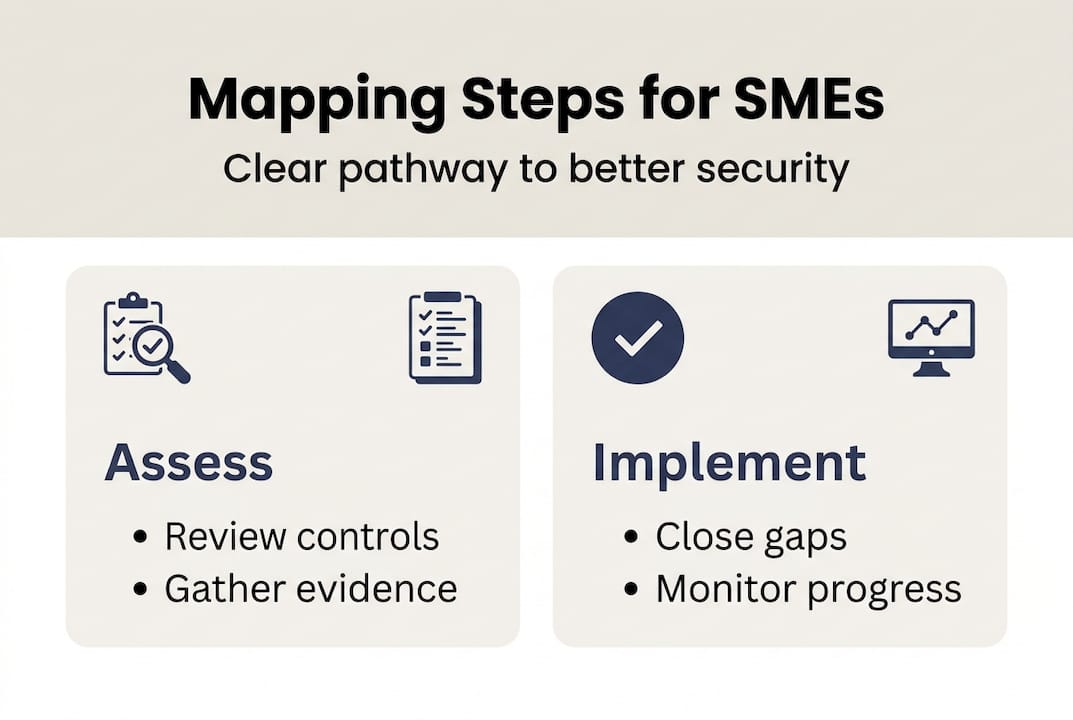
Step 2: Align with your chosen framework. For most Queensland SMEs, Essential 8 is the right starting point. Review each of the eight controls and rate your current status against the ACSC’s maturity levels. This step alone often surfaces uncomfortable surprises, particularly around application control and restricting administrative privileges.
Step 3: Map your gaps. Once you’ve rated each control, you’ll have a clear picture of where the gaps are. Mapping means creating a documented record that shows which controls are fully implemented, which are partially implemented, and which are missing entirely. This map becomes your security roadmap.
Step 4: Implement improvements. Prioritise based on risk. Which gaps expose you to the greatest potential harm? Address those first. Mapping enables SMEs to focus efforts on highest-risk areas first, which is critical when resources are tight.
Step 5: Review regularly. A mapping exercise is not a one-off project. It needs to be repeated as your systems change, as new threats emerge, and as your business grows.
Consider a practical example. A Brisbane professional services firm decides to map their email security against Essential 8. They discover that while MFA is enabled for some users, it’s not enforced for all accounts and shared mailboxes are completely unprotected. This gap, invisible before mapping, is exactly the kind of entry point attackers use. The fix is straightforward once the gap is visible.
Here’s a simple checklist to track progress in your mapping programme:
- Current Essential 8 maturity level documented for each of the eight controls
- Gap register updated with specific remediation tasks assigned
- Evidence log maintained (screenshots, policy documents, audit logs)
- Review date scheduled (minimum annually, ideally quarterly)
- Key staff trained on their role in maintaining controls
Consider also linking your mapping efforts to staff cybersecurity training, because controls that depend on human behaviour, like recognising phishing emails, only work when people understand why they matter.
Pro Tip: Even partial mapping is valuable. If you can only assess and document four of the eight Essential 8 controls this quarter, that’s still four areas where you now have clear visibility and a defined path to improvement. Progress beats perfection every time.
The secure IT environment steps for Queensland SMEs always begin with knowing your current state. Mapping is the mechanism that makes that knowledge concrete and actionable.
Why mapping matters more than ever for Queensland SMEs
After years of working with SMEs across Brisbane and Queensland, the pattern we see most often is this: business owners invest in security tools but treat the overall programme as a vague, background concern. They know they’ve “done something” about security, but they can’t say exactly what, or whether it’s actually working.
This is precisely where mapping earns its value. It’s not a compliance exercise for its own sake. It’s the process that converts vague confidence into verified security. As experts note, true resilience comes from thoughtful mapping tailored to specific business risks, not generic tool adoption.
What most SME owners get wrong is treating mapping as a one-off event tied to an audit or insurance renewal. The businesses we’ve seen avoid costly incidents are those who maintain a living map of their controls, one that gets updated when systems change, when staff leave, or when a new threat category emerges. Queensland’s threat landscape continues to evolve, and static security programmes inevitably fall behind.
A well-maintained risk-cutting IT security workflow for SMEs should treat mapping as an ongoing discipline, not a project with a finish line. That mindset shift is what separates businesses that genuinely reduce their risk from those that simply feel like they have.
Strengthen your cybersecurity with expert guidance
Turning a security mapping exercise into real, lasting protection requires both the right framework and the expertise to apply it properly. At IT Start, we work directly with Queensland SMEs using Essential 8 and SMB 1001 Gold to assess, confirm, and strengthen your security posture with clear evidence rather than assumptions. Our cyber security solutions are built specifically for small and medium businesses that need practical, cost-effective protection without the overhead of an in-house security team. Pair that with our cloud services for SMEs and you have a complete, scalable foundation. Reach out today for a free assessment and find out exactly where your business stands.
Frequently asked questions
What is mapping to a security framework?
Mapping means aligning your business’s existing security practices to the requirements of a recognised framework like Essential 8, clearly identifying both what’s already in place and where gaps in coverage remain. It turns your security posture from a feeling into a fact.
Is Essential 8 enough to protect my business?
Essential 8 provides a strong, evidence-based foundation, but hybrid approaches with NIST or ISO can address broader risks and specific regulatory requirements, particularly for businesses in healthcare, legal, or financial services sectors.
How often should Queensland SMEs review their mapping?
At minimum, SMEs should review their mapping annually, but quarterly reviews are strongly recommended because system changes, staff turnover, and evolving threats can all create new gaps between scheduled audits.
Can mapping help small businesses with limited budgets?
Absolutely. Mapping helps small businesses prioritise resources on highest-risk areas rather than spreading limited budgets across every possible security tool, which means every dollar spent on security has a clear, justified purpose.