
TL;DR:
- Phishing emails cost Australian SMEs tens of thousands of dollars per incident.
- Effective cybersecurity training is affordable, involving repetition and role-specific content.
- Ongoing, low-cost micro-drills and leadership support improve staff behaviour and security culture.
A single phishing email costs Australian SMEs an average of tens of thousands of dollars per incident, and that figure doesn’t count the reputational damage that follows. Most breaches don’t happen because of sophisticated hacking. They happen because a staff member clicked the wrong link or reused a weak password. Many Brisbane business owners know training matters but put it off, assuming it’s too expensive or too complicated to organise. It isn’t. This guide walks you through every step, from assessing your current gaps to rolling out a programme that actually changes behaviour, without needing a massive IT budget.
Table of Contents
- Assess your current cybersecurity awareness and needs
- Design an effective, engaging cybersecurity training programme
- Roll out training: Step-by-step for lasting impact
- Monitor, measure, and refine your cybersecurity training
- Why low-cost, high-frequency training delivers better SME results
- Take the next step: Professional cybersecurity support for your team
- Frequently asked questions
Key Takeaways
| Point | Details |
|---|---|
| Start with a quick assessment | Understanding your team’s skills and weak points will guide a targeted training plan. |
| Mix training formats for impact | Combining simulations, video, and real examples boosts engagement and learning. |
| Leadership involvement matters | Security culture grows from the top—owners and managers must participate. |
| Track and adapt continuously | Regular quizzes and feedback keep skills fresh and spot problem areas early. |
| Affordable resources get results | You don’t need a huge budget to make a real difference in staff cybersecurity awareness. |
Assess your current cybersecurity awareness and needs
Before launching into training, it pays to know where your team stands. Jumping straight into a programme without understanding your starting point wastes time and money. A solid baseline assessment tells you which staff are most vulnerable, which systems carry the most risk, and where your training dollars will have the greatest impact.
Start by reviewing your recent history. Have there been phishing attempts that staff reported, or ones that slipped through unnoticed? Any accidental data sharing, lost devices, or unauthorised system access? These incidents are goldmines of information about where knowledge gaps exist. Establishing a baseline by identifying current staff knowledge, tools in use, and any previous incidents is the foundation of any effective programme.
Next, identify which roles carry the most risk. Finance staff handle payment details and banking credentials. Administration staff often have broad system access. Anyone with remote access to your network is a potential entry point for attackers. Prioritise these roles when planning your training rollout.
Here’s a quick readiness checklist to work through:
- Past incidents: Have you logged phishing attempts, data leaks, or device losses in the past 12 months?
- Training records: Can you confirm when staff last completed any security awareness training?
- Tool awareness: Do staff know how to use your antivirus, VPN, or multi-factor authentication (MFA) tools?
- Cultural attitudes: Do staff treat security as someone else’s job, or do they feel personally responsible?
- Reporting habits: Are staff comfortable flagging suspicious emails without fear of embarrassment?
Use a simple scoring table to map your readiness:
| Area | Current status | Risk level | Priority |
|---|---|---|---|
| Phishing awareness | Low | High | Immediate |
| Password hygiene | Medium | High | Immediate |
| Device management | Low | Medium | Short-term |
| Incident reporting | Medium | Medium | Short-term |
| Remote access security | Unknown | High | Immediate |
For more guidance on improving cybersecurity awareness across your team, it’s worth reviewing what other Brisbane SMEs have found effective. You can also explore cybersecurity basics for SMEs as a starting reference point.
Pro Tip: Run an anonymous staff survey before your first training session. People are far more honest about their habits and confusion when their name isn’t attached. You’ll often uncover surprising gaps that wouldn’t surface in a group setting.
Design an effective, engaging cybersecurity training programme
Once gaps are clear, build a programme your team can’t ignore. The biggest mistake SMEs make is treating cybersecurity training as a one-off compliance exercise. A single annual seminar is quickly forgotten. The goal is to build habits, and habits form through repetition and relevance.

Mixing gamification, video, hands-on simulations, and just-in-time coaching increases learning retention significantly. Here’s how different formats compare for a typical Brisbane SME:
| Format | Engagement | Cost | Ease of delivery | Best for |
|---|---|---|---|---|
| In-person workshop | High | Medium | Moderate | Initial rollout, leadership buy-in |
| Online modules | Medium | Low | Easy | Ongoing, self-paced learning |
| Microlearning (5-min videos) | High | Low | Very easy | Busy staff, reinforcement |
| Phishing simulations | Very high | Low | Moderate | Behaviour testing |
| Quizzes and gamification | High | Low | Easy | Knowledge checks |
Follow these steps to build your programme:
- Set clear objectives. What do you want staff to do differently? Be specific. “Staff will report suspicious emails within one hour” is a better objective than “staff will understand phishing.”
- Choose your methods. Mix at least two formats. A short video followed by a quiz works well for remote teams.
- Tailor content by role. Finance staff need training on invoice fraud. Admin staff need training on access controls. IT staff need deeper technical content.
- Involve leadership early. When managers and business owners visibly participate, staff take it seriously. Leadership modelling positive cyber behaviour is one of the most powerful signals you can send.
- Schedule it into the calendar. Training that isn’t scheduled doesn’t happen. Block time quarterly at minimum.
For practical examples of what user security awareness training looks like in practice, and to review cybersecurity training practices that work for Brisbane businesses, those resources are worth bookmarking.
Pro Tip: Use real examples from Australian news stories about local businesses that suffered breaches. When staff see that it happened to a business two suburbs away, the risk stops feeling abstract.
Roll out training: Step-by-step for lasting impact
With your training methods chosen, now put them into daily action. A well-designed programme that never gets properly launched is just a document. Execution is where most SMEs either succeed or quietly abandon their good intentions.
Follow these steps for a rollout that sticks:
- Announce the programme clearly. Send a brief message from the business owner or manager explaining why cybersecurity training matters and what’s coming. Frame it as protecting the business and the team, not policing behaviour.
- Run an engaging kickoff session. Start with a short, energetic session that includes a real-world example. A simulated phishing test before the kickoff, with results shared (anonymously), is a powerful wake-up call.
- Stagger the rollout by team. Don’t train everyone at once if it disrupts operations. Start with the highest-risk roles, then roll out to the rest of the business over two to four weeks.
- Schedule quarterly refreshers. Set calendar reminders now. Each quarter, run a short micro-drill or simulation to keep awareness sharp.
- Spotlight wins publicly. When a staff member correctly identifies and reports a phishing email, acknowledge it. Positive reinforcement builds the culture you want.
Critical reminder: Never treat cybersecurity training as a “set and forget” exercise. Threats evolve constantly, and a programme that was relevant 18 months ago may not cover today’s attack methods. Ongoing training is not optional.
Leadership buy-in is vital for building a security-focused culture that lasts beyond the first training session. Without it, staff will treat security as an IT problem rather than a shared responsibility.
For a detailed step-by-step cybersecurity rollout guide tailored to Brisbane SMEs, that resource covers the operational side in more depth. If you’re in financial services, finance firm cybersecurity essentials addresses sector-specific risks worth knowing. Emphasising basics like MFA and incident protocols remains as important as ever in 2026.
Monitor, measure, and refine your cybersecurity training
The real results show up over time. Here’s how to keep training sharp and ensure it’s actually changing behaviour, not just ticking a box.
The most reliable measurement tool is the phishing simulation. Send a simulated phishing email to your team every quarter and track how many staff click the link, how many report it, and how those numbers change over time. Improvement in those numbers is direct evidence that training is working.
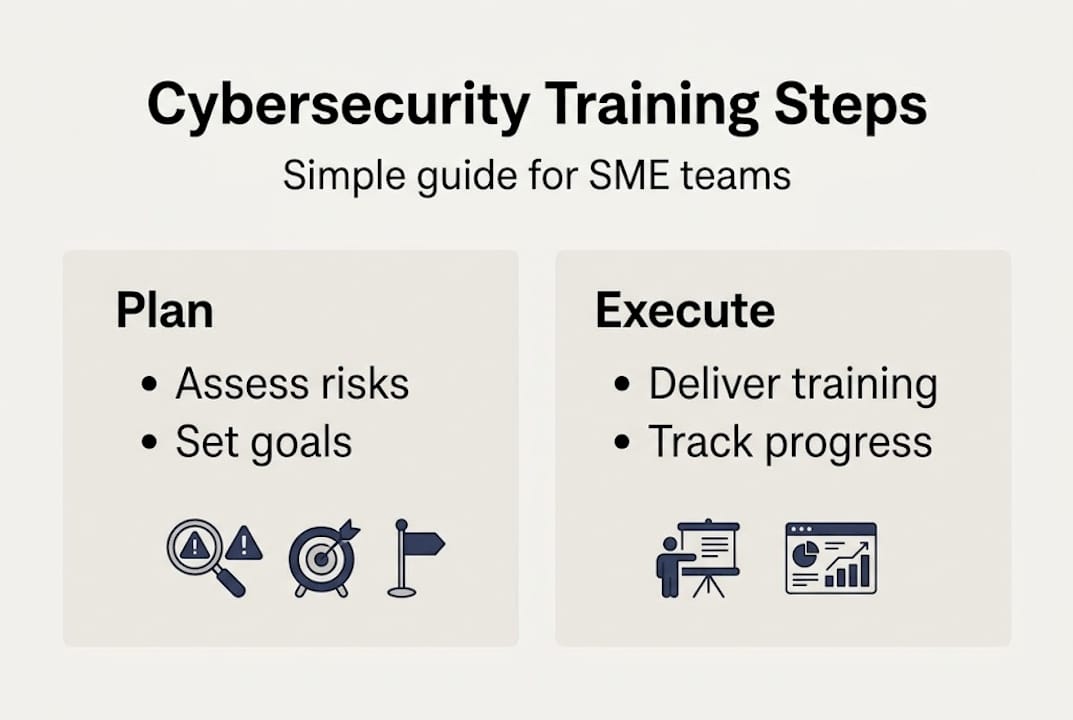
Just-in-time coaching after security mistakes is one of the most effective interventions available. When a staff member clicks a simulated phishing link, don’t shame them. Immediately provide a short, supportive explanation of what they missed and why it matters. That moment of mild embarrassment, handled well, creates lasting memory.
Track these practical metrics regularly:
- Phishing simulation click rates: Are they declining quarter on quarter?
- Suspicious email reporting rates: Are more staff flagging potential threats?
- Training completion rates: Is everyone completing modules on time?
- Incident frequency: Are real security incidents decreasing?
- Staff feedback scores: Do staff find training relevant and useful?
When metrics show weak results in a particular area, respond with targeted refreshers rather than repeating the entire programme. If finance staff are still clicking phishing links at a high rate, run a focused session on invoice fraud specifically for that team.
For a broader look at cybersecurity solutions comparison and to find the right tools to support your training programme, that resource covers the options well. A cyber security course guide for Brisbane SMEs can also help you identify formal training options when your team is ready to go deeper. You can also review how to monitor training impact using frameworks designed for small business contexts.
Why low-cost, high-frequency training delivers better SME results
There’s a common misconception that only big-budget programmes work. We’ve seen it repeatedly: a business invests in an expensive annual seminar, staff sit through it politely, and within three months the lessons are forgotten. Meanwhile, another business runs a five-minute phishing quiz every month and achieves far better outcomes.
Frequency beats intensity. Brief, regular sessions with role-playing and just-in-time learning stick far better than a full-day event once a year. The brain retains information through repetition, not duration.
Before spending on formal platforms, leverage what you already have. Identify an internal champion, someone who is genuinely interested in security, and give them time to run short sessions. Use free government resources and real news stories as teaching material. The essential cybersecurity for SMBs perspective reinforces this: relevance and consistency matter far more than budget.
Pro Tip: The best teaching moment is immediately after an incident. If a staff member nearly fell for a scam, use that story (with their permission) as a training example. Real stories from your own business are worth ten generic case studies.
Cost is rarely the barrier. Relevance, consistency, and leadership support are what determine whether training changes behaviour or simply satisfies a compliance checklist.
Take the next step: Professional cybersecurity support for your team
If you’ve worked through this guide and want expert support to put it all into practice, IT Start works with Brisbane SMEs to design, deliver, and manage cybersecurity training and protection. Our managed cyber security services cover everything from staff awareness programmes to ongoing threat monitoring, tailored specifically for small and medium businesses. We also offer secure cloud solutions that reduce your exposure without adding complexity. Whether you need a full needs assessment or just a second opinion on your current approach, speak to a cybersecurity expert at IT Start today. We’re local, we’re practical, and we understand what Brisbane businesses actually need.
Frequently asked questions
How often should cybersecurity training be held for staff?
Short, regular micro-drills drive retention far better than infrequent long sessions. Training should be held at least quarterly, with simulations and brief refreshers in between.
What are the most important topics to cover in cybersecurity training?
Critical topics include phishing awareness, password security, MFA setup, device management, and incident reporting. Basics like phishing and MFA remain the highest-priority areas for most SMEs.
Is there affordable or free training available for SMEs?
Yes. SMEs can start free using government resources, industry guides, and open-access online modules before scaling up to paid platforms as needs grow.
What signs show that staff cybersecurity training is working?
Watch for improved phishing reporting rates, fewer accidental clicks on suspicious links, and staff proactively asking questions about safe practices. These behavioural shifts are the clearest indicators of genuine progress.
Should the business owner take part in cybersecurity training?
Absolutely. Leadership buy-in supports a strong security culture, and staff are far more likely to take training seriously when they see their manager doing the same.
Recommended
- How to Improve Cyber Security Awareness for SMEs – IT Start
- Practice Cyber Security for Brisbane SMEs: Step-by-Step Guide – IT Start
- How to Improve Cyber Security for Brisbane SMEs Easily – IT Start
- User Security Awareness Training for Brisbane Businesses – IT Start
- Sicurezza garage aziende: guida completa PMI 2026