

TL;DR:
- Nearly 60% of SMEs experienced cyber attacks in the past year, risking heavy fines and reputational damage.
- Financial firms face targeted threats like phishing, ransomware, and supply chain breaches, with regulatory obligations.
- Building cyber resilience involves ongoing staff training, implementing zero trust principles, and conducting regular security audits.
Nearly six in ten small and medium enterprises faced at least one cyber attack in the past 12 months, and 33% received hefty fines as a result. For Brisbane finance professionals, those numbers are not abstract. You hold client banking details, investment records, and sensitive personal data that attackers actively seek. Regulatory bodies are watching closely, and the cost of a single breach can far exceed the investment in prevention. This guide cuts through the noise to explain what effective cybersecurity actually means for small to medium finance firms, what the law expects of you, and the practical steps you can start taking right now.
Table of Contents
- Why finance firms are major cyber targets
- Cybersecurity and compliance: What finance professionals must know
- Beyond compliance: Building true cyber resilience
- Practical steps: Cybersecurity measures that work for Brisbane firms
- Our perspective: What most SMEs get wrong about finance cybersecurity
- Boost your finance firm’s security with expert support
- Frequently asked questions
Key Takeaways
| Point | Details |
|---|---|
| Finance SMEs are top targets | Brisbane finance businesses face frequent attacks and regulatory fines, making cyber defence essential. |
| Compliance is just the baseline | Meeting regulations is necessary but not enough; real security demands ongoing action. |
| Zero Trust works in stages | Adopting phased Zero Trust—starting with identity controls—fits resource-limited firms. |
| Third-party risk is critical | Scrutinise vendors and partners as supply chain attacks are becoming common. |
| Staff training is high-impact | Regular staff awareness and testing greatly reduce the chance of costly breaches. |
Why finance firms are major cyber targets
Financial services businesses are not targeted by chance. Attackers follow the data, and finance firms hold some of the most valuable data available: account numbers, tax file numbers, credit records, and transaction histories. A single successful breach can yield enough information to commit fraud across dozens of client accounts simultaneously. That makes your firm a far more attractive target than a general retail business of similar size.
The three most common attack vectors in this sector are phishing, ransomware, and supply chain compromise. Phishing emails impersonate trusted institutions, tricking staff into handing over credentials. Ransomware encrypts your files and demands payment before you can operate again. Supply chain attacks are subtler: attackers infiltrate a software vendor or cloud provider you rely on, then use that access to reach your systems. All three are rising in frequency, and Australian finance SMEs face repeated attacks alongside tightening regulatory scrutiny.
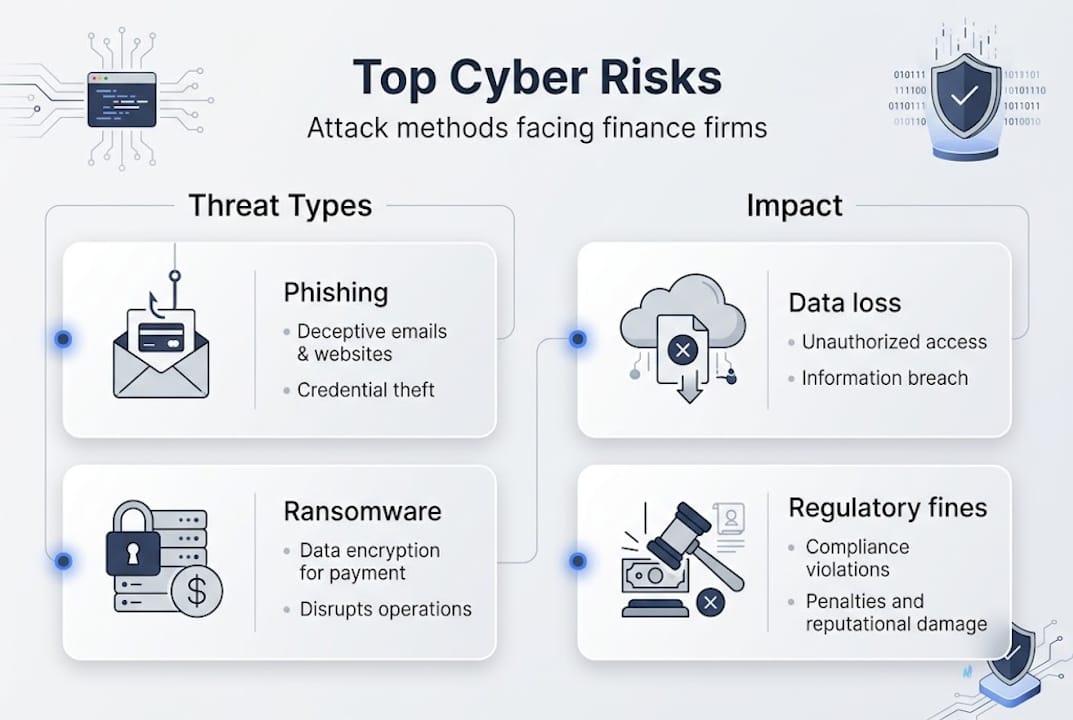
The financial and regulatory consequences for finance firms are uniquely severe. Beyond the direct cost of a breach, you face potential licence suspension, mandatory breach notifications, and civil penalties. Clients who lose trust rarely return.
| Attack type | Frequency in finance SMEs | Potential impact |
|---|---|---|
| Phishing | Very high | Credential theft, fraud |
| Ransomware | High | Operational shutdown, data loss |
| Supply chain breach | Growing | Widespread client data exposure |
| Insider threat | Moderate | Regulatory breach, reputational damage |
Understanding cyber risks for Brisbane SMEs is the first step toward building a defence that actually holds. The attack surface for finance firms is wide, and attackers are patient. They probe for weaknesses over weeks before striking. Building cybersecurity awareness for SMEs across your entire team is not optional; it is your first line of defence.
“Finance SMEs are increasingly in the crosshairs. The combination of valuable data and historically under-resourced IT creates a target that sophisticated attackers find hard to resist.”
Cybersecurity and compliance: What finance professionals must know
If you hold an Australian Financial Services Licence, your cybersecurity obligations are legally binding, not aspirational. Section 912A of the Corporations Act requires you to have adequate risk management systems in place. APRA’s CPS 234 sets out specific information security requirements for regulated entities, covering governance, policy, controls, and incident response. ASIC has made clear it will act on failures.
In a landmark case, ASIC imposed a $2.5 million penalty on FIIG Securities for inadequate cybersecurity, directly citing AFSL Section 912A obligations. The regulator found that weak controls allowed an attacker to access client data for an extended period. The penalty was significant, but the reputational damage was arguably greater.
Here is a comparison of minimum compliance versus a mature cybersecurity posture:
| Area | Minimum compliance | Mature posture |
|---|---|---|
| Staff training | Annual awareness session | Quarterly training and phishing simulations |
| Incident response | Basic plan documented | Tested, updated, and rehearsed regularly |
| Access controls | Password policy in place | Multi-factor authentication enforced everywhere |
| Third-party risk | Contracts reviewed | Ongoing vendor assessments and monitoring |
| Monitoring | Reactive to alerts | Continuous, proactive threat detection |
To meet your obligations and move toward genuine resilience, work through these steps:
- Review your AFSL conditions and confirm your risk management systems are documented.
- Assess your controls against APRA CPS 234 requirements, even if you are not directly regulated by APRA.
- Conduct a cybersecurity audit for finance firms to identify gaps before regulators do.
- Implement a written incident response plan and test it at least once a year.
- Document all third-party relationships and assess their security posture.
Pro Tip: Start with risk-based controls rather than trying to implement everything at once. Identify your three highest-risk areas, fix those first, and build outward. Regulators respond well to evidence of a structured, improving programme.
Beyond compliance: Building true cyber resilience
Meeting the minimum standard keeps you out of trouble today. It does not necessarily protect your clients or your business tomorrow. Compliance is not the same as true cyber capability; a firm can tick every regulatory box and still suffer a devastating breach because the controls are theoretical rather than operational.
Zero Trust is the framework gaining the most traction in financial services right now. The core idea is simple: never assume any user, device, or system is trustworthy by default, even inside your own network. Every access request is verified. This sounds complex, but for SMEs, a phased approach works well. You do not need to overhaul everything overnight.
Key components of a practical Zero Trust approach for finance SMEs:
- Identity verification first: Enforce multi-factor authentication (MFA) across all accounts before anything else.
- Least privilege access: Staff should only access the data and systems their role requires.
- Device health checks: Verify that devices connecting to your network meet security standards.
- Micro-segmentation: Separate sensitive financial data from general business systems to limit breach spread.
- Continuous monitoring: Log and review access patterns to catch anomalies early.
The investment appetite is there. 94% of SMEs plan to increase their cyber investment in the coming year, recognising that the cost of inaction is rising faster than the cost of protection.
Third-party and supply chain risk deserves special attention in finance. Cloud accounting platforms, payment processors, and data aggregators all represent potential entry points. Reviewing third-party risk best practices and applying them to your vendor relationships is not bureaucracy; it is practical protection. Embedding business continuity in your cyber security strategy ensures that when something does go wrong, your firm can recover quickly rather than scrambling.

Pro Tip: Start your Zero Trust journey with identity and MFA. It delivers the highest risk reduction per dollar spent and creates a foundation every other control can build on.
Practical steps: Cybersecurity measures that work for Brisbane firms
Practical cybersecurity for a Brisbane finance SME does not require a dedicated security team or an enterprise budget. It requires consistency, prioritisation, and the right external support where your internal capability has limits.
Here is a five-step action plan designed for small to medium finance firms:
- Enable MFA everywhere. Email, accounting software, client portals, and cloud storage. Phased Zero Trust starting with identity controls prevents operational disruption while dramatically reducing breach risk.
- Establish a tested backup routine. Back up critical data daily, store copies offsite or in a separate cloud environment, and test restoration quarterly. A backup you have never tested is a backup you cannot rely on.
- Write and rehearse an incident response plan. Know who calls whom, how you notify clients and regulators, and how you contain a breach. Practice matters more than paperwork.
- Run regular staff training. Phishing simulations and short awareness sessions cost little and deliver strong returns. Most breaches begin with a human error, not a technical failure.
- Audit your cloud and account access every quarter. Remove former staff, review permissions, and check that cloud data security in finance settings meet your current risk profile. Understanding the role of cloud solutions for finance firms helps you use these tools safely rather than reactively. Firms that secure cloud data for SMEs proactively avoid the configuration errors that cause most cloud-related breaches.
Pro Tip: Build vendor risk assessment into your onboarding process for any new software or service provider. Ask for their security certifications, data handling policies, and breach notification procedures before you sign. It takes thirty minutes and can save months of pain.
Our perspective: What most SMEs get wrong about finance cybersecurity
Working with Brisbane finance SMEs over many years, we have seen a consistent pattern: firms invest in compliance certificates and then assume the work is done. It is not. The certificate tells you that your policies existed on the day of the audit. It says nothing about whether your team actually follows them on a Tuesday afternoon when they are under pressure.
The most damaging breaches we have seen started with the basics. A staff member reusing a password. An alert that went unread for three days. A former employee’s account that was never deactivated. None of these require sophisticated attackers. They just require inattention.
The firms that handle cybersecurity well treat it as a business enabler, not just insurance. They understand that data security in the cloud and strong operational controls protect their reputation and their client relationships, which are ultimately their most valuable assets. Simple actions, applied consistently, outperform expensive technology that nobody uses correctly. That is the uncomfortable truth most vendors will not tell you.
Boost your finance firm’s security with expert support
If you are ready to move beyond checkbox compliance and build genuine cyber resilience, IT Start works specifically with Brisbane finance firms to make that happen. Our team understands the regulatory environment you operate in and the practical constraints of running a small to medium business. We combine expert cybersecurity services with proactive managed IT support, so you are not reacting to incidents but preventing them. Our cloud services for finance firms are designed with security and compliance built in from the start. Reach out to IT Start today for a no-obligation assessment and find out exactly where your firm stands.
Frequently asked questions
What are the main cybersecurity risks for finance SMEs in Brisbane?
The most common risks are phishing, ransomware, supply chain breaches, and regulatory fines linked to data mishandling. 59% of SMEs endured a cyber attack in the past year, with many facing financial penalties on top of the direct breach costs.
How is ‘adequate’ cybersecurity defined by regulators in Australia?
Adequate means measures proportionate to your firm’s specific risk profile, covering staff training, incident response planning, and controls aligned to AFSL and APRA standards. ASIC’s penalty on FIIG clarified that adequacy is judged against the actual risks your business faces, not a generic checklist.
Why isn’t compliance enough to secure my business?
Compliance is a starting point; true security requires a culture of vigilance, regular updates, and practical measures like Zero Trust and third-party risk reviews. Compliance does not equal capability, and firms that treat it as a destination rather than a baseline are the ones that get caught out.
What first steps can my firm take today for stronger cybersecurity?
Begin with identity controls and multi-factor authentication, run a staff awareness session, and audit your cloud and account access immediately. A Zero Trust strategy starting with MFA delivers the fastest risk reduction with the least operational disruption for SMEs.
Recommended
- Cyber Security Audit: Strengthening Brisbane Financial Firms – IT Start
- 7 Essential Cybersecurity Tips for Small Businesses – IT Start
- How to Improve Cyber Security Awareness for SMEs – IT Start
- Cloud Data Security – Protecting Financial Firms in Brisbane – IT Start
- Streamline your crypto trading workflow: step-by-step guide – DayProp Funding