

TL;DR:
- Most Brisbane SMBs need to understand that cybersecurity involves people, processes, and technology working together. It covers email, endpoint protection, identity management, and backup practices, with a focus on resilience and quick recovery. Building an effective cybersecurity program starts with basics like MFA, tested backups, and staff awareness, supported by managed services and strategic planning.
Most Brisbane business owners, when they hear the words “cyber security,” picture a programmer staring at scrolling code on a dark screen. That image isn’t just unhelpful. It actively gets in the way of understanding what do cyber security practices actually involve and why they matter to your operation. Cybersecurity touches email, cloud accounts, staff behaviour, backup processes, and your ability to keep working after something goes wrong. If you think it’s purely a tech problem solved by buying the right software, this article will change that view.
Table of Contents
- Key takeaways
- What do cyber security tools and domains actually cover
- What cyber security professionals actually do
- Common cybersecurity mistakes SMBs make
- Building resilience after a cyber incident
- My honest take on cybersecurity for Brisbane SMBs
- How IT Start helps Brisbane businesses stay protected
- FAQ
Key takeaways
| Point | Details |
|---|---|
| Cybersecurity covers multiple domains | Email, endpoints, identity, networks, and cloud each need specific protections and clear ownership. |
| People and process matter as much as tools | Buying software without training staff or planning responses leaves major gaps attackers exploit. |
| SMBs are frequent targets | Small businesses are not too small to be targeted. Most incidents hit businesses with under 50 staff. |
| Resilience beats perfect prevention | Assume something will go wrong and plan to recover fast, not just to block every threat. |
| Start with the basics and build from there | MFA, tested backups, and staff awareness training fix the majority of common attack paths. |
What do cyber security tools and domains actually cover
Most people think of cybersecurity as a single thing you either have or don’t have. In practice, cybersecurity spans multiple domains, each covering a different part of how your business operates digitally. Without coordinated governance across those domains, gaps appear between what your tools cover and what actually happens during an incident.
Here is how those domains break down for a typical Brisbane SMB:
| Domain | What it protects | Common SMB risk |
|---|---|---|
| Email security | Phishing, malicious attachments, impersonation | Staff clicking credential harvesting links |
| Endpoint protection | Laptops, desktops, mobile devices | Unpatched machines running outdated software |
| Identity and access | User accounts, passwords, admin privileges | No multi-factor authentication, shared passwords |
| Network security | Internal traffic, remote access, Wi-Fi | Open firewall rules, no network segmentation |
| Cloud services | Microsoft 365, file sharing, hosted apps | Misconfigured permissions, no conditional access |
| Backup and recovery | Data availability after incident or failure | Backups untested, stored in same location as primary data |
We see this a lot. A business has antivirus on every laptop but no MFA on their Microsoft 365 accounts, and the backups haven’t been tested in two years. Each of those domains needs a responsible owner and a defined process, not just a tool switched on and forgotten.
Pro Tip: Prioritise protections by what would hurt most if it failed. For most Brisbane SMBs, that’s email, identity, and backups. Get those three solid before worrying about anything more advanced.
What cyber security professionals actually do
This is where the confusion really kicks in. Business owners sometimes hire a general IT person and assume the security side is covered. Other times they buy a security product and assume the vendor handles everything. Cybersecurity roles span prevention, detection, and response, and those are genuinely different skill sets.
Here’s a rough breakdown of the main functions:
- Security analyst. Monitors alerts, investigates suspicious activity, and triages incidents before they escalate. This is an ongoing, day-to-day function.
- Incident responder. Steps in when something has already gone wrong. Containment, forensics, recovery coordination. This person works fast under pressure.
- Governance and compliance lead. Writes policies, manages risk registers, handles audits and frameworks like Essential Eight or ISO 27001. Less technical, more process-driven.
- Penetration tester. Deliberately tries to break into your systems to find weaknesses before attackers do. Usually engaged periodically, not full-time.
Most SMBs with 10 to 50 staff cannot afford a dedicated person for each of these. That’s the practical argument for managed security services. You get access to analysts and responders without putting each on your payroll.
What surprises a lot of clients is this: cybersecurity is people, processes, and technology working together. We’ve seen businesses spend significant money on security tools while still running with no documented incident response plan and no idea which staff member would be called first if something went wrong. That’s a governance gap, not a technology gap, and no software fixes it.

Understanding what cybersecurity companies do for SMBs specifically helps clarify where the real value comes from. It’s not just monitoring dashboards. It’s building the processes and accountability that hold the whole thing together.
Common cybersecurity mistakes SMBs make
Honestly, we see the same errors repeated across businesses of all sizes. The good news is that most of them are fixable without a massive budget. Here are the five we encounter most often:
-
Assuming tools alone provide protection. Antivirus and a firewall are a starting point, not a finished security posture. Attackers routinely bypass tools when processes around them are broken.
-
Poor backup practices. This one causes real damage. Many businesses think they’re backed up when they’re not. Backups stored in the same Microsoft 365 environment as the primary data, never tested, or overwritten by ransomware don’t count. The human factor in SMB breaches is significant, but bad backup hygiene is often what turns a containable incident into a catastrophic one.
-
Neglecting user training. Phishing is still the most common way attackers get in. Staff clicking a convincing link in an email isn’t stupidity. It’s what happens when people haven’t been trained to spot the signs. Regular, practical training makes a measurable difference.
-
No incident response plan. If something happens at 9 PM on a Friday, who calls who? What do you turn off first? Which systems are critical? These questions need answers before an incident, not during one.
-
Treating cybersecurity as a one-time project. Security isn’t a box you tick once. Threats change. Staff come and go. Software gets updated. Your approach needs to evolve too.
Pro Tip: You don’t need a massive budget to make real progress. Enforcing MFA, running quarterly phishing simulations, and testing backups monthly covers the majority of realistic attack vectors for most Brisbane SMBs. Check out these practical cybersecurity tips to get started.
Building resilience after a cyber incident
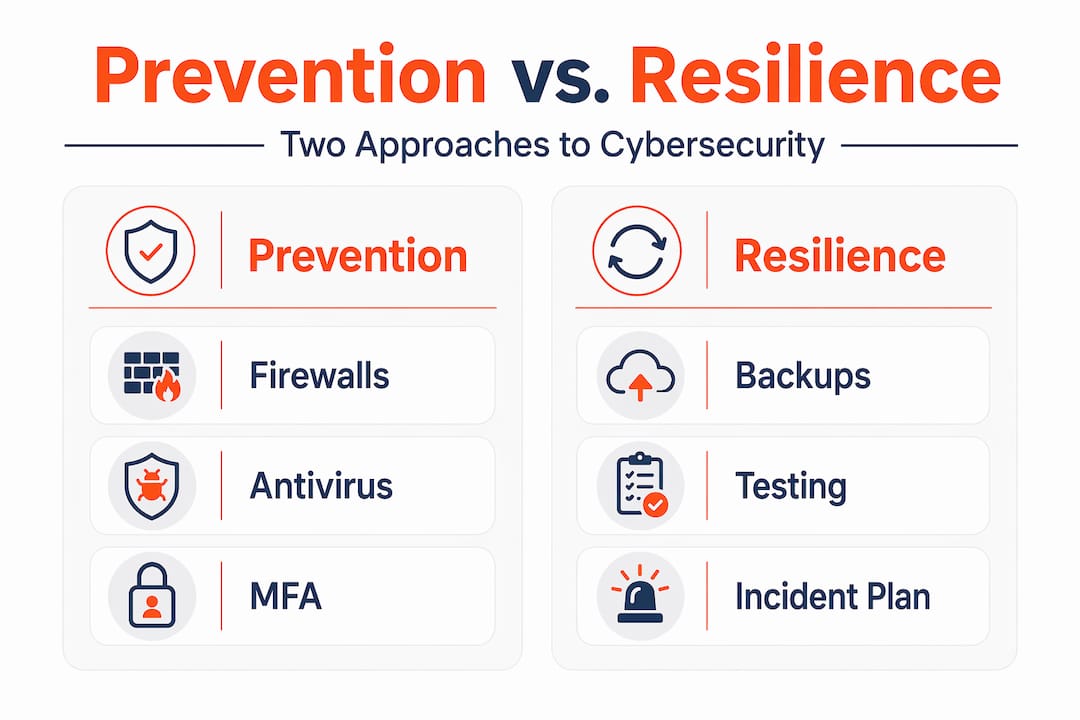
There’s an important shift in thinking here that a lot of business owners resist at first. Reducing risk is less about stopping every attack and more about keeping your business operational through disruption and recovering fast. That’s a different goal to “prevent everything,” and it leads to different decisions.
Good cyber resilience includes response and recovery, not just prevention. Organisations that plan and practise recover faster and with far less disruption. Here’s what that looks like practically:
- Tested backups. Not just backups that exist. Backups you have actually restored from, recently, to confirm they work. Offsite or air-gapped copies separate from your primary environment.
- A written incident response plan. Even a one-page document covering who to call, what to isolate, and what to communicate externally is vastly better than nothing.
- Incident response drills. Think of it like a fire drill. Walk through a simulated ransomware scenario with your team every six months. Find the gaps before an attacker does.
- Cyber insurance. Insurance supports financial recovery but is not a substitute for good security practices. Most policies now require evidence of basic controls like MFA and patching before they’ll pay out.
We worked with a Brisbane professional services firm that had reasonable tools in place but had never tested their backups. When ransomware hit on a Thursday afternoon, they discovered their backups were two weeks old and the restore process took three days. With a tested backup and a documented recovery plan, that situation would have resolved in a few hours.
The distinction between a prevention-only approach and a resilience-focused approach matters enormously when things go wrong.
My honest take on cybersecurity for Brisbane SMBs
I’ve been working with small businesses in Brisbane for a long time, and the pattern I keep seeing is that owners don’t take security seriously until something goes wrong. Then they want to fix everything at once, which is expensive, stressful, and usually reactive rather than thoughtful.
What I’ve found works is framing cybersecurity as an operational issue, not a technical one. Cybersecurity is a business issue, not just a concern for your IT person. When a business owner thinks of it that way, the decisions become clearer. You’re not choosing between security products. You’re deciding how much disruption your business can absorb and what you’re willing to invest to reduce that risk.
I’ve also learned that effective cyber leadership balances technology, people, and culture. The businesses I’ve seen recover well from incidents weren’t necessarily the ones with the best tools. They were the ones whose staff knew what to do, whose backups actually worked, and who had someone to call at 10 PM.
My honest advice: don’t try to build a perfect security programme from day one. Start with MFA on every account, a tested offsite backup, and one hour of staff phishing awareness training per quarter. That alone puts you ahead of most SMBs. Then build from there, systematically, as your budget and capacity allow.
— Matt
How IT Start helps Brisbane businesses stay protected
If you’ve read this far, you probably have a clearer picture of what cyber security actually involves and where your business might have gaps. IT Start works with Brisbane SMBs across professional services, healthcare, legal, and financial sectors to build security programmes that fit real-world budgets and operational constraints.
Our managed cyber security services cover the key domains discussed in this article, including email security, endpoint protection, identity management, and backup and recovery. We also offer free security assessments so you can see exactly where you stand before committing to anything. For businesses that also need broader support, our cloud services and business IT support teams work alongside your security setup to keep operations running smoothly. Get in touch with IT Start to book a no-obligation cybersecurity review tailored to your Brisbane business.
FAQ
What does cyber security actually protect?
Cybersecurity protects your data, systems, and operations from unauthorised access, theft, damage, and disruption. This includes confidentiality, integrity, and availability of everything from email accounts to client records and financial data.
Is cyber security only relevant for large businesses?
No. Most incidents target small and medium-sized businesses because they typically have fewer protections in place. Businesses with under 50 staff are frequently targeted through email phishing, credential theft, and poorly secured cloud accounts.
What is the most important first step for an SMB?
Enabling multi-factor authentication on all accounts, particularly Microsoft 365 and email, removes one of the most common attack paths attackers use against SMBs. Pair that with tested backups and you’ve covered the most critical risks.
Do I need to hire a dedicated cyber security person?
Not necessarily. Most SMBs in Brisbane get better value from a managed security service provider that covers monitoring, response, and governance functions across a team, rather than a single hire who cannot cover all those areas alone.
How does cyber insurance fit into a security plan?
Cyber insurance helps cover the financial costs of an incident but does not replace good security practices. Most policies require basic controls like MFA and regular patching to be in place before they pay out, so your security posture affects your coverage.