

TL;DR:
- Security awareness training provides a high return on investment by reducing breach costs and downtime.
- Effective training requires ongoing, engaging methods beyond static, annual courses.
- Building a security-aware culture involves continuous reinforcement, leadership involvement, and regular testing.
Every $1 invested in security awareness training can return $4 to $7 through avoided breaches, reduced downtime, and lower recovery costs. Yet most Brisbane SME owners still treat awareness training as a compliance checkbox rather than a genuine business safeguard. That gap between perception and reality is expensive. Cyber threats targeting small and medium-sized businesses are rising sharply, and the weakest link is almost never the firewall. It is the person clicking an email at 4:30pm on a Friday. This guide unpacks what security awareness really means, what the evidence says about its value, where it falls short, and how you can build something that actually changes behaviour in your organisation.
Table of Contents
- What is security awareness and why does it matter?
- The business impact: costs, ROI, and risk reduction
- Limitations and criticisms: does security awareness really work?
- Building a security-aware culture in your organisation
- Why security awareness needs a rethink in 2026
- How IT Start can help your Brisbane business
- Frequently asked questions
Key Takeaways
| Point | Details |
|---|---|
| Security awareness ROI | Investing in awareness can yield up to seven times return through reduced breach costs. |
| Beyond box-ticking | Effective training is ongoing and culturally embedded, not just occasional compliance exercises. |
| Balanced approach required | Combine behavioural insight, real-world practice, and technology for best results. |
| Practical steps matter | A clear security culture and regular engagement make the biggest difference for SMEs. |
What is security awareness and why does it matter?
Security awareness is the human-centric layer of your cyber defence. It is not a piece of software or a firewall rule. It is the collective knowledge, habits, and instincts your staff bring to every email they open, every password they create, and every link they click. When that layer is strong, threats get caught early. When it is weak, even the best technical controls can be bypassed in seconds.
For Brisbane SMEs, the threat landscape is specific and real. Phishing emails remain the most common attack vector, with criminals crafting messages that mimic your bank, the ATO, or even your own suppliers. Social engineering attacks manipulate staff into transferring funds or sharing credentials by exploiting trust and urgency. Credential theft, often through reused passwords, gives attackers quiet access to your systems for weeks before anyone notices.
Several myths keep business owners from taking this seriously:
- “We have antivirus and a firewall, so we are covered.” Technical tools catch known threats, but they cannot stop a staff member who willingly hands over login details.
- “We are too small to be a target.” Attackers often prefer smaller businesses precisely because defences tend to be weaker.
- “We did training last year, so we are fine.” One session does not change long-term behaviour. Threats evolve constantly.
- “This is an IT problem, not a people problem.” Security is everyone’s responsibility, from the receptionist to the director.
Security awareness isn’t just a technical issue; it is core to organisational culture. The way your team thinks about risk shapes every decision they make online.
For Brisbane businesses, this is particularly relevant given the concentration of professional services, healthcare, and financial firms in the region. These industries handle sensitive data and are high-value targets. Building cyber security awareness for Brisbane businesses is not optional. It is a baseline expectation for operating responsibly in 2026. If you want practical starting points, there are solid resources on improving SME cyber security awareness that go beyond generic advice.
The business impact: costs, ROI, and risk reduction
Let us talk numbers, because this is where the conversation usually shifts for business owners.
| Factor | Without training | With training |
|---|---|---|
| Average SME breach cost | $46,000+ | Significantly reduced |
| Staff phishing click rate | 30%+ | Can drop below 5% |
| Cyber insurance premium | Standard rate | Often discounted |
| Recovery time after incident | Days to weeks | Faster with aware staff |
| Regulatory compliance risk | Higher | Lower |
The return on awareness investment is compelling: for every dollar spent, businesses can expect between four and seven dollars back through avoided incidents, lower insurance costs, and reduced recovery expenses. That is a return most marketing budgets would envy.
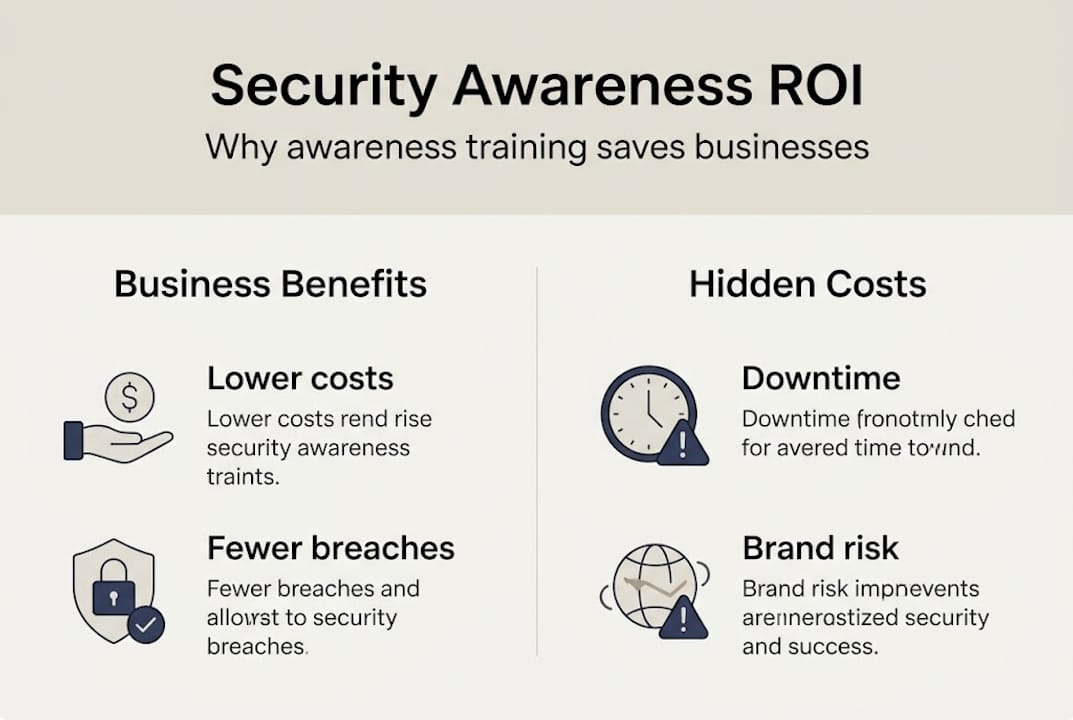
Beyond the direct financial return, security awareness reduces reputational risk. A breach that exposes client data does not just cost money to fix. It costs trust, and in industries like legal, accounting, and healthcare, trust is the product. Clients who feel their data was mishandled rarely return, and word travels fast in Brisbane’s tight-knit business community.
Operational disruption is another hidden cost. When a ransomware attack locks your systems, your team cannot work. Every hour of downtime has a dollar value attached to it. Aware staff who recognise and report suspicious activity early can stop an attack before it escalates.

Pro Tip: Documented and ongoing security awareness programmes are increasingly reviewed by insurers when calculating premiums. If you can show a consistent training schedule and simulated phishing results, you are in a much stronger position to negotiate lower cyber insurance costs. This is one of the most overlooked financial benefits of a structured programme.
For a broader view of what works, the guide on effective ways to improve cyber security covers both technical and human-focused strategies that complement each other well.
Limitations and criticisms: does security awareness really work?
Here is where it gets interesting. Not all security awareness training delivers results, and the research is worth understanding before you invest.
Some studies show that traditional computer-based training (CBT) may yield only around 1.7% improvement in secure behaviour, with static, passive learning sometimes producing no measurable change at all. That is a sobering finding, and it explains why many business owners feel their annual compliance training is not moving the needle.
The problem is not awareness training itself. The problem is how it is delivered.
| Feature | Traditional CBT | Behavioural science approach |
|---|---|---|
| Engagement | Low, passive viewing | High, interactive scenarios |
| Long-term effect | Fades quickly | Sustained through repetition |
| Adaptability | Static content | Updated to reflect current threats |
| Integration with tech | Separate from tools | Embedded in workflows |
| Measurement | Completion rates only | Behaviour change tracked |
The pitfalls of poor training programmes are consistent across organisations:
- Training that feels irrelevant to staff roles or daily tasks
- Annual sessions with no follow-up or reinforcement
- No connection between training content and real incidents the business has faced
- Passive video-watching with no practical application
- Zero accountability or reporting culture after training ends
The solution is not to abandon awareness training. It is to redesign it. Behavioural nudges, real-world simulations, and continuous micro-learning outperform a once-a-year CBT module by a significant margin. Reviewing current security awareness approaches can help you identify which methods suit your team’s size and work style. There are also best awareness practices for IT managers that provide a framework for moving beyond tick-box compliance.
Building a security-aware culture in your organisation
Knowing the theory is useful. Applying it is what protects your business. Here is a practical sequence that works for Brisbane SMEs regardless of size or technical maturity.
- Assess your current baseline. Run a simulated phishing campaign or a short staff survey to understand where your vulnerabilities actually sit. You cannot improve what you have not measured.
- Tailor training to your context. A legal firm faces different threats than a construction company. Make the scenarios and examples relevant to your industry and the specific roles in your team.
- Reinforce through leadership. When directors and managers visibly take security seriously, staff follow. If leadership skips training or dismisses concerns, the culture reflects that.
- Incentivise reporting. Create a blame-free environment where staff feel safe reporting a suspicious email or a mistake they made. Early reporting prevents small incidents from becoming major breaches.
- Review and adapt regularly. Threats change. Your training should too. Schedule quarterly reviews and update content to reflect current attack trends.
Pro Tip: Simulated phishing campaigns are one of the most effective tools available to SMEs. They create a safe, real-world test that reveals exactly which staff members need more support, without any actual risk to the business. The follow-up conversation after a failed simulation is often more valuable than the training itself.
To realise training ROI, a holistic culture is needed, not just courses. The cyber security awareness steps for SMEs and the practical cyber security guide for Brisbane SMEs both offer structured approaches to embedding this into your operations.
Why security awareness needs a rethink in 2026
Most SMEs we speak with have done some form of security awareness training. Very few have seen lasting behaviour change from it. That gap is not a coincidence. It reflects a fundamental misunderstanding of how people actually learn and change habits.
The 1.7% improvement figure from static training research should be a wake-up call. If your programme is a once-a-year video module, you are essentially doing nothing. The threats your staff face in 2026 are sophisticated, targeted, and constantly evolving. A static programme cannot keep pace.
What works is weaving security into the daily rhythm of your business. Mention it in onboarding. Raise it in team stand-ups. Have managers coach their teams when a suspicious email circulates. Make it a normal conversation, not an annual event. The goal is not just knowledge. It is instinct. When your staff automatically pause before clicking a link, that is when your investment pays off. Exploring local awareness training insights can help you shape a programme that fits Brisbane’s specific business environment.
How IT Start can help your Brisbane business
Building a security-aware culture takes more than good intentions. It takes structure, expertise, and ongoing commitment. At IT Start, we work with Brisbane SMEs to design and deliver managed cyber security solutions that go well beyond tick-box training. Our approach combines simulated phishing campaigns, tailored staff education, and real-time monitoring to create lasting behaviour change across your organisation. We also provide specialised IT support for SMEs and secure cloud services to ensure your technical controls and human defences work together. If you are ready to find out where your business stands, contact IT Start today for a free security assessment.
Frequently asked questions
What is the main benefit of security awareness training for SMEs?
The main benefit is reducing the likelihood and cost of cyber breaches by empowering staff to spot and respond to threats early. Staff training yields measurable ROI and significant risk reduction for businesses of all sizes.
How often should security awareness training be conducted?
Best practice is at least bi-annual formal training, supported by ongoing reminders, simulated phishing, and real-world scenarios throughout the year. Behavioural change requires continuous reinforcement rather than isolated sessions.
Does security awareness training really work?
It works best when combined with real-world practice and a genuine culture shift rather than relying on static courses alone. Static approaches show only small gains, so diversifying your methods is essential.
Can security awareness reduce my cyber insurance premiums?
Yes, documented and ongoing training programmes can lower insurance costs because insurers view them as evidence of proactive risk management. Training can reduce premiums when programmes are structured and consistently maintained.