

Every day, Australian financial data moves between staff, clients, and cloud platforms in ways that open unexpected doors for attackers. Many Brisbane financial services firms underestimate how easily small gaps in employee awareness can lead to costly breaches. With practical steps and proven tools, you can turn basic staff knowledge into lasting resilience, addressing the real risks your team faces and making ongoing awareness a normal part of business life.
Table of Contents
- Step 1: Assess Current Awareness Levels And Identify Gaps
- Step 2: Develop Targeted Training Programs For Staff
- Step 3: Implement Regular Phishing Simulations And Feedback
- Step 4: Monitor Results And Update Awareness Strategies
4 Steps to Strengthen Cyber Security Awareness in SMEs
| Key Insight | Explanation |
|---|---|
| 1. Conduct Baseline Assessment | Evaluate current understanding of cyber risks within your team to identify knowledge gaps. |
| 2. Develop Tailored Training | Create role-specific training modules to address unique cyber risks faced by different staff roles. |
| 3. Execute Regular Phishing Simulations | Implement ongoing phishing tests to provide practical experience and identify weaknesses in recognising threats. |
| 4. Monitor and Adjust Strategies | Continuously track training effectiveness and adjust awareness programmes based on measurable outcomes and feedback. |
| 5. Foster a Reporting Culture | Encourage employees to report suspicious activities, making it a safe and rewarding process to enhance vigilance. |
Step 1: Assess current awareness levels and identify gaps
Before you can improve cybersecurity awareness across your financial services firm, you need a clear picture of where your team currently stands. This step involves measuring what your employees know, what they’re doing wrong, and where the biggest vulnerabilities lie in their understanding.
Start by running a baseline assessment. This doesn’t require fancy tools or external consultants. Ask yourself what cyber risks your people face daily. Are they handling client financial data? Accessing cloud services? Using email for sensitive communications? Each activity carries specific risks your team should understand.
The good news? Research shows that 68% of SMEs consider cyber security a top priority, which means your employees likely care. The challenge is they often lack proper guidance on what that actually means in practice.
Here’s how to assess your team’s current state:
- Conduct anonymous surveys asking employees to rate their confidence in recognising phishing emails, creating strong passwords, and handling data safely
- Review recent incidents such as password resets, suspicious email reports, or accidental data disclosures to spot patterns
- Interview key staff including finance administrators, loan officers, and customer service representatives who handle sensitive information daily
- Test awareness by sending controlled phishing simulations (optional at first) to see who clicks suspicious links
- Analyse access logs to identify unusual login patterns or after-hours activity
Look for common gaps that plague financial services firms. The 2023 ACSC Small Businesses Survey Report revealed that many SMEs underestimate cyber risks and lack dedicated IT staff to reinforce good practices. You might discover your team simply doesn’t realise how valuable client data is to attackers.
The gaps you identify now become your roadmap for improvement, not a measure of failure.
Document your findings in a simple spreadsheet. Note which departments or roles scored lowest. Are your finance staff lagging behind? Do newer employees lack training? This data shapes your next steps.
Pro tip: Start with an anonymous survey rather than immediate testing; this builds trust with your team and reveals genuine knowledge gaps without triggering defensive reactions.
Step 2: Develop targeted training programs for staff
Generic cyber security training bores people and fails to stick. Your financial services team needs training that speaks directly to their daily work and the threats they actually face.
Start by tailoring content to roles. A loan officer faces different risks than a receptionist. Client-facing staff need to spot social engineering tactics. Back-office administrators need to understand data handling protocols. Finance staff need to recognise authorisation fraud attempts. One-size-fits-all training wastes everyone’s time.

The Australian Government supports tailored capacity building through targeted training that addresses specific SME cyber security needs. This approach equips your staff with knowledge that directly applies to their roles, making training relevant rather than theoretical.
Here’s how different staff roles face unique cyber security threats and training needs:
| Staff Role | Primary Cyber Risk | Training Focus |
|---|---|---|
| Loan Officer | Social engineering scams | Fraudulent requests |
| Receptionist | Email phishing | Recognising suspicious emails |
| Finance Administrator | Authorisation fraud | Payment verification |
| Customer Service | Data mishandling | Privacy and safe handling |
| Back-office IT | System access abuse | Data protection protocols |
Here’s how to structure your programs:
- Create role-based modules covering threats specific to each position (phishing for all staff, data loss prevention for finance, social engineering for client handlers)
- Keep sessions short and frequent rather than long annual sessions that employees forget by March
- Use real scenarios from your industry, such as fake loan requests or falsified wire transfer instructions
- Include hands-on practice where staff interact with simulated threats in safe environments
- Measure understanding with simple quizzes after each module, not as punishment but to identify where people need extra help
Timing matters. Introduce critical training during onboarding so new hires understand expectations from day one. Schedule refreshers quarterly, focusing on emerging threats your business faces.
Effective training changes behaviour because it’s relevant, practical, and shows people why it matters to their specific work.
Involve your IT team in designing modules. They know your actual systems and vulnerabilities. Ask yourself: what mistakes do you see most often? What phishing attempts have actually reached your inbox? Build training around those real problems.
Consider your team’s learning preferences too. Some learn better through videos, others through written guides or interactive workshops. A mix keeps people engaged.
Pro tip: Start with a pilot group of 5-10 people, gather their feedback on what worked and what felt irrelevant, then refine before rolling out company-wide.
Step 3: Implement regular phishing simulations and feedback
Phishing remains the most common entry point for attackers targeting financial services firms. The best way to teach your team to spot fake emails is to let them practise in a safe environment where mistakes don’t cost money.
Phishing simulations are controlled tests where you send fake phishing emails to your staff. They click, they learn. No actual breach occurs, but the lesson sticks hard.
Australia’s 2023-2030 Cyber Security Strategy supports practical exercises such as phishing simulations to help organisations identify vulnerabilities and improve cyber security awareness through real-world scenarios. These tests provide continuous feedback, showing your team exactly where the gaps are.
Here’s how to run effective simulations:
- Start with obvious phishing emails in your first round so people gain confidence recognising attacks
- Gradually increase difficulty with more sophisticated emails that mimic your actual business communications
- Send simulations monthly or quarterly, not just once a year
- Track who clicks and who reports the email to IT
- Follow up immediately with anyone who clicks, offering brief education rather than blame
The feedback part matters more than the test itself. When someone falls for a simulation, send them a short educational message within hours, not weeks. Explain what they missed and how to spot it next time.
The goal isn’t to shame people, it’s to train them before attackers target them for real.
Create a simple reporting system so staff can easily flag suspicious emails they receive. Award points or recognition to those who report phishing attempts. Make reporting feel safe and rewarding, not risky.
Track your results over time. Watch your click rates drop as awareness improves. Share these wins with your team to show progress.
Pro tip: Use phishing simulation tools that allow you to customise emails with your company details and industry-specific scenarios rather than generic templates.
Step 4: Monitor results and update awareness strategies
Launching awareness programmes is only half the battle. Without measurement and ongoing refinement, your efforts plateau and your team’s knowledge grows stale as new threats emerge.
Monitoring means tracking what actually matters. This isn’t about collecting data for its own sake. It’s about understanding whether your training and simulations are changing behaviour.
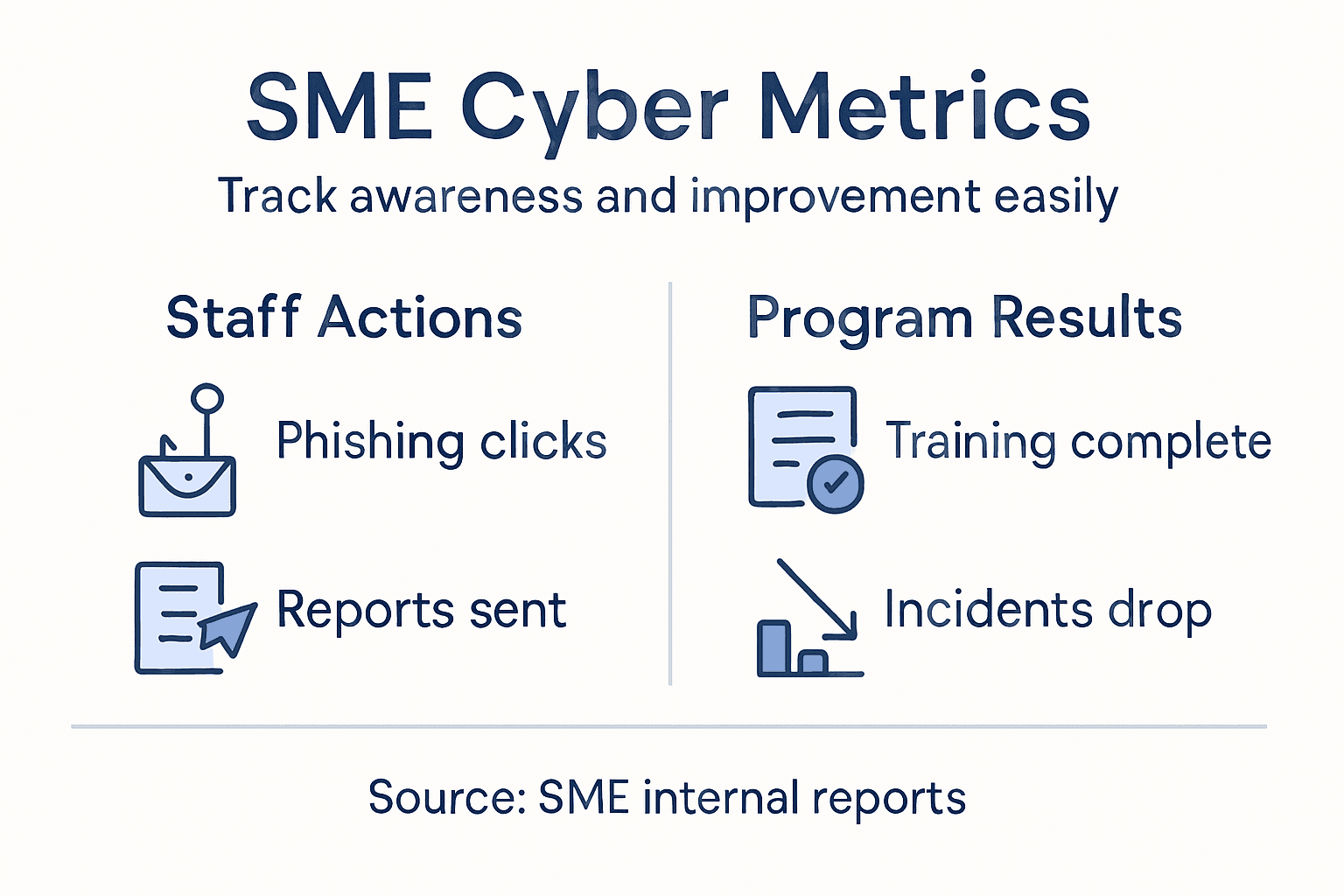
Data-driven insights and stakeholder feedback help organisations refine awareness strategies continually and adapt to emerging threats. The 2023-2030 Australian Cyber Security Strategy emphasises this approach because it works. You measure, you learn, you adjust.
Here’s what to track:
- Phishing click rates over time (aim for steady decline as training takes effect)
- Email reporting numbers from staff catching suspicious messages
- Training completion rates and quiz scores across departments
- Incident reports such as password compromises or data disclosure near-misses
- Help desk tickets related to security questions or suspicious activity
Set up a simple dashboard or spreadsheet. Review metrics monthly. Notice trends. Are finance staff improving faster than operations? Do certain roles struggle more? These patterns guide your next moves.
The following table summarises key metrics for tracking and improving cyber awareness over time:
| Metric | What It Measures | Why It Matters |
|---|---|---|
| Phishing click rates | Staff susceptibility | Gauges training effectiveness |
| Email reporting numbers | Vigilance levels | Identifies engagement |
| Training completion rates | Programme reach | Ensures all roles covered |
| Security incident reports | Culture of transparency | Spots recurring weaknesses |
Research from the Cyber Wardens initiative shows that continuous monitoring of cyber safety behaviours enables targeted adjustments that strengthen cyber safety culture. This means your updates aren’t random. They’re based on what your actual data reveals about your team.
Measurement without action wastes time. Action without measurement wastes money.
Schedule quarterly reviews with your IT team and department heads. Ask what’s working and what needs changing. If phishing simulations show improvement, celebrate it. If click rates plateau, refresh your email templates. If specific roles lag, create targeted follow-up training.
Update your strategies at least twice yearly. New threats emerge constantly. Your awareness programmes must keep pace.
Pro tip: Create a simple one-page monthly report showing key metrics and share it company-wide to keep cyber security visible and demonstrate progress to staff.
Strengthen Your Business Cyber Security Awareness with IT Start
Improving cyber security awareness is essential for SMEs facing daily risks such as phishing attacks, social engineering scams, and authorisation fraud. Many businesses struggle with gaps in staff knowledge and behaviours that put sensitive client data and financial information at risk. With specialised challenges in financial services and other sectors, tailored training and ongoing support become critical to protect your operations and build a resilient workforce.
At IT Start, we understand these risks and offer proactive managed IT support and customised cybersecurity solutions built specifically for Brisbane-based businesses. Our expert team helps you assess your current cyber risk exposure, develop role-based training programs, implement phishing simulations, and monitor ongoing results to continually strengthen your security culture. Don’t leave your business vulnerable when experts are ready to partner with you for lasting protection.
Discover how IT Start can become your strategic cyber security partner. Take action now with a free cyber security assessment or engage our team for tailored solutions designed around your unique business needs. Visit our contact page today and start building a more secure future. For expert guidance on managed IT services and proactive security, explore our managed IT support and cybersecurity services to see how we help Queensland SMEs operate confidently and compliantly.
Frequently Asked Questions
How can I assess my team’s current cyber security awareness levels?
Start by conducting anonymous surveys to gauge confidence in recognising phishing emails and handling sensitive data. Additionally, review recent incident reports and interview key staff to identify knowledge gaps and vulnerabilities within 30 days.
What type of training should I provide to my staff for improved cyber security awareness?
Tailor training content to specific roles within your firm, focusing on the unique cyber risks each position faces. Design bite-sized, engaging modules that utilise real-life scenarios to ensure relevance and retention.
How often should I conduct phishing simulations for my employees?
Run phishing simulations monthly or quarterly to reinforce lessons and improve recognition skills. Gradually increase the complexity of these simulations so that employees are better prepared for real threats over time.
What metrics should I track to monitor the effectiveness of my cyber security awareness programs?
Track metrics such as phishing click rates, email reporting numbers, and incident reports to measure improvements. Review these metrics monthly to identify trends and adapt your strategies accordingly.
How can I encourage my team to report suspicious emails?
Create a simple reporting system that makes it easy for staff to flag suspicious emails. Recognise and reward those who report these attempts to foster a culture of vigilance and accountability within your firm.
Recommended
- Cyber Security Actions for Brisbane Businesses – IT Start
- What Is Cyber Security Like for Brisbane SMEs – IT Start
- 7 Key Cybersecurity Risks Examples Every Brisbane SME Should Know – IT Start
- How to Improve Cyber Security for Brisbane SMEs Easily – IT Start
- 7 Most Common Cyber Attack Tips For Miami CPA Firms