

TL;DR:
- Vulnerability assessments identify and prioritize security weaknesses across IT environments to reduce cyber risks. Regular, repeatable scans, combined with clear remediation timelines, significantly improve cybersecurity posture for SMBs. Building a structured cycle of assessment, prioritization, and fixing is essential for ongoing protection.
A vulnerability assessment is defined as a systematic process to identify, classify, and prioritise security weaknesses across an organisation’s IT environment before attackers can exploit them. This is the starting point for any serious cyber security programme, and the numbers make the case clearly. Approximately 59,000 new CVEs are forecast for 2026, up from 48,185 in 2025. That is not a slow drip of risk. It is a flood, and most Australian SMBs are standing in it without knowing where the holes are. Understanding what a vulnerability assessment covers, how the process works, and why it matters is the foundation of sound IT security for Brisbane businesses.
What is vulnerability assessment in cyber security?
A vulnerability assessment is broader than running a scanner. Assessment includes business context and asset awareness, not just automated scanning results. That distinction matters enormously in practice.
The process maps every asset in your environment, identifies weaknesses against known vulnerability databases, and then ranks those weaknesses by the actual risk they pose to your business. NIST defines this under its Risk Management Framework, and the Australian Cyber Security Centre references similar structured approaches in its Essential Eight guidance. The goal is not a list of every flaw. The goal is a prioritised picture of what genuinely threatens your operations.
One finding that surprises most business owners: only about 2% of discovered vulnerabilities are actively exploited at any given time. That means a raw scan result with hundreds of findings is mostly noise. A proper assessment filters that noise and tells you what to fix first.
How does the vulnerability assessment process work in practice?
A well-run assessment follows a clear sequence. Skipping steps is where most organisations get into trouble.
- Asset inventory. You cannot assess what you do not know exists. Start by cataloguing every device, application, and cloud service in scope. We see this step skipped constantly, and it always creates blind spots.
- Pre-scan preparation. Confirm credentials, verify backups, and check monitoring are active before any scanning begins. Skipping pre-checks causes false positives and, in some cases, service disruptions during the scan itself.
- Automated scanning. Run authenticated scans across your environment using a recognised vulnerability scanner. Authenticated scans produce far more accurate results than unauthenticated ones.
- Vulnerability identification. Match scan findings against CVE databases and vendor advisories to confirm what is real and what is a false positive.
- Risk classification. Score each finding using a framework like CVSS, but do not stop there. CVSS alone produces noisy results because fewer than 1% of published vulnerabilities are ever weaponised. Layer in asset criticality and threat intelligence to get a meaningful score.
- Prioritisation. Rank findings by the combination of exploitability, asset value, and business impact. A critical CVE on an internet-facing server beats a medium CVE on an isolated test machine every time.
- Remediation planning and reporting. Produce a report that maps findings to owners, timelines, and actions. A finding without an owner is a finding that never gets fixed.
Pro Tip: Run your asset inventory before you book the scan. An incomplete inventory means an incomplete assessment. Use your IT asset management records as the starting point, and reconcile them against what the scanner actually finds.
The most common pitfall is treating a vulnerability assessment as a one-off project. One scan tells you where you stood on one day. Threats change, systems change, and new CVEs appear daily. A single assessment is useful. A repeatable cycle is what actually reduces risk.
What are the main types of vulnerability assessments?
Different parts of your environment need different assessment approaches. Choosing the right type depends on what you are trying to protect.
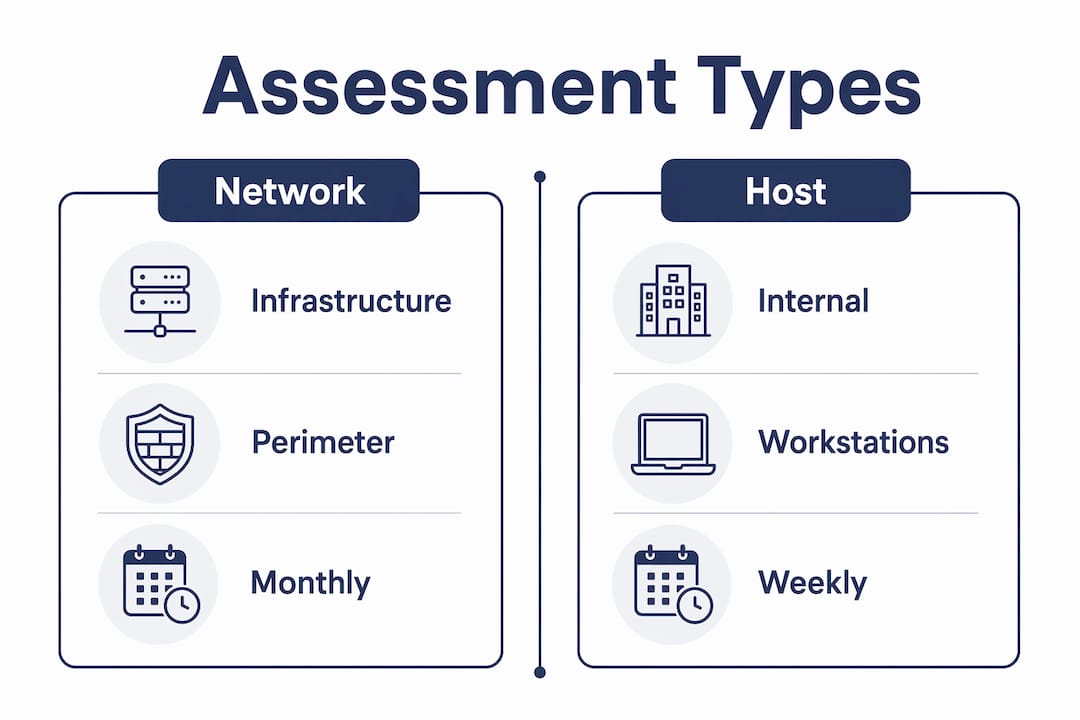
- Network vulnerability assessment. Scans infrastructure including routers, switches, firewalls, and servers for known weaknesses and misconfigurations. This is the most common starting point for SMBs.
- Host-based assessment. Examines individual endpoints and servers in detail, including patch levels, local configurations, and installed software. More granular than a network scan.
- Application vulnerability assessment. Tests web applications and APIs for flaws like SQL injection, cross-site scripting, and authentication weaknesses. Critical for any business running customer-facing software.
- Cloud-specific assessment. Reviews cloud configurations, identity permissions, and storage settings. Cloud environments change rapidly, which makes point-in-time assessments less useful here.
The table below summarises the key differences between assessment types and related practices.
| Method | Focus | Frequency | Best for |
|---|---|---|---|
| Network assessment | Infrastructure and perimeter | Monthly or quarterly | All SMBs as a baseline |
| Host-based assessment | Endpoints and servers | Quarterly | Environments with sensitive data |
| Application assessment | Web apps and APIs | Per release or quarterly | Businesses with customer-facing systems |
| Cloud assessment | Cloud configs and permissions | Continuous or monthly | Cloud-native or hybrid environments |
| Penetration testing | Exploiting confirmed weaknesses | Annually or post-assessment | Validating remediation effectiveness |
Vulnerability assessment is a point-in-time snapshot. Vulnerability management is the ongoing lifecycle that includes continuous scanning, tracking, and remediation. Cloud and container environments in particular need continuous assessment because their configurations change so frequently that a quarterly scan misses too much.
Penetration testing is a separate activity. Assessments provide the foundation that makes penetration tests more targeted and effective. Running a penetration test without a prior assessment is like asking a surgeon to operate without an X-ray.
Why is vulnerability assessment essential for managing cyber risk?
The financial case is straightforward. The global average cost of a data breach reached approximately $4.44 million in 2025. For Australian SMBs, a breach at even a fraction of that figure is a business-ending event for many. The good news is that regular assessments reduce threat exposure by up to 50%, primarily because most breaches exploit known, unpatched vulnerabilities rather than sophisticated zero-day attacks.
Regulatory pressure is also real. The Australian Privacy Act, the Notifiable Data Breaches scheme, and industry frameworks like PCI DSS all expect organisations to demonstrate they actively identify and manage security weaknesses. A documented vulnerability assessment programme is evidence of that effort.
Pro Tip: Define your remediation SLAs before you start scanning. Without them, findings sit in a spreadsheet indefinitely. A practical starting point: 72 hours for critical vulnerabilities and 30 days for medium severity issues.
Prioritisation is where most organisations fail after the scan. They receive a report with 300 findings and either panic or ignore it. The right approach is to focus remediation on the small subset of vulnerabilities that are both exploitable and attached to critical assets. That is where the real risk lives.
- Patch internet-facing systems first. They carry the highest exposure.
- Address any finding with a known public exploit immediately, regardless of CVSS score.
- Treat unpatched systems with no business justification as a policy failure, not just a technical one.
- Review findings against your IT asset inventory to confirm asset criticality before assigning priority.
What practical steps can Australian SMBs take to implement effective assessments?
Most SMBs we work with have never had a formal vulnerability assessment. They have antivirus, maybe a firewall, and a vague sense that someone is watching. That is not a security posture. Here is what actually works.
Start with your asset inventory. You need to know what you have before you can assess it. This includes shadow IT, personal devices used for work, and cloud services staff have signed up for without IT approval. We find unmanaged assets in almost every environment we assess. A solid IT asset management process is the prerequisite, not an optional extra.
Use automated scanning tools with expert review. Automated scanners cover ground quickly and consistently. But they produce results that need interpretation. A scanner will flag a vulnerability on a decommissioned test server the same way it flags one on your production finance system. An experienced reviewer applies business context to separate the urgent from the irrelevant.

Set remediation timelines before you scan. This is the step most businesses skip, and it is the reason assessments fail to reduce risk. If there is no agreed timeline for fixing findings, they accumulate. Define who owns each finding, what the fix is, and when it must be done. Then track it.
Scan monthly at minimum. Quarterly scanning was acceptable five years ago. With nearly 59,000 CVEs expected in 2026, a three-month gap between scans is too long. Monthly scanning for network and host-based assessments, with continuous monitoring for cloud environments, is the current best practice.
- Integrate assessment findings into your change management process so new systems are assessed before they go live.
- Review your scope regularly. New cloud services, remote workers, and acquired businesses all expand your attack surface.
- Do not rely on a single tool. Combine network scanning with application testing and network assessment reviews for full coverage.
- Train staff to report suspicious activity. Cybersecurity awareness training reduces the human risk that no scanner can catch.
Pro Tip: After your first assessment, do not try to fix everything at once. Pick the top ten findings by risk score and business impact, fix those, then rescan. Incremental progress beats paralysis every time.
The businesses that get the most value from assessments are the ones that treat them as a regular operating rhythm, not a compliance checkbox. Build it into your quarterly IT review, assign ownership, and track remediation the same way you track any other business project.
Key takeaways
A vulnerability assessment is the most direct way to reduce cyber risk, but only when paired with defined remediation timelines and a repeatable scanning cycle.
| Point | Details |
|---|---|
| Definition and scope | A vulnerability assessment systematically identifies, classifies, and prioritises security weaknesses across your IT environment. |
| Prioritisation over volume | Only about 2% of vulnerabilities are actively exploited; focus remediation on that subset, not every finding. |
| Remediation SLAs matter | Define timelines before scanning: 72 hours for critical issues, 30 days for medium severity, with named owners. |
| Assessment vs management | A single assessment is a snapshot; vulnerability management is the ongoing cycle needed to stay ahead of new threats. |
| SMB starting point | Begin with asset inventory, run monthly authenticated scans, and combine automated tools with expert review. |
Honestly, most SMBs are flying blind
We have run assessments for businesses that were convinced they had no significant vulnerabilities. They had antivirus, a firewall, and a managed switch. Every single one had critical findings. Unpatched servers, open RDP ports, admin accounts with no MFA, cloud storage buckets with overly permissive access. The list is always longer than the client expects.
The thing that frustrates me most is not the vulnerabilities themselves. It is the lack of prioritisation after the fact. Businesses receive a report and either hand it to someone who does not have the authority to fix anything, or they file it and move on. A vulnerability assessment without a remediation plan is just an expensive document.
Cloud environments have made this harder. Configurations change constantly, new services spin up, and permissions drift. A quarterly scan of a cloud environment misses weeks of exposure. Continuous assessment is not optional for businesses running significant workloads in Azure or Microsoft 365.
The businesses that genuinely improve their security posture are the ones that build a repeatable cycle: scan, prioritise, fix, rescan. They treat it like a business process, not a one-time project. That is the only approach that actually works in practice.
— Matt
How IT Start supports your vulnerability assessment programme
IT Start works with Brisbane SMBs to run structured vulnerability assessments, interpret findings in business terms, and build remediation plans that actually get executed. Our cyber security services cover vulnerability scanning, risk prioritisation, and ongoing management so findings do not sit unaddressed. We also support cloud environments through our cloud services, where continuous assessment is built into how we manage your environment. If you have never had a formal assessment, or your last one produced a report that went nowhere, get in touch with the IT Start team for a straightforward conversation about where your business stands.
FAQ
What is the difference between a vulnerability assessment and a penetration test?
A vulnerability assessment identifies and ranks security weaknesses across your environment. A penetration test goes further by actively attempting to exploit confirmed weaknesses to measure real-world impact. Assessments should come first because they make penetration tests more targeted and effective.
How often should an SMB run a vulnerability assessment?
Monthly scanning is the current best practice for network and host-based assessments. Cloud environments benefit from continuous monitoring given how frequently configurations change.
What tools are used in a vulnerability assessment?
Assessments combine automated network scanners with manual expert review. Authenticated scanning tools check systems against CVE databases, while analysts apply business context to filter noise and prioritise genuine risks.
Does a vulnerability assessment satisfy compliance requirements?
A documented assessment programme supports compliance with the Australian Privacy Act, the Notifiable Data Breaches scheme, and frameworks like PCI DSS. Compliance bodies expect evidence of active, ongoing vulnerability identification and remediation, not a single annual scan.
What happens after a vulnerability assessment is completed?
The assessment produces a prioritised findings report. Each finding should be assigned an owner, a remediation action, and a deadline. Critical vulnerabilities require a 72-hour response timeline. Medium severity issues should be resolved within 30 days.