
TL;DR:
- Digital transformation replaces outdated workflows with integrated technology to improve Brisbane businesses’ operations. Successful projects are driven by clear goals, structured sprints, and ongoing IT support to prevent data silos and improve local search visibility. Consistent management of online profiles and connecting existing tools help sustain growth and maximize operational benefits.
Digital transformation is the process of replacing outdated workflows and disconnected tools with integrated technology that improves how your Brisbane business operates and serves customers. Done properly, it is not a single project. It is a series of deliberate upgrades, each tied to a measurable business outcome. Brisbane businesses that have taken this approach have seen results as significant as 247% sales growth after combining digital upgrades with conversion-focused web design. The industry term for this process is digital transformation, and consulting projects in Brisbane typically run between 4 and 12 weeks, using sprint-based delivery to build minimum viable products before scaling further.
What does your Brisbane business need before starting digital transformation?
The biggest barrier to a successful Brisbane business digital upgrade is not technology. Legacy systems and siloed data are the primary obstacles, and businesses that skip a clear digital roadmap almost always stall partway through. That roadmap needs to connect every technology decision back to an operational goal, not just a wish list of new tools.
We see this constantly with clients who come to us after a failed project. They bought software, hired a developer, launched something, and then found their customer data was still in three separate spreadsheets. The technology worked in isolation. The business did not improve.
Before you spend a dollar on new tools, get clear on these foundations:
- Business goals first. Define what you want to achieve: faster quoting, fewer manual errors, better customer visibility. Technology follows the goal, not the other way around.
- Audit your current systems. Map every tool, every manual process, and every data source. Identify where data gets stuck or duplicated.
- Assign ownership. Every digital initiative needs one internal owner who is accountable for outcomes, not just delivery.
- Set a realistic budget. Include implementation, training, and ongoing support. Most businesses underestimate the last two.
A well-structured IT roadmap for Brisbane SMBs gives you a prioritised plan that aligns technology investment with where the business is actually heading.
Pro Tip: Before committing to any platform, check whether it integrates with your existing accounting software, CRM, or Microsoft 365 environment. Integration gaps are where projects die.
The table below shows the most common project models Brisbane businesses use when starting out.
| Project model | Best suited for | Typical timeline |
|---|---|---|
| Fixed scope | Defined deliverables, limited budget | 4–8 weeks |
| Time and materials | Evolving requirements, complex systems | 6–12 weeks |
| Monthly retainer | Ongoing improvement and support | Ongoing |
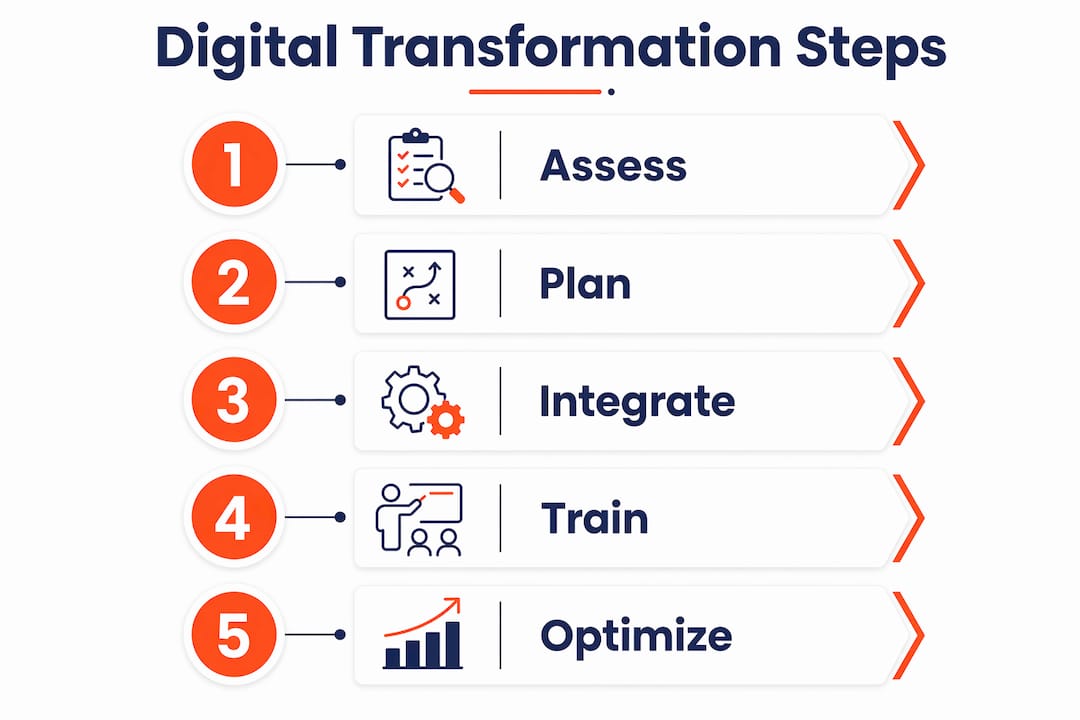
How to implement digital transformation step by step in a Brisbane SMB

A structured delivery model for Brisbane businesses includes team mentoring, clear code standards, technical leadership, and sprint-based iterations. That structure exists for a reason. Without it, projects drift, budgets blow out, and the business ends up with half-finished tools nobody uses.
Here is the practical sequence that works.
-
Run a discovery and assessment phase. Spend two to four weeks mapping current workflows, identifying bottlenecks, and interviewing the people who do the actual work. Do not rely on what management thinks happens. Find out what actually happens.
-
Prioritise by impact and effort. Not every problem needs solving first. Rank initiatives by how much they affect revenue or cost, and how difficult they are to fix. Start with high-impact, lower-effort wins.
-
Build a minimum viable product. Deliver a working version of the most critical improvement first. A basic automated quoting workflow beats a perfect one that takes six months to build.
-
Run sprint cycles. Work in two-week sprints. Test each sprint output with real users before moving on. This catches problems early, when they are cheap to fix.
-
Integrate automation and connected workflows. Once the core system works, layer in automation. Connecting your CRM to your email platform, or your job management tool to your invoicing software, removes the manual steps that slow everything down.
-
Redesign customer-facing touchpoints. Your website and booking or enquiry process should reflect the same efficiency you are building internally. Conversion-focused design is not cosmetic. It directly affects revenue.
-
Train your team properly. A new system nobody knows how to use is worse than the old system. Budget for training as part of the project, not an afterthought.
Pro Tip: The most common mistake we see is businesses skipping the discovery phase to save money. They spend twice as much fixing problems that a proper assessment would have caught in week one.
Avoid relying on disconnected tools that do not talk to each other. A project management app, a separate invoicing tool, and a standalone CRM with no integration creates three data silos instead of one. That is not a digital upgrade. That is a more expensive version of the same problem.
What local SEO and digital marketing tactics help Brisbane businesses after a digital upgrade?
Upgrading your internal systems is only half the picture. If local customers cannot find you online, the operational improvements do not translate into growth. This is where digital marketing tactics specific to Brisbane make a real difference.
70% of mobile clicks for Brisbane local searches happen in Google’s Map Pack. That means your Google Business Profile is not optional. It is one of the highest-return assets a local business can manage.
“Consistent Google Business Profile management and NAP (name, address, phone) consistency are critical ranking factors for Brisbane businesses competing in local search.”
Practical tactics that move the needle:
- Update your Google Business Profile weekly. Adding photos weekly increases direction requests by 42%. Most Brisbane SMBs upload photos once and forget them.
- Keep NAP consistent. Your business name, address, and phone number must be identical across your website, Google Business Profile, and every directory listing. Inconsistency hurts your map ranking.
- Use suburb-specific content. A Brisbane plumber serving Paddington, Toowong, and Indooroopilly should have content that names those suburbs. Generic content does not rank for local intent.
- Implement schema markup. Structured data using schema.org helps search engines understand your business details, improving your chances of appearing in rich search results.
- Analyse mobile behaviour. Most local searches happen on mobile. If your site loads slowly or your enquiry form is hard to use on a phone, you are losing leads before they contact you.
These tactics compound. A business with a well-managed Google Business Profile, consistent NAP data, and fast mobile experience will outrank a competitor with better services but a neglected online presence.
How to maintain and scale digital transformation for sustained growth
Getting the initial transformation done is the hard part. Keeping it working and building on it is where most Brisbane businesses fall short. Growing businesses need to move beyond basic websites toward integrated systems that handle lead management, automation, and connected data. A website that generates enquiries is a starting point, not a destination.
Pro Tip: Set a quarterly review date for every digital system you run. Check whether it is still doing what you built it to do, and whether the business has grown past it.
The most common growth plateau we see comes from siloed data. A business adds a new tool every time it hits a problem, and within two years it has eight platforms that do not share information. The fix is not another tool. It is connecting the ones you already have.
Key practices for scaling sustainably:
- Monitor system performance with real data. Use dashboards that show you lead volume, conversion rates, and operational throughput. If you cannot measure it, you cannot improve it.
- Review cybersecurity as complexity grows. More connected systems mean more attack surface. Businesses that add cloud tools without reviewing their cybersecurity posture create new vulnerabilities with every integration.
- Plan for ongoing IT support. Digital systems need maintenance. Software updates, security patches, and configuration changes are not one-off tasks. They are ongoing responsibilities.
- Scale staffing with systems. As your digital infrastructure grows, consider whether your internal team has the capacity to manage it. Offshore staffing models can support operational scaling without the overhead of full-time local hires.
The table below shows what a mature digital operation looks like compared to a basic setup.
| Capability | Basic setup | Mature digital operation |
|---|---|---|
| Customer data | Spreadsheets or single CRM | Integrated CRM with automated workflows |
| Invoicing | Manual or standalone software | Connected to job management and accounting |
| Cybersecurity | Antivirus only | MFA, endpoint protection, monitored backups |
| Reporting | Ad hoc, manual | Automated dashboards with real-time data |
Key takeaways
Digitally transforming a Brisbane business succeeds when technology decisions are tied to specific operational goals, delivered in structured sprints, and supported by ongoing IT management and local digital marketing.
| Point | Details |
|---|---|
| Roadmap before tools | Define business goals and audit current systems before selecting any technology. |
| Sprint-based delivery | Build minimum viable products first, then iterate based on real user feedback. |
| Local SEO amplifies results | Manage your Google Business Profile weekly and keep NAP data consistent across all listings. |
| Integration over addition | Connect existing tools rather than adding new ones to avoid data silos. |
| Ongoing support is non-negotiable | Cybersecurity, updates, and system reviews must be maintained after the initial transformation. |
What I have seen Brisbane businesses get wrong about digital transformation
Honestly, most Brisbane SMBs I have worked with come to us after a bad experience with a previous project. The pattern is almost always the same. Someone sold them a website or a new platform, delivered it, and walked away. Six months later, nothing has changed operationally. The business is paying for a tool nobody fully uses.
The technology is rarely the problem. The problem is that nobody mapped the workflow before building the solution. A quoting tool built without understanding how the sales team actually quotes is going to be ignored. We see this a lot with Microsoft 365 rollouts too. Businesses pay for the licences, get the email set up, and never touch SharePoint, Teams, or any of the collaboration features. They are paying for a system they are using at about 20% of its capacity.
The other thing I push back on hard is the idea that digital transformation is a one-time event. It is not. The businesses that get the best results treat it as an ongoing discipline. They review their systems quarterly, they fix things that have drifted, and they add capability when the business genuinely needs it. That is very different from buying something new every time a vendor sends a good pitch.
The benefits of IT consulting are real, but only when the consultant is focused on your business outcomes, not their preferred technology stack. Ask any consultant you engage what they will measure success by before you sign anything.
— Matt
How IT Start supports Brisbane businesses through digital change
IT Start works with Brisbane SMBs across professional services, healthcare, legal, and financial services to build and maintain the IT foundations that make digital transformation stick. That means managed cloud services configured for your actual workflows, cybersecurity that grows with your systems, and ongoing business IT support that keeps everything running after the initial project is done. IT Start holds SMB 1001 Gold certification, which means the security standards applied to your environment are independently verified. If you want a clear picture of where your business sits and what to fix first, IT Start offers a free assessment to get you started without any obligation.
FAQ
How long does digital transformation take for a Brisbane SMB?
Most Brisbane digital transformation projects run between 4 and 12 weeks for the initial phase, using sprint-based delivery to build and test improvements incrementally.
What is the biggest mistake Brisbane businesses make with digital transformation?
Skipping the discovery and planning phase is the most common mistake. Businesses that buy tools before mapping their workflows end up with disconnected systems that do not solve the original problem.
How does Google Business Profile affect digital transformation results?
Google Business Profile management directly affects how many local customers find your business. Adding photos weekly increases direction requests by 42%, making it one of the highest-return tactics available to Brisbane SMBs.
Do I need ongoing IT support after a digital transformation project?
Yes. Connected digital systems require regular security updates, configuration reviews, and monitoring. Without ongoing support, systems drift and vulnerabilities accumulate.
What is an IT roadmap and why does a Brisbane business need one?
An IT roadmap is a prioritised plan that connects technology investments to business goals. It prevents reactive, disconnected purchasing and gives your digital transformation a measurable direction.