

TL;DR:
- A technical information security officer manages an organization’s security controls and communicates risks to executives. They possess extensive hands-on security experience and authority to enforce compliance, unlike roles focused solely on policy or infrastructure. SMEs can adopt hybrid models like vCISO or managed service providers to fulfill TISO functions affordably.
A technical information security officer (TISO) is a specialist leader who owns an organisation’s technical security controls and translates risk findings into language executives can act on. The role sits at the intersection of hands-on security work and business risk management. For small and medium-sized businesses in Brisbane and across Queensland, getting this function right is one of the most consequential cybersecurity decisions you will make. This guide covers what a TISO actually does, what qualifications matter, how the role differs from a CISO or IT Manager, and what practical options exist when a full-time hire is not yet feasible.
What does a technical information security officer do?
A TISO is responsible for the technical side of an organisation’s security posture, not just the paperwork. The role covers compliance evaluation across frameworks like ISO 27001, NIST, and SOC 2, alongside hands-on tasks like vulnerability management and privileged access control. That combination is what separates a TISO from a pure compliance officer.
Core responsibilities include:
- Compliance management. Evaluating and maintaining alignment with ISO 27001, NIST CSF, SOC 2, and relevant Australian standards.
- Asset security testing. Running or overseeing vulnerability assessments and penetration tests to identify weaknesses before attackers do.
- Privileged access management. Controlling who can access critical systems and enforcing least-privilege principles across the environment.
- Incident escalation. Acting as the technical escalation point when a security event occurs, managing incident response and restoring information confidentiality.
- Remediation planning. Defining the specific steps IT teams need to take after a vulnerability or breach is identified.
- Security policy enforcement. Writing and enforcing policies that govern how staff and systems handle sensitive data.
The TISO also serves as the bridge between technical teams and executive leadership. When the board asks “are we secure?”, the TISO is the person who can answer with evidence, not reassurance.
Pro Tip: If your TISO candidate cannot explain a firewall misconfiguration to a non-technical executive in under two minutes, they are not ready for the role. Communication is as important as technical skill.

The incident management function includes monitoring security reports, coordinating response teams, and verifying that systems are restored securely after an event. That is not a task you can delegate to a general IT support person.
What qualifications should you look for when hiring a TISO?
Effective information security officers typically bring 8–12 years of security experience to the role, including 3–5 years in a leadership position. That experience baseline matters because the TISO needs to have seen real incidents, not just studied them.
Certifications worth prioritising:
- CISSP (Certified Information Systems Security Professional): the most widely recognised credential for senior security roles.
- CISM (Certified Information Security Manager): focuses on governance and risk management alongside technical skills.
- CSOC (Cyber Security Officer Certification): a growing credential that bridges technical knowledge with governance, gaining traction for security leadership roles.
- DoD 8570-compliant certifications: relevant for organisations working with government or defence supply chains.
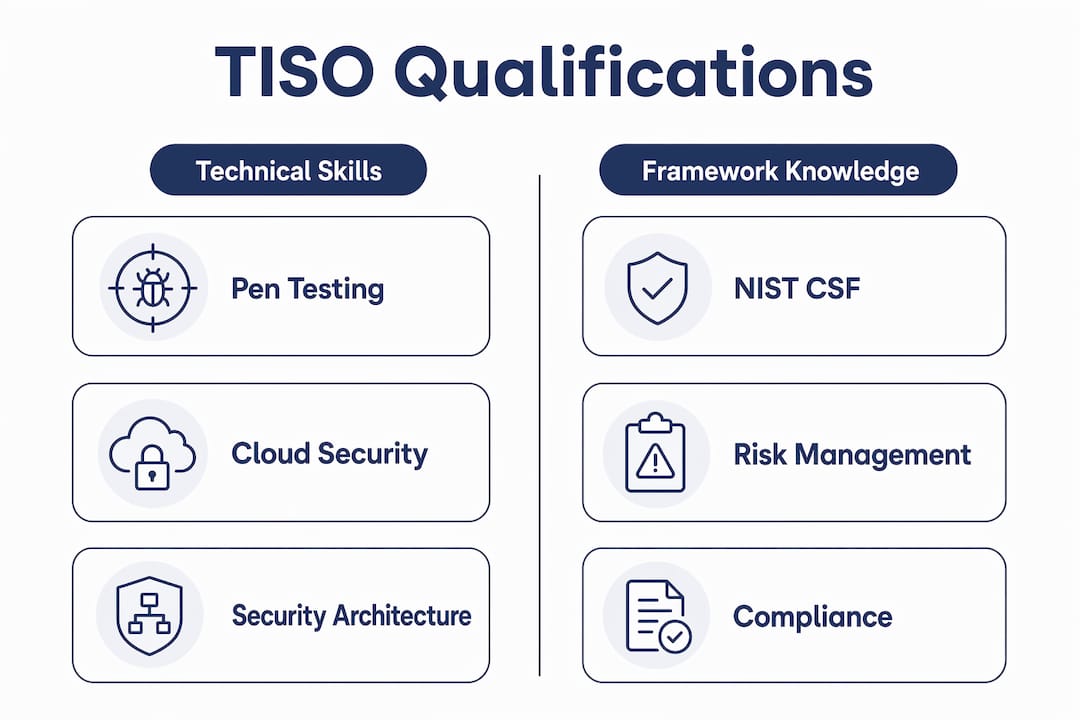
Framework knowledge is equally important. Employers consistently prioritise mastery of NIST CSF, the Risk Management Framework (RMF), and CMMC for roles involving regulated data or government contracts. For most Brisbane SMEs, NIST CSF and ISO 27001 are the practical starting points.
The technical foundation should include penetration testing experience, security architecture design, and cloud security. A candidate who has only ever worked in on-premises environments will struggle with the hybrid Microsoft 365 and cloud setups that most SMEs now run.
Pro Tip: Ask candidates to walk you through a real incident they managed. Compliance-only hires who lack hands-on architecture experience typically struggle to implement effective defences. The story they tell about a real incident reveals more than any certification list.
For more on which cyber security certifications carry the most weight for Brisbane businesses, the landscape has shifted considerably in the past two years.
| Qualification | Why it matters for SMEs |
|---|---|
| CISSP | Demonstrates broad security knowledge across architecture, risk, and operations |
| CISM | Governance and risk focus, useful for board-level reporting |
| CSOC | Combines technical and governance skills in a single credential |
| NIST CSF mastery | Directly applicable to building and auditing security programmes |
| Penetration testing experience | Proves the candidate can find real vulnerabilities, not just document them |
How does a TISO differ from a CISO, IT Manager, or security analyst?
The confusion between these roles costs SMEs real money. Businesses hire the wrong person, then wonder why their security posture does not improve.
A TISO focuses on technical risk and compliance enforcement. A Chief Information Security Officer (CISO) operates at the strategic level, setting organisational security direction, managing budgets, and reporting to the board. The TISO executes within that direction. In smaller organisations without a CISO, the TISO often absorbs some of that strategic function, which is why the technical-business balance is so critical.
The distinction from an IT Manager is sharper. An IT Manager focuses on infrastructure availability: keeping systems running, managing vendors, and resolving helpdesk tickets. A TISO focuses on risk governance. Critically, a TISO has the authority to reject or delay changes that introduce unacceptable security risk, even when the IT Manager wants to push them through. That authority creates friction, and that friction is the point.
A cybersecurity analyst or technical security analyst handles day-to-day security operations: monitoring alerts, investigating events, and running scans. The TISO sets the direction for that work, defines what gets monitored, and makes the calls when an analyst escalates something serious.
| Role | Primary focus | Authority level |
|---|---|---|
| CISO | Organisational security strategy | Executive, board-facing |
| TISO / information security manager | Technical risk and compliance | Operational, can reject risky changes |
| IT Manager | Infrastructure availability | Operational, focused on uptime |
| Cybersecurity analyst | Day-to-day monitoring and response | Executes under TISO direction |
The roles of information security officers across these levels are complementary, not interchangeable. Trying to get your IT Manager to cover TISO responsibilities is one of the most common mistakes we see in SMEs with 20 to 50 staff.
How can SMEs incorporate the TISO function practically?
A full-time TISO is not always financially viable for a business with 15 or 25 staff. That is a real constraint, not an excuse to skip the function entirely.
The most practical options for Brisbane SMEs in 2026:
-
Virtual CISO (vCISO) with a technical lead. A vCISO provides governance oversight and board-level reporting on a part-time or retainer basis. A technical lead inside the business handles daily operations. This hybrid model gives you both governance and execution without the cost of two full-time senior hires.
-
Managed security provider with embedded TISO functions. A managed security provider can deliver vulnerability management, compliance monitoring, incident response, and policy enforcement as a service. The IT security compliance work gets done without a dedicated internal headcount.
-
Fractional TISO engagement. Some security professionals work across multiple SME clients on a fractional basis. This works well for businesses that need genuine technical depth but cannot justify a full salary.
-
Upskilling an existing technical lead. If you have a capable IT or security person internally, investing in CISSP or CISM training and pairing them with a vCISO for governance can work. The risk is that they get pulled back into helpdesk work when things get busy.
The common pitfall is underestimating the technical depth required. We see businesses hire a compliance consultant, call them a security officer, and then wonder why their security frameworks never get implemented properly. Compliance knowledge without hands-on technical skill produces documentation, not defence.
Pro Tip: When evaluating managed security providers or vCISO candidates, ask specifically about their experience with your industry’s compliance requirements. A provider who has worked with Brisbane healthcare or financial services firms will already understand the ACSC Essential Eight and relevant regulatory expectations.
Security officers are also evolving beyond policy writing into roles that integrate security by design during cloud migrations and infrastructure changes. If your business is moving workloads to the cloud, the TISO function needs to be involved from the planning stage, not brought in to review decisions already made.
Key takeaways
A TISO is the most technically grounded security leadership role an SME can hire, combining hands-on risk management with the authority to enforce security decisions across the business.
| Point | Details |
|---|---|
| Core TISO responsibilities | Cover compliance, vulnerability management, privileged access, incident escalation, and policy enforcement. |
| Qualifications that matter | CISSP, CISM, CSOC, and NIST CSF mastery, backed by 8–12 years of real security experience. |
| TISO vs IT Manager | A TISO governs risk and can reject insecure changes; an IT Manager focuses on keeping systems running. |
| SME implementation options | Hybrid vCISO models and managed security providers deliver TISO functions without full-time headcount costs. |
| Biggest hiring mistake | Choosing compliance-only candidates who lack hands-on security architecture experience. |
Why the TISO role is misunderstood in most SMEs
Honestly, the TISO role gets misunderstood more than almost any other position in cybersecurity. I have seen businesses hand the title to their most senior IT person, give them no additional authority, and then act surprised when nothing changes. The title without the authority is just a label.
What makes a TISO effective is the combination of technical credibility and organisational standing. They need to be able to say “no” to a system change that introduces risk, and have that decision stick. That requires backing from the executive team. Without it, the TISO becomes a compliance administrator who writes policies nobody reads.
We also see the opposite problem. Businesses hire someone with strong governance credentials but limited hands-on experience, then wonder why their vulnerability remediation backlog never shrinks. A TISO who cannot read a penetration test report and translate it into a prioritised fix list is not doing the job. The technical depth is not optional.
The most effective model I have seen in Brisbane SMEs is a fractional or virtual arrangement where a technically strong security person works closely with the executive team on a regular cadence. Monthly reporting, quarterly risk reviews, and a clear escalation path for incidents. It is not glamorous, but it works. The businesses that do this consistently have better security posture than those with a full-time person who is buried in helpdesk tickets.
— Matt
How IT Start supports SME cybersecurity leadership
IT Start works with Brisbane SMEs that need the TISO function delivered without the overhead of a full-time hire. The team provides managed cybersecurity services covering vulnerability management, compliance monitoring against NIST and ISO 27001, incident response, and security policy development. For businesses moving to the cloud, IT Start’s cloud services integrate security controls from the start rather than bolting them on later. If your business needs a clearer picture of its current security posture or wants to understand what a practical TISO function would look like for your size and industry, IT Start offers assessments tailored to Queensland SMEs. Contact the team to discuss your situation directly.
FAQ
What is a technical information security officer?
A technical information security officer is a senior security leader who manages an organisation’s technical security controls, compliance obligations, and incident response. The role combines hands-on security expertise with the ability to communicate risk to executive leadership.
How many years of experience does a TISO need?
Effective TISOs typically have 8–12 years of security experience, including 3–5 years in a leadership role. Candidates with fewer years can work in analyst or technical security analyst positions while building toward the TISO level.
Can a small business afford a TISO?
Most small businesses cannot justify a full-time TISO salary. A hybrid model using a virtual CISO for governance and a managed security provider for technical operations delivers the same functions at a fraction of the cost.
What is the difference between a TISO and a CISO?
A CISO sets organisational security strategy and reports to the board. A TISO executes that strategy at the technical level, managing controls, compliance, and incidents. In smaller organisations, one person often covers both functions.
Which certifications matter most for a TISO role?
CISSP and CISM are the most widely recognised credentials for senior security roles. CSOC is gaining traction for roles that combine technical and governance responsibilities. Framework knowledge across NIST CSF and ISO 27001 is equally important for practical effectiveness.