

TL;DR:
- Effective ITIL cybersecurity integrates security controls into daily IT operations, enabling SMEs to manage risks proactively and maintain compliance.
- Key practices include continuous policy updates, rigorous access management, incident logging, and embedding security into service design and change processes.
- This approach operationalizes frameworks like ISO 27001 and NIST, providing a practical, process-driven method that enhances accountability and audit readiness without requiring dedicated security teams.
ITIL cyber security is the structured integration of Information Security Management within the ITIL 4 framework, embedding security controls directly into IT service processes rather than treating them as a separate compliance exercise. ITIL 4’s Information Security Management is one of 34 core practices, focused on protecting the confidentiality, integrity, and availability of information assets across the entire service value system. For IT managers in small to medium-sized enterprises, this matters because it gives you a repeatable, documented way to manage security that auditors, insurers, and clients can actually verify. Most SMEs we work with have the tools but not the process. ITIL fixes that.
What are the core ITIL cyber security practices SMEs should adopt?
ITIL 4 embeds security controls across technical, physical, and administrative domains within the service value system. This is not a checklist you run once a year. It is a set of ongoing practices woven into how your IT team operates every day. For SMEs, the most relevant practices are:
- Risk management. ITIL risk management is integral to the Service Value System, not a standalone activity. The goal is informed risk treatment, not risk elimination. That means documenting what you accept, what you mitigate, and why.
- Policy development and compliance monitoring. Security policies need to be living documents. Information Security Management must be continuously updated to align with evolving threats and business context. A policy written in 2021 and never reviewed is a liability.
- Security awareness and training. Embedding training into onboarding and regular operations reduces human error, which remains the leading cause of breaches in SME environments.
- Incident management and response. ITIL’s Incident Management practice provides the structure for logging, escalating, and resolving security events. Without this, incidents get handled ad hoc and leave no audit trail.
- Access management and change control. Every change to your environment should go through a documented approval process. This is where most SMEs fall down. We regularly see admin accounts shared across teams, no change log, and no way to trace who did what.
Pro Tip: Start with access management and incident logging before anything else. These two practices generate the documented evidence that auditors and cyber insurers ask for first.
The ITIL security framework does not replace tools like Microsoft Defender, CrowdStrike, or your SIEM. It provides the process layer that makes those tools accountable and traceable.

How does ITIL align with ISO 27001, NIST, and CIS Controls?
One of the most practical benefits of the ITIL security framework is that it speaks the same language as the other standards your business is likely already dealing with. Mapping ITIL to ISO 27001, NIST, and CIS Controls reduces duplication and creates a shared operational language that improves governance across the board.
| Framework | What it does | How ITIL connects |
|---|---|---|
| ISO 27001 | Defines information security controls and governance requirements | ITIL processes provide the operational evidence ISO 27001 audits require |
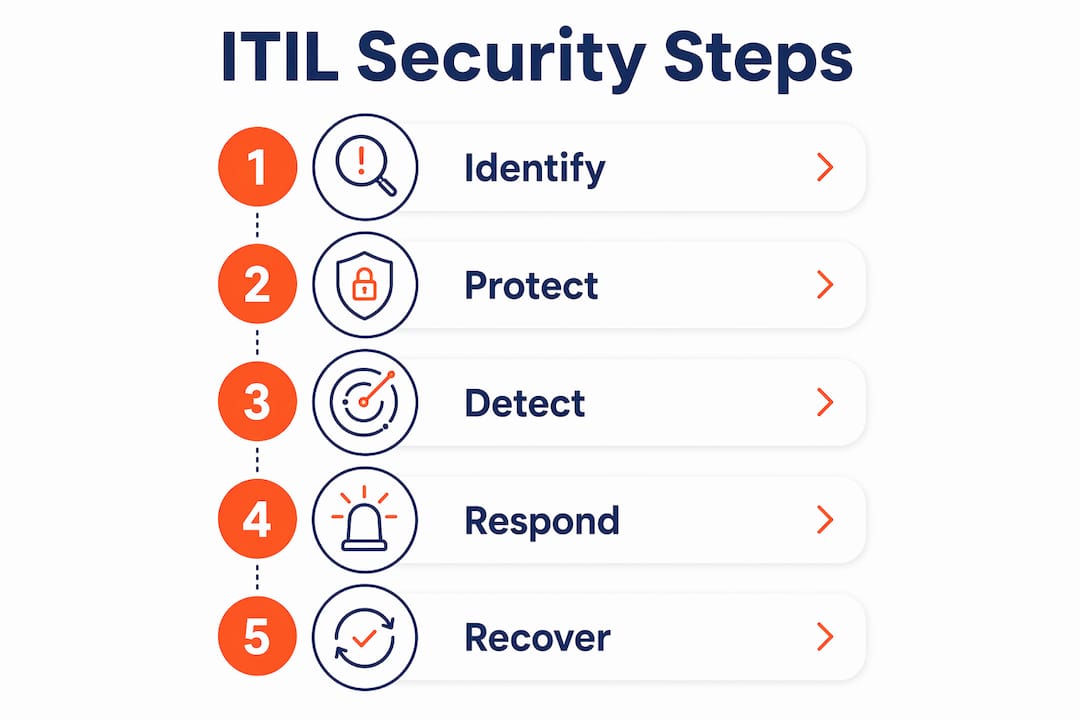
| NIST CSF | Structures incident response and control maturity across five functions | ITIL Incident and Problem Management map directly to NIST’s Respond and Recover functions |
| CIS Controls | Prioritises hardening and asset inventory for practical security | ITIL Change Enablement and Configuration Management support CIS asset tracking requirements |
The key insight here is that ITIL does not compete with these frameworks. It operationalises them. ISO 27001 tells you what controls to have. ITIL tells you how to run them day to day. NIST gives you a maturity model. ITIL gives you the process discipline to move up that model. For an SME trying to meet client contractual requirements or pass a cyber insurance assessment, this combination is far more practical than trying to implement any single framework in isolation.
ITIL operationalises governance, risk, and compliance by embedding controls into routine IT service operations rather than treating compliance as a separate project. That distinction matters enormously for teams without a dedicated security officer.
What practical steps embed ITIL security into daily operations?
This is where most guides go vague. Here is what actually works in practice for SMEs with 10 to 50 staff.
- Connect your security tools to your service desk. Automated ticket creation from security alerts bridges security events with ITSM workflows, reducing alert fatigue and ensuring every event is documented. If your Microsoft Defender alert fires and nobody logs a ticket, it did not happen as far as your audit trail is concerned.
- Use Problem Management for recurring security issues. When the same phishing attempt hits three staff members in a week, that is a Problem, not three separate Incidents. Root cause analysis through Problem Management generates the documented evidence auditors want and drives actual fixes rather than repeated band-aids.
- Apply Change Enablement to every security-relevant change. Firewall rule changes, new admin accounts, software installations. ITIL’s Problem and Change Management generate the approved change logs and root cause documentation that auditors consistently flag as missing.
- Shift security left using Security Stories. Security Stories are attacker-focused scenarios embedded in agile backlogs, aligning with ITIL 4 design principles. Fixing a security gap during design costs a fraction of what it costs after deployment. This applies even if you are not running formal agile sprints. Ask “how could this be attacked?” before you build or buy anything.
- Document your risk treatment decisions. Every risk you accept needs a written rationale. This protects you legally and operationally. We see this skipped constantly. Businesses accept risk by default because nobody wrote it down, and then they have no defence when something goes wrong.
Pro Tip: Map your existing Microsoft 365 security alerts directly to your helpdesk platform, whether that is ConnectWise, Autotask, or even a shared inbox with a ticketing add-on. The goal is zero unlogged security events.
For Queensland SMEs specifically, the IT security workflow approach of using managed security services to automate this integration is worth examining if your internal team does not have the capacity to manage it manually.
What challenges and misconceptions trip up SMEs using ITIL for security?
Honestly, the biggest mistake we see is treating Information Security Management as an audit activity rather than an operational one. A business will spend three weeks preparing documentation for a compliance review, then go back to doing nothing structured for the next 11 months. That is not ITIL. That is theatre.
The common pitfalls break down like this:
- Security siloed from IT operations. When the security function sits separately from the service desk, incidents get handled inconsistently. The ITIL security framework only works when security events flow through the same processes as every other IT event.
- Policies that never get reviewed. Information Security Management must be iterative and aligned with evolving business needs. A policy review cycle of at least every 12 months is the minimum. Threat environments change faster than that, but annual is better than never.
- No MFA, no matter how good the process. We work with clients who have documented ITIL processes and still have staff accounts without multi-factor authentication. Process without basic technical controls is not security. The cyber security best practices that underpin ITIL governance start with identity protection.
- Alert fatigue from unintegrated tools. When security alerts go to an email inbox that nobody monitors, the process has already failed. Integration between your security tooling and your ITSM platform is not optional if you want ITIL to function as intended.
- Assuming backups equal recovery. We see this constantly. Businesses believe they are backed up because a backup job runs nightly. Nobody has tested restoration. Nobody has documented the recovery time objective. ITIL’s Service Continuity Management practice exists precisely to close this gap.
The solution to most of these is cultural, not technical. Security needs to be part of how your IT team thinks about every ticket, every change, and every new service. That shift takes time, but it starts with embedding the right processes.
Key takeaways
Effective ITIL cyber security requires embedding Information Security Management into daily IT operations, not treating it as a periodic compliance task separate from service delivery.
| Point | Details |
|---|---|
| Security is an ITIL practice, not an add-on | ITIL 4 includes Information Security Management as one of 34 core practices, integrated across the service value system. |
| ITIL complements ISO 27001 and NIST | ITIL provides the operational processes that make other security frameworks auditable and repeatable in daily operations. |
| Automate alert-to-ticket workflows | Connect security tools to your ITSM platform so every alert generates a documented, trackable incident. |
| Shift security left in design | Embedding Security Stories in design phases costs far less than fixing vulnerabilities after deployment. |
| Policy review must be continuous | Security policies set and forgotten create compliance gaps; review cycles of at least 12 months are the minimum standard. |
Why I think most SMEs are doing ITIL security backwards
The businesses I work with that struggle most with security are not the ones without tools. They have Microsoft Defender, they have a firewall, some even have a SIEM. What they are missing is the process layer that makes all of it accountable. They log into their security dashboard when something breaks, not as a routine operational activity.
ITIL’s value in a security context is not the framework itself. It is the discipline of treating every security event as a documented service event with an owner, a timeline, and a resolution. When you do that consistently, you get an audit trail. You get trend data. You get the ability to tell a cyber insurer exactly what happened, when, and what you did about it.
The thing most guides do not say is that ITIL also protects you internally. When a client asks why their data was exposed, or when an insurer asks what your incident response process looked like, having documented ITIL processes is the difference between a defensible answer and a very expensive silence.
I have seen SMEs with 15 staff implement this well. It does not require a dedicated security team. It requires the IT manager to treat security events the same way they treat any other service request. That is the mindset shift. Everything else follows from there. The security steps for SMBs in 2026 are not complicated. They just require consistency.
— Matt
How IT Start supports ITIL-aligned security for Brisbane SMEs
IT Start works with small to medium-sized businesses across Brisbane and Queensland to implement security governance that actually holds up under scrutiny. That means connecting your security tooling to documented ITSM workflows, building incident response processes aligned with ITIL and the ACSC Essential Eight, and making sure your cyber security services are not just reactive but structured. We also support businesses moving to cloud infrastructure that is built with access controls, change management, and audit logging from day one. If your current setup has gaps between your security tools and your service processes, that is exactly where we start.
FAQ
What is ITIL Information Security Management?
ITIL Information Security Management is one of ITIL 4’s 34 core practices, designed to protect the confidentiality, integrity, and availability of information assets by embedding security controls across the entire IT service value system.
How does ITIL support cybersecurity incident response?
ITIL’s Incident Management and Problem Management practices provide structured workflows for logging, escalating, and resolving security events, generating the documented audit trail that compliance frameworks like ISO 27001 and NIST require.
Can a small business with no security team use ITIL for cyber security?
Yes. ITIL does not require a dedicated security officer. An IT manager can embed the core practices, particularly access management, incident logging, and change control, into existing service desk operations using tools like Microsoft 365 and a standard ITSM platform.
How does ITIL relate to ITIL risk management for SMEs?
ITIL risk management is integral to the Service Value System, not a separate process. It focuses on informed risk treatment decisions across the service lifecycle, meaning SMEs document what risks they accept, mitigate, or transfer rather than attempting to eliminate all risk.
What is the first ITIL security practice an SME should implement?
Access management and incident logging are the highest-priority starting points. These two practices generate the documented evidence that cyber insurers and auditors request first, and they address the most common vulnerabilities seen in SME environments.