

TL;DR:
- A security architect designs, builds, and oversees an organization’s security systems to protect data and infrastructure.
- They focus on security by design, risk assessment, policy development, and continuous verification through principles like Zero Trust.
A cyber security architect is defined as the specialist responsible for designing, building, and overseeing an organisation’s entire security infrastructure to protect its data, systems, and people. The industry also uses the term security architect interchangeably, though the role increasingly spans cloud, network, and identity domains that go well beyond traditional IT security. For Australian SMBs, this role is no longer a luxury reserved for large enterprises. Threat actors do not discriminate by company size, and regulators increasingly expect documented security design decisions. Understanding what a cyber security architect actually does, and what expertise they bring, helps business leaders make smarter decisions about how their organisations are protected.
What are the core responsibilities of a cyber security architect?
A security architect’s job starts before a single line of code is written. The principle is called Security by Design, and it means security controls are built into systems from the outset rather than bolted on after the fact. That distinction matters enormously. Retrofitting security into a live system costs far more in time, money, and risk than designing it correctly from the start.
The core responsibilities of a cyber security architect cover the full system lifecycle:
- Threat modelling. Architects think like attackers to identify potential attack vectors before design is finalised. This reduces costly redesign later and catches weaknesses that standard checklists miss.
- Risk assessment. They evaluate which assets carry the highest risk and prioritise controls accordingly. Not every system needs the same level of protection.
- Security policy and standards development. Architects write the rules that the rest of the IT team follows. Without documented standards, every project team makes its own decisions, and those decisions are rarely consistent.
- Vulnerability and penetration testing oversight. They direct ongoing security assessments to validate that controls are working as intended, not just on paper.
- Regulatory compliance integration. Architects map security controls to frameworks like the Australian Cyber Security Centre’s Essential Eight, NIST, and ISO 27001 to satisfy compliance obligations.
Pro Tip: If your organisation is designing a new system or migrating to cloud, bring the security architect in at the requirements stage. Waiting until the build phase is one of the most common and expensive mistakes we see.
Architects also coordinate across teams. They do not work in isolation. They sit between the technical engineers and the business leadership, translating risk into language both groups understand.

Which skills and certifications validate expertise for cyber security architects?
Experience requirements for this role are significant. Typical prerequisites include at least 5 years in architecture or engineering and a minimum of 3 years in information security. That combination matters because architects need to understand both how systems are built and how they fail under attack.
The technical skills that matter most in 2026 include:
- Cloud platform expertise. Architects must understand AWS, Microsoft Azure, and Google Cloud security models. Most Australian SMBs now run hybrid or multi-cloud environments, and the security implications differ significantly across platforms.
- Identity and access management (IAM). Identity is the new perimeter in cloud-native environments where the traditional network boundary no longer exists. Architects need deep knowledge of federation, single sign-on, and privileged access management.
- Network security design. A network security architect understands firewall architecture, segmentation, intrusion detection, and secure remote access. These fundamentals still apply even in cloud-first environments.
- Vendor-agnostic thinking. Multi-vendor expertise is critical. Architects who are locked into one vendor’s toolset build brittle architectures that struggle when technology changes.
- Communication and leadership. This one surprises people. A security architect who cannot explain risk clearly to a CEO or a board is only half effective. The ability to translate technical findings into business decisions is what separates good architects from great ones.
Certifications that carry genuine weight in the industry include CISSP for broad security architecture knowledge, Microsoft SC-100 for Microsoft cloud environments, and AWS Security Specialty for Amazon Web Services. Vendor-specific credentials like Palo Alto PCNSE also add credibility in network-heavy environments. A full breakdown of which certifications suit different career paths is covered in IT Start’s guide to cyber security certifications.
Pro Tip: CISSP is widely recognised as the benchmark certification for security architects. If you are evaluating a candidate or a service provider, CISSP is the first credential to look for.
What are the fundamental cyber security design principles architects must apply?
Security architecture is guided by a set of principles that shape every design decision. These are not abstract concepts. They have direct, practical implications for how systems behave under attack.
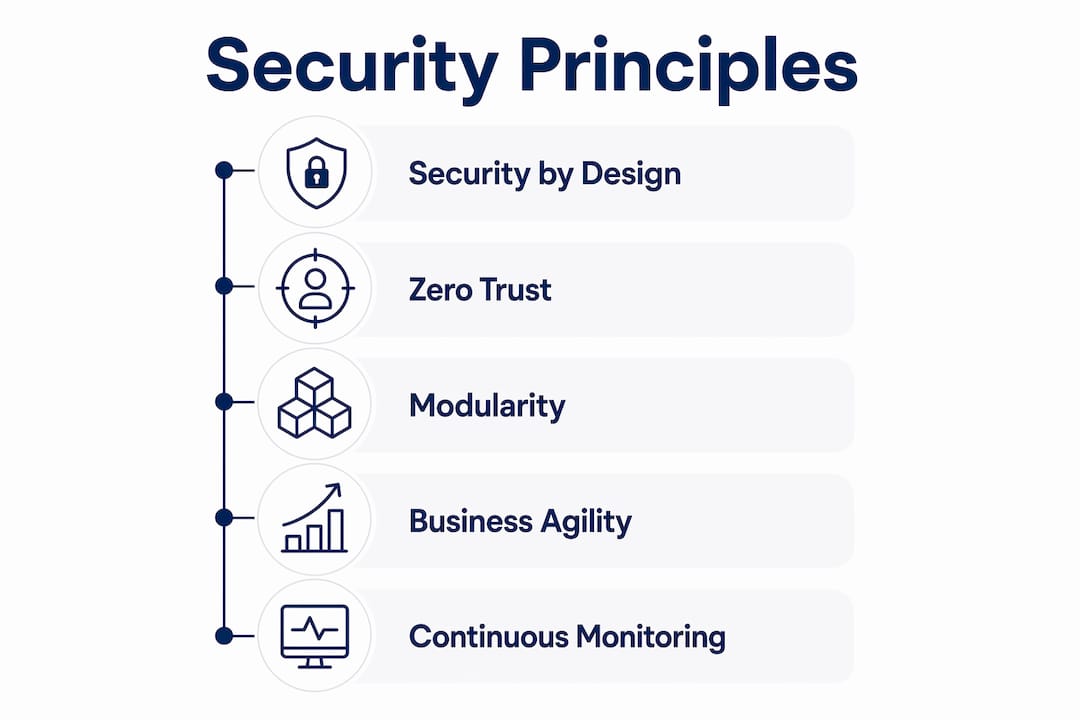
| Principle | What it means in practice |
|---|---|
| Security by Design | Security controls are built into systems from the start, not added after deployment. |
| Zero Trust | No user or device is trusted by default. Every access request is verified continuously. |
| Identity as the new perimeter | IAM replaces the network boundary as the primary control point in cloud environments. |
| Least privilege | Users and systems receive only the minimum access needed to perform their function. |
| Modularity and microservices | Systems are broken into smaller components so a breach in one area does not compromise the whole. |
Zero Trust architecture challenges the old assumption that everything inside the network is safe. That assumption was always flawed, but it became completely untenable once cloud services and remote work removed the concept of a fixed perimeter. Zero Trust means continuous verification of every user, every device, and every connection, regardless of where they sit.
Modularity is equally important. Architects who design monolithic systems create single points of failure. Breaking systems into smaller, independently secured components means a compromised module does not bring down the entire environment. This approach also makes incident response faster because the blast radius of any breach is contained.
Balancing these principles with business agility is where architects earn their keep. Security controls that slow down legitimate work get bypassed. Good architecture makes the secure path the easy path.
How do cyber security architects work with IT teams and business leaders?
Designing security in isolation leads to friction. Architects who disappear into a design cave and emerge with a 200-page policy document that nobody reads have wasted everyone’s time. The most effective architects work continuously alongside IT teams and business leaders throughout a project.
We see this a lot with SMBs. The security function gets treated as a separate department that reviews things at the end. By that point, the design decisions are locked in and changing them is painful. Embedding security thinking into agile delivery from day one avoids that problem entirely.
The coordination role of a security architect in an SMB context includes:
- Translating business risk into controls. A business leader who understands that a particular gap could result in regulatory fines or reputational damage will prioritise remediation. An architect who only speaks in CVE scores and CVSS ratings loses that audience.
- Setting security guardrails for development teams. Rather than reviewing every pull request, architects define the boundaries within which developers can move quickly and safely.
- Acting as a point of reference during incidents. When something goes wrong, the architect is the person who understands the full design and can direct the response effectively.
- Facilitating risk conversations at board level. Senior security architects translate complex risk into pragmatic controls that support rapid product delivery without sacrificing trust.
Honestly, the communication skill is underrated. Technical depth without the ability to influence decisions at a leadership level means security stays a cost centre rather than becoming a business enabler.
What practical steps can Australian SMBs take to implement effective security architecture?
Most Australian SMBs do not have a full-time security architect on staff. That is a reality, not a criticism. The question is how to get the benefit of architectural thinking without the overhead of a dedicated hire.
Pro Tip: Start with a threat and asset analysis before you spend a dollar on new security tools. Knowing what you are protecting and what threatens it is the foundation of every good security decision.
Practical steps that make a real difference include:
- Map your assets and classify them by sensitivity. Not all data carries the same risk. Financial records, client data, and credentials need stronger controls than general business documents.
- Adopt a recognised framework. The ACSC Essential Eight is the right starting point for Australian businesses. It is practical, well-documented, and increasingly expected by insurers and regulators.
- Invest in IAM from the start. Multi-factor authentication, conditional access policies, and privileged access management are not optional in 2026. They are the baseline. IT Start’s guidance on cloud security for financial firms covers IAM implementation in detail for regulated environments.
- Run regular threat modelling sessions. These do not need to be formal exercises. A structured conversation about what could go wrong, who might target you, and what the impact would be is enormously valuable.
- Conduct vulnerability assessments and penetration tests. Knowing your weaknesses before an attacker finds them is the point. Annual testing at minimum, quarterly for higher-risk environments.
The security steps every SMB must take in 2026 covers the full implementation roadmap in practical detail.
Key takeaways
A cyber security architect is the professional who designs secure systems from the ground up, and their absence from the design process is one of the most common and costly mistakes Australian SMBs make.
| Point | Details |
|---|---|
| Security by Design is non-negotiable | Building security in from the start costs far less than retrofitting controls after deployment. |
| IAM is the new perimeter | Identity and access management is the primary control point in cloud and hybrid environments. |
| Zero Trust replaces perimeter security | Every user and device must be continuously verified, regardless of network location. |
| Architects bridge business and technical teams | Translating risk into business language is as important as the technical design itself. |
| SMBs can access architectural expertise without a full-time hire | Partnering with a qualified MSP delivers security architecture thinking at a fraction of the cost. |
What most SMBs get wrong about security architecture
Honestly, the biggest mistake I see is treating security architecture as something that happens after the fact. A business will spend six months building a new system, then ask us to “make it secure” before go-live. At that point, we are working with what we have got. The design decisions that created the risk are already baked in.
The second mistake is confusing tools with architecture. Buying a next-generation firewall or an endpoint detection product does not give you a security architecture. Those tools need to sit within a coherent design that accounts for identity, data flows, access controls, and incident response. Without that design, you have expensive tools that are not configured to work together.
The communication gap between technical teams and leadership is real and persistent. I have sat in meetings where a technically excellent security engineer presents a risk assessment that the business owner completely disengages from because it is full of acronyms and severity scores. The architect’s job is to fix that gap. If the leadership team does not understand the risk, they will not fund the remediation.
Multi-vendor knowledge matters more than most people realise. Architects who only know one platform build environments that are fragile when that platform changes or when the business needs to add a different tool. The best architects I have worked with treat vendor independence as a design principle, not an afterthought.
Security architecture done well is not a barrier to growth. It is what makes growth sustainable.
— Matt
How IT Start helps Brisbane businesses with security architecture
IT Start works with Brisbane-based SMBs to design and manage security environments that hold up under real-world conditions. Our team brings architectural thinking to businesses that cannot justify a full-time security hire, covering everything from initial threat assessments and IAM implementation to ongoing security management and compliance support. We hold SMB 1001 Gold certification and work across industries including financial services, healthcare, and legal. If your organisation needs a clearer picture of its security posture or wants to build a more structured approach to protection, our cyber security services are the right starting point. We also offer managed cloud services for businesses moving to or already operating in cloud environments.
FAQ
What does a cyber security architect do?
A cyber security architect designs and oversees an organisation’s security systems, applying principles like Security by Design and Zero Trust to protect data and infrastructure. The role covers threat modelling, policy development, IAM, and coordination across technical and business teams.
How many years of experience does a security architect need?
Typical experience requirements include at least 5 years in architecture or engineering and 3 or more years in information security. Both technical depth and security-specific knowledge are required to manage enterprise-level environments.
What certifications should a cyber security architect hold?
The most recognised certifications are CISSP for broad security architecture, Microsoft SC-100 for cloud environments, and AWS Security Specialty for Amazon platforms. Vendor-specific credentials like Palo Alto PCNSE add value in network-focused roles.
Do Australian SMBs need a dedicated security architect?
Not necessarily. Many SMBs access security architecture expertise through a managed service provider rather than a full-time hire. The architectural thinking matters more than the employment arrangement.
What is the difference between Zero Trust and traditional perimeter security?
Traditional perimeter security assumes everything inside the network is safe. Zero Trust assumes no user or device is trusted by default and requires continuous verification of every access request, regardless of location.