

Most Queensland SMEs only revisit their IT plans after something goes wrong. A server fails, a phishing attack slips through, or a software tool stops working with everything else. By then, the damage is already done. IT roadmaps align technology investments with business goals, enabling operational efficiency and cybersecurity improvements through staged planning. If your business is still running on reactive fixes, this guide will show you exactly how a strategic IT roadmap works, why it matters in 2026, and how to get started.
Table of Contents
- What is an IT roadmap and why it matters
- Core stages of successful IT roadmaps for SMEs
- Roadmap methodologies: Making IT plans practical
- Frameworks: Enterprise architecture and hybrid models for SMEs
- Cyber security and compliance: The non-negotiables in Queensland
- Avoiding pitfalls: Common SME IT roadmap mistakes
- How to fast-track your IT roadmap with local expertise
- Frequently asked questions
Key Takeaways
| Point | Details |
|---|---|
| IT roadmaps align and protect | A clear roadmap connects tech investments to real business goals, improving both efficiency and security. |
| Frameworks matter for SMEs | Hybrid approaches using enterprise models and agile reviews are best for ongoing adaptability. |
| Cyber compliance is compulsory | Queensland SMEs must integrate cyber frameworks like ACSC Essential Eight and SMB1001 into all IT plans. |
| Quarterly reviews prevent risk | Updating your roadmap every quarter keeps your business ahead of changing threats and opportunities. |
| Expert help accelerates success | Local MSPs and vCIOs can fast-track tailored, robust IT roadmaps even for SMEs with limited in-house resources. |
What is an IT roadmap and why it matters
An IT roadmap is a planned, phased approach that aligns your technology investments with your actual business needs. It is not a wish list of software upgrades. It is a living document that connects where your business is today with where it needs to be in 12, 24, or 36 months.
Without a roadmap, most SMEs fall into the trap of ad-hoc decision-making. You buy a tool because a salesperson pitched it well. You upgrade a server because the old one broke. You add a new app because a staff member requested it. The result is tool sprawl, wasted budget, and a patchwork IT environment that nobody fully understands.
A well-structured roadmap prevents this. It gives your leadership team a shared view of technology priorities, costs, and timelines. According to research, IT roadmaps transform SMEs from reactive firefighting to proactive growth enablers. That shift alone can save thousands in unplanned downtime and emergency fixes.
Here is what a strong IT roadmap covers:
- Operational efficiency: Streamlining systems so your team spends less time on workarounds
- Cyber security: Embedding protection at every stage, not bolting it on later
- Risk management: Identifying vulnerabilities before they become incidents
- Compliance: Meeting regulatory requirements without last-minute scrambles
- Budget visibility: Spreading costs predictably across financial years
“A roadmap is not a one-time document. It is a strategic tool that evolves with your business, your industry, and the threat landscape around you.”
For a deeper look at IT roadmap basics, including how Brisbane SMBs are using them right now, it is worth exploring what a structured plan actually looks like in practice.
Core stages of successful IT roadmaps for SMEs
The most effective IT roadmaps for Queensland SMEs follow a four-stage model: Stabilise, Secure, Optimise, and Enable. Each stage builds on the last, so you are never jumping ahead before the foundations are solid.
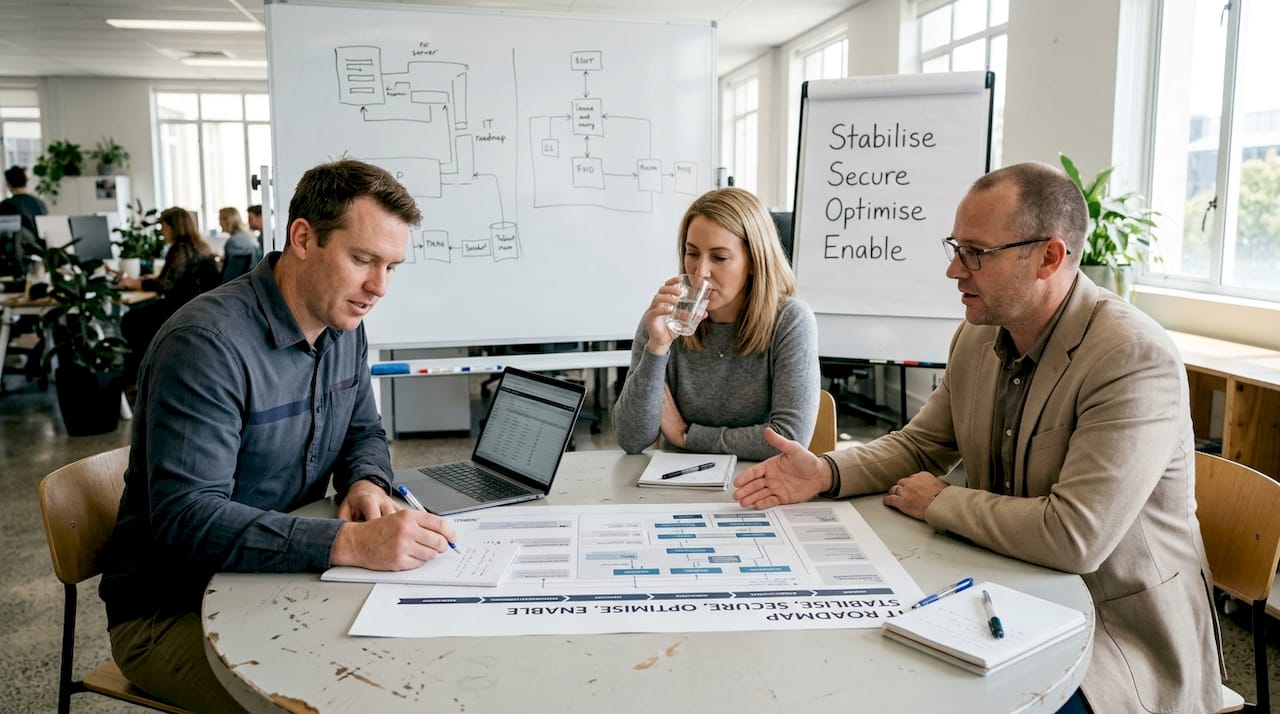
Staged IT planning aligns technology investments with business goals at each phase, which means your spending is always tied to a clear outcome. Here is how each stage breaks down:
| Stage | Key actions | Primary goal | Typical budget focus |
|---|---|---|---|
| Stabilise | Fix infrastructure gaps, standardise hardware | Reliability and uptime | Core infrastructure |
| Secure | Implement MFA, patching, backups, ACSC Essential Eight | Cyber security and compliance | Security tools and training |
| Optimise | Automate workflows, reduce redundant tools | Efficiency and cost reduction | Cloud migration, automation |
| Enable | Adopt AI, analytics, advanced integrations | Growth and competitive edge | Innovation and capability |
Most Queensland SMEs we work with start at Stabilise, even if they think they are ready for Optimise. Skipping stages is one of the most expensive mistakes a business can make.
Pro Tip: Before you invest in any new technology, ask yourself which stage your business is genuinely at. Buying AI tools when your backups are unreliable is like fitting solar panels on a house with a leaking roof.
For real-world examples of IT upgrades that Queensland businesses have used to move through these stages, you will find practical case studies that map directly to this model.
Roadmap methodologies: Making IT plans practical
Knowing the stages is one thing. Turning them into a working plan is another. The methodology behind your roadmap determines whether it stays on a shelf or drives real change.
Here are the six core steps every effective SME IT roadmap should follow:
- Current state assessment: Audit your existing systems, tools, contracts, and security posture
- Goal-setting: Define what business outcomes you need technology to support
- Prioritisation: Rank initiatives by impact, urgency, and cost
- Timeline mapping: Assign realistic timeframes to each initiative
- Budget allocation: Split spending across quick wins, upgrades, and transformation projects
- Quarterly review: Revisit and adjust the plan every three months
A structured approach that includes current state assessment, prioritised initiatives, budget allocation, and quarterly reviews is the gold standard for SME planning in 2026.
Here is a practical guide to how budget and timeframes typically break down:
| Initiative type | Timeframe | Budget share | Example |
|---|---|---|---|
| Quick wins | 0 to 3 months | 20% | MFA rollout, password manager |
| Upgrades | 3 to 12 months | 50% | Cloud migration, endpoint protection |
| Transformation | 12 to 36 months | 30% | AI integration, full platform overhaul |
Quarterly reviews are not optional. In 2026, the threat landscape and technology options shift fast enough that a static annual plan is outdated before the ink dries. Businesses that review regularly can pivot quickly, reallocate budget, and avoid locking into tools that no longer serve them.
For guidance on boosting efficiency with IT compliance and understanding how compliance and IT planning intersect for Queensland businesses, both resources offer practical frameworks you can apply immediately.
Frameworks: Enterprise architecture and hybrid models for SMEs
Every roadmap needs a framework to give it structure. Two of the most widely referenced are TOGAF and Zachman, and understanding the difference helps you choose the right approach for your business.
TOGAF is used by 80% of Fortune 500 companies and follows a process-driven Architecture Development Method. It is thorough, but it can be bureaucratic for smaller teams. Zachman, on the other hand, is a taxonomy rather than a process. It gives you a structured way to classify your IT components, but it does not tell you what to do with them.
For Queensland SMEs, neither framework works perfectly on its own. A hybrid model that blends TOGAF’s governance structure with agile, business-readable planning delivers the best results. You get the rigour without the red tape.
Here is what a hybrid framework does well for growing businesses:
- Stakeholder engagement: Translates technical plans into language your leadership team can act on
- Decision-making clarity: Gives you a consistent way to evaluate new technology investments
- Scalability: Grows with your business without requiring a complete overhaul
- Security integration: Embeds cyber security from the start, informed by ACSC and SMB1001 standards
The Zachman model explained in detail shows how the taxonomy works across six dimensions, which can be useful when you are mapping your current IT environment for the first time.
“The best framework is the one your team will actually use. Complexity for its own sake is the enemy of progress.”
For Queensland SMEs, cybersecurity frameworks should sit at the centre of any hybrid model, not as an add-on but as a foundational layer.
Cyber security and compliance: The non-negotiables in Queensland
If there is one area where Queensland SMEs consistently underinvest in their roadmaps, it is security and compliance. Many business owners treat it as a checkbox exercise. That mindset is expensive.
Getting security wrong risks regulatory fines, business downtime, reputational damage, and in some industries, loss of operating licences. The Cyber Security Act 2024 has raised the bar significantly, and ACSC Essential Eight and SMB1001 must now be integrated into roadmaps for Queensland SMEs to meet compliance requirements.
Here is how to embed the Essential Eight practically at each roadmap stage:
- Stabilise: Enable multi-factor authentication (MFA) across all accounts and enforce application control
- Secure: Implement automated patching for operating systems and applications, configure macro settings
- Optimise: Restrict administrative privileges, harden user application settings
- Enable: Establish daily backups with tested recovery processes, maintain regular vulnerability scanning
SMB1001 adds a governance layer through its Bronze, Silver, and Gold tiering system. Bronze covers the essentials. Silver adds monitoring and incident response. Gold, which IT Start holds, represents the highest standard of managed security governance. This tiering helps you allocate resources proportionally as your business grows.
Pro Tip: Do not wait until you are applying for cyber insurance or responding to a client security questionnaire to discover your gaps. Build your ACSC Essential Eight compliance into your roadmap from day one.
For businesses looking at MSS risk reduction strategies, managed security services offer a cost-effective way to maintain compliance without hiring a full internal security team.
Avoiding pitfalls: Common SME IT roadmap mistakes
Even businesses with good intentions make avoidable mistakes when building their IT roadmaps. Here are the five most common ones we see across Queensland SMEs:
- No roadmap at all: Running purely on reactive support leads to tool sprawl, project panic, and budget blowouts
- Annual-only reviews: Static annual plans fail amid rapid technology changes and emerging threats
- Security as an afterthought: Bolting on cyber security after the fact costs far more than embedding it from the start
- Ignoring staff capability: Buying tools your team cannot use effectively wastes money and creates frustration
- No ownership: Roadmaps without a clear internal or external owner drift and stall within months
Quarterly reviews matter far more than most SME owners realise. A plan reviewed every three months stays relevant. A plan reviewed once a year is already behind by the time you look at it again.
If your internal resources are stretched, this is exactly where managed service providers (MSPs) or virtual CIOs (vCIOs) add genuine value. They bring the strategic oversight your business needs without the cost of a full-time IT director. The benefits of ongoing IT support for Queensland SMEs are well documented, and security frameworks for 2026 give you a clear picture of what best-practice looks like right now.
“Moving from IT chaos to clarity is not about spending more. It is about spending smarter, with a plan that connects every dollar to a business outcome.”
How to fast-track your IT roadmap with local expertise
You now have a clear picture of what a winning IT roadmap looks like, how it is structured, and what mistakes to avoid. The next step is putting it into action. IT Start works with Queensland SMEs from the initial discovery session through to quarterly optimisation reviews, building roadmaps that are practical, compliant, and aligned with your growth goals. Whether you need cyber security specialists to embed Essential Eight compliance or business IT support that covers your full technology environment, we bring local Brisbane expertise and SMB1001 Gold-level governance to every engagement. If you are ready to move from reactive fixes to a proactive plan, contact local IT experts at IT Start for a no-obligation consultation today.
Frequently asked questions
Why does my SME need an IT roadmap, not just a tech support plan?
A tech support plan keeps the lights on. An IT roadmap gives your business a strategic, step-by-step path for growth, risk management, and compliance. IT roadmaps transform SMEs from reactive firefighting into proactive, efficient operations.
How often should my business review and update its IT roadmap?
Quarterly reviews are the best practice for SMEs in 2026. Static annual plans fail to keep pace with rapid technology changes and emerging cyber threats, leaving your business exposed.
What frameworks are best for SME IT roadmaps in Queensland?
A hybrid approach works best. Combining TOGAF and Zachman gives you governance structure and flexibility, without the bureaucratic overhead that larger enterprise frameworks typically require.
Are there compliance requirements unique to Queensland SME IT roadmaps?
Yes. Queensland SMEs must integrate ACSC Essential Eight and SMB1001 into their roadmaps to meet Cyber Security Act 2024 obligations and manage risk effectively.
How can I get started if I lack IT resources internally?
Partnering with a local MSP or vCIO gives you access to affordable strategic expertise. SMEs with limited resources can still build and maintain effective roadmaps through managed service partnerships tailored to their budget and goals.