

TL;DR:
- IT security audits evaluate an organization’s controls through a structured, five-phase process, taking two to six weeks. They focus on documented evidence, testing controls, and vulnerability scanning to identify operational gaps. Regular internal and external audits are essential for maintaining ongoing security and compliance.
IT security auditing is the formal process of evaluating an organisation’s IT infrastructure, policies, and controls to verify they meet security and compliance requirements. The industry term is “IT security audit,” and it sits within the broader discipline of IT risk management. Done properly, it tells you what you actually have, not what you think you have. For small to medium-sized businesses in Brisbane and across Queensland, that gap between assumption and reality is where breaches happen. This guide covers the full cybersecurity audit process, the difference between audits and assessments, and the pitfalls we see SMBs fall into every single time.
What does IT security auditing actually involve?
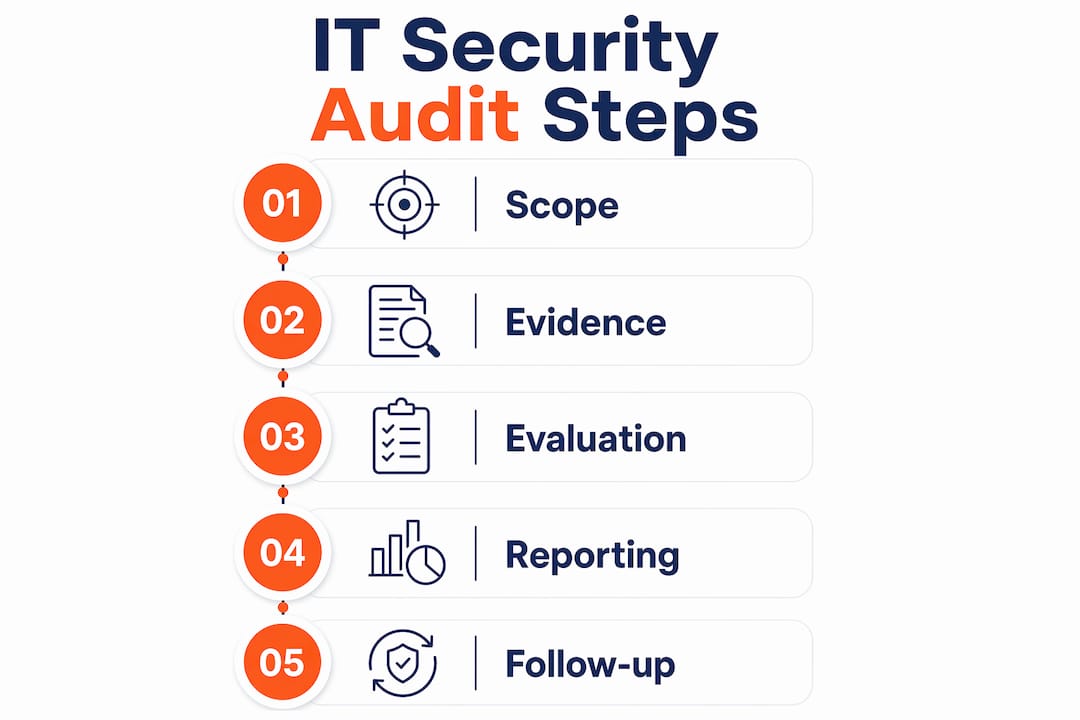
An IT security audit follows a five-phase process: planning and scope definition, documentation review and interviews, control testing, vulnerability scanning and penetration testing, and finally reporting with remediation guidance. The whole process typically takes 2–6 weeks depending on the size of your organisation. That timeframe surprises most business owners who expect it to be a quick checklist exercise.
Here is what each phase actually looks like in practice:
- Planning and scope — Define which systems, locations, and processes are in scope. A poorly scoped audit wastes everyone’s time and misses critical gaps.
- Documentation review and interviews — Auditors examine your policies, procedures, and records. They also interview staff to check whether documented processes are actually followed.
- Control testing — Auditors test whether your security controls work as intended. This includes checking access management, patch levels, backup configurations, and user offboarding processes.
- Vulnerability scanning and penetration testing — Tools like Nessus scan your network for known vulnerabilities. More targeted penetration testing procedures simulate real attacks to find exploitable gaps.
- Reporting and remediation — The audit produces a formal report mapping findings to risks. You get a prioritised list of what to fix and by when.
Frameworks like NIST CSF and COBIT provide the control benchmarks auditors measure against. Tools like Ping Castle and BloodHound are commonly used for Active Directory assessments during the technical testing phase. Compliance standards such as ISO 27001, HIPAA, and PCI DSS each have their own control requirements that map into this process.
Pro Tip: Start building your evidence folder before the audit begins. Collect user access logs, offboarding records, patch reports, and backup confirmation emails now. Auditors ask for this on day one, and scrambling for it wastes days.

Organisations should conduct security audits at least annually, with highly regulated industries such as healthcare and financial services requiring quarterly or semi-annual reviews. Annual is the floor, not the target.
Internal vs external IT security audits: what SMBs need to know
SMBs often ask whether they need to hire an external firm or whether their internal IT person can run the audit. The honest answer is: both serve different purposes, and the right choice depends on what you are trying to achieve.
| Factor | Internal audit | External audit |
|---|---|---|
| Cost | Lower, uses existing staff | Higher, third-party fees apply |
| Objectivity | Limited, staff audit their own work | Independent, no conflict of interest |
| Frequency | Can run quarterly or more often | Typically annual or for certification |
| Best for | Continuous improvement, quick wins | Compliance certification, ISO 27001 |
| Compliance value | Low to moderate | High, accepted by regulators and insurers |
Internal audits focus on continuous improvement and are good for frequent, low-cost self-assessment. External audits provide the independent validation required for compliance certifications. That distinction matters when you are trying to satisfy a cyber insurance provider or meet a client’s vendor security requirements.
The practical approach for most SMBs is to run internal IT compliance checks quarterly and bring in an external auditor annually or when pursuing certification. This balances thoroughness against budget. A business with 20 staff does not need a Big Four audit firm every quarter, but it does need someone outside the building to look at things once a year.
One thing to watch: internal audits only work if the person running them has genuine authority to report findings upward. We see this fail when the IT manager audits their own environment and then has to tell the owner that the owner’s admin account has no MFA. That conversation rarely goes well without external backing.
How do audits differ from assessments and penetration tests?
This is the most common misconception we encounter. Business owners use these three terms interchangeably, but they are distinct activities with different outputs.
Technical vulnerability scans and penetration tests are not audits. Scans find technical gaps. Audits validate whether your governance, policies, and operational processes are working as intended. A penetration test tells you a door is unlocked. An audit tells you whether your policy required the door to be locked, who was responsible for locking it, and whether anyone checked.
Key distinctions:
- IT security audit — Formal, evidence-based, standard-driven. Produces a compliance finding against a framework like ISO 27001 or NIST CSF. Requires documentation, interviews, and control testing.
- IT security assessment — Broader and risk-focused. Identifies real-world vulnerabilities across people, process, and technology. Less formal than an audit, more practical for identifying what actually needs fixing.
- Penetration testing — Simulated attack by a qualified tester. Finds exploitable technical vulnerabilities. Does not evaluate governance or policy compliance.
Passing a compliance audit does not guarantee a secure environment. An audit confirms that mandatory controls exist and are documented. A security assessment reveals whether those controls actually stop a real attack. We have seen businesses pass ISO 27001 audits and still get hit by ransomware within six months because the audit confirmed a policy existed but nobody checked whether staff followed it.
Pro Tip: After any compliance audit, run a separate IT security assessment to test whether your controls hold up in practice. Treat the audit as the floor, not the ceiling.
Cybersecurity audits specifically evaluate governance, risk management, and enterprise-wide defence including leadership accountability and vendor management. That goes well beyond what a vulnerability scanner can tell you.
Common pitfalls SMBs face during IT security audits
We run into the same problems repeatedly when helping Brisbane businesses prepare for their first formal audit. None of them are exotic. They are all basic operational hygiene issues.
The biggest security gaps found during audits are operational, not technical. Inconsistent user offboarding, outdated administrator permissions, and unpatched legacy systems show up in almost every SMB audit. These are not sophisticated failures. They are the result of nobody having time to do the basics consistently.
The most common pitfalls:
- Missing documentation — Auditors ask for evidence, not promises. If you cannot produce offboarding records, change logs, or backup verification reports, you fail that control regardless of what your policy document says.
- Scope confusion — Many businesses assume the audit only covers their main server. If your staff use personal devices, cloud apps like Microsoft 365, or third-party platforms, those are likely in scope too.
- Excessive admin access — We almost always find former employees or contractors still holding active admin accounts. This is a critical finding in every framework from NIST to ISO 27001.
- Confusing scans with audits — Running a Nessus scan and calling it an audit is not the same thing. Scans find vulnerabilities. Audits validate controls. Both matter, but they are not interchangeable.
- No continuous monitoring — Automated evidence collection is now the standard approach. Businesses that rely on manual evidence gathering spend weeks pulling together logs and reports that automated tools can produce in hours.
Audit success depends more on documentation than on technical security gaps. We have seen well-secured environments fail audits because nobody kept records. The auditor cannot credit a control they cannot see evidence of.
The fix is not complicated. Build a simple evidence library that captures user access reviews, patch reports, backup logs, and incident records on a regular schedule. Tools within Microsoft 365 can automate much of this. The shift to continuous monitoring means you no longer need to scramble before an audit. The evidence is already there.
Key takeaways
A successful IT security audit depends on documented evidence, defined scope, and regular frequency — not just having the right technology in place.
| Point | Details |
|---|---|
| Audit frequency matters | Run audits at least annually; regulated industries need quarterly or semi-annual reviews. |
| Documentation is the audit | Missing evidence fails controls even when the security practice exists in reality. |
| Audits and pentests are different | Audits validate governance and policy; penetration tests find exploitable technical gaps. |
| Internal and external audits serve different goals | Use internal audits for continuous improvement and external audits for compliance certification. |
| Operational hygiene is the biggest risk | Outdated admin access and inconsistent offboarding are the most common critical findings in SMB audits. |
What audits keep teaching me about SMB security
Honestly, after years of working with SMBs across Brisbane, the thing that strikes me most is how rarely the audit findings are about technology. The technology is usually fine. It is the human and process side that falls apart.
I have sat in rooms with business owners who were genuinely confident their IT was in good shape. Then the audit comes back and the first three findings are: a former employee still has admin access, nobody has reviewed the backup logs in eight months, and the incident response policy was last updated in 2021. None of that is a technology failure. It is an operational one.
The other thing I see constantly is businesses treating a compliance audit as the finish line. They get their ISO 27001 certificate or pass their PCI DSS review and then coast for twelve months. Security does not work that way. The threat environment changes, staff turn over, systems get added without proper review. A certificate from last year does not protect you today.
My honest recommendation: treat your audit programme as a continuous process, not an annual event. Use the audit to set your baseline. Use monthly internal reviews to maintain it. And when something changes in your environment, such as a new cloud platform or a staff departure, treat that as a trigger for a targeted review, not something to catch up on at the next annual audit.
The information technology security audit process is genuinely useful when businesses engage with it seriously. When it is treated as a box-ticking exercise, it produces a certificate and leaves the real risks untouched.
— Matt
How IT Start can help with your security audit
IT Start works with Brisbane SMBs to prepare for and manage IT security audits, from scoping and evidence collection through to remediation and ongoing compliance. Our cybersecurity services cover audit readiness, access management reviews, vulnerability scanning, and continuous monitoring so your evidence library is always current. We also provide business IT support that keeps your environment documented and maintained between audits, which is where most SMBs fall short. If you are preparing for your first formal audit or want to understand where your current gaps are, contact IT Start for a straightforward conversation about what your business actually needs.
FAQ
What is a security audit in cyber security?
A security audit in cyber security is a formal, evidence-based review of an organisation’s IT controls, policies, and governance against a defined standard such as ISO 27001 or NIST CSF. It produces documented findings and a remediation plan.
How often should SMBs conduct IT security audits?
General businesses should audit at least annually. Healthcare, financial services, and other regulated industries should conduct reviews quarterly or semi-annually to meet compliance obligations.
What is the difference between an IT audit and a penetration test?
An IT audit validates whether your governance, policies, and controls are implemented and operating correctly. A penetration test simulates a real attack to find exploitable technical vulnerabilities. Both are useful but serve different purposes.
Why do businesses fail compliance audits?
Many audits fail due to missing documentation, not absent security controls. If you cannot produce evidence that a control is operating, the auditor cannot credit it, regardless of what your policy says.
Does passing an IT security audit mean you are secure?
No. A compliance audit confirms that documented controls exist and meet a standard. It does not confirm those controls stop real attacks. A separate security assessment is needed to test practical effectiveness.