

TL;DR:
- A cyber risk management strategy is a continuous process that identifies, assesses, and mitigates digital threats to business assets.
- Embedding risk management into broader business governance and treating it as an ongoing program improves effectiveness and funding.
A cyber risk management strategy is a continuous, structured process that identifies, assesses, prioritises, and mitigates digital threats to your business assets. The industry term for this discipline is cybersecurity risk management, and it covers everything from asset discovery and threat identification through to control selection and ongoing monitoring. Organisations with structured programmes detect threats 74 days faster than those relying on reactive monitoring alone. For Australian small to medium-sized businesses, that speed difference is the gap between a contained incident and a full business disruption. Frameworks like NIST CSF and governance bodies like the NACD give you the scaffolding. What you do with them is what matters.
What are the key components of a cyber risk management strategy?
A cybersecurity risk management strategy breaks down into five stages: asset discovery, threat identification, risk scoring, control selection, and continuous monitoring. Miss any one of them and the whole programme develops blind spots.
Asset discovery
Asset discovery is the foundation, and it is where most organisations fail first. You cannot protect what you do not know you have. We see this constantly with SMBs running 20 to 40 staff. Someone set up a cloud storage account two years ago, nobody documented it, and now it sits outside any security control. Attackers find these gaps faster than your IT team does.

Threat identification and risk scoring
Once you have an accurate asset list, you map threats to each asset. The standard scoring method uses the formula Risk = Likelihood x Impact, with each dimension scored 1 to 5 using written criteria. Written criteria matter because they remove guesswork and keep scoring consistent across reviews. A score of 4 for likelihood means something specific, not whatever feels right that week.
Control selection and monitoring
Controls fall into three categories: preventive (stopping an attack before it lands), detective (spotting it in progress), and corrective (limiting damage after the fact). MFA is preventive. Security logging is detective. Backups are corrective. A good information security strategy uses all three, not just the one that is easiest to deploy.
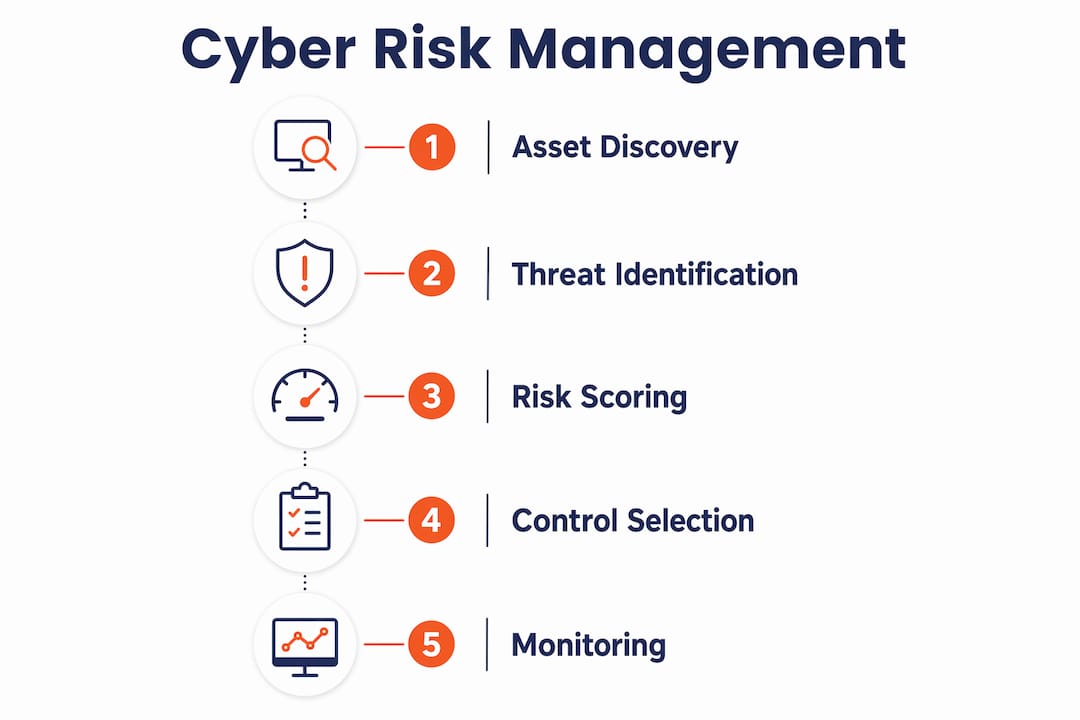
| Stage | Purpose | Best practice |
|---|---|---|
| Asset discovery | Build a complete inventory of systems and data | Audit quarterly, include cloud and remote assets |
| Threat identification | Map known threats to each asset | Use NIST or ASD frameworks as a reference |
| Risk scoring | Rank risks by likelihood and impact | Score 1 to 5 on both dimensions with written criteria |
| Control selection | Choose preventive, detective, or corrective controls | Match control cost to risk score |
| Continuous monitoring | Detect changes and new threats over time | Set a review cadence, not a one-off audit |
Pro Tip: The asset discovery stage fails most often because businesses treat it as a one-time task. Run a discovery scan every quarter and include SaaS applications, not just on-premises hardware.
How to prioritise risks and select the right mitigation controls
Risk prioritisation is where most SMBs either do it well or waste money on the wrong things. The formula Risk = Likelihood x Impact gives you a number, but the number only means something if you score attack paths rather than isolated vulnerabilities.
A medium-severity vulnerability on an internet-facing system can pose a higher real-world risk than a critical-severity flaw buried on an isolated internal server. Exposure and exploitability matter more than the severity label alone. This is a shift in thinking that most SMBs have not made yet.
Once you have ranked your risks, you have four responses available:
- Avoid the risk by removing the asset or activity that creates it
- Mitigate it by applying a technical or process control
- Transfer it through cyber insurance or a managed security provider
- Accept it with documented compensating controls and a review date
That last option is the one that bites businesses. Accepted risks need named owners, documented compensating controls, and expiry dates on any exceptions. Without expiry dates, accepted risks become permanent gaps that nobody revisits.
For most Australian SMBs, the practical control list looks like this:
- Multi-factor authentication on all accounts, especially Microsoft 365 and email
- Endpoint detection and response (EDR) on every device, not just antivirus
- Tested, offsite backups with a documented recovery time objective
- Patch management with a defined schedule, not patches applied whenever someone remembers
- Staff phishing awareness training at least twice a year
Pro Tip: Set a fixed review date for every accepted risk, the same way you would set a contract renewal reminder. If a risk exception has no expiry date, it will never get reviewed.
How does cyber risk management fit into broader business governance?
Cyber risk cannot be eliminated completely and must be managed as a business risk that informs operational decisions. That means it belongs inside your enterprise risk management process, not sitting separately in the IT department.
The NACD’s 2026 guidance is clear on governance roles. The board defines risk appetite and communicates it in terms linked to business and financial goals. Management then implements risk-based programmes and reports back transparently. When those two roles blur or when the board has no stated risk appetite, cyber risk programmes lose direction and funding.
Frameworks working in isolation from business strategy are consistently underfunded and neglected. Embedding your cybersecurity risk assessment process inside your existing enterprise risk management structure fixes that. It gives cyber risk the same visibility as financial or operational risk.
| Role | Responsibility |
|---|---|
| Board | Define risk appetite, set oversight expectations, review reporting |
| Executive management | Implement risk programmes, allocate resources, report to board |
| IT or MSP | Execute controls, monitor threats, maintain asset inventory |
| Department heads | Own risks within their business units, report exceptions |
For SMBs without a formal board, the business owner fills the board role. That means you need to make an explicit decision about how much risk you are willing to accept, write it down, and share it with whoever manages your IT.
What are common pitfalls SMBs face in cyber risk management?
Honestly, the list is depressingly consistent. We see the same mistakes across businesses of 10 to 50 staff regardless of industry.
The biggest one is incomplete asset inventories. Businesses think they know what they have. They do not. A precise asset inventory is the foundation of effective risk management, and without it, every subsequent step is built on guesswork. You end up applying controls to the systems you know about while the real exposure sits in the ones you forgot.
The second pitfall is treating risk management as a project rather than a programme. A one-off audit or annual review is not a cyber risk management strategy. Effective risk management requires ongoing discipline and continuous improvement embedded across the organisation. The threat environment changes monthly. Your programme needs to keep pace.
Common SMB mistakes we see regularly:
- No MFA on email or cloud accounts, despite it being free in most Microsoft 365 plans
- Backups that have never been tested and turn out to be incomplete or broken
- No documented risk register, so risks are managed informally and inconsistently
- Security exceptions that were accepted years ago and never reviewed
- Staff who have never received phishing training and click on obvious test emails
Pro Tip: Run a backup restoration test every quarter. Not a check that the backup ran. An actual restoration of a file or folder to confirm the data is usable. Most businesses that think they are backed up discover problems only when they need the data.
What practical steps can Australian SMBs take today?
Building a cyber risk management programme does not require a large team or a big budget. It requires consistency and a starting point.
Here are six steps that work in real SMB environments:
- Build an asset list. Document every device, cloud service, and application your business uses. Include personal devices if staff use them for work. This is your starting point for any cybersecurity risk assessment.
- Assign risk owners. Every significant asset or process needs a named person responsible for its risk. Without ownership, nothing gets reviewed.
- Create a basic risk register. A spreadsheet works. List each risk, its likelihood and impact score, the control in place, and the review date. Keep it simple and keep it current.
- Deploy MFA everywhere. Start with email and any cloud platform. MFA blocks the majority of credential-based attacks and costs nothing extra in most Microsoft 365 licences.
- Test your backups. Confirm your backup actually restores. Set a quarterly reminder. A backup you have never tested is not a backup.
- Set a review cadence. Review your risk register every quarter. Assign a calendar event. Treat it the same way you treat your BAS lodgement.
Cloud services reduce your on-premises attack surface and shift some security responsibility to providers with dedicated security teams. Managed security providers can run your monitoring, patching, and incident response if you do not have internal IT staff. For most Brisbane SMBs, that combination of cloud-based risk reduction and managed support is the most cost-effective path to a functioning programme.
Pro Tip: Staff training is the cheapest control you have. A phishing simulation twice a year costs very little and measurably reduces click rates on malicious emails. Pair it with a clear process for reporting suspicious messages.
Key takeaways
A cyber risk management strategy works only when it runs as a continuous programme, not a one-off project, with clear ownership, scored risks, and tested controls reviewed on a fixed cadence.
| Point | Details |
|---|---|
| Asset discovery comes first | You cannot protect systems you have not documented. Audit every device and cloud service quarterly. |
| Score risks on two dimensions | Use Likelihood x Impact on a 1 to 5 scale with written criteria to keep assessments consistent. |
| Accepted risks need expiry dates | Every risk exception must have a named owner and a review date, or it becomes a permanent gap. |
| Embed cyber risk in business governance | Cyber risk managed in isolation loses funding. Align it with your enterprise risk management process. |
| Treat it as a programme, not a project | Continuous monitoring and regular reviews are what separate effective strategies from paper exercises. |
What I have learned from watching SMBs get this wrong
Most SMBs approach cyber risk management the same way they approach their annual tax return. They do it once, feel relieved it is done, and then ignore it for twelve months. That mindset is the single biggest reason cyber incidents keep hitting businesses that thought they were covered.
I have seen businesses with decent antivirus and no MFA get compromised through a single phished Microsoft 365 account. I have seen businesses with a written security policy and no tested backups lose weeks of data after a ransomware hit. The paperwork existed. The practice did not.
The frameworks, whether NIST, the ASD Essential Eight, or anything else, are useful guides. But they are not a substitute for actually doing the work. The businesses that manage cyber risk well are the ones that treat it like a recurring operational task, the same way they manage their accounts or their staff reviews. They have a risk register, they review it, and they fix things before an attacker finds them.
My honest advice: start with your asset list and your backups. Get those right before you worry about anything else. If you do not know what you have and you cannot recover from an incident, no framework will save you. Once those two things are solid, build from there with MFA, patching, and staff training. Get support from an MSP who will tell you what is actually broken, not just sell you tools. For Queensland SMBs, understanding the right cyber firms for your size makes a real difference in getting practical help rather than generic advice.
— Matt
How IT Start helps Brisbane SMBs manage cyber risk
IT Start works with small to medium-sized businesses across Brisbane and Queensland to build and maintain practical cyber risk management programmes. The team handles asset discovery, risk assessments, MFA deployment, backup testing, and ongoing monitoring as part of managed IT support. IT Start holds SMB 1001 Gold certification, which means the security baseline it applies to clients meets independently verified standards. If your business has no risk register, untested backups, or accounts without MFA, that is exactly where IT Start starts. Reach out for a no-obligation assessment through the cyber security services page to find out where your biggest gaps are.
FAQ
What is cyber security risk management?
Cyber security risk management is the ongoing process of identifying, assessing, and reducing digital threats to a business’s systems and data. It covers asset discovery, risk scoring, control selection, and continuous monitoring rather than a single one-off audit.
How often should an SMB review its cyber risk register?
A quarterly review cadence works for most SMBs. Threats and business systems change frequently enough that annual reviews leave gaps unaddressed for too long.
What is the Risk = Likelihood x Impact formula?
It is a standard scoring method where each risk is rated on two dimensions, likelihood and impact, each on a scale of 1 to 5 with written criteria. The resulting score helps prioritise which risks to address first based on objective assessment rather than gut feel.
Why do cyber risk frameworks fail in SMB environments?
Frameworks managed in isolation from business strategy are consistently underfunded and deprioritised. SMBs get better results by embedding cyber risk inside their existing business risk processes and assigning clear ownership to each identified risk.
What is the first step in building a cyber risk management strategy?
Build a complete asset inventory first. You cannot score, prioritise, or mitigate risks against systems you have not documented, and incomplete asset inventories are the most common reason risk programmes fail at the start.