

TL;DR:
- Cyber firms provide SMBs with 24/7 threat detection, penetration testing, and expert cybersecurity guidance tailored to their budget and risk profile. They use AI-driven platforms and human expertise to identify vulnerabilities, reduce false positives, and improve response times, ensuring ongoing security validation. Choosing an objective, scalable firm with incident response capability and compliance alignment maximizes benefits and minimizes costly breaches.
Cyber firms are specialised companies that deliver professional cybersecurity services, from threat detection and penetration testing to fully managed security operations, to protect businesses from attacks. The term “cyber firm” is informal shorthand; the recognised industry categories are managed security service providers (MSSPs), cybersecurity consulting firms, and IT security firms. Understanding the difference matters because each model suits a different budget and risk profile. For small and medium-sized businesses in Australia, the stakes are real. Attackers target SMBs precisely because they assume the defences are thin, and honestly, they are often right.
What do cyber firms actually do?

Cyber firms cover a lot of ground, and that breadth is part of what makes them confusing to evaluate. At the core, they identify vulnerabilities in your systems before attackers do, monitor your environment for threats around the clock, and respond when something goes wrong. The three main service types are penetration testing, managed detection and response (MDR), and cybersecurity consulting.
Penetration testing, or pen testing, involves ethical hackers deliberately probing your systems to find weaknesses. Firms like Synack run continuous penetration testing programs that reduce risk far better than traditional point-in-time tests, because attackers do not wait for your annual audit. Managed detection and response means a team is watching your environment 24 hours a day, seven days a week, and responding to incidents in real time. Cybersecurity consulting is more advisory: a firm assesses your risk posture, recommends controls, and helps you build a plan.
For most SMBs with 10 to 50 staff, the managed services model makes the most sense. You get expert coverage without hiring a full security team, which is simply not affordable at that scale.
What technologies do modern cybersecurity companies use?
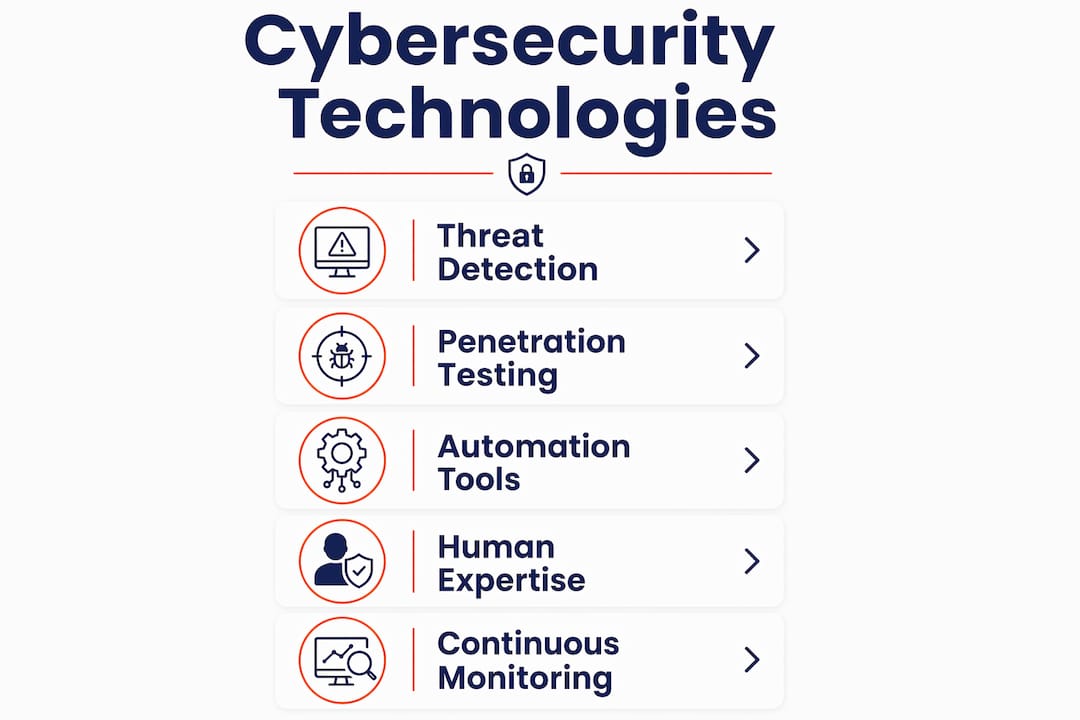
The technology gap between what an SMB can deploy internally and what a professional IT security firm brings is significant. Modern cyber firms use AI-driven platforms that process data at a scale no internal team could match.
Proofpoint, for example, analyses over 100 billion data points daily and achieves threat-stopping rates as high as 99.999%. That figure matters because it means the volume of threats reaching your inbox or network is being filtered at a scale that manual review cannot replicate. Intezer’s AI-powered forensic triage resolves over 98% of false positives within one minute, which frees your internal team from chasing alerts that turn out to be nothing. Alert fatigue is a genuine problem in smaller businesses where one person is wearing three hats.
The smarter platforms do not just react to alerts. Wiz, for instance, uses a unified security graph that connects code, cloud, and runtime data to identify root causes rather than surface symptoms. That contextual awareness is what separates genuine AI-speed security from a tool that just fires off notifications.
Automation handles the volume. Human ethical hackers handle the nuance. Human validation remains critical for identifying complex logic flaws and chained exploits that automated scans consistently miss. The best cyber firms combine both.
What service models do IT security firms offer SMBs?
Cyber firms are not one-size-fits-all, and the service model you choose has a direct impact on cost, coverage, and how much internal effort you need to contribute.
The main models available to SMBs are:
-
Fully managed security operations. The firm handles everything: monitoring, detection, response, and reporting. Managed cybersecurity services like this can be deployed within minutes for some tools and days for penetration testing platforms, according to Barracuda Networks. This suits businesses that want to hand off the problem entirely.
-
Cybersecurity consulting. A firm assesses your environment, identifies gaps, and produces a remediation roadmap. You implement the fixes, either internally or with a separate provider. This works well as a starting point if you have never had a formal security review.
-
Hybrid models. Your internal team handles day-to-day IT, while an external cyber firm manages security monitoring and periodic testing. SMBs scaling security often move through this model as they grow, combining boutique and platform-level services to maintain detailed coverage without overcomplicating the stack.
-
Penetration testing as a service (PTaaS). A subscription-based model where ethical hackers continuously test your environment rather than running a single annual engagement.
Pro Tip: Ask any prospective cyber firm whether they are vendor-objective. GuidePoint Security, for example, evaluates over 800 vendors to find the best fit for a client’s risk profile rather than pushing a proprietary product. That distinction matters enormously when you are trying to solve a real problem rather than buy a product.
The shift from periodic to continuous security validation is the most important structural change in how cyber firms operate. One-off projects give you a snapshot. Continuous monitoring gives you a living picture.
How to choose the best cyber firm for your SMB
Choosing the wrong cyber firm is expensive in two ways: you pay for a service that does not fit your needs, and you get a false sense of security. Here is what to actually look for.

Vendor-objective guidance. A firm that only recommends its own tools is not advising you; it is selling to you. Look for firms that assess your environment first and recommend technology second.
Balance of automation and human expertise. Automation handles scale. Humans handle complexity. A firm that relies entirely on automated scanning will miss the chained vulnerabilities that cause real breaches. A firm with no automation will be too slow and too expensive.
Scalability. Your needs at 15 staff are different from your needs at 50. The firm you choose should be able to grow with you without requiring a complete platform change.
Incident response capability. Detection without response is half a service. Ask specifically: if we are breached at 2am on a Saturday, what happens? Who calls us, what do they do, and how fast?
Compliance alignment. For Brisbane businesses in financial services, healthcare, or legal, compliance with frameworks like the Australian Privacy Act, ISO 27001, or the Essential Eight is not optional. Firms that integrate risk, compliance, and defence into a single model save you from managing those threads separately.
| What to assess | What to look for |
|---|---|
| Vendor independence | Evaluates multiple vendors, not just their own stack |
| Human and AI balance | Combines automated triage with ethical hacker validation |
| Scalability | Supports boutique to platform-level service transitions |
| Incident response | Defined 24/7 response process with clear escalation paths |
| Compliance support | Covers Australian Privacy Act, Essential Eight, or ISO 27001 |
The best cybersecurity companies for SMBs in Brisbane share one trait: they treat security as a business problem, not a technical one.
What are the real benefits of partnering with cyber firms?
The numbers are concrete. AI-powered forensic triage reduces remediation time by 47% or more compared to manual processes. For an SMB where the IT person is also managing helpdesk tickets and printer problems, that time saving is the difference between a contained incident and a full breach.
Reduced alert fatigue is the benefit nobody talks about enough. When your team is drowning in false positives, real threats get missed. Resolving those false positives automatically means your people focus on what matters. We see this a lot with clients who had a security tool running but no one was actually reviewing the alerts because there were simply too many.
“Cybersecurity is a continuous process, not a one-time project. Ongoing external attack surface management and risk-based prioritisation are what separate businesses that recover quickly from those that do not.” — Outpost24
The risks of skipping professional cyber support are not theoretical. SMBs without managed cybersecurity services are more likely to have no multi-factor authentication, unpatched systems, and backups that have never been tested. We have seen businesses discover their backup had not been running for six months, only after a ransomware attack. That is not a technology failure. That is a monitoring failure that a managed security provider would have caught.
Managed IT services for SMEs that include security monitoring close that gap by treating security as an ongoing operational function rather than a project you complete and forget.
Key takeaways
Cyber firms deliver the most value to SMBs when they combine continuous monitoring, human expertise, and vendor-objective advice rather than selling a single product or running a one-off assessment.
| Point | Details |
|---|---|
| Continuous over periodic | Ongoing security validation catches vulnerabilities before attackers exploit them. |
| AI plus human expertise | Automation handles volume; ethical hackers identify complex, chained vulnerabilities. |
| Vendor-objective selection | Choose firms that evaluate multiple vendors to find the best fit for your risk profile. |
| Incident response matters | Confirm 24/7 response capability before signing any managed security contract. |
| Compliance integration | The best firms align security controls with Australian regulatory requirements from the start. |
What I have learned from watching SMBs choose cyber firms
Honestly, the biggest mistake I see is SMBs treating cybersecurity as a box to tick. They get a pen test done, file the report, and move on. Six months later, half the findings are still open because no one had a remediation plan. The pen test was theatre, not security.
The second mistake is choosing a cyber firm based on price alone. I understand the budget pressure. But a cheap managed security service that generates 500 alerts a week and never calls you is worse than nothing, because it gives you confidence you have not earned. We have taken over accounts where a previous provider was technically “monitoring” the environment but had not escalated a single alert in three months. That is not monitoring. That is a dashboard nobody is reading.
What actually works is a firm that treats your business like a client, not a ticket. That means they know your environment, they understand what normal looks like, and they call you when something is wrong rather than waiting for you to log in and check a portal. Managed network security done well feels like having a security team, not a software subscription.
The other thing I would push back on is the idea that SMBs cannot afford proper cybersecurity. The cost of a breach, including downtime, data recovery, regulatory notification, and reputational damage, is almost always higher than the annual cost of a managed security service. The maths are not complicated.
— Matt
How IT Start helps Brisbane SMBs with cybersecurity
IT Start works with small and medium-sized businesses across Brisbane to deliver managed cybersecurity services that match your actual risk profile and budget. We do not push a single product stack. We assess your environment, identify the gaps that matter most, and build a security model that covers monitoring, response, and compliance without overcomplicating your operations. Whether you need a starting point assessment or a fully managed security service, we offer flexible options designed for businesses with 10 to 50 staff. If you are not sure where your biggest exposures are, a free consultation is the right first step. Our team is local, responsive, and direct about what you actually need.
FAQ
What do cyber firms do for small businesses?
Cyber firms provide services including threat monitoring, penetration testing, incident response, and cybersecurity consulting tailored to a business’s size and risk profile. For SMBs, the most common engagement is a managed security service that covers 24/7 monitoring without requiring an internal security team.
How much do managed cybersecurity services cost for SMBs?
Costs vary depending on the service model and scope, but managed security services for SMBs typically range from a few hundred to a few thousand dollars per month. The cost of a breach, including downtime and data recovery, almost always exceeds the annual cost of professional coverage.
What is the difference between an MSSP and a cybersecurity consulting firm?
A managed security service provider (MSSP) delivers ongoing, operational security coverage including monitoring and response. A cybersecurity consulting firm typically provides advisory services such as risk assessments and remediation roadmaps, without managing your environment on an ongoing basis.
How do I know if a cyber firm is vendor-objective?
Ask the firm directly which vendors they are certified to resell and whether they receive referral fees. A genuinely vendor-objective firm, like GuidePoint Security, evaluates hundreds of vendors and recommends based on fit rather than commercial incentive.
Why is continuous security testing better than annual pen tests?
Continuous pentesting programs detect and reduce high-risk vulnerabilities faster than point-in-time tests, because attackers exploit gaps between annual assessments. Ongoing testing means patches are applied before vulnerabilities become entry points.