

TL;DR:
- Most Brisbane SMEs underestimate the importance of continuous, role-specific cybersecurity awareness training in reducing human errors that lead to breaches.
- Implementing ongoing, behavior-focused programmes with reinforcement, simulations, and leadership involvement significantly improves incident reporting and risk mitigation.
Most Brisbane business owners assume cybersecurity awareness training means a one-hour online course ticked off once a year. That assumption is costing them real money. Human error drives the majority of small business cyber breaches, yet the training designed to address it rarely gets the investment or strategic attention it deserves. This article unpacks the genuine, measurable advantages of well-implemented cybersecurity awareness training for Brisbane SMEs, how to run programs that actually change behaviour, and what you need to measure to prove it’s working.
Table of Contents
- Why cybersecurity awareness training matters for Brisbane SMEs
- Core advantages: From behaviour change to measurable risk reduction
- Best-practice methodologies: Ongoing, role-based, and reinforced
- Proving ROI and business value: From compliance to continuity
- What most businesses miss: Psychological safety and continuous improvement
- Why Brisbane SMEs should view cybersecurity awareness as operational, not optional
- How to get started: Cybersecurity training and support for your Brisbane business
- Frequently asked questions
Key Takeaways
| Point | Details |
|---|---|
| Human factor risks dominate | Most cyber incidents in Brisbane SMEs are linked to staff mistakes, making awareness critical. |
| Behaviour change delivers impact | Training works when it reduces risky behaviours and speeds up incident reporting. |
| Ongoing, role-based programs win | Continuous, role-appropriate training outperforms one-time courses for lasting results. |
| ROI relies on measurable outcomes | You must track reporting speed and behaviour change to prove the real business value. |
| Psychological safety boosts reporting | Staff must feel safe and supported to report threats quickly and honestly. |
Why cybersecurity awareness training matters for Brisbane SMEs
Brisbane’s small and medium businesses operate in a threat environment that’s become considerably more hostile over the past few years. Cybercriminals increasingly target SMEs precisely because they assume smaller organisations lack the defences of large enterprises. And in many cases, that assumption is correct.
The core vulnerability is not technology. It’s people. Phishing emails, credential harvesting, and social engineering attacks all rely on a staff member making one poor decision under pressure. A rushed employee clicks a suspicious link. Someone reuses a weak password across accounts. A team member doesn’t report an unusual email because they’re unsure of the process. These are not isolated events; they’re the norm when staff aren’t given proper guidance.
What makes this particularly alarming for local businesses is that only 20% of SMEs have a cyber policy or formal staff training programme in place. That means four out of five Brisbane SMEs are relying on staff instinct rather than informed, practised behaviour. Brisbane City Council’s business guidance acknowledges this gap directly, reinforcing that investing in security awareness for Brisbane businesses is no longer optional.
The key risk pathways facing Brisbane SMEs right now include:
- Phishing and spear-phishing attacks targeting staff via email and SMS
- Weak or reused passwords giving attackers easy access to cloud accounts
- Failure to report suspicious activity due to uncertainty or fear of blame
- Poor patch and update habits leaving known vulnerabilities open
- Inadequate understanding of website security for small business across digital touchpoints
“Staff awareness training is one of the most cost-effective steps a small business can take to reduce cyber risk. The weakest link in most networks is human, not technical.” — Brisbane City Council business cyber guidance
With the local threat in mind, let’s explore how awareness training delivers change where it matters most.
Core advantages: From behaviour change to measurable risk reduction
The business case for cybersecurity awareness training is strongest when you look at what it actually changes, not just what it teaches. The distinction matters. Teaching someone about phishing is different from changing the likelihood they’ll click a malicious link next Tuesday morning when they’re juggling three deadlines.
Effective awareness training reduces human-factor breach likelihood by shifting employee behaviour over time, particularly around phishing recognition and incident reporting. This is the central value proposition for SMEs. Every percentage point reduction in phishing click rates translates directly to fewer compromised accounts, fewer ransomware incidents, and lower recovery costs.

Here’s a comparison of what traditional one-off training delivers versus a behaviour-focused ongoing programme:
| Metric | One-off annual training | Ongoing behaviour-focused programme |
|---|---|---|
| Phishing click rate | Marginal short-term drop | Sustained downward trend |
| Incident reporting rate | Minimal change | Significant, measurable improvement |
| Time-to-report | No consistent change | Measurably faster over months |
| Staff confidence | Low, fades quickly | Builds progressively |
| Measurable ROI | Difficult to demonstrate | Trackable via key indicators |
The operational metrics worth tracking are not quiz scores. They are the rate at which staff report suspicious emails, how quickly they report them, and whether phishing simulation click rates are falling over successive campaigns. These numbers tell you whether real behaviour is changing.
Pro Tip: Set up a dedicated “report phishing” button or shared inbox before you launch any training programme. This removes friction from the reporting process and gives you an immediate metric to track from day one.
Another underappreciated advantage is the speed at which your team detects and escalates incidents. A staff member who understands what a business email compromise attempt looks like will flag it within minutes. Without that training, the same incident might go unnoticed for days while attackers move laterally through your systems.
Improving cyber security awareness is directly linked to faster detection. Faster detection limits damage. That’s not a theoretical benefit; it’s a quantifiable operational improvement that boards and CFOs can understand and support.
One more factor that significantly lifts these metrics is psychological safety. Blame-free environments are essential for reporting rates to improve. If staff worry about consequences when they make a mistake or spot something suspicious, they’ll stay quiet. And quiet incidents become expensive ones.
Best-practice methodologies: Ongoing, role-based, and reinforced
Modern cybersecurity awareness programmes bear little resemblance to the annual compliance video most business owners picture. The shift in methodology reflects what actually works based on research and real-world outcomes.
Effective programmes are multi-phase, reinforce learning through repetition, and deliver content that’s appropriate to the specific role. An accounts payable officer faces different threats than a frontline sales rep or a warehouse manager. Sending everyone the same generic module wastes time and misses the point.
The components that define best-practice programmes include:
- Awareness content delivered regularly in short, digestible formats rather than long annual sessions
- Role-specific training modules targeting the threats most relevant to each job function
- Simulated phishing attacks run periodically to test real-world response without real-world consequences
- Reporting dashboards that track behavioural metrics across the organisation over time
- Reinforcement communications such as brief security reminders and real-world incident examples shared with staff
- Leadership involvement that models good security behaviour from the top down
Phishing simulations paired with dashboards allow you to identify which teams or roles are most at risk and direct reinforcement training exactly where it’s needed. This targeted approach is far more efficient than blanket retraining.
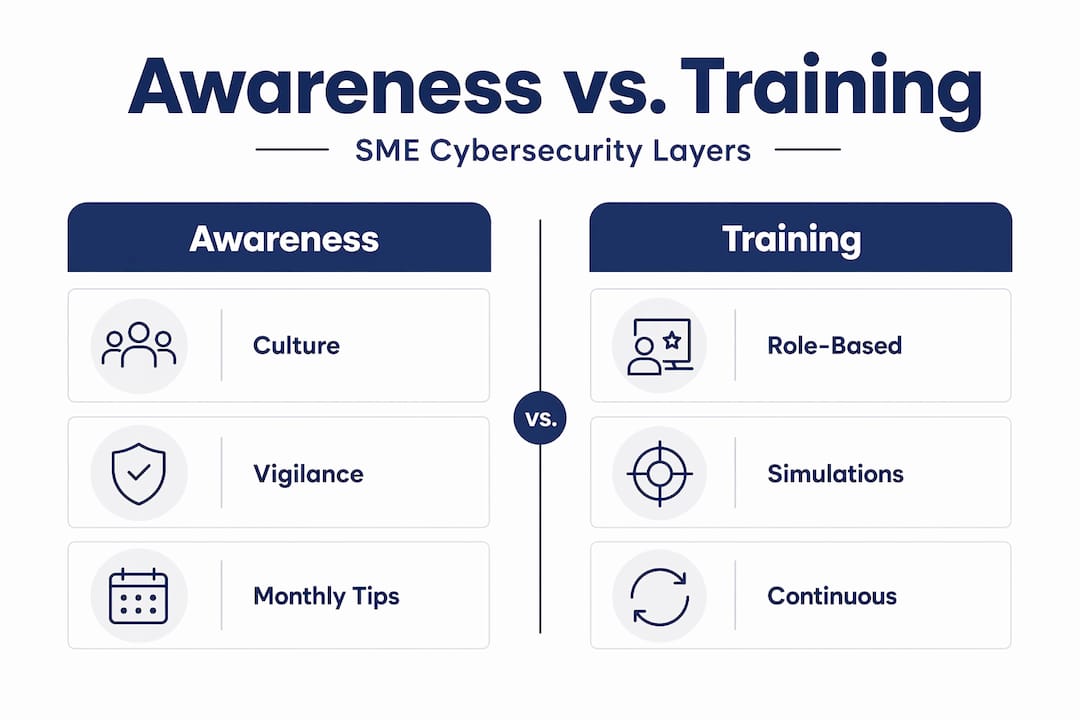
The NIST Awareness, Training and Education framework provides a recognised structure for building these programmes. It separates awareness (broad understanding) from training (specific skill development) from education (deeper conceptual knowledge), and Brisbane SMEs can use this layered model to scale their programmes proportionally to their size and risk profile.
| Programme layer | Focus | Example for SMEs |
|---|---|---|
| Awareness | Culture and general vigilance | Monthly security tips, phishing alert reminders |
| Training | Specific skills and procedures | Phishing recognition, password hygiene, reporting process |
| Education | Deeper understanding | IT staff, senior managers with broader responsibility |
Pro Tip: When you run your first simulated phishing campaign, don’t use it to punish staff who click. Use results to identify where more support is needed and position it as a learning experience. This preserves trust and keeps staff engaged with future training.
The transition from one-off courses to this structured, continuous model is the single biggest upgrade most Brisbane SMEs can make to their security posture. Training staff on cybersecurity effectively is less about volume of content and more about frequency and relevance. Pair this with practical cyber security steps applied at the technical level and you have a genuinely layered defence.
Proving ROI and business value: From compliance to continuity
One of the biggest barriers to proper investment in cybersecurity awareness training is that business owners struggle to justify the spend. That’s a measurement problem, not a value problem.
Some organisations that calculate ROI on security awareness training see returns between 3.5x and 6.5x, depending on sector and methodology. But only 33% of organisations actually measure it. The ones who don’t track outcomes tend to see training as a cost. The ones who do tend to see it as one of their better risk investments.
The key to making this case inside your business is shifting from completion metrics to outcome metrics. These include:
- Reduction in successful phishing incidents compared to your baseline period
- Average cost per incident before and after training implementation
- Number of incidents escalated early versus those discovered late
- Hours saved by IT or management not dealing with preventable security events
- Reduction in downtime linked to human-error security incidents
Training framed as a business continuity measure rather than a compliance exercise produces measurably different results. When your team understands they’re protecting operational continuity, not just satisfying an audit requirement, engagement and retention of knowledge improve.
Cybersecurity best practices for SMEs should incorporate regular reporting to leadership on these behavioural metrics. A short monthly update showing phishing click rate trends, reporting frequency, and simulation results gives boards and CFOs the visibility to support ongoing investment.
Pro Tip: Build a simple baseline report in the first month of your programme, capturing your current phishing click rate, average time-to-report, and number of incidents in the past quarter. This becomes your before-and-after comparison point and is your strongest tool for demonstrating ROI six months later.
What most businesses miss: Psychological safety and continuous improvement
Most Brisbane SMEs who implement cybersecurity awareness training focus almost entirely on content delivery. They pick a platform, assign modules, and track completion rates. And then they wonder why their incident reporting hasn’t improved.
The missing ingredient is almost always psychological safety. This means creating an environment where staff feel genuinely safe to report mistakes, suspicious emails, and near-misses without fear of punishment or embarrassment.
If employees fear punishment, incident reporting rates won’t improve even when quiz scores rise. This is a critical distinction. A staff member who clicked on a phishing simulation and failed won’t voluntarily report the next suspicious email if they’re worried about their job or their manager’s reaction.
The businesses that see sustained improvement share some common cultural traits:
- Leaders who openly discuss past security incidents as learning opportunities rather than failures
- Clear, accessible reporting channels with no friction or judgment attached
- Celebration of good reporting behaviour rather than punishment for errors
- Regular updates to training content that reflect current threats, not outdated scenarios
- Two-way feedback mechanisms so staff can raise concerns and contribute to improvement
Good security behaviour also builds customer trust beyond the internal benefits. When Brisbane SMEs can demonstrate they take staff security training seriously, it strengthens their credibility with clients in regulated industries like healthcare, financial services, and legal.
Understanding the Queensland SME cyber security landscape in 2026 means recognising that threats evolve faster than annual training cycles can keep up with. Continuous improvement is not a nice-to-have; it’s the mechanism that keeps your programme relevant.
“The goal is not perfect quiz results. It is a workplace where every person knows what to do when something looks wrong, and feels confident enough to say something.” — Core principle of behaviour-focused security training
Why Brisbane SMEs should view cybersecurity awareness as operational, not optional
Here’s the perspective that most cybersecurity advice avoids saying directly. The businesses that get the most out of awareness training are not the ones with the best platform or the most polished content modules. They’re the ones where leadership treats it as a core operational responsibility, not a box to tick before an audit.
We’ve worked with Brisbane SMEs across professional services, healthcare, and construction. The ones who struggle to show results from training have one thing in common: the programme is owned by someone other than a senior decision-maker. It sits in HR or with an office manager. It gets done when there’s time. Leadership doesn’t model it or talk about it.
The ones who succeed treat cybersecurity awareness the same way they treat WH&S (workplace health and safety) training. It’s recurring. It’s role-specific. Leadership participates. Near-misses are discussed openly. And they measure actual safety outcomes, not just whether everyone completed the induction.
The investment mindset shift is straightforward. Cybersecurity awareness training is not a cost of compliance. It is a cost of doing business safely. The average cost of a small business data breach in Australia now runs to hundreds of thousands of dollars when you factor in recovery, reputational damage, and lost productivity. A well-run awareness programme costs a fraction of that.
Improving cyber security for Brisbane SMEs requires exactly this shift in perspective. Operational focus, leadership buy-in, and continuous measurement are what separate the businesses that grow their resilience from those that cycle through the same compliance exercise year after year without seeing meaningful change.
How to get started: Cybersecurity training and support for your Brisbane business
If this article has prompted you to take a harder look at how your team handles security threats, you’re already ahead of most Brisbane SMEs. The next step is moving from awareness to action with support that’s built for businesses your size and location.
IT Start provides Brisbane business IT support with a specific focus on SMEs in Queensland who need proactive, strategic guidance rather than reactive break-fix services. Our team understands the local threat landscape and can help you design and implement an awareness training programme that produces measurable behavioural outcomes. From simulated phishing campaigns to reporting dashboards and staff training frameworks, our cyber security services are built to move the needle on the metrics that matter. Reach out to IT Start for a tailored assessment of your current cyber security posture and a clear plan for improving it.
Frequently asked questions
How do you measure the effectiveness of cybersecurity awareness training?
Track behavioural metrics like phishing click rate, reporting rate, and time-to-report for real impact rather than course completion alone. Behaviour metrics such as phishing click rate and time-to-report reflect genuine change in staff behaviour.
What’s the best approach to training for Brisbane SMEs?
Ongoing, role-specific programmes with reinforcement, phishing simulations, and dashboards drive the best behaviour change and risk reduction. Multi-phase programmes with repeat, role-appropriate content consistently outperform one-off annual courses.
What ROI can small businesses expect from effective awareness training?
Some SMEs see returns between 3.5x and 6.5x, but real ROI depends on measuring outcomes like reduced breaches and improved reporting speed. 33% of organisations that calculate ROI on security awareness training see returns in this range.
Why is psychological safety important in cybersecurity training?
Staff will only report incidents quickly if they feel safe to do so without fear of blame or punishment. Blame-free psychological safety is the key factor in boosting incident reporting rates over time.
Are most cyber breaches in small business caused by staff error?
Yes, human error is cited as the main cause for the majority of small business breaches in Australia. Most breaches in small business happen due to human error rather than technical failure.