

Cyber attacks targeting Brisbane’s small to medium enterprises have surged dramatically, leaving many business owners uncertain about how to respond effectively when systems are compromised. The first 30 minutes of an attack determine whether your business faces minor disruption or catastrophic data loss. This guide provides clear, actionable steps to help you contain damage, preserve evidence, and restore operations confidently during a cyber security incident.
Table of Contents
- Preparing Your Business Before A Cyber Attack
- Immediate Steps To Take During A Cyber Attack
- Verifying And Recovering After A Cyber Attack
- Summary Of Key Response Steps During A Cyber Attack
- How IT Start Can Help Your Brisbane Business Recover From Cyber Attacks
Key takeaways
| Point | Details |
|---|---|
| Immediate containment | Isolate affected systems within minutes to prevent attack spread and limit financial damage. |
| Preparation reduces impact | Having documented policies, tested backups, and defined roles accelerates recovery significantly. |
| Evidence preservation | Avoid shutting down systems until forensic experts advise, as premature actions destroy critical evidence. |
| Communication matters | Legal guidance on internal and external messaging protects your business from reputational and regulatory harm. |
| Testing validates recovery | Regularly restore backups in separate environments to confirm data integrity before emergencies occur. |
Preparing your business before a cyber attack
Effective cyber attack response begins long before an incident occurs. Brisbane SMBs that invest in preparation significantly reduce damage and recover faster when threats materialise. Your first priority is establishing a documented cyber security incident management policy that defines roles, escalation pathways, and communication protocols.
Establishing a cyber security incident management policy.pdf) increases detection and response effectiveness by ensuring everyone understands their responsibilities during an attack. This policy should identify your incident response team, including internal staff and external specialists, and outline clear decision-making authority.
Create a comprehensive asset inventory documenting all systems, devices, software applications, and sensitive data locations. Understanding what you’re protecting enables faster identification of compromised assets during an attack. Your inventory should include network diagrams, software versions, and data classification levels.
Implement a rigorous patching schedule for all applications and operating systems. Patching operating systems within 14 days prevents exploitation of known vulnerabilities that attackers actively target. Automate patch deployment where possible to reduce human error and ensure consistency across your environment.
Password security remains a critical defence layer. Most ransomware attacks begin with compromised passwords and malicious emails, making strong password policies and multi-factor authentication essential. Enforce minimum password complexity requirements, regular password rotation, and MFA across all business systems.
Regularly review user access rights and remove unnecessary permissions. Conduct quarterly audits of third-party applications and plugins, removing those no longer required. This reduces your attack surface and limits potential entry points for malicious actors.
Pro Tip: Schedule automated weekly backups to multiple locations, including one offline or immutable backup that ransomware cannot encrypt. Test restoration procedures quarterly to verify backup integrity before you need them urgently.
Establish relationships with cyber security specialists and legal advisers before incidents occur. Having pre-negotiated contracts and contact details readily accessible eliminates delays when minutes matter. Your preparation checklist should include cyber insurance coverage review and understanding your policy’s notification requirements.
Consider implementing these foundational security controls:
- Deploy endpoint detection and response tools across all devices
- Configure email filtering to block phishing attempts
- Restrict administrative privileges to essential personnel only
- Enable logging and monitoring for suspicious activity detection
- Document your network architecture and critical system dependencies
The table below outlines essential preparation activities and their recommended implementation frequency:
| Activity | Frequency | Responsibility |
| — | — |
| Backup testing | Quarterly | IT Manager |
| Patch deployment | Within 14 days | Systems Administrator |
| Access rights review | Quarterly | Security Officer |
| Incident response drill | Annually | Response Team |
| Policy documentation update | Annually | Management |
Understanding cybersecurity best practices 2025 helps Brisbane businesses build resilient security postures. Recognising common cybersecurity risks examples brisbane sme face enables proactive defence strategies. Implementing robust computer security brisbane smes require reduces vulnerability to emerging threats.
Immediate steps to take during a cyber attack
When you detect a cyber attack, your immediate actions determine whether the incident remains contained or escalates into a business-threatening crisis. The first 30 minutes of a ransomware attack are critical for effective response, requiring swift, decisive action following your predefined procedures.
Follow these steps in order when an attack is detected:
-
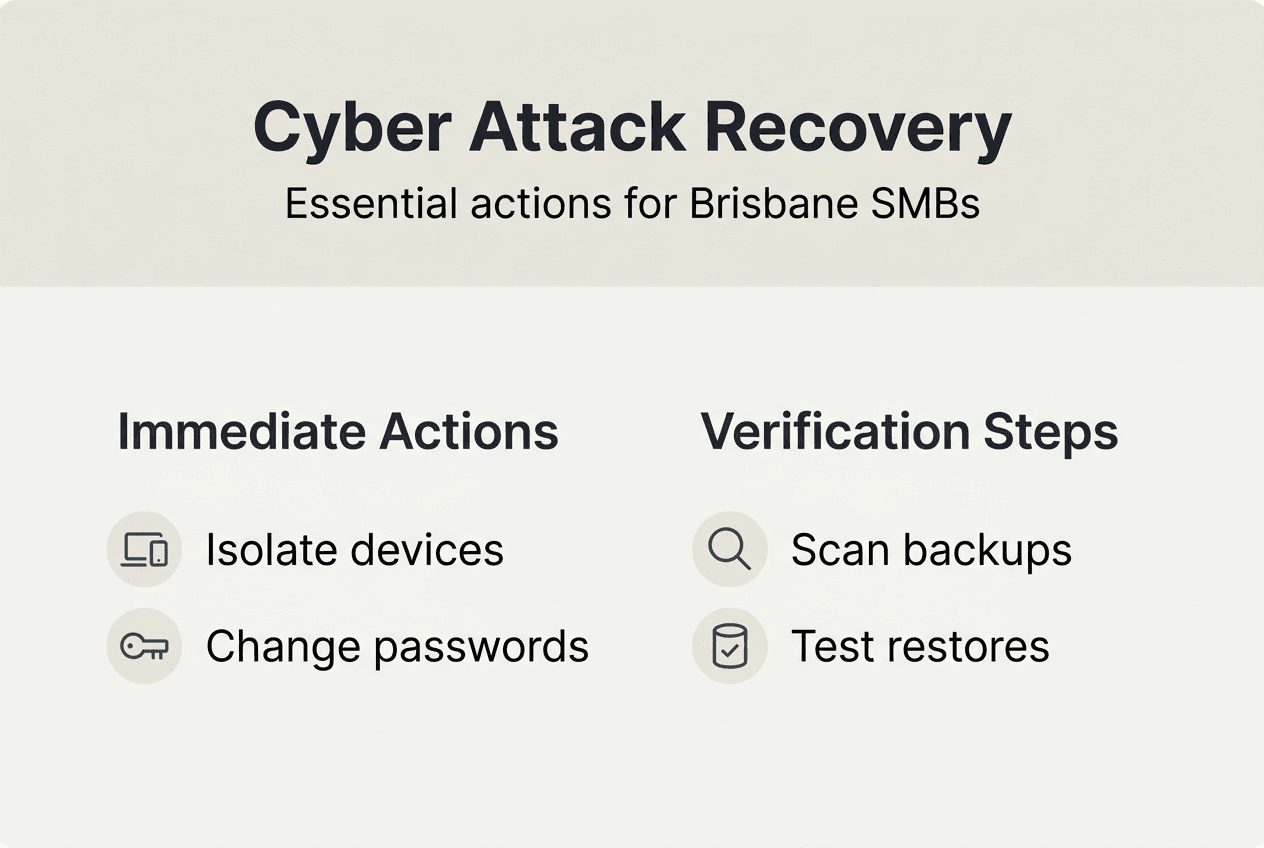
Isolate affected systems immediately. Disconnect compromised devices from your network by disabling network adapters or unplugging ethernet cables. This containment prevents malware spreading to other systems and limits data exfiltration.
-
Preserve evidence for forensic analysis. Avoid shutting down affected systems unless absolutely necessary, as this destroys volatile memory containing crucial evidence. Photograph screens showing ransom messages or unusual activity before taking any remediation actions.
-
Activate your incident response team. Contact designated team members using predefined communication channels, avoiding potentially compromised email systems. Escalate to external specialists immediately if internal capabilities are insufficient.
-
Document everything meticulously. Record timestamps, affected systems, observed symptoms, and actions taken. This documentation supports forensic investigation, insurance claims, and regulatory reporting requirements.
-
Assess the attack scope and type. Determine whether you’re facing ransomware, data breach, denial of service, or another attack vector. Understanding the threat type guides appropriate response strategies.
-
Notify relevant stakeholders according to your communication plan. Inform management, legal counsel, and cyber insurance providers within timeframes specified in your policy. Premature external communication without legal guidance can create liability issues.
-
Implement your business continuity procedures. Activate backup systems and alternative work arrangements to maintain critical operations while remediation occurs. Prioritise customer-facing services and revenue-generating activities.
-
Change credentials for administrative accounts. Reset passwords for privileged accounts that may have been compromised, starting with those having broad system access. Use secure, out-of-band methods for credential distribution.
Pro Tip: Create a physical incident response card listing emergency contacts, critical system passwords stored securely, and key decision points. Keep this accessible when digital systems are compromised.
Fast, structured response reduces damage and improves recovery outcomes by preventing attackers from establishing persistence or expanding their foothold. Brisbane businesses benefit from understanding cyber threat response guide brisbane smbs provide for local context.
During the attack, maintain clear communication channels with your response team. Establish a dedicated incident room, either physical or virtual, where team members coordinate activities and share updates. Assign a single point of contact for external communications to ensure consistent messaging.
Avoid these common mistakes during the initial response phase:
- Paying ransoms before exploring recovery options
- Attempting to remove malware without proper expertise
- Failing to preserve evidence through premature system wipes
- Neglecting to isolate backup systems from the network
- Communicating publicly before consulting legal counsel
Your cyber security actions brisbane business owners take during the first hour often determine total recovery costs and downtime duration. Implementing a robust business continuity plan cyber security strategy ensures operations continue despite system compromises.
Remember that attackers often monitor victim responses and may accelerate their activities if they detect containment efforts. Work quickly but methodically, following your documented procedures rather than improvising under pressure. Your preparation work pays dividends during this critical phase.
Verifying and recovering after a cyber attack
Successful containment marks only the beginning of your recovery journey. Thorough verification ensures threats are completely eradicated before restoring normal operations, preventing reinfection and secondary attacks that exploit incomplete remediation.
Validate that malware and backdoors are completely removed before restoring systems. Engage forensic specialists to conduct comprehensive scans across your entire environment, not just obviously affected systems. Attackers frequently establish persistence mechanisms in multiple locations, and missing even one allows them to regain access.

Test backup data regularly and restore it to a separate, isolated environment to confirm integrity before production deployment. Regular backups and disaster recovery plans minimise downtime and financial loss after an attack by providing known-good restore points. Verify that restored data is complete, uncorrupted, and free from malware before reconnecting to your network.
Maintain transparent communication with customers, regulators, and insurers throughout the recovery process. Most recovery delays arise from unclear ownership and untested communication workflows rather than technical challenges. Notify affected parties according to privacy legislation requirements, typically within 72 hours of confirming a data breach.
Your recovery verification checklist should include:
- Complete malware removal confirmed by multiple scanning tools
- Vulnerability patching that prevented the initial compromise
- Password resets for all accounts, prioritising privileged users
- Review of system logs for signs of persistent threats
- Validation of backup integrity through test restorations
- Network segmentation improvements to limit future attack spread
- Updated firewall rules and access control policies
Document lessons learned through a structured post-incident review. Gather your response team to analyse what worked well and what needs improvement. Update your incident response plan based on these insights, incorporating new procedures and addressing identified gaps.
Create a staged infrastructure roadmap to strengthen security going forward. Prioritise quick wins that address the most critical vulnerabilities first, then plan longer-term architectural improvements. This phased approach balances immediate risk reduction with budget constraints typical of Brisbane SMBs.
The recovery phase often reveals systemic weaknesses in business processes beyond technical systems. Review your vendor management, employee training programmes, and change management procedures. Strengthen areas where human factors contributed to the successful attack.
Consider these recovery priorities:
| Priority Level | Activity | Timeline |
|---|---|---|
| Critical | Restore customer-facing services | 24-48 hours |
| High | Complete forensic analysis | 3-7 days |
| Medium | Implement security improvements | 2-4 weeks |
| Ongoing | Employee security awareness training | Quarterly |
Understanding cybersecurity insurance smb australia requirements helps ensure coverage applies when you need it most. Maintaining a comprehensive business continuity plan cyber security strategy reduces recovery time and costs significantly.
Engage with industry peers and professional networks to share experiences and learn from others’ incidents. Brisbane’s business community benefits from collective knowledge about emerging threats and effective response strategies. Consider joining local cyber security forums or industry associations.
Monitor your environment closely for several weeks following an attack. Attackers sometimes return after initial remediation, exploiting the same or different vulnerabilities. Enhanced monitoring helps detect and contain secondary attempts before they cause additional damage.
Summary of key response steps during a cyber attack
Understanding effective versus ineffective responses helps Brisbane business owners make confident decisions during stressful incidents. The table below contrasts recommended actions against common mistakes and their consequences.
| Response Phase | Effective Action | Ineffective Action | Consequence of Mistake |
|---|---|---|---|
| Detection | Isolate affected systems immediately | Ignore warning signs or delay response | Attack spreads across entire network |
| Containment | Preserve evidence and document everything | Shut down systems without forensic guidance | Loss of critical evidence for investigation |
| Communication | Consult legal counsel before external statements | Publicly disclose details prematurely | Regulatory penalties and reputation damage |
| Recovery | Restore from tested, verified backups | Restore without malware scanning | Reinfection from compromised backup data |
| Post-incident | Update policies based on lessons learned | Resume operations without addressing root causes | Vulnerability to repeat attacks |
This decision-making framework provides clarity when minutes matter and stress levels are high. Print this table and keep it accessible as part of your incident response materials. Quick reference during an active incident prevents costly mistakes that extend recovery time.
Brisbane SMBs implementing these structured approaches demonstrate significantly better outcomes when facing cyber attacks. Your cyber threat response guide brisbane smbs follow should align with industry best practices while addressing your specific business context and risk profile.
How IT Start can help your Brisbane business recover from cyber attacks
Navigating cyber attacks requires specialist expertise that most Brisbane SMBs lack internally. IT Start delivers comprehensive cyber security services designed specifically for Queensland businesses facing evolving threats. Our incident response planning ensures your team knows exactly what to do when attacks occur, reducing panic and accelerating containment.
Our managed services include 24/7 threat detection, automated backup solutions, and rapid recovery capabilities that minimise downtime. We implement layered security controls tailored to your industry requirements, whether you operate in financial services, healthcare, legal, or professional services sectors. Understanding cyber security through our proactive approach means threats are identified and neutralised before causing business disruption.
IT Start’s cloud services provide resilient infrastructure that maintains operational continuity during incidents. Our Brisbane-based team delivers local expertise with rapid response times when you need support most. Partner with IT Start to build cyber resilience that protects your business, customers, and reputation.
FAQ
How quickly should I respond to a suspected cyber attack?
You should respond immediately, ideally within the first 30 minutes, to contain damage and preserve recovery options. Every minute of delay allows attackers to spread further through your network, encrypt additional data, or exfiltrate sensitive information. Having predefined procedures speeds your reaction and reduces risks of secondary damage from hasty, uninformed decisions made under pressure.
What are the early signs my business is under cyber attack?
Unusual system slowdowns, unexpected file encryption notices, or ransom messages displayed on screens indicate active attacks requiring immediate response. Other warning signs include failed login attempts from unusual locations, unexpected password reset emails, or files with changed extensions. Ransomware attacks often start with malicious emails and compromised passwords, so increased phishing attempts may signal reconnaissance preceding a larger attack.
How can I ensure my backups will work when recovering from an attack?
Regularly test restoring backups in separate, isolated environments to verify data integrity and completeness before emergencies occur. Many businesses find their backups fail during recovery due to lack of testing, discovering corruption or incomplete data only when they desperately need restoration. Maintain documented disaster recovery procedures and update them as your systems evolve, ensuring backup locations include offline or immutable storage that ransomware cannot encrypt.
Should I pay the ransom if my data is encrypted?
Paying ransoms is strongly discouraged as it funds criminal operations, provides no guarantee of data recovery, and marks your business as a willing payer for future attacks. Explore all recovery options first, including backup restoration, forensic recovery tools, and specialist assistance. Many ransomware variants have known decryption tools available through law enforcement and security researchers. Consult with cyber security specialists and law enforcement before considering payment as a last resort.
What legal obligations do Brisbane businesses have after a cyber attack?
Australian privacy legislation requires businesses to notify affected individuals and the Office of the Australian Information Commissioner within 72 hours of confirming a data breach involving personal information. You must also notify your cyber insurance provider within timeframes specified in your policy to maintain coverage. Consult legal counsel immediately to ensure compliance with notification requirements and to manage communications that could create liability. Document all actions taken during the incident for regulatory reporting and potential legal proceedings.