
TL;DR:
- Cyber security training helps Australian small and medium businesses reduce human error in cyber threats. Regular, short modules improve staff awareness and strengthen their defense against attacks. Without ongoing training and leadership support, businesses remain vulnerable to costly breaches.
Cyber security training is the process of educating employees to recognise, prevent, and respond to cyber threats before those threats become costly incidents. For Australian small and medium businesses, the stakes have never been higher. In 2026, small businesses face $56,600 per cyber incident on average, while medium businesses face $97,200. Those numbers have jumped sharply year on year. The Australian Cyber Security Centre (ACSC) and the Notifiable Data Breach (NDB) scheme both point to the same root cause: untrained staff. Understanding why cyber security training is important starts with accepting that your people are both your biggest vulnerability and your most effective line of defence.
What are the main benefits of cyber security training for small and medium businesses?
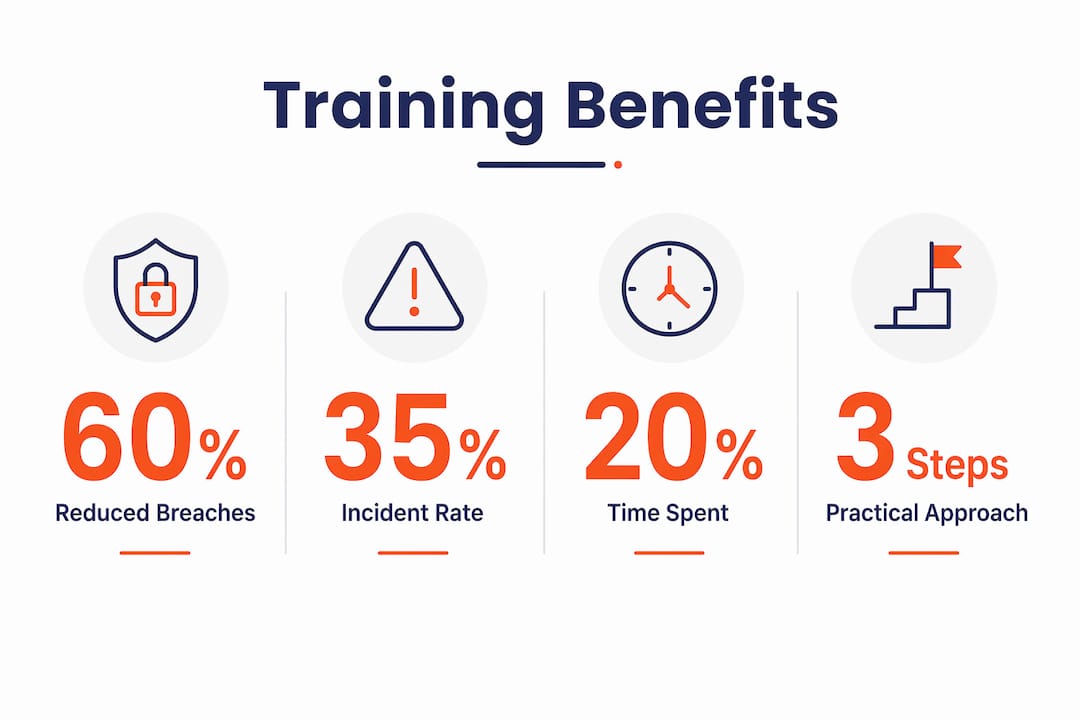
Cyber security training directly reduces the frequency and cost of incidents for SMEs. When staff know how to spot a phishing email, handle a suspicious link, or report an unusual login, they stop attacks before they escalate. That is not a theory. Human error enables 60% of notifiable data breaches in Australia, with phishing as the primary cause. Training addresses that gap at the source.
The benefits of cyber awareness extend well beyond avoiding breaches. Trained staff improve your compliance posture under the NDB scheme, which requires organisations to have reasonable steps in place to protect personal information. Documented training records also form part of your audit trail if a breach does occur. Regulators and insurers increasingly ask for evidence of staff education, not just technical controls.
Here is what we see in practice with Brisbane SMBs after a structured training programme:
- Phishing click rates drop significantly within the first few months of simulated phishing exercises.
- Staff report suspicious emails rather than ignoring or acting on them.
- Password hygiene improves when employees understand why weak passwords create real risk.
- Incident response becomes faster because staff know who to call and what not to touch.
- Leadership feels more confident discussing cyber risk with insurers and clients.
The importance of cyber security training also shows up in culture. When security becomes a shared responsibility rather than an IT department problem, the whole business gets harder to attack.
Pro Tip: Run a simulated phishing test before your first training session. The results will shock most business owners and give you a concrete baseline to measure improvement against.
How vulnerable are SMEs without cyber security training?
35% of Australian SMEs have experienced a cyber incident. That figure alone should concern any business owner. What makes it worse is that 52% of SMEs do not believe they are a target, and 60% have no formal response plan. The gap between perceived risk and actual exposure is where most breaches happen.
We see this constantly. A client thinks they are protected because they have antivirus software and a firewall. Then someone clicks a fake Microsoft 365 login page, hands over their credentials, and the attacker is inside the network before anyone notices. No technical tool catches that. Only a trained employee does.
The threat environment has also shifted. AI-powered phishing tools now generate convincing, personalised emails at scale. Attackers no longer send obvious scam messages with spelling errors. They send emails that look like they came from your accountant, your bank, or your own CEO. Untrained staff cannot tell the difference.
| Common SME vulnerability | Why it matters |
|---|---|
| No multi-factor authentication (MFA) | Stolen passwords give attackers full access |
| Poor password hygiene | Reused or weak passwords are cracked quickly |
| No formal incident response plan | Breaches escalate because no one knows what to do |
| Untrained staff clicking phishing links | Human error is the leading cause of breaches |
| No simulated phishing exercises | Staff never practise spotting real attacks |
20% of SMEs spend no time on cyber security prevention each month. That figure reflects competing priorities, not indifference. But it also explains why awareness alone does not translate into readiness. Knowing cyber threats exist and knowing how to handle them are two very different things.
Pro Tip: Check whether your staff know your incident response process right now. Ask them what they would do if they clicked a suspicious link. Most will say “nothing” or “close the tab.” That answer tells you everything.

What practical approaches make cyber security training effective?
One-off annual training sessions do not work. Staff forget most of what they learn within weeks, and the threat environment changes faster than a yearly workshop can keep up with. Effective training uses short 10–15 minute modules, delivered regularly, with mobile-friendly content that fits into a busy workday. That format keeps knowledge fresh without pulling people away from their jobs for hours at a time.
Here is a practical approach that works for SMBs with limited time and budget:
- Start with a baseline assessment. Use the free ACSC Cyber Health Check Tool to understand where your gaps are before you spend anything on training.
- Run a simulated phishing exercise. This gives you real data on how your staff respond to attacks and creates urgency without lecturing.
- Deliver short, regular training modules. Aim for monthly or quarterly sessions covering one topic at a time: phishing, passwords, MFA, safe browsing, or incident reporting.
- Use free government resources. The Cyber Wardens programme delivers free employee training specifically designed for small businesses with 19 or fewer employees.
- Repeat simulated phishing tests. Measure improvement over time and use results to target further training where staff still struggle.
Beyond the mechanics, leadership buy-in is the decisive factor in whether training actually changes behaviour. When the business owner or manager treats security seriously, staff follow. When leadership skips the training or dismisses it as an IT issue, the culture never shifts.
A few additional approaches that improve results:
- Tie training to real incidents. When a phishing attack hits a local business, use it as a teaching moment.
- Make reporting easy. Staff who spot something suspicious need a clear, simple way to report it without fear of being blamed.
- Acknowledge good behaviour. Recognising staff who flag threats reinforces the right habits.
For a detailed guide on training staff on cybersecurity, IT Start has put together a practical SME-focused resource that covers these steps in depth.
How does cyber security training fit into your broader risk management strategy?
Training is not a standalone fix. It works best as part of a layered defence that includes technical controls, documented policies, and a clear incident response plan. The ISO 27001 standard and the NDB scheme both treat staff education as a required component of a sound security framework, not an optional extra. That matters when you are dealing with insurers, clients, or regulators after an incident.
Think of it this way. MFA stops stolen passwords from being useful. Backups let you recover from ransomware. Firewalls block known threats. But none of those controls stop an employee from willingly handing credentials to an attacker who has convinced them they are from IT support. Training closes that gap.
A practical cyber risk management strategy for an SME looks like this: assess your current risks, implement technical controls, train your staff, document everything, and review the whole picture at least annually. The cyber risk management strategy guide from IT Start walks through each of these steps with Australian SMBs specifically in mind.
Documentation matters more than most business owners realise. If a breach occurs and you face a regulatory investigation or an insurance claim, your training records, policy documents, and incident logs are evidence that you took reasonable steps. Businesses without that paper trail face harder conversations. The impact of cyber security education shows up not just in fewer incidents, but in faster, cleaner recoveries when something does go wrong.
Awareness alone is not enough. Transforming knowledge into readiness requires intentional action, formal plans, and regular practice. That is the difference between a business that survives a breach and one that does not. For more on building staff awareness as part of a wider programme, the IT Start guide on improving cyber security awareness covers the cultural and operational side in detail. Understanding common network security threats also helps business owners see where training fits within the full picture of cyber defence.
Key takeaways
Cyber security training is the single most cost-effective step an Australian SME can take to reduce breach risk, because human error drives the majority of incidents and training directly addresses that cause.
| Point | Details |
|---|---|
| Human error is the primary cause | 60% of notifiable data breaches in Australia involve human error, making staff training the highest-priority control. |
| Financial stakes are high | Small businesses face $56,600 per incident on average in 2026, a cost that training can significantly reduce. |
| Most SMEs are underprepared | 60% of SMEs have no incident response plan, leaving them exposed when an attack succeeds. |
| Short, regular training works best | Monthly 10–15 minute modules outperform annual workshops for retention and behaviour change. |
| Training must sit inside a strategy | Documented training records support NDB compliance, insurance claims, and audit responses. |
What I have learned from watching SMEs handle cyber security training
Honestly, the most common mistake I see is business owners treating training as a box to tick. They run one session, hand out a certificate, and consider the job done. Then twelve months later, someone clicks a phishing link and the whole business is offline. The training did not fail because the content was bad. It failed because nothing reinforced it.
The second mistake is thinking that technical tools replace training. We manage Microsoft 365 environments for dozens of Brisbane businesses. Every one of them has some form of spam filtering. Every one of them still gets phishing emails that make it through. The filters catch the obvious ones. The convincing ones land in inboxes, and at that point, the only thing standing between the attacker and your data is whether your staff member knows what to look for.
What actually works is making security a normal part of how the business operates. Not a big annual event. Not a lecture from IT. Just regular, short conversations, a simulated test every few months, and a manager who takes it seriously enough to do the training themselves. I have seen businesses with no dedicated IT budget make real improvements just by being consistent. The cyber security tips for small businesses that apply in practice are rarely the complicated ones. They are the basics, done repeatedly, by people who understand why they matter.
— Matt
How IT Start supports your cyber security training needs
IT Start works with Brisbane SMBs to build practical, ongoing cyber security programmes that fit real business constraints. That means helping you assess your current risk, set up staff training that actually sticks, and put the right technical controls in place around it. The cyber security services IT Start provides cover everything from phishing simulations and awareness training to full risk assessments and compliance support. For businesses that need broader support, IT Start’s business IT support service keeps your whole environment secure and well-managed. Get in touch with IT Start to book a free consultation and find out where your biggest gaps are.
FAQ
Why is cyber security training important for small businesses?
Cyber security training reduces the risk of human error, which drives 60% of notifiable data breaches in Australia. Small businesses face an average cost of $56,600 per incident, making prevention far cheaper than recovery.
How often should employees receive cyber security training?
Short monthly or quarterly sessions outperform annual workshops for knowledge retention. Regular refreshers, combined with simulated phishing exercises, keep staff prepared as threats evolve.
What is the Notifiable Data Breach scheme and how does training help?
The NDB scheme requires Australian organisations to notify affected individuals and the Office of the Australian Information Commissioner when a serious data breach occurs. Documented training records demonstrate that your business took reasonable steps to protect personal information, which matters during regulatory reviews.
Are there free cyber security training resources for Australian SMEs?
The Cyber Wardens programme provides free employee training for small businesses, and the ACSC Cyber Health Check Tool offers anonymous risk assessments at no cost. Both are practical starting points for businesses with limited budgets.
What is the biggest mistake SMEs make with cyber security training?
The most common mistake is running a single training session and treating it as complete. Without regular refreshers, simulated tests, and leadership involvement, staff revert to old habits quickly and the training has little lasting effect.