
TL;DR:
- A cyber security CISO in Australian SMBs is responsible for managing compliance, risk, and security culture under the Cyber Security Act 2024. They must oversee documentation, AI risks, continuous monitoring, and communicate risks clearly to the board. Building ongoing security awareness and adopting integrated frameworks are essential for effective SMB cybersecurity.
A cyber security CISO, formally known as a Chief Information Security Officer, is the senior executive accountable for an organisation’s entire information security posture. In Australian SMBs, this role carries real legal weight under the Cyber Security Act 2024, which defines 14 controls across 5 domains that the CISO must own and manage. The CISO bridges the gap between technical teams and the board, translating risk into business language and turning compliance requirements into workable security programmes. Get this role right and your organisation is genuinely protected. Get it wrong and you are one phishing email away from a very bad week.
What are the primary responsibilities of a cyber security CISO in SMBs?
The CISO role in cyber security is not just about firewalls and antivirus. It covers strategy, culture, compliance, and budget, all at once.
The core duties of an effective CISO include:
- Security strategy alignment. The CISO sets the organisation’s security direction and makes sure it matches business goals, not just IT preferences.
- Risk reporting. The CISO reports the organisation’s risk posture to executives and the board in plain terms, not technical jargon.
- Budget allocation. Security spend must be divided sensibly across people, process, and technology. Most SMBs over-invest in tools and under-invest in training.
- Compliance management. Under the Cyber Security Act 2024, CISO responsibilities include owning organisational-level security documentation and approving it formally.
- Incident response readiness. The CISO owns the incident response plan and makes sure the team can actually execute it under pressure.
- Security culture. Building awareness across the business is as important as any technical control.
Pro Tip: If your board cannot describe your top three cyber risks in plain English, your reporting is not working. Rewrite your risk summary until a non-technical director can read it in two minutes.
The CISO also manages the Essential Eight framework, which the Australian Cyber Security Centre recommends as the baseline for Australian organisations. Patching, application control, and restricting admin privileges are not optional extras. They are the floor.

What challenges do CISOs face in Australian SMBs?
Honestly, the CISO role in an SMB is harder than the same role in a large enterprise. You have fewer resources, less budget, and the same threat environment.
The most common challenges, in order of how often we see them cause real problems:
- Justifying security investment. Boards want ROI. Security does not generate revenue, so CISOs must frame risk in financial terms. “This control prevents a breach that would cost us $X” lands better than “we need better endpoint protection.”
- Managing overlapping compliance frameworks. The Cyber Security Act 2024, the Essential Eight, the Privacy Act, and industry-specific requirements all overlap. Without a mapping approach, you end up doing the same work three times.
- Recruiting and retaining skilled staff. The security talent shortage is real. SMBs cannot compete with enterprise salaries, so many CISOs end up doing hands-on technical work themselves.
- Integrating AI risks safely. The ACSC’s January 2026 guidance specifically calls out AI adoption as a new risk vector for small businesses. Most SMBs are using AI tools without any formal risk assessment.
- Balancing security with usability. Lock things down too hard and staff find workarounds. Too loose and you have a breach. Finding that balance is a daily negotiation.
Pro Tip: Map your compliance frameworks side by side in a spreadsheet before you build any controls. You will find that 60–70% of requirements overlap. Build once, satisfy many.
We see this a lot: a CISO spends months building a compliance programme for one framework, then discovers they need to start again for another. Cross-framework mapping eliminates that duplication and saves significant time.
How does the Cyber Security Act 2024 shape the CISO role in Australia?
The Cyber Security Act 2024 is the most significant change to Australian cyber security obligations in years. For CISOs, it creates direct accountability for documentation, controls, and reporting.
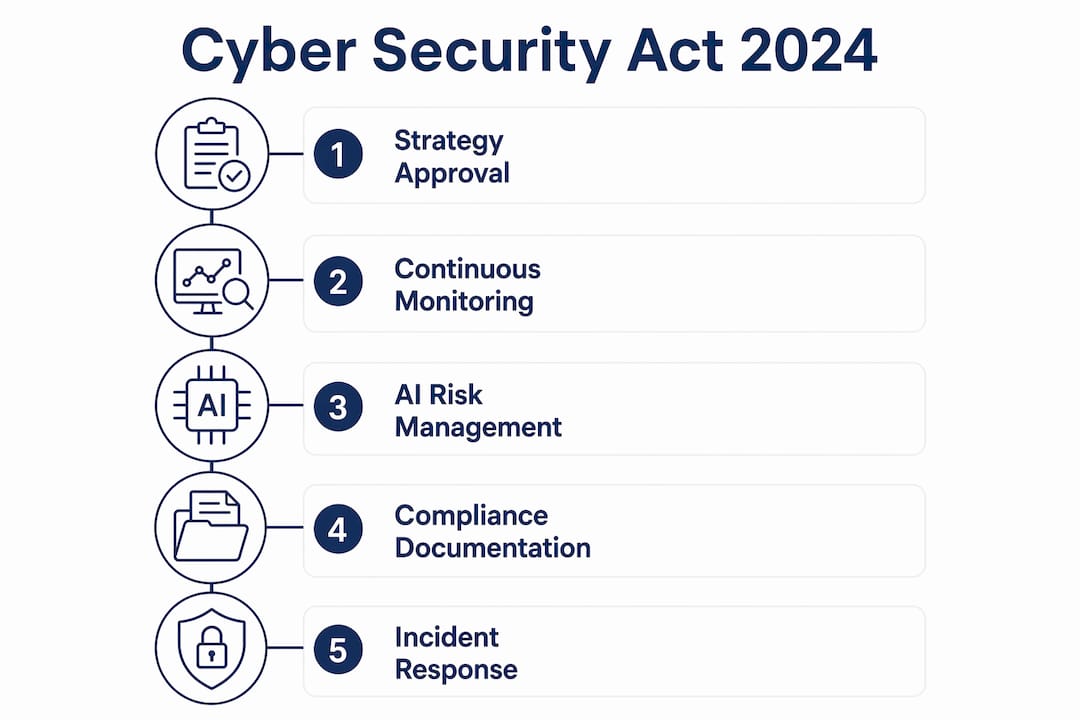
Compliance documentation approved by the CISO forms the primary defence against legal liability and audit failures. System-specific plans are owned by system owners, but organisational-level security strategy requires the CISO’s formal approval. That distinction matters enormously in an audit.
The Act also shapes how CISOs must approach AI. The ACSC’s January 2026 publication on AI for small businesses urges comprehensive risk documentation and a proactive management checklist. This is not optional guidance. It is the direction regulators are moving.
| Compliance area | CISO obligation | Practical action |
|---|---|---|
| Security strategy | Approve organisational-level documents | Maintain a signed, dated security plan |
| Risk management | Document and report risk posture | Quarterly board risk briefings |
| AI adoption | Assess and document AI-specific risks | Complete ACSC AI risk checklist |
| Incident response | Own and test the response plan | Annual tabletop exercise minimum |
| Continuous monitoring | Maintain a live monitoring plan | Monthly vulnerability review cycle |
Continuous monitoring plans help organisations proactively identify and prioritise vulnerabilities. Systems with active monitoring are better prepared for evolving threats and maintain compliance far more easily than those relying on annual reviews.
Automated compliance tools that offer gap analysis, control mapping, and evidence collection across multiple frameworks are worth the investment. Effective compliance management using these tools reduces duplication, saves time, and improves accuracy for CISOs managing complex requirements with small teams.
What cyber security risks are most prevalent for SMBs?
SMBs face the same threats as large enterprises but with a fraction of the defences. The risk profile is well established and, honestly, not surprising.
The top risks for Australian SMBs are phishing, ransomware, data breaches, and supply chain vulnerabilities. Phishing remains the entry point for the majority of incidents. Ransomware follows because SMBs often have poor backup strategies and no tested recovery process. Many SMBs believe they are protected because they have a backup solution running. They are not actually checking whether it works.
AI adoption adds a new layer of risk that most SMB CISOs are not yet managing formally. The ACSC identifies three specific AI risks:
- Data leaks from improper anonymisation. Staff feeding sensitive client data into AI tools without understanding where that data goes.
- Prompt injection attacks. Manipulated inputs that cause AI systems to behave in unintended ways, producing incorrect or harmful outputs.
- Supply chain vulnerabilities. Third-party AI providers with weak security controls becoming an entry point into your environment.
The ACSC’s mitigation guidance for AI risks covers staff training, vendor evaluation, continuous monitoring, and human oversight in AI-based decision workflows. These are not complex controls. They are discipline and process.
For general SMB risk mitigation, the fundamentals still matter most:
- Multifactor authentication on every account, no exceptions.
- Privileged access management so admin credentials are not used for daily tasks.
- Encryption for data at rest and in transit.
- Regular, tested backups stored separately from production systems.
- Staff training that covers phishing recognition and reporting procedures.
- Vendor security assessments before onboarding any third-party tool.
The IT risks most SMBs face are not exotic. They are predictable. The gap is not knowledge. It is execution.
What practical steps build a strong security culture and incident readiness?
Security culture is the hardest thing to build and the easiest thing to lose. A CISO can deploy every technical control available and still suffer a breach because one staff member clicked a link in a convincing email.
Building genuine security awareness in an SMB requires:
- Tailored training. Generic annual compliance training does not change behaviour. Short, role-specific sessions delivered regularly are far more effective. A finance team needs different training than a sales team.
- Phishing simulations. Running controlled phishing tests tells you exactly where your human risk sits. The results are often uncomfortable. That discomfort is useful.
- Clear reporting channels. Staff must know how to report a suspicious email or incident without fear of blame. If reporting feels risky, people stay quiet and incidents escalate.
- Documented incident response plans. The plan must be written, approved, tested, and updated. A plan that exists only in someone’s head is not a plan.
- Regular tabletop exercises. Walk your team through a simulated ransomware attack once a year. You will find gaps in your response process that no amount of documentation would have revealed.
Communication between security, IT, and executive teams is where most SMB CISOs fall short. The CISO needs a direct line to the CEO and board, not just the IT manager. Security decisions with business impact cannot sit in the IT queue.
Pro Tip: After every security incident or near-miss, run a 30-minute debrief with the relevant team. Document what happened, what worked, and what did not. These lessons are worth more than any training course.
Improving cyber security awareness across your SMB is not a one-off project. It is an ongoing programme that the CISO must own, fund, and champion at the executive level.
Key takeaways
The CISO role in Australian SMBs requires formal documentation ownership, proactive AI risk management, and continuous security culture investment to meet Cyber Security Act 2024 obligations and protect the business.
| Point | Details |
|---|---|
| Documentation ownership | The CISO must formally approve organisational security plans to satisfy audit and legal requirements. |
| AI risk management | ACSC January 2026 guidance requires CISOs to assess and document AI-specific risks including data leaks and prompt injection. |
| Cross-framework mapping | Mapping compliance frameworks side by side eliminates duplicated effort and reduces compliance overhead significantly. |
| Security culture investment | Regular, role-specific training and phishing simulations reduce human risk more effectively than annual compliance sessions. |
| Continuous monitoring | Live monitoring plans keep organisations ahead of evolving threats and maintain compliance between formal audits. |
What I have learned about the CISO role in Australian SMBs
The biggest mistake I see CISOs make is treating documentation as a box-ticking exercise. They write a security plan, get it signed off, and file it away. Twelve months later, the plan describes a network that no longer exists. Auditors notice. Regulators notice. Attackers certainly do not care.
The second mistake is underestimating AI risk. Every SMB we work with has staff using AI tools. Almost none of them have a formal policy covering what data can be entered into those tools. That is a data breach waiting to happen, and the CISO will own it.
Honestly, the CISOs who do this well are the ones who treat their security programme as a living system, not a project with a completion date. They update their incident response plan after every exercise. They brief the board quarterly, not annually. They push back when a new AI tool gets adopted without a risk assessment.
The cybersecurity framework guidance available for Queensland SMBs is genuinely useful and underused. CISOs should be pulling from the Essential Eight and the ACSC’s published guidance regularly, not just when an audit is approaching.
The CISO role is not glamorous in an SMB. You are often the only person in the room who understands the risk. That is exactly why the role matters.
— Matt
How IT Start supports CISOs with SMB cyber security
IT Start works directly with CISOs and security-conscious business leaders across Brisbane and Queensland to manage cyber risk, compliance, and security operations. Our managed cyber security services cover compliance gap analysis against the Cyber Security Act 2024 and Essential Eight, incident response planning, continuous monitoring, and staff security awareness programmes. We hold SMB 1001 Gold certification, which means our own security standards are independently verified. If you are a CISO carrying compliance obligations with a small team, we can fill the gaps without replacing your leadership. Our cloud security services also support CISOs managing hybrid environments and third-party AI tool risks. Contact IT Start for a no-obligation security assessment tailored to your organisation’s current risk posture.
FAQ
What does a CISO do in a small business?
A CISO in a small business owns the organisation’s security strategy, manages compliance obligations, reports risk to the board, and builds security awareness across the team. The role combines technical oversight with executive communication and budget management.
What is the Cyber Security Act 2024 and how does it affect CISOs?
The Cyber Security Act 2024 defines 14 controls across 5 domains that Australian organisations must manage. CISOs are directly accountable for approving organisational-level security documentation and demonstrating compliance during audits.
What are the biggest cyber security risks for Australian SMBs?
Phishing, ransomware, data breaches, and supply chain vulnerabilities are the most common threats. AI adoption adds new risks including data leaks from improper anonymisation and prompt injection attacks, as identified by the ACSC in january 2026.
How often should a CISO update the incident response plan?
The incident response plan should be reviewed and updated at least annually, and after every significant incident or tabletop exercise. Continuous monitoring plans require the same discipline to remain effective.
Does an SMB need a full-time CISO?
Not necessarily. Many SMBs use a virtual CISO or engage a managed security provider to fulfil CISO responsibilities at a fraction of the cost of a full-time hire, while still meeting compliance and risk management obligations.