

Security concerns and legacy systems often slow down progress for Brisbane firms in banking, finance, and legal sectors. Managing operational complexity while keeping costs in check feels like a constant challenge. Embracing a hybrid cloud approach unlocks scalable resources, improved cybersecurity, and compliance control, giving decision-makers practical options to act quickly and confidently. This guide offers clear, real-world insights so you can choose and implement the right hybrid cloud strategy for your organisation.
Table of Contents
- Hybrid Cloud Explained For Brisbane Firms
- Key Components And How Hybrid Cloud Works
- Benefits Of Hybrid Cloud For SMEs
- Cybersecurity And Compliance Considerations
- Comparing Hybrid Cloud To Public And Private
Table of Contents: Hybrid Cloud Guide for Brisbane Businesses
| Point | Details |
|---|---|
| Hybrid Cloud Adoption | Brisbane businesses are increasingly leveraging hybrid cloud strategies to enhance scalability and manage costs effectively. |
| Cybersecurity Focus | Robust cybersecurity measures are critical in hybrid cloud environments to ensure data protection and compliance with regulations. |
| Infrastructure Assessment | Conducting a comprehensive infrastructure audit is essential before implementing hybrid cloud solutions to identify optimal workload placements. |
| Comparative Deployment Models | Hybrid cloud offers a balanced approach combining the benefits of public and private clouds, making it suitable for diverse business needs. |
Hybrid Cloud Explained for Brisbane Firms
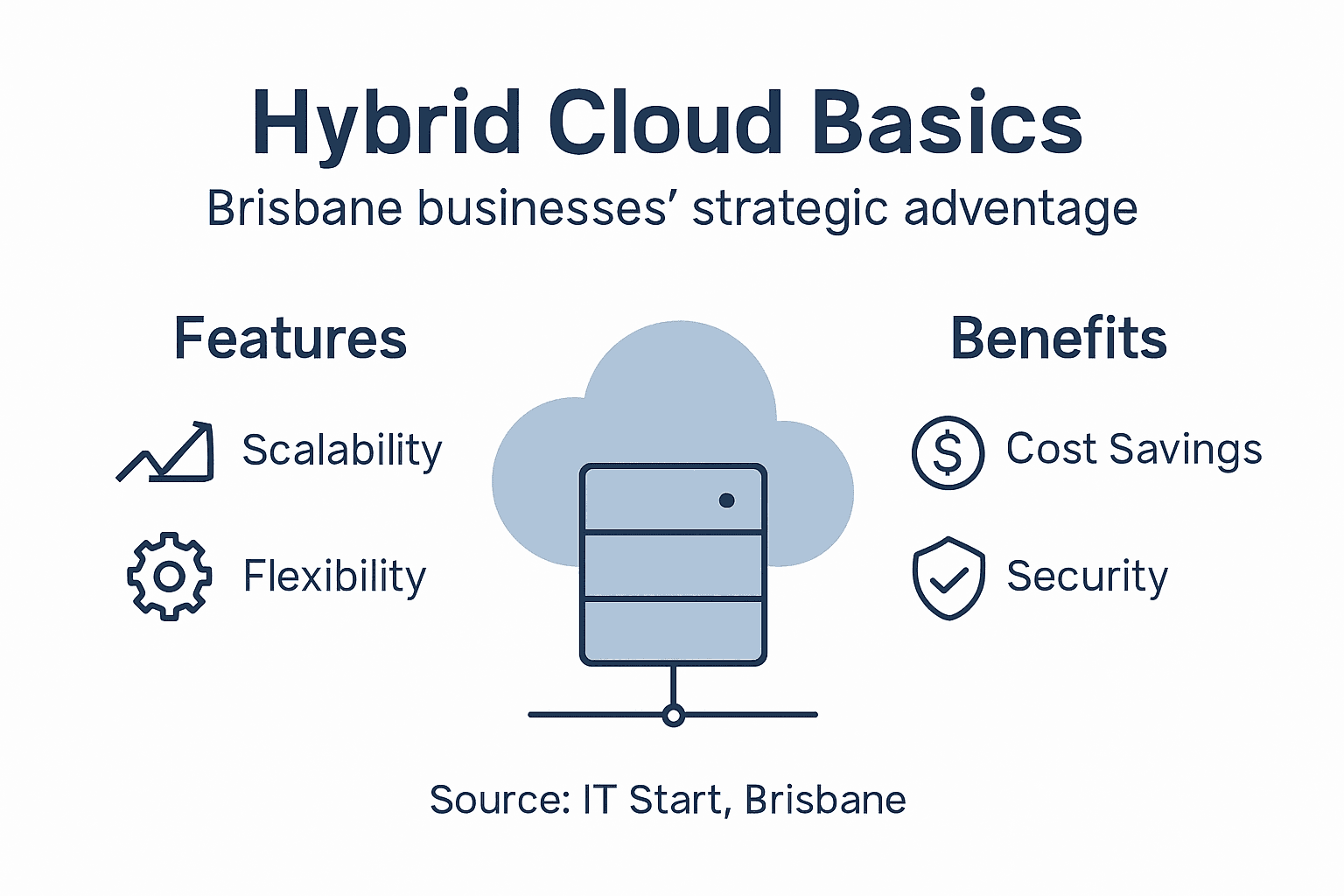
Hybrid cloud represents a strategic technology approach that combines public cloud, private cloud, and on-premises infrastructure into a unified, flexible IT environment for Brisbane businesses. This innovative solution allows organisations to leverage the best aspects of different cloud deployment models while maintaining critical control and compliance requirements.
Businesses across Brisbane are increasingly adopting hybrid cloud strategies to address complex technological challenges. Hybrid cloud infrastructure offers significant advantages by enabling rapid resource provisioning and supporting advanced technologies like artificial intelligence and internet of things (IoT) integrations.
Key benefits of hybrid cloud for Brisbane firms include:
- Enhanced scalability to match business growth
- Improved cost management through flexible infrastructure
- Greater cybersecurity control compared to pure public cloud models
- Regulatory compliance for industries with strict data governance requirements
- Seamless integration of legacy systems with modern cloud platforms
Australian businesses are uniquely positioned to leverage hybrid cloud solutions. Hybrid cloud approaches support Australian enterprise needs by addressing skills shortages, managing ageing infrastructure, and reducing operational expenses.
Pro tip: Conduct a comprehensive infrastructure audit before implementing hybrid cloud to identify precise integration requirements and potential optimisation opportunities.
Key Components and How Hybrid Cloud Works
Hybrid cloud architecture integrates multiple cloud environments to create a flexible, powerful IT infrastructure for Brisbane businesses. Hybrid cloud architecture combines on-premises infrastructure, private clouds, and public clouds into a unified system that supports diverse technological requirements and business strategies.
The typical hybrid cloud configuration includes three primary components:
- On-premises infrastructure: Traditional computing resources located within the organisation’s physical facilities
- Private cloud: Isolated cloud environment dedicated to a single organisation’s secure computing needs
- Public cloud: Scalable, shared cloud services accessed via internet infrastructure
By strategically deploying different workloads across these environments, businesses can optimise performance, security, and cost-effectiveness. Cloud configurations balance security and scalability by allocating specific tasks to appropriate cloud platforms. For instance, sensitive data and critical applications might remain in private or on-premises clouds, while dynamic workloads leverage the flexibility of public cloud services.
Key operational mechanisms that enable seamless hybrid cloud functionality include:
- Unified management platforms that provide centralised control
- Robust network connectivity between different cloud environments
- Standardised integration protocols
- Advanced security and compliance tools
- Automated workload migration capabilities
Pro tip: Develop a comprehensive cloud strategy that maps specific workloads to the most appropriate cloud environment before implementing hybrid cloud infrastructure.
Benefits of Hybrid Cloud for SMEs
Hybrid cloud computing provides Brisbane small and medium enterprises with a transformative approach to managing technological infrastructure. SMEs benefit from increased agility and scalable resources that can dynamically adapt to changing business requirements.
The primary advantages for local businesses include:
- Flexible resource allocation that matches precise business needs
- Cost-effective infrastructure management
- Enhanced business continuity capabilities
- Improved cybersecurity control
- Rapid deployment of new technological solutions
Hybrid cloud strategies support local data processing needs while maintaining robust security protocols. This approach allows Brisbane SMEs to keep sensitive information on-premises while leveraging public cloud flexibility for less critical workloads. The model enables businesses to balance performance, cost, and compliance requirements effectively.
Technical benefits that make hybrid cloud attractive to SMEs encompass:
- Seamless scalability during peak business periods
- Reduced operational downtime
- Advanced disaster recovery mechanisms
- Optimised IT spending
- Compliance with local data regulations
Pro tip: Conduct a comprehensive infrastructure assessment to identify which specific workloads are best suited for public versus private cloud environments before implementing your hybrid cloud strategy.

Cybersecurity and Compliance Considerations
Hybrid cloud environments demand rigorous cybersecurity approaches for Brisbane businesses navigating complex digital landscapes. Australian enterprises face increasing cybersecurity challenges that require sophisticated multi-layered security strategies across different cloud infrastructure components.
Critical cybersecurity considerations for hybrid cloud include:
- Data segregation between public and private cloud environments
- Comprehensive access management
- Encryption protocols for sensitive information
- Continuous security monitoring
- Compliance with Australian data protection regulations
Hybrid cloud supports a zero-trust security model that enforces strict authentication and authorisation mechanisms across different technological environments. This approach enables Brisbane businesses to maintain granular control over their digital assets while leveraging the flexibility of cloud infrastructure.
Key compliance strategies for hybrid cloud implementation encompass:
Below is a summary of essential cybersecurity and compliance mechanisms in hybrid cloud environments:
| Mechanism | Purpose | Benefit to Brisbane Firms |
|---|---|---|
| Unified access management | Controls user permissions | Minimises data breaches |
| Encryption protocols | Protects sensitive information | Meets legal requirements |
| Routine security audits | Finds vulnerabilities early | Ensures compliance |
| Incident response plans | Prepares for cyber incidents | Improves organisational resilience |
- Regular security audits
- Implementing multi-factor authentication
- Maintaining detailed access logs
- Developing comprehensive incident response plans
- Ensuring data residency compliance
Pro tip: Engage a specialised cybersecurity consultant to conduct a thorough risk assessment and develop a tailored hybrid cloud security strategy specific to your business requirements.
Comparing Hybrid Cloud to Public and Private
Cloud deployment models represent distinct approaches to managing technological infrastructure for Brisbane businesses. Hybrid cloud strategically combines public and private cloud architectures to deliver flexible, secure, and scalable computing environments that address diverse organisational requirements.
Key differences between deployment models include:
-
Public cloud:
- Shared, multi-tenant infrastructure
- Lower upfront costs
- Highly scalable resources
- Limited customisation options
-
Private cloud:
- Dedicated, single-tenant environment
- Enhanced security control
- Higher infrastructure investment
- Customisable infrastructure
-
Hybrid cloud:
- Combines best features of public and private clouds
- Flexible workload placement
- Optimised cost management
- Comprehensive security options
Cloud environments offer different architectural approaches for managing computational resources. Public clouds provide cost-effective, scalable solutions managed by third-party providers, while private clouds offer granular control for sensitive workloads. Hybrid cloud enables businesses to strategically distribute applications and data across these environments based on specific performance, security, and compliance requirements.
Here’s how the key cloud deployment models serve Brisbane businesses differently:
| Deployment Model | Customisation Level | Ideal Use Cases | Security Control |
|---|---|---|---|
| Public Cloud | Limited flexibility | Start-ups, scaling quickly | Lower, relies on provider |
| Private Cloud | Highly customisable | Sensitive data, compliance | Highest, full internal control |
| Hybrid Cloud | Balanced approach | Mixed workloads, evolving needs | Granular, combines models |
Comparative advantages of hybrid cloud deployment include:
- Greater workload flexibility
- Improved cost optimization
- Enhanced security management
- Scalable infrastructure
- Compliance with regulatory requirements
Pro tip: Conduct a comprehensive infrastructure assessment to determine which workloads are best suited for public, private, or hybrid cloud environments based on your specific business needs.
Unlock the Full Potential of Hybrid Cloud for Your Brisbane Business
Hybrid cloud systems offer powerful flexibility but managing the complexities of scalable infrastructure, seamless integration, and especially stringent cybersecurity can quickly become overwhelming. If your Brisbane business faces challenges around workload placement, cost control, or compliance with local regulations, it is vital to partner with an expert who understands these demands and can tailor a hybrid cloud strategy to your needs.
At IT Start we specialise in managed IT support, cloud solutions and cybersecurity services designed for Brisbane small to medium enterprises. We help you gain clear control over hybrid cloud environments by optimising resource allocation, enhancing security protocols, and ensuring smooth integration across public and private clouds. Don’t leave your business exposed to compliance risks or operational inefficiencies when you can benefit from our proactive, transparent support delivered with local Brisbane expertise.
Discover how your organisation can leverage trusted hybrid cloud solutions with IT Start’s managed IT support. Ready to improve your operational efficiency and strengthen cybersecurity? Contact us today at https://itstart.com.au/contact-us for a free consultation and take the first step towards a secure, scalable hybrid cloud future.
Frequently Asked Questions
What is hybrid cloud?
Hybrid cloud is a technology approach that combines public cloud, private cloud, and on-premises infrastructure into a single, flexible IT environment, allowing businesses to optimise their resources while maintaining control and compliance.
What are the benefits of hybrid cloud for businesses?
Hybrid cloud offers benefits such as enhanced scalability, improved cost management, greater cybersecurity control, regulatory compliance, and seamless integration of legacy systems with modern cloud platforms.
How does hybrid cloud architecture work?
Hybrid cloud architecture integrates multiple cloud environments — on-premises infrastructure, private clouds, and public clouds — allowing for strategic workload deployment to optimise performance and cost-effectiveness.
What cybersecurity considerations should be taken into account with hybrid cloud?
Cybersecurity considerations for hybrid cloud include data segregation, comprehensive access management, encryption protocols, continuous monitoring, and compliance with data protection regulations.