

Vulnerability scanning, penetration testing, red and blue team exercises, breach and attack simulation, and security audits are the core cyber security testing methods businesses use to find and fix weaknesses before someone else does. For most small to medium businesses, the right order is an audit first, continuous scanning second, and penetration testing or red team work reserved for high-risk systems or after you have actually fixed the obvious problems. Skip the audit and jump straight to a pen test, and you will usually pay someone just to confirm what a $50 scanner licence would have told you for free.
TL;DR:
- Vulnerability scanning should be performed frequently, with internet-facing systems scanned daily and internal systems weekly, to ensure up-to-date detection of known flaws.
- Penetration testing is a high-cost, point-in-time validation that should only be conducted after basic security hygiene is confirmed and fixed.
- Red team exercises and breach and attack simulations are advanced tests best suited for environments where foundational security controls like MFA and backups are already in place.
- Security audits and risk assessments should precede technical testing to identify policy gaps, with findings informing scope and priorities for subsequent testing.
- Fixing basic hygiene issues such as MFA, patching, and backup testing is essential before investing in deep validation or adversary simulation exercises.
Table of Contents
- What are the types of cyber security testing, and how do they compare?
- How does vulnerability scanning work and where does it fall short?
- When should a business run a penetration test?
- What do red teaming, blue teaming and BAS actually test?
- Why do audits and risk assessments usually come first?
- What do SAST, DAST and specialist tests cover?
- How do you scope and report a security test properly?
- What we see when we walk into a new SMB client
- Our take on where SMBs get this wrong
- Get a practical starting point for your business
- Where to check the source guidance
- Sources
- FAQ
What are the types of cyber security testing, and how do they compare?
Every method answers a different question, and mixing them up is the single most common mistake we see business owners make when they call around for quotes.
- Vulnerability scanning finds known weaknesses across your network. It is automated, cheap, and should run continuously or at least weekly. Output is a list, not proof of exploitability.
- Penetration testing is human led and proves whether a flaw can actually be exploited. It is point in time, usually annual or after major changes, and costs far more than scanning.
- Red teaming simulates a real attacker chasing an objective, testing people and process as much as technology. It is occasional and expensive, and it only makes sense once basic hygiene is sorted.
- Blue team exercises test your detection and response, not the target’s weaknesses. Often run alongside red team work as a “purple team” exercise.
- Breach and attack simulation (BAS) runs continuously in the background, replaying known attack techniques against your controls automatically.
- Security audits and risk assessments check policy, governance and control coverage across the whole business, not just technical holes.
The distinction that matters most is “hygiene” versus “validation.” Scanning and BAS are hygiene, continuous and broad. Pen testing and red teaming are validation, deep and occasional. You need both, in that order.
How does vulnerability scanning work and where does it fall short?
Vulnerability scanning checks your systems against a database of known flaws and misconfigurations, and it is the cheapest, fastest way to see where you stand. But there is a huge difference between an authenticated scan (logged in, checking patch levels and config from the inside) and an unauthenticated one (poking from the outside with no credentials). Authenticated scans catch far more, and honestly, most of the SMBs we onboard have only ever had the unauthenticated version run against them, if they have had one at all.
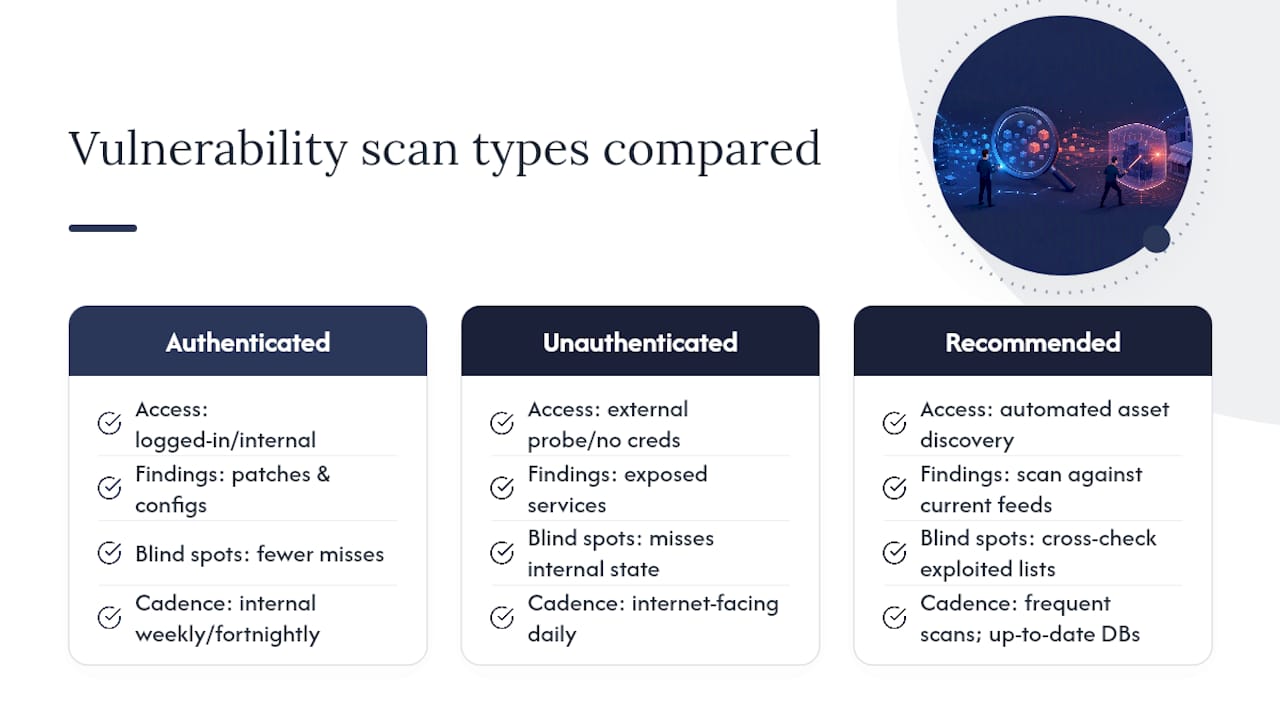
Cadence matters. Internet-facing systems should be scanned daily where possible; internal systems weekly or fortnightly depending on how often things change. The ACSC’s Essential Eight assessment guidance recommends automated asset discovery paired with frequent scanning against up-to-date vulnerability feeds, because a scan run against a six-month-old database is close to useless.
Not every finding deserves a fire drill. Cross-reference results against known exploited vulnerability lists and patch dates before panicking over every “critical” flag, because scanners produce plenty of false positives.
Pro Tip: Don’t buy a scanner and assume you’re covered. We’ve seen businesses run a free scanner once a year, file the PDF, and call that “cyber security.” A scan tells you what might be wrong, not whether an attacker could actually get in.
When should a business run a penetration test?
A penetration test proves impact. Where a scan says “this port is open,” a pen tester chains that with three other small issues and shows you exactly how someone lands in your finance system. That is a different conversation with the board.
Pen tests come in several flavours, and scoping the wrong one wastes money:
- External tests what an attacker sees from the internet, your firewall, VPN, and public-facing services.
- Internal simulates a compromised device or malicious insider already on your network.
- Web application and API testing targets custom-built software and the interfaces it exposes.
- Cloud configuration testing checks Microsoft 365, Azure, or AWS setups against misconfiguration and privilege escalation paths.
- Identity-focused testing looks specifically at multi-factor authentication gaps and conditional access rules, which we find broken more often than anything else.
Expect a good report to include an attack path narrative, proof-of-concept evidence, and specific recommended controls, not a 40-page scanner dump with a new cover page. Retesting after remediation should be built into the quote, not billed as an extra. The most cost-effective approach is to feed scanner output into the pen test scope up front, so testers spend billable hours proving impact instead of rediscovering what an automated scan already found, a point TechBrain’s comparison makes well.
What do red teaming, blue teaming and BAS actually test?
Red teaming asks “could a determined attacker achieve their goal here,” not “does this box have a patch missing.” A red team might phish your finance staff, plant a rogue device in your office, and pivot through your network over two weeks, all without your helpdesk knowing it is a drill. That is the point.
- Red team simulates a realistic adversary against people, process and technology together.
- Blue team is your detection and response side, tested by how fast and accurately they spot the red team’s activity.
- Purple team runs both together with shared visibility, so lessons get applied immediately instead of buried in a report nobody reads.
- Breach and attack simulation (BAS) platforms run known attack techniques continuously and automatically, validating that your controls still catch what they caught last month.
None of this makes sense for a business with no MFA and a backup nobody has tested. Red team and BAS work belongs after hygiene is fixed, when the real question shifts from “do we have holes” to “would we notice if someone used one.” The outputs are detection gaps, tuned alerting, and playbooks that actually match how your team responds at 2am.
Why do audits and risk assessments usually come first?
An audit checks whether your policies, controls and governance hold up across the whole business. A pen test proves whether a specific technical flaw is exploitable. Confusing the two is expensive, because plenty of businesses commission a pen test to find out they have no MFA and unpatched servers, something a half-day audit would have flagged for a fraction of the cost.
- Audit covers policy, access control, backup practices and governance, mapped against a framework.
- Pen test proves exploitability of specific technical weaknesses within an agreed scope.
- The ASD Essential Eight and ISO 27001 are the two baselines we see most often for Australian SMBs, one operational and one governance focused.
- Risk assessment output should directly drive spend: if backups are the biggest gap, fund backup testing before you fund a red team.
We see this constantly: a business skips the audit, spends thousands on a pen test, and the report comes back saying “no MFA on admin accounts” and “backups not tested in six months.” Both of those show up in a basic risk assessment for a lot less money.
What do SAST, DAST and specialist tests cover?
If you run custom software, application testing needs its own category. SAST (static application security testing) scans source code for insecure patterns before it ever runs. DAST (dynamic application security testing) attacks the running application the way a real user or attacker would. IAST blends both, watching code behaviour during actual execution to catch what static analysis misses.
- SAST catches insecure code early, in the build pipeline, before deployment.
- DAST catches runtime flaws like broken authentication or injection that only appear when the app is live.
- IAST gives fuller coverage but needs more setup and is less common outside larger dev teams.
- Social engineering tests (phishing, vishing, pretexting) need strict rules of engagement and HR sign-off before you start, because someone will get “caught” and that needs to be handled properly, not punitively.
- Wireless and physical testing matters more now with hybrid offices, checking guest network isolation and whether someone can walk into your server room unchallenged.
Prioritise by exposure. A business with a customer-facing web app needs DAST before it needs a wireless assessment of an office nobody visits anymore.
How do you scope and report a security test properly?
Nothing wastes budget faster than a test run without an agreed scope, and the ACSC’s documentation guidelines are blunt about this: agree scope, schedule and rules of engagement before anyone touches a system, or you risk outages and evidence nobody trusts.
- Agree scope and rules of engagement first. What is in bounds, what times, who to call if something breaks.
- Understand evidence quality. IRAP guidance grades evidence excellent, good, fair or poor. A configuration screenshot is fair evidence; a simulated exploit proving the control actually stops an attack is excellent.
- Use sampling sensibly for large environments. Random, stratified or risk-based sampling is acceptable under IRAP rules, but document the method and sample size so the report can be relied on.
- Turn findings into a prioritised remediation plan. Rank by risk and business impact, assign an owner, set a timeline, and use scan output to seed the next pen test scope rather than starting cold.
Pro Tip: If a testing firm hands you a raw findings list with no owners or dates attached, send it back. A report without a remediation plan is a bill, not a service.
What we see when we walk into a new SMB client
Honestly, the pattern is the same almost every time. No MFA on admin accounts, backups that “run” but have never been test-restored, and a Microsoft 365 tenant set up by whoever was around five years ago with global admin handed out like lollies.
- No MFA anywhere near critical accounts, despite it being free in most Microsoft 365 plans.
- Backups that exist but have never had a restore test, so nobody actually knows if they work.
- Messy Microsoft 365 permissions, shared mailboxes, and forwarding rules nobody remembers setting up.
- Scope creep on quotes, where a “quick pen test” turns into three weeks of billable discovery because nobody scanned first.
We prioritise the cheap, high-impact fixes before any pen test gets booked: MFA, backup verification, patching. Then we validate with scanning and, where the risk warrants it, a proper pen test or BAS deployment. IT Start holds SMB 1001 Gold, and that framework pushes exactly this order: fix the basics, then prove they hold.
Our take on where SMBs get this wrong
The conventional advice treats every business like it needs a pen test. It doesn’t. Most SMBs we work with have not turned on MFA everywhere, have never restored a backup to check it works, and have a Microsoft 365 tenant that has never been reviewed. A red team exercise against that environment is a waste of money, because the attacker doesn’t need to be clever when the front door is unlocked.
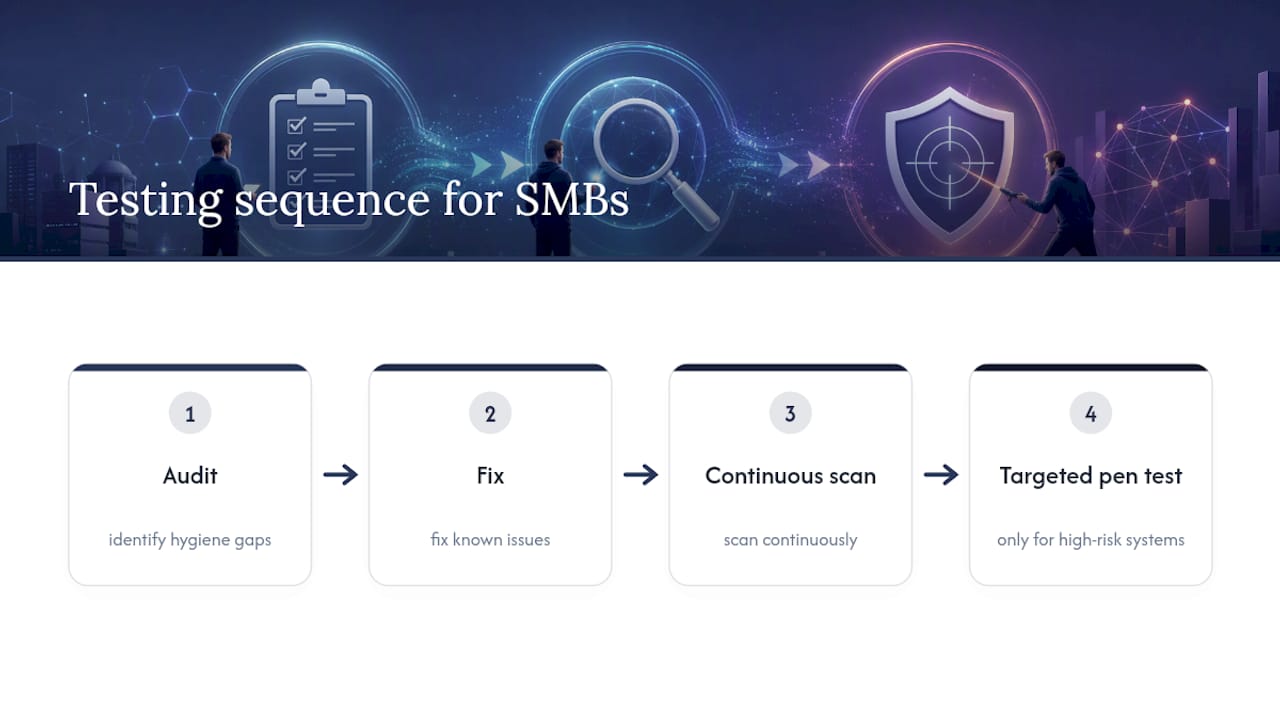
What actually works is boring: audit first, fix what it finds, scan continuously, then escalate to pen testing or red team work only for the systems where a breach would genuinely hurt (finance systems, customer data, anything regulated). The ASD Essential Eight and IRAP evidence-quality rules exist precisely because “we ran a test” means nothing if nobody can tell whether the evidence was good, fair, or fabricated by a rushed contractor ticking boxes.
If you take one thing from this: don’t buy validation testing before you have hygiene testing in place. Fix what you already know about first.
— Matt
Get a practical starting point for your business
Running the right mix of these tests without wasting money means starting with an honest look at where you actually stand, not a generic checklist. Security audits, continuous vulnerability scanning, and coordinated penetration testing and remediation work for small to medium businesses are recommended, built around the same ASD Essential Eight and evidence-quality thinking covered above. We scope engagements properly first: agreed rules of engagement, realistic timelines, and a remediation plan attached to the findings, not a PDF that sits in someone’s inbox.
For businesses running Microsoft 365, Azure or hybrid setups, our cloud services work alongside the security side to close configuration gaps scanning tends to flag first, while also helping you understand the risks of cloud servers to better protect your environment. If you want a clear picture of where your business sits before committing to anything bigger, start with our cyber security page and book an assessment.
Where to check the source guidance
- Essential Eight assessment process guide, for how ASD structures assessments and evidence.
- IRAP common assessment framework, for sampling methods and evidence grading.
- ISO/IEC 27001, the international standard behind most audit baselines.
Sources
FAQ
What are the types of cyber security testing?
The main types are vulnerability scanning, penetration testing, red team and blue team exercises, breach and attack simulation, and security audits or risk assessments, each answering a different question about your defences.
What are the best methods for testing cyber security in an SMB?
For most SMBs, a security audit against a framework like the ASD Essential Eight, continuous vulnerability scanning, targeted penetration testing, breach and attack simulation, and periodic risk assessments cover the essentials without overspending.
What are the top security testing tools businesses ask about?
Businesses commonly ask about vulnerability scanners, penetration testing platforms, breach and attack simulation tools, and SAST/DAST code scanning tools, though the right tool depends entirely on what you are protecting and your existing maturity.
What are CVE and CVSS?
CVE (Common Vulnerabilities and Exposures) is the public catalogue that identifies a specific known flaw, while CVSS (Common Vulnerability Scoring System) rates how severe that flaw is, which scanners use to help prioritise what to patch first.
How often should a business run a penetration test?
Most businesses run a penetration test annually or after a significant change to systems, while vulnerability scanning should run far more often, ideally continuously for internet-facing systems.