

TL;DR:
- Cybersecurity professionals defend organizations by monitoring threats, responding to incidents, and managing vulnerabilities.
- In Australia, roles range from generalists in SMBs to specialists in large enterprises, with salaries varying based on experience.
A cybersecurity professional protects an organisation’s digital assets by finding and fixing security gaps, responding to incidents, and shaping secure practices across the business. The Australian Bureau of Statistics defines the role as designing and maintaining secure systems, assessing vulnerabilities, and leading incident response. The Australian Signals Directorate (ASD) adds that the best practitioners bridge technical reality and business goals, not just tick compliance boxes.
Day to day, the work typically covers:
- Monitoring security alerts and triaging events in a SIEM platform
- Investigating and containing incidents before they spread
- Running vulnerability assessments and tracking remediation
- Patching systems, hardening configurations, and updating policies
Table of Contents
- What does a cybersecurity professional do on a typical day?
- Core cybersecurity job responsibilities every pro handles
- Common job titles and what each one actually does
- Skills, qualifications and certifications that matter in Australia
- What tools do cybersecurity professionals use every day?
- Career progression and salary expectations in Australia
- How do you break into cybersecurity from scratch?
- What most businesses get wrong about cybersecurity professionals
- Key takeaways
- A practical perspective on what this role really demands
- Useful sources and further reading
- FAQ
What does a cybersecurity professional do on a typical day?
The honest answer: it depends heavily on the role. A SOC analyst, a security engineer, and a security consultant have very different mornings.
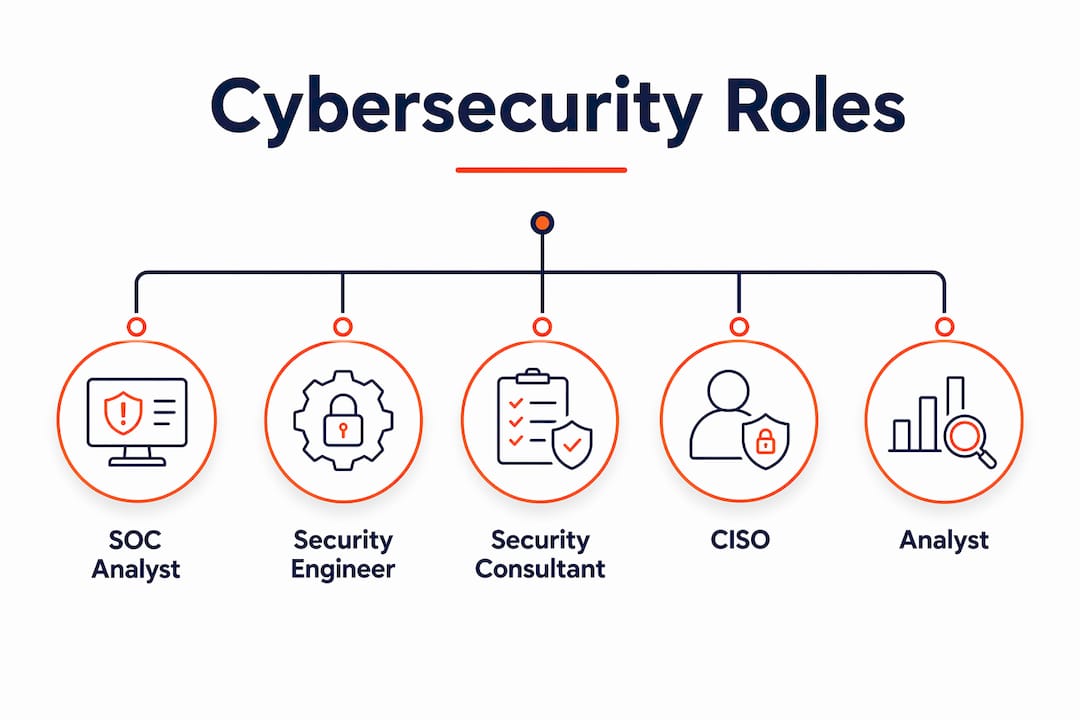
SOC analyst
A SOC analyst usually starts by reviewing overnight alerts. Most are false positives, but you cannot skip them. By 9 AM they are triaging anything that escalated, checking endpoint detection and response (EDR) dashboards, and joining a short team standup. Midday often means writing up incident tickets, chasing asset owners for context, and tuning detection rules to cut noise. Afternoons can involve threat hunting or reviewing logs from the previous night’s patch window.
Security engineer
Engineers spend less time on live alerts and more time building controls. A typical morning might involve reviewing a pull request for security issues, updating firewall rules, or configuring identity and access management (IAM) policies. The ABS occupation group notes that engineers also coordinate incident responses in complex cases, so they get pulled into major events when analysts need deeper technical support.

Security consultant
Consultants move between clients. One morning might be a risk workshop with a law firm’s leadership team; the afternoon is writing a gap analysis report. The role is heavily communication-focused. ASIO’s careers guidance notes that constant adaptation is core to the job, because last year’s best practice can be insufficient today.
In an SMB, one person often covers all three of these roles before lunch. The ASD Cyber Skills Framework acknowledges this directly: small organisations need multi-role practitioners who can do technical work and explain it in plain English to managers.
Core cybersecurity job responsibilities every pro handles
These are the steady-state duties you will find across most roles, regardless of title.
- Monitoring and detection: Watching for anomalous activity across networks, endpoints, and cloud environments using SIEM tools and EDR platforms.
- Incident response: Containing threats, capturing evidence, resetting credentials, patching the entry point, and communicating scope to leadership. In practice, this rarely starts with a forensic report; it starts with stopping the bleeding.
- Vulnerability management: Running regular scans, prioritising findings by risk, and tracking remediation through to completion.
- System hardening: Applying secure configurations to servers, workstations, and network devices, often guided by the ACSC’s Essential Eight framework.
- Identity and access management (IAM): Managing who has access to what, enforcing least privilege, and maintaining MFA across accounts.
- Compliance and policy: Developing and maintaining security policies, supporting audits, and aligning controls with frameworks like the ASD ISM or ISO 27001.
- Security awareness training: Running staff training sessions and phishing simulations to reduce human risk.
The weight of each responsibility shifts by environment. In an enterprise, a team of specialists handles each area. In an SMB, one person owns all of it. That is not a complaint, just reality. The APS Professions day-in-the-life notes that half the job is communication: translating why a control matters and negotiating scope with project owners. Without that skill, security becomes a tick-box exercise.
Common job titles and what each one actually does
Titles vary a lot between employers, and they blur badly in smaller organisations. Here is a practical map.
| Job title | What they actually do | Environment |
|---|---|---|
| Cybersecurity analyst | Monitors alerts, investigates incidents, produces reports | SOC, enterprise, government |
| SOC analyst | Real-time threat monitoring and triage, shift-based | Large enterprise, MSSP |
| Security engineer | Builds and maintains security controls, integrates tools | Mid to large enterprise |
| Penetration tester | Simulates attacks to find weaknesses before attackers do | Consultancy, specialist firms |
| Security consultant | Advises on strategy, risk, and compliance; writes policies | Consultancy, advisory |
| CISO | Owns security strategy, budget, and board-level reporting | Large enterprise, government |
| Cybersecurity generalist | Covers analyst, engineer, and compliance duties in one role | SMBs, small teams |
The CISO and pure SOC analyst roles exist mainly in larger organisations. In a 20-person professional services firm, the “cybersecurity professional” is usually a generalist who handles monitoring, patching, compliance, and staff training in the same week. That is not a lesser role; it requires broader knowledge and stronger communication skills than a narrow specialist position.
Skills, qualifications and certifications that matter in Australia
Technical skills employers expect
- Networking fundamentals (TCP/IP, DNS, VPNs, firewalls)
- Windows and Linux security administration
- Cloud security basics (AWS, Azure, or Microsoft 365 security features)
- Scripting for automation (Python or PowerShell)
- Familiarity with SIEM platforms, EDR tools, and vulnerability scanners
- Understanding of identity and access management concepts
Soft skills that separate good from great
Communication is the one that most people underestimate. The ASD guidelines are explicit: effective professionals align security controls with business objectives and communicate clearly with non-technical stakeholders. If you cannot explain a risk to a CFO in two sentences, the control probably will not get funded.
Certifications worth pursuing in Australia
- CompTIA Security+: A solid entry-level cert, widely recognised by Australian government and private sector employers.
- CISSP (Certified Information Systems Security Professional): The benchmark for senior and governance roles; requires five years of experience.
- CISM (Certified Information Security Manager): Strong for management and compliance-focused positions.
- AWS Certified Security Specialty / Microsoft SC-200: Increasingly expected as workloads move to cloud.
- CEH (Certified Ethical Hacker) or OSCP: Relevant for penetration testing roles; OSCP is more respected technically.
For Australian context, alignment with the ASD ISM and the ACSC’s Essential Eight is often more practically useful than any single certification. Employers in government and regulated industries will ask about it directly. You can explore cyber security frameworks aligned to ASD guidance as a starting point.
Pro Tip: A cert gets you the interview; practical experience gets you the job. Build a home lab, do capture-the-flag challenges on platforms like Hack The Box or TryHackMe, and document what you built and why.
What tools do cybersecurity professionals use every day?
Tool families matter more than specific product names, because the products change but the categories stay consistent.
SIEM (Security Information and Event Management): Aggregates logs from across the environment and surfaces alerts. Microsoft Sentinel and Splunk are common in Australian enterprise environments. The analyst’s job is to tune the rules so the signal-to-noise ratio stays manageable.
EDR (Endpoint Detection and Response): Monitors endpoints for suspicious behaviour and allows remote isolation of a compromised device. CrowdStrike Falcon and Microsoft Defender for Endpoint are widely deployed. During an incident, EDR is usually the first place a responder looks.
Firewalls and next-generation firewalls (NGFW): Control traffic between network segments. Palo Alto Networks and Fortinet are common in mid-market Australian businesses. Misconfigured firewall rules are one of the most common findings in any security review.
Identity and access management (IAM): Tools like Microsoft Entra ID (formerly Azure AD) manage who can access what. MFA enforcement sits here. We see this a lot: organisations that think they have MFA enabled but have left service accounts and admin accounts excluded.
Vulnerability scanners: Tenable Nessus and Qualys are standard. They identify known weaknesses in systems and applications. The scan is only useful if someone acts on the findings, which is where most programmes fall short.
Cloud security tools: AWS Security Hub, Microsoft Defender for Cloud, and similar platforms provide visibility into cloud misconfigurations. As more SMBs move workloads to cloud, this skill set is becoming non-negotiable.
Pro Tip: Alert fatigue is real. If your SIEM is generating hundreds of alerts a day and the team is acknowledging them without investigating, the tool is providing false confidence. Tune ruthlessly and set escalation thresholds that mean something.
Career progression and salary expectations in Australia
Cybersecurity careers in Australia follow a fairly predictable ladder, though the pace depends on the sector and how quickly you build practical skills.
Typical progression: Junior analyst or help desk with security exposure, then cybersecurity analyst, then senior analyst or security engineer, then team lead or security architect, then CISO or principal consultant.
Contracting pays significantly more per hour than permanent employment, but without leave entitlements or job security. Many experienced professionals move into contracting after five or more years once they have the reputation and network to sustain it.
| Experience level | Typical annual salary (AU$) | Source |
|---|---|---|
| Entry level | ~$69,008 | PayScale |
| Early career (1–4 years) | ~$84,005 | PayScale |
| Specialist / mid-senior | ~$136,163 | Indeed |
| Senior analyst (top reported) | up to $124,000 | PayScale |
Salaries vary by city, sector, and role type. Government and financial services tend to pay at the higher end. Brisbane and Perth roles can sit below Sydney and Melbourne averages for equivalent positions. Treat these figures as a guide, not a guarantee.
How do you break into cybersecurity from scratch?
This is the question we get most often. Below is a realistic sequence.
- Learn the fundamentals. Start with networking (CompTIA Network+ or free resources like Professor Messer) and basic operating systems. You cannot defend what you do not understand.
- Get hands-on early. Set up a home lab using free tools: a virtualised Windows Server, a Linux VM, and a basic firewall. Document everything you build.
- Do capture-the-flag (CTF) challenges. Platforms like TryHackMe and Hack The Box give structured, practical experience that employers actually notice.
- Earn a foundational cert. CompTIA Security+ is the most broadly recognised starting point in Australia. Sit it once you have the practical grounding.
- Build a portfolio. A GitHub repository showing your lab work, scripts, or CTF write-ups is more useful than a blank CV with a cert listed.
- Apply for entry roles broadly. Help desk, IT support, and junior analyst roles all build relevant experience. Do not wait until you feel “ready.”
- Attend local meetups and communities. AISA (Australian Information Security Association) runs events in most capital cities. Networking matters more than most people expect.
- Prepare for interviews honestly. Employers want to see how you think through a problem, not whether you have memorised definitions. Practice talking through incident scenarios out loud.
A realistic timeline from zero to first role is 12–18 months of focused effort. Some people do it faster with prior IT experience; others take longer. The cybersecurity best practices guide from IT Start covers foundational hygiene that also helps you understand what you will be protecting.
What most businesses get wrong about cybersecurity professionals
Honestly, this is where the gap between expectation and reality is widest. We work with SMBs across Brisbane every week, and the same mistakes come up repeatedly.
“We have MFA, we’re covered.” We see this constantly. A business enables MFA on email but leaves admin accounts, VPN access, and line-of-business applications completely unprotected. A cybersecurity professional’s job is to find those gaps, not assume the policy covers everything. The ACSC is clear that MFA is one layer, not a complete defence.
“Our backups are fine.” They are often not. We regularly find that backup jobs have been failing silently for weeks, or that backups exist but have never been tested for restoration. A real cybersecurity professional validates backups, not just the backup job status. The APS Professions guidance notes that common remediation steps include validating backups as a first priority.
“We hired someone technical, so we’re secure.” One person cannot run a security programme without executive buy-in and budget. If leadership treats security as an IT problem rather than a business risk, the technical person will spend most of their time fighting for basic resources. The ASD guidelines are direct on this: security controls need to align with business objectives, and that requires management engagement, not just a capable hire.
For employers building a checklist, look at whether a candidate can explain a risk in plain English, describe how they would validate a control, and give an example of a time they pushed back on a bad decision. Those answers reveal more than any certification. A practical IT compliance checklist can also help you understand what a competent professional should be working through.
Key takeaways
Cybersecurity professionals protect organisations by combining technical controls, continuous monitoring, and clear communication with leadership, and the role looks very different depending on whether you are in a SOC, an SMB, or a consultancy.
| Point | Details |
|---|---|
| Core duties are consistent | Monitoring, incident response, vulnerability management, and IAM appear in almost every cybersecurity role. |
| SMB roles are broader | One person often covers analyst, engineer, and compliance duties; communication skills matter as much as technical ones. |
| Salary varies significantly | Entry-level roles have a typical salary range; specialist roles earn more, with variation by city and sector. |
| Certifications help, experience wins | CompTIA Security+ opens doors; hands-on lab work and CTF portfolios are what employers actually remember. |
| Businesses underestimate the basics | Missing MFA on admin accounts, unvalidated backups, and poor network segmentation are the most common real-world failures. |
A practical perspective on what this role really demands
The framing of cybersecurity as a purely technical discipline misses something important. The professionals who make the biggest difference in the organisations we work with are not necessarily the ones with the most certifications. They are the ones who can sit in a room with a business owner, explain a real risk without causing panic, and get a decision made.
We work with SMBs across Brisbane where the “cybersecurity professional” is often a managed service provider filling that gap. What we see in practice is that the technical work, patching, monitoring, hardening, is the straightforward part. The hard part is getting a 15-person accounting firm to understand why they need to spend money on something they cannot see. That requires patience, clear language, and a genuine understanding of how the business operates.
If you are exploring a career in this field, do not underestimate the communication side. And if you are a business owner trying to evaluate whether your current setup is actually secure, the right question to ask your provider is not “are we protected?” It is “show me the last time you tested the backup restoration” and “which admin accounts are excluded from MFA?” Those two questions will tell you more than any compliance report.
IT Start provides cybersecurity services for Brisbane SMBs, including security assessments, ongoing monitoring, and practical remediation. If you want to understand where your business actually stands, start with a conversation.
Useful sources and further reading
These are the sources worth bookmarking, depending on what you need.
- Australian Cyber Security Centre (ACSC): The primary source for practical guidance, the Essential Eight framework, and mitigation advice for Australian businesses and defenders. Best for: technical guidance and employer readiness.
- Australian Signals Directorate (ASD) ISM Guidelines: Detailed role guidance and the Information Security Manual. Best for: understanding what security roles are expected to do in government and regulated environments.
- ABS Occupation 271133 Cyber Security Analyst: The official Australian occupational definition. Best for: understanding how the role is classified and what tasks are formally recognised.
- ASD Cyber Skills Framework v2: Maps skills to roles across the profession. Best for: career planning and understanding what employers in government and large enterprise expect.
- APS Professions: Day in the Life of a Cyber Security Specialist: Practical role descriptions from the Australian Public Service. Best for: career changers wanting a realistic picture of daily work.
- PayScale: Cyber Security Analyst Salary in Australia: Salary data broken down by experience level. Best for: setting pay expectations at entry and early career stages.
- Indeed: Cybersecurity Specialist Salary in Australia: Broader salary data including specialist and senior roles. Best for: mid-career benchmarking.
FAQ
What is the role of a cybersecurity professional?
A cybersecurity professional protects an organisation’s systems and data by monitoring for threats, responding to incidents, managing vulnerabilities, and developing security policies. The ABS defines the role as including vulnerability analysis, incident investigation, and security awareness training.
What is the average salary for a cybersecurity professional in Australia?
Salaries range from around AU$69,008 at entry level to about AU$84,005 for early career professionals, and can reach approximately AU$136,163 for specialist roles, according to PayScale and Indeed data. Figures vary by city, sector, and whether the role is permanent or contract.
Can you earn AU$200,000 or more in cybersecurity in Australia?
Senior roles such as CISO, principal security architect, or experienced contractor positions can command significantly higher salaries, particularly in financial services, government, and large enterprise. These salaries reflect significant experience, leadership responsibility, and often a combination of technical depth and business communication skills.
How do you become a cybersecurity professional in Australia?
Start with networking and operating system fundamentals, build hands-on experience through home labs and CTF platforms like TryHackMe, earn a foundational certification such as CompTIA Security+, and apply for entry-level analyst or IT support roles. Most people reach their first dedicated security role within 12–18 months of focused study and practice.