

Which cyber security frameworks should Australian businesses use?
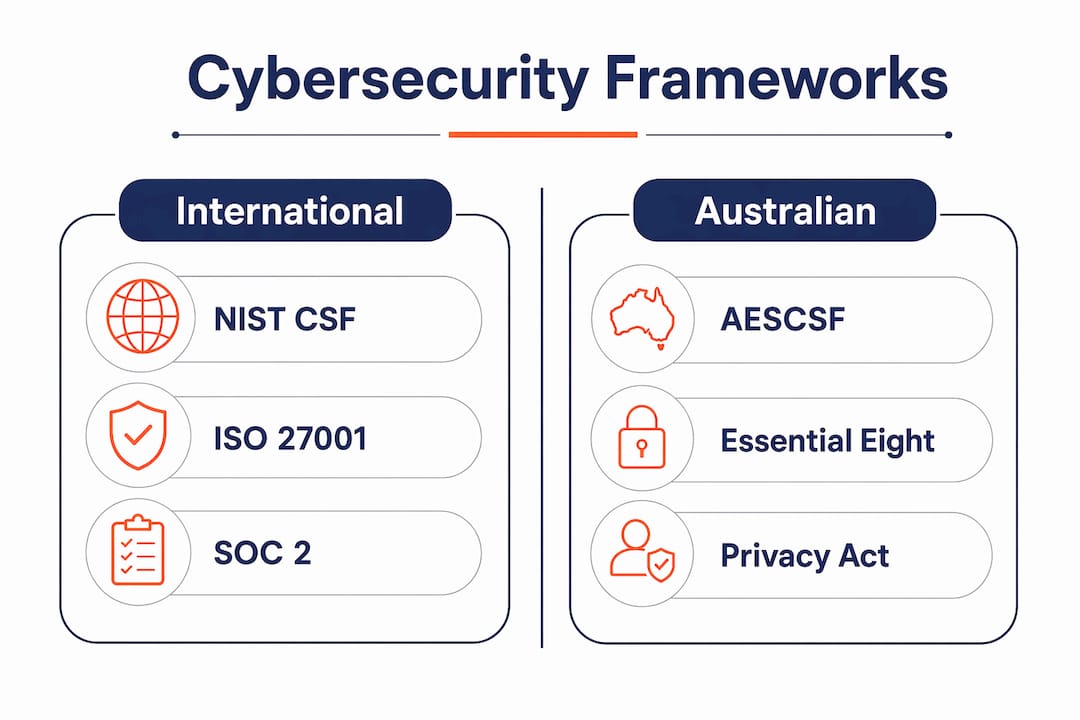
Choosing the best cyber security framework comes down to your sector, size, and what you actually need to prove to clients, insurers, or regulators. There is no single right answer, but there are clear front-runners for Australian organisations in 2026.
Here are the frameworks you need to know:
- NIST Cybersecurity Framework (CSF 2.0): A flexible, risk-based model built around five core functions. Widely adopted in Australia, particularly by organisations wanting a structured maturity path without mandatory certification.
- ISO 27001: The international standard for an Information Security Management System (ISMS). Requires third-party certification and suits organisations needing formal, auditable proof of security governance.
- ISO 27002: The companion guide to ISO 27001, providing detailed control implementation guidance. Not certifiable on its own.
- SOC 2: Designed for service providers and cloud vendors. Built around customisable Trust Service Criteria, making it popular with Australian SaaS companies and businesses serving US clients.
- Australian Energy Sector Cyber Security Framework (AESCSF): A sector-specific framework for energy market participants, aligned to the Security of Critical Infrastructure Act 2018 (SOCI Act) and built on NIST CSF and ISO 27001 foundations.
- Essential Eight: Developed by the Australian Signals Directorate (ASD), this is the most practical starting point for most Australian SMBs. Eight prioritised mitigation strategies with a four-level maturity model.
Each framework suits a different risk profile. A 15-person accounting firm in Brisbane has different needs than an energy retailer in Melbourne. The sections below break down each one so you can make a genuinely informed decision.
Table of Contents
- How the NIST Cybersecurity Framework works in practice
- What ISO 27001 and ISO 27002 actually require
- What SOC 2 means for Australian service providers
- Australian-specific frameworks: AESCSF and Essential Eight
- What we see go wrong when Australian SMBs adopt frameworks
- How do these frameworks compare for Australian businesses?
- How frameworks connect to Australian privacy and data breach laws
- What is changing in cybersecurity frameworks in 2026?
- IT Start helps Brisbane businesses get frameworks right
- Key takeaways
- FAQ
How the NIST Cybersecurity Framework works in practice
The NIST Cybersecurity Framework is probably the most widely referenced security framework globally, and Australian organisations have adopted it heavily despite it originating in the US. Version 2.0, released in 2024, added a sixth function, “Govern,” sitting above the original five.
The six core functions are:
- Govern: Establish organisational context, risk tolerance, and accountability structures.
- Identify: Understand your assets, risks, and business environment.
- Protect: Put controls in place to limit the impact of a cyber event.
- Detect: Build the capability to identify when something goes wrong.
- Respond: Have a plan for containing and managing incidents.
- Recover: Restore systems and services after an incident.
What makes NIST CSF genuinely useful is its tiered implementation approach. You can sit at Tier 1 (ad hoc, reactive) and work toward Tier 4 (adaptive, continuously improving) at your own pace. There is no mandatory certification, which suits SMBs that need structure without the overhead of a formal audit programme. The NIST CSF’s flexible tiers help organisations continuously identify security gaps and prioritise controls over time, making it a practical choice for Australian businesses aiming for maturity without overburdening resources.
Honestly, we see NIST CSF used most often as a gap analysis tool. A business runs through the functions, maps what they currently have, and the gaps become obvious fast. No MFA on Microsoft 365? That sits under Protect. No incident response plan? That is a Respond gap. It is a useful structure for having the conversation with leadership about where money needs to go.
Pro Tip: If you are new to NIST CSF 2.0, start with the Identify function. Map every asset, every data flow, and every third-party access point before touching controls. Most SMBs skip this step and end up protecting the wrong things.
What ISO 27001 and ISO 27002 actually require
ISO 27001 is the gold standard for organisations that need to prove their security posture to clients, regulators, or partners. It requires you to build and maintain a documented ISMS, conduct formal risk assessments, implement controls, and get certified by an accredited third-party auditor. ISO 27001 certification demands documented policies, risk assessments, and controls verified by an accredited body.

ISO 27002 is different. It does not certify you for anything. Think of it as the detailed instruction manual that sits alongside ISO 27001, explaining how to implement each control category. You reference ISO 27002 when building your control set, but you certify against ISO 27001.
Key things ISO 27001 requires:
- A documented scope for your ISMS.
- A formal risk assessment process with documented outputs.
- A Statement of Applicability listing which controls apply and why.
- Internal audits and management reviews at defined intervals.
- A corrective action process for identified nonconformities.
The cost of ISO 27001 certification is real. For an SMB, you are looking at consultant fees, internal staff time, and ongoing surveillance audits. It is not a one-off exercise. That said, if you are selling to enterprise clients, government agencies, or operating in healthcare or financial services, ISO 27001 certification often becomes a practical requirement rather than a choice.
What SOC 2 means for Australian service providers
SOC 2 is an American framework developed by the American Institute of Certified Public Accountants (AICPA), but it has become a de facto requirement for Australian SaaS companies and service providers with US clients. Unlike ISO 27001, which covers your entire ISMS, SOC 2 focuses on service providers’ operational controls rather than broad organisational security management.
SOC 2 is built around five Trust Service Criteria:
- Security: The foundational criterion, required in every SOC 2 report.
- Availability: Systems are available for operation as agreed.
- Processing Integrity: System processing is complete, accurate, and authorised.
- Confidentiality: Information designated as confidential is protected.
- Privacy: Personal information is collected, used, and retained appropriately.
You choose which criteria apply to your services, which makes SOC 2 flexible. A cloud storage provider might include Availability and Confidentiality. A payroll processor would likely add Processing Integrity. SOC 2 reports come in two types: Type I covers design of controls at a point in time, and Type II covers operating effectiveness over a period, typically six to twelve months. Type II is what enterprise clients actually want to see.
For Australian businesses without US clients, SOC 2 is rarely the first priority. But if you are a managed service provider, SaaS vendor, or cloud platform serving international customers, expect to be asked for it.
Australian-specific frameworks: AESCSF and Essential Eight
These two frameworks are the ones most directly shaped by Australian conditions, and for many local businesses, they are the most immediately relevant.

The AESCSF
The Australian Energy Sector Cyber Security Framework is a voluntary self-assessment tool for energy market participants, led by the Australian Energy Market Operator (AEMO). It is built on global standards including NIST CSF and ISO 27001, integrated with Australian-specific controls like the Essential Eight, and aligned to SOCI Act risk management requirements. AESCSF V2 updates strengthen supply chain security and support risk-based decision-making for energy sector compliance.
A key principle in the AESCSF is collective asset inclusion: assessing all assets together rather than in silos, because attackers exploit the weakest link. An organisation that secures its corporate network but ignores operational technology sits exposed. The AESCSF moves security management from reactive compliance toward proactive, system-wide operational resilience.
The Essential Eight
The Essential Eight is the ASD’s prioritised set of mitigation strategies for protecting internet-connected IT networks. It is the most practical starting point for Australian SMBs because it is free, locally developed, and directly supported by cyber.gov.au.
The eight strategies are:
- Application control
- Patch applications
- Configure Microsoft Office macro settings
- User application hardening
- Restrict administrative privileges
- Patch operating systems
- Multi-factor authentication (MFA)
- Regular backups
The maturity model runs from Level Zero (weaknesses present) through to Level Three (mitigating advanced adversary tradecraft). Organisations should reach the same maturity level across all eight strategies before moving up, rather than excelling at two or three while ignoring the rest.
Pro Tip: Auditors fail businesses on the Essential Eight not because controls are missing, but because documentation is missing. You need to show not just what you do, but how you do it, who approved exceptions, and how you review those exceptions regularly. “We have MFA” is not enough. Show the policy, the exceptions register, and the last review date.
What we see go wrong when Australian SMBs adopt frameworks
We work with businesses of 10 to 50 staff across Brisbane and Queensland, and the same mistakes come up repeatedly.
The biggest one: treating compliance as security. A business ticks off the Essential Eight checklist, declares themselves compliant, and then gets hit by a phishing attack that bypassed their half-configured MFA. Compliance and security are not the same thing. Framework maturity evidence heavily influences insurer premiums and contract eligibility, which means real implementation matters far more than a checkbox exercise.
Achieving maturity levels under the Essential Eight requires documented policies, procedures, and compensating controls. Businesses often fail auditors by documenting “what” they implement instead of “how” they implement controls and manage exceptions. Without that evidence, audit success and insurer confidence are both compromised.
Other common pitfalls:
- Assuming frameworks are legally mandatory. Most are voluntary, but insurers and government procurement panels treat them as practical requirements. If you want cyber insurance at a reasonable premium, expect to demonstrate at least Essential Eight Maturity Level One.
- Starting too big. Businesses attempt ISO 27001 certification without the internal resources to sustain it. The documentation burden alone can overwhelm a small IT team.
- Ignoring backups. We see this constantly. Clients believe they are backed up because a backup job runs nightly. They have never tested a restore. Under the Essential Eight, backups must be tested, stored offline or offsite, and recoverable within a defined timeframe.
- No MFA on critical systems. Microsoft 365 without MFA is one of the most common gaps we find. It sits squarely under both NIST CSF’s Protect function and Essential Eight Maturity Level One.
The businesses that succeed with framework adoption start with a gap analysis, pick one framework appropriate to their size and sector, and implement it progressively. They document everything as they go, not retrospectively.
How do these frameworks compare for Australian businesses?
Picking the right framework depends on three things: who you need to prove security to, what sector you operate in, and how much internal resource you can commit.
| Framework | Best suited to | Certification available | Australian regulatory alignment |
|---|---|---|---|
| NIST CSF 2.0 | All sizes, all sectors | No | Widely referenced by ACSC and ISM |
| ISO 27001 | Mid-market, enterprise, regulated sectors | Yes (third-party) | Recognised by Australian regulators |
| ISO 27002 | Organisations implementing ISO 27001 controls | No | Companion to ISO 27001 |
| SOC 2 | Service providers, SaaS, cloud vendors | Yes (AICPA auditor) | Relevant for US-facing businesses |
| Essential Eight | Australian SMBs, government suppliers | No (maturity assessed) | Directly aligned to ACSC guidance |
| AESCSF | Energy sector participants | No (self-assessment) | Aligned to SOCI Act 2018 |
A few practical observations from working with SMBs across Queensland. NIST CSF and the Essential Eight are not competing frameworks. Many businesses use NIST CSF as the overarching structure and Essential Eight as the specific control set within the Protect function. That combination works well for businesses of 10 to 100 staff. ISO 27001 becomes relevant when a client contract or government tender specifically requires it. SOC 2 is almost exclusively driven by client demand from US-based enterprise customers.
For Brisbane SMBs navigating frameworks, the practical starting point is almost always the Essential Eight, with NIST CSF providing the broader governance structure around it.
How frameworks connect to Australian privacy and data breach laws
Cybersecurity frameworks do not exist in isolation from Australian law. Two obligations are directly relevant to most businesses.
The Privacy Act 1988 applies to organisations with an annual turnover above $3 million, as well as health service providers and certain others regardless of size. It requires reasonable steps to protect personal information from misuse, interference, loss, and unauthorised access. “Reasonable steps” is not defined in the Act, but regulators and courts look at whether you had documented security controls in place. Running the Essential Eight or maintaining ISO 27001 certification provides strong evidence of reasonable steps.
The Notifiable Data Breaches (NDB) scheme, which sits within the Privacy Act, requires eligible organisations to notify the Office of the Australian Information Commissioner (OAIC) and affected individuals when a data breach is likely to cause serious harm. Your incident response capability, which sits under NIST CSF’s Respond and Recover functions, directly determines how quickly and effectively you can meet that obligation. A business with no documented incident response plan will struggle to assess whether a breach triggers NDB notification requirements, let alone respond within a reasonable timeframe.
For businesses in regulated sectors, additional obligations apply. Healthcare organisations must comply with the My Health Records Act 2012. Financial services firms face APRA Prudential Standard CPS 234, which sets specific requirements for information security capability, incident response, and third-party risk management. CPS 234 aligns closely with ISO 27001 and NIST CSF, and APRA has been increasingly active in enforcing it. If you are in financial services and have not mapped your security controls against CPS 234, that gap is worth addressing in 2026.
For a practical guide to reporting a cyber incident under Australian law, the process is more involved than most businesses expect.
What is changing in cybersecurity frameworks in 2026?
A few developments are worth tracking this year.
NIST CSF 2.0 is still being absorbed by Australian organisations. The addition of the Govern function is a meaningful change because it places accountability for cybersecurity at the executive and board level, not just with the IT team. Boards that previously treated security as an IT problem now have a framework that explicitly names governance as a security function.
The AESCSF V2 updates, released through AEMO, strengthen supply chain security requirements. This reflects a broader shift across all frameworks toward third-party and supply chain risk. The 2020 SolarWinds attack and subsequent incidents demonstrated that your security posture is only as strong as your weakest supplier. Expect this theme to intensify across ISO 27001 revisions and ACSC guidance through 2026.
The Australian Government’s 2023-2030 Cyber Security Strategy introduced a target of making Australia the most cyber-secure nation in the world by 2030. Practical outcomes from that strategy include proposed mandatory reporting for ransomware payments and expanded SOCI Act obligations. Businesses that have not yet aligned to the Essential Eight should treat 2026 as the year to start, given the direction of regulatory travel.
The ASD’s Essential Eight maturity model is updated regularly to reflect current threat intelligence, so checking for the latest version before any assessment is worth doing.
IT Start helps Brisbane businesses get frameworks right
Most Brisbane SMBs know they need a framework. The hard part is knowing where to start and having someone who can actually implement it, not just hand you a document.
IT Start holds SMB 1001 Gold certification and works with businesses of 10 to 50 staff across Queensland. The team manages Microsoft 365, security controls, backups, and networking day-to-day, which means framework gaps show up in real work, not just on paper. Whether you need to reach Essential Eight Maturity Level One for a government contract, prepare for a cyber insurance renewal, or work toward ISO 27001 certification, IT Start can map your current posture, identify the gaps, and build a practical remediation plan.
No long-term lock-in. No consultant who disappears after the report. Get in touch with the IT Start team through the cyber security services page to book a security assessment for your business.
Key takeaways
The best cyber security framework for an Australian business depends on sector, size, and compliance obligations, but the Essential Eight and NIST CSF 2.0 cover most SMBs well as a combined starting point.
| Point | Details |
|---|---|
| Essential Eight is the SMB baseline | ASD’s eight mitigation strategies with a four-level maturity model are the most practical starting point for Australian businesses. |
| Documentation beats checkbox compliance | Auditors and insurers require evidence of how controls are implemented and how exceptions are managed, not just that controls exist. |
| ISO 27001 suits regulated sectors | Organisations in financial services, healthcare, or enterprise supply chains often need third-party ISO 27001 certification to meet client or regulatory requirements. |
| Privacy Act and NDB scheme tie to frameworks | Documented security controls under any recognised framework provide evidence of “reasonable steps” under the Privacy Act and support NDB incident response obligations. |
| IT Start for practical implementation | IT Start provides gap assessments and hands-on framework implementation for Queensland SMBs, backed by SMB 1001 Gold certification. |
FAQ
Which cyber security framework is best for Australian SMBs?
The Essential Eight is the most practical starting point for Australian SMBs, developed by the ASD and directly aligned to ACSC guidance. Pairing it with NIST CSF 2.0 for broader governance gives most businesses of 10 to 100 staff a solid, scalable security structure.
Does Australia use NIST?
Yes. Many Australian organisations reference the NIST Cybersecurity Framework alongside local frameworks like the Essential Eight. The ASD’s Information Security Manual draws on NIST guidance documents, and NIST CSF 2.0 is widely used for gap analysis and maturity assessments across Australian government and private sector organisations.
What is the difference between ISO 27001, NIST CSF, and SOC 2?
ISO 27001 is a certifiable ISMS standard requiring third-party audit. NIST CSF is a flexible, voluntary framework for managing cyber risk across any organisation size or sector. SOC 2 is specific to service providers and cloud vendors, focused on operational controls around the Trust Service Criteria. They serve different purposes and are not mutually exclusive.
What are the Essential Eight maturity levels?
The Essential Eight has four maturity levels: Level Zero (weaknesses present), Level One (mitigating opportunistic attacks), Level Two (mitigating targeted attacks), and Level Three (mitigating sophisticated adversary tradecraft). Organisations should reach the same level across all eight strategies before progressing upward.
How does the AESCSF differ from the Essential Eight?
The AESCSF is a sector-specific framework for Australian energy market participants, aligned to the SOCI Act 2018 and built on NIST CSF and ISO 27001 foundations with Essential Eight controls integrated. The Essential Eight is a general-purpose framework for any Australian organisation with internet-connected IT systems.