

Cybersecurity job descriptions usually map to a handful of role families: operations, testing, engineering, assurance and leadership. Each has different daily tasks, different tools, and different pay bands, and mixing them up is the fastest way to hire the wrong person or write a vacancy nobody qualified applies for. Below, we break each family down by responsibilities, skills, qualifications and career step so you can either find your own path or draft a job ad that actually gets you what you need.
TL;DR:
- Cyber threat analysts typically progress to senior roles or threat hunting positions within two to four years, leveraging threat intelligence tools and scripting skills.
- SOC analysts usually advance from tier 1 to higher levels or shift into threat hunting or engineering, requiring experience with SIEM and incident response basics.
- Penetration testers who attain OSCP and develop deep exploitation skills can move into security architecture or leadership roles after gaining practical experience.
- Employers should focus on specific responsibilities and tools in job descriptions, rather than titles or only certifications, to attract qualified candidates for actual role functions.
- SMBs benefit more from hiring generalists with fundamentals in identity, backups, and patching, or outsourcing via managed services, instead of attempting to fill full senior cybersecurity teams.
Table of Contents
- What are the main cybersecurity role families?
- Cybersecurity job descriptions, role by role
- Which skills and certifications actually matter?
- How do people progress through a cyber security career?
- How should employers write a cybersecurity job description?
- What we see when SMBs hire (or try to) for cyber roles
- Get a hand hiring or covering the gap
- Our take on how these roles get described
- Sources
- FAQ
What are the main cybersecurity role families?
Most cyber jobs fall into one of five buckets, and the ASD Cyber Skills Framework actually names nine distinct roles across these groupings, with defined capability and proficiency levels. That framework is worth knowing even if you never work in government, because it’s becoming the reference point Australian employers quietly copy when they write their own job ads.
Here’s the rough shape of it:
- Operations — the people watching alerts, triaging incidents, and keeping the lights on day to day (SOC analysts, incident responders).
- Testing — the people trying to break in before someone else does (penetration testers, red teamers).
- Engineering — the people building and hardening the systems (security engineers, architects).
- Assurance and advice — the people making sure the business meets its obligations (GRC officers, risk assessors).
- Leadership — the person accountable for the whole security posture (CISO, head of security).
Job titles vary wildly between employers. A “Cyber Security Specialist” at a 20 person business might be doing SOC work, engineering, and vendor management all at once, while at a bank the same title might mean one narrow slice of governance work. That’s the reality most job seekers run into, and it’s why the Australian Bureau of Statistics occupation profile for Cyber Security Analyst (271133) is genuinely useful. It gives a standard task list independent of whatever title a business decides to slap on the role.
Frameworks like ASD, NICE (used in the US) and SFIA exist precisely because titles alone don’t tell you what a job actually involves. If you’re comparing two ads with the same job title, check the responsibilities list, not the label.
Cybersecurity job descriptions, role by role
This is the part most people actually want. Below is a structured rundown of the roles you’ll see advertised most often in Australia, each with the summary, core responsibilities, technical and soft skills, typical qualifications, and where the role tends to lead next.
Cyber threat analyst. Monitors threat intelligence feeds, tracks adversary tactics, and briefs the business on what’s coming. Responsibilities: track threat actor campaigns, produce intelligence reports, correlate indicators of compromise, brief stakeholders, maintain threat feeds, support incident response with context. Technical skills: threat intelligence platforms, OSINT tools, MITRE ATT&CK familiarity, scripting (Python). Soft skills: written communication, analytical patience. Typical qualifications: degree in IT/security or equivalent experience, GIAC certifications common. Progression: often moves into senior analyst or threat hunting roles within 2 to 4 years.
SOC analyst / incident responder. The frontline shift worker watching dashboards and responding when something fires. Responsibilities: triage alerts, investigate suspicious activity, escalate incidents, run initial containment, document findings, tune detection rules, support forensics. Technical skills: SIEM tools (Sentinel, Splunk), EDR platforms, log analysis, basic scripting, networking fundamentals. Soft skills: calm under pressure, clear escalation communication. Qualifications: Security+ is the common entry point; degree helpful but not always required. Progression: Tier 1 to Tier 2/3 analyst, then into threat hunting or engineering.
Intrusion analyst / threat hunter. Goes looking for attackers who’ve already slipped past the automated tools. Responsibilities: proactive hunting across logs and endpoints, hypothesis-driven investigation, refine detection logic, collaborate with SOC on findings, document hunt methodology. Technical skills: advanced SIEM/EDR use, scripting, understanding of adversary tradecraft, network forensics. Soft skills: curiosity, structured thinking. Qualifications: several years SOC experience plus GIAC (GCFA, GCIH) common. Progression: senior hunter, then engineering or leadership.
Malware analyst. Pulls apart malicious code to understand what it does and how to stop it. Responsibilities: static and dynamic malware analysis, reverse engineering, write signatures, support incident response, document behaviour, brief technical teams. Technical skills: disassemblers (IDA Pro, Ghidra), sandboxing tools, assembly language, scripting. Soft skills: methodical documentation, technical writing. Qualifications: computer science or security degree common, GREM certification well regarded. Progression: senior malware analyst, or lateral into threat research.
Penetration tester / red teamer. Simulates real attacks against systems, applications or people, with permission. Responsibilities: scope and run engagements, exploit vulnerabilities, document findings, write reports with remediation advice, sometimes run phishing simulations, present findings to clients. Technical skills: exploitation frameworks (Metasploit, Burp Suite), scripting, networking and application security depth. Soft skills: client communication, clear report writing. Qualifications: OSCP is the industry benchmark; CREST certification for consulting roles. Progression: senior tester, red team lead, or security consulting.
Vulnerability assessor / researcher. Runs the scanning and testing programs that feed patching priorities. Responsibilities: run vulnerability scans (Tenable, Qualys, Nessus), validate findings, prioritise by risk, coordinate remediation with IT teams, track patch compliance, report to management. Technical skills: scanning tools, CVSS scoring, basic scripting, patch management understanding. Soft skills: negotiation with IT teams who don’t want to patch. Qualifications: Security+ or CEA common starting point. Progression: senior vulnerability manager, or move into engineering.
Cyber security engineer. Builds and hardens the actual infrastructure. Responsibilities: configure firewalls and endpoint protection, manage identity and access controls, deploy security tooling, harden systems, support cloud security configuration, respond to engineering escalations from SOC. Technical skills: firewall management, Azure/AWS security configuration, scripting/automation, identity platforms (Entra ID). Soft skills: cross-team collaboration with IT operations. Qualifications: Security+ through to CISSP depending on seniority, cloud certifications (AZ 500) valuable. Progression: senior engineer, then architect.
Assurance and advice officer (GRC). Keeps the business compliant and manages risk on paper as well as in practice. Responsibilities: run risk assessments, maintain compliance frameworks, support audits, write policy, brief executives, track remediation of audit findings. Technical skills: risk frameworks (ISO 27001, Essential Eight), audit tools, policy writing. Soft skills: stakeholder management, plain English writing for non-technical audiences. Qualifications: CISM or ISO 27001 lead auditor common, business or legal background sometimes valued. Progression: GRC manager, then CISO track.
Security architect. Designs how all the pieces fit together securely before anything gets built. Responsibilities: design secure system architecture, review new projects for security risk, set technical standards, mentor engineers, evaluate new tooling, align architecture with compliance obligations. Technical skills: deep infrastructure and cloud knowledge, threat modelling, enterprise architecture frameworks. Soft skills: influencing without direct authority. Qualifications: CISSP is close to standard, years of engineering experience expected. Progression: usually a senior step before CISO, or a permanent specialist path.
CISO / head of security. Accountable for the whole security posture and reports to the board. Cyber is explicit that the CISO should report to the board and own security strategy and incident response accountability, not sit buried under IT operations. Responsibilities: set security strategy, own budget and resourcing, board reporting, incident response accountability, vendor and regulatory relationships, build the security team. Technical skills: broad technical literacy across all the above, but the job is largely about judgement and communication. Soft skills: executive communication, risk framing for non technical boards. Qualifications: CISSP or CISM plus years leading teams. Progression: this is usually the top of the individual career ladder, sometimes leading to CIO or consulting.
For a deeper look at how the analyst role plays out day to day, our breakdown of the cyber security analyst role covers the SMB version of this job, and our security architect guide does the same for architecture.
Which skills and certifications actually matter?
Every role above needs a foundational layer before anything specialist matters: networking basics, an understanding of the Windows and Linux environments most businesses run, and a grasp of common attack patterns. Verizon’s Data Breach Investigations Report keeps showing credential theft and phishing as the entry point for most breaches, which is why every role from analyst to architect gets asked about identity and phishing controls in interviews, not just the GRC officer.
Certifications map roughly to experience bands rather than specific roles:
- CompTIA Security+ — entry level, good for SOC analyst and vulnerability roles.
- GIAC certifications (SANS) — mid to senior, strong for threat hunting, incident response, malware analysis.
- OSCP — the benchmark for penetration testing and red team work.
- CISSP — broad, senior level, expected for architect and CISO roles.
- CISM — governance focused, common for GRC and leadership tracks.
Here’s the thing we tell every business that asks us to help write a job ad: experience plus framework alignment beats a wall of certifications every time. We’ve seen candidates with three certs and zero practical incident response experience get filtered through, while someone who’s actually run a SOC shift gets skipped because their resume doesn’t have the right acronyms. That’s a hiring mistake, not a skills gap.
Pro Tip: Check whether the job ad references the ASD Information Security Manual or the PSPF. If it doesn’t mention either, there’s a decent chance the “security role” is really just an IT job that’s been relabelled to sound more senior.
How do people progress through a cyber security career?
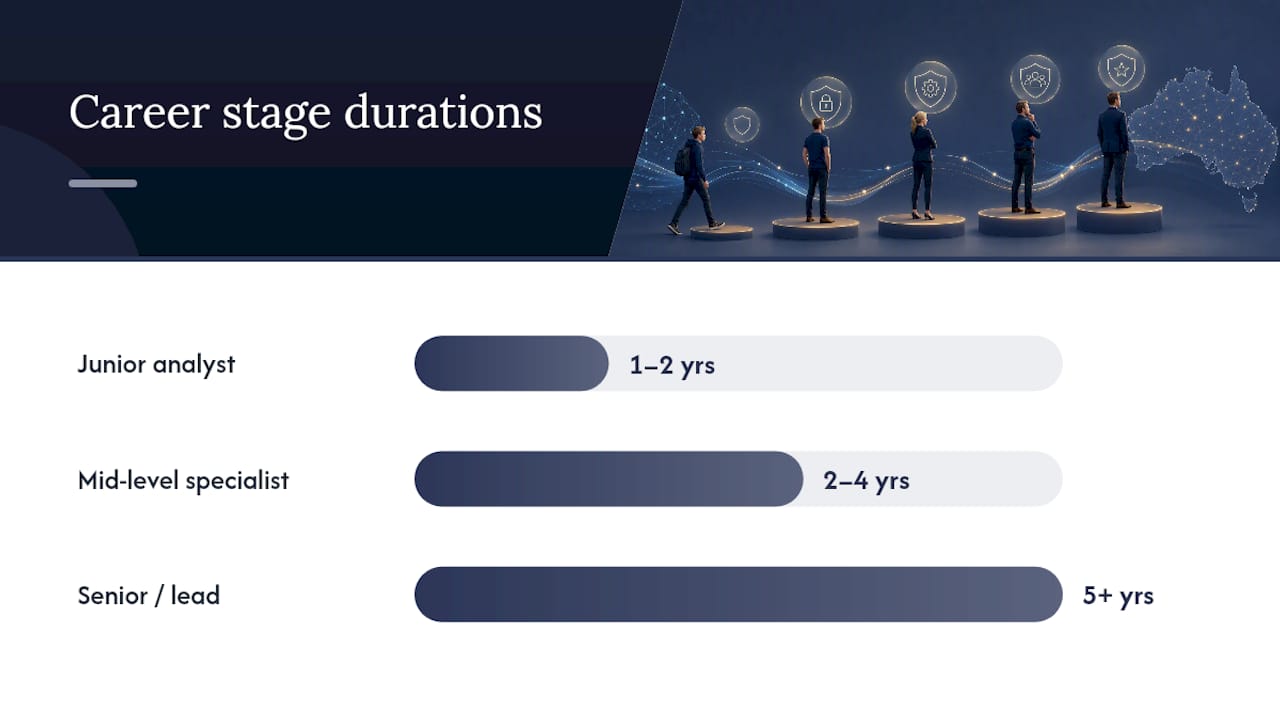
Most careers follow a rough ladder: junior analyst for one to two years, then a mid-level specialist role for two to four years, then senior or lead positions from around year five onward. That’s a guide, not a rule. We’ve seen people move faster when they build a home lab and get active on platforms like TryHackMe, and slower when they get stuck doing pure ticket triage with no exposure to anything else.
Lateral moves happen more than people expect:
- SOC analysts often move sideways into engineering once they get tired of alert fatigue and want to build rather than react.
- Penetration testers sometimes move into security architecture after a few years, bringing an attacker’s mindset to design work.
- GRC officers frequently move into CISO track roles, since board communication skills transfer directly.
If a four-year degree isn’t your path, government intake programs, apprenticeships, and graduate cyber streams run by agencies and larger employers are genuine alternatives. The Australian cyber workforce playbook points to building consistent job families specifically so businesses can support this kind of internal mobility instead of forcing everyone through the same narrow entry point. Our guide on cyber security degree pathways covers this in more detail if you’re weighing formal study against on the job routes.
How should employers write a cybersecurity job description?
A tight job description needs five things: a one-line role summary, 5 to 8 concrete responsibilities (not “manage security” but “triage SIEM alerts and escalate per runbook”), the actual tools used, minimum experience band, and a clear reporting line.
The mistakes we see constantly:
- Blending admin and security duties into one ad, so the successful hire ends up resetting passwords instead of doing threat analysis.
- Filtering purely on certifications, which knocks out capable candidates with real experience and lets under-skilled cert collectors through.
- Leaving the reporting line vague, so nobody actually owns the outcome when something goes wrong.
- Copying a generic template off the internet instead of describing the actual tools and environment the person will work in.
Six interview prompts that cut through resume padding: ask them to walk through a real incident they handled; ask what they’d do in the first hour of a ransomware alert; ask how they’d explain a risk to a non-technical owner; ask what they’d patch first with limited time; ask about a mistake they made and what changed after; ask how they’d approach a business with no MFA and patchy backups.
Pro Tip: If you can’t describe what the person does on a Tuesday afternoon, the job description isn’t ready to post yet.
What we see when SMBs hire (or try to) for cyber roles
Honestly, most SMBs we work with don’t need a CISO. They need someone who can get MFA rolled out properly, fix a backup that’s been silently failing for months, and clean up the twelve admin accounts nobody remembers creating. We see this constantly: a business thinks they’re covered because a junior IT person set something up years ago, and nobody’s checked it since.
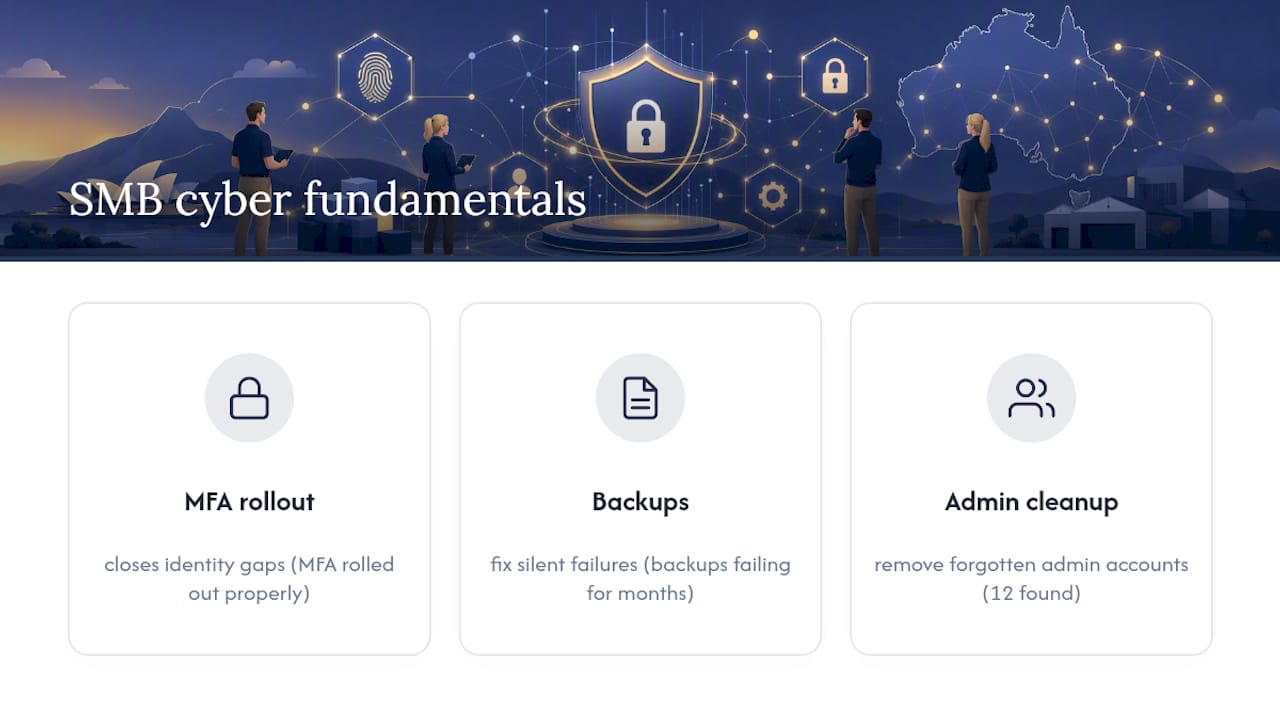
Our advice for SMB hiring: prioritise fundamentals over specialisms. A generalist who’s solid on identity, backups and patching will do more for a 20 to 50 person business than a narrow specialist with one deep skill. IT Start holds SMB 1001 Gold certification and offers free assessments to Brisbane businesses working out exactly this gap between what they think they have and what’s actually configured.
Get a hand hiring or covering the gap
If you’re an SMB owner reading this and thinking “we need three of these roles and can’t afford any of them,” that’s a normal reaction. Most 10 to 50 person businesses can’t justify a full time SOC analyst, engineer and GRC officer on the payroll. That’s exactly the gap managed services exist to fill. IT Start’s cyber security services cover endpoint protection, firewall management, risk assessment and proactive monitoring, essentially the operations and engineering roles above, delivered as a service instead of three separate salaries. If you’re specifically weighing up Microsoft 365 security and cloud posture, our Azure services team handles that side directly. Book a free assessment through IT Start and we’ll tell you plainly where your current setup actually sits, not where you assume it sits.
Our take on how these roles get described
Most job description advice online treats titles as if they’re standardised. They’re not. The ASD framework and the ABS occupation profile exist precisely because “Cyber Security Specialist” means three different jobs depending on who’s hiring, and the conventional advice to “just write a clear JD” skips the harder problem: most people writing these ads don’t know which framework to check against in the first place.
Our honest read, after years of watching SMBs try to hire for this: businesses overrate certifications and underrate fundamentals. A CISSP holder who’s never dealt with a real ransomware call is less useful in a 30-person business than someone who’s rebuilt a backup from scratch under pressure. If you’re a job seeker, build a portfolio of real scenarios you’ve handled, even from a home lab, before you chase another acronym. If you’re hiring, write the job around the actual Tuesday afternoon task list, check it against the ASD framework, and stop filtering purely on paper qualifications. That’s where the ROI actually sits.
— Matt
Sources
Use the ASD Cyber Skills Framework for role definitions and proficiency levels, the ABS occupation profile for standardised task lists, and cyber.gov.au’s role guidelines for governance and reporting structure. For workforce planning at scale, ASIO’s position descriptions show what real daily tooling looks like. Coursera’s role roundup is a useful plain English starting point if government PDFs feel dense.
FAQ
What are the responsibilities of a cyber security job?
Responsibilities depend heavily on the specific role, but common ones include monitoring for threats, responding to incidents, assessing vulnerabilities, and recommending fixes. The ABS occupation profile lists vulnerability assessment, incident analysis and remediation advice as core tasks for a Cyber Security Analyst specifically.
Can I make a high salary in cyber security?
Senior roles like security architect, CISO or specialist consulting positions often command high salaries in Australia, especially in larger organisations or consulting firms. Entry level or mid-career roles typically earn less until several years of specialised experience accumulate.
What are the job roles in cyber security?
The main role families are operations (SOC analyst, incident responder), testing (penetration tester, red teamer), engineering (security engineer, architect), assurance and advice (GRC officer, risk assessor) and leadership (CISO). The ASD Cyber Skills Framework defines nine specific roles across these groupings.
What are the 5 C’s of cybersecurity?
Definitions of the “5 C’s” vary across sources and there’s no single official version tied to Australian frameworks. Rather than repeat an unverified acronym, it’s more useful to focus on the responsibilities and frameworks covered above, particularly the ASD and cyber.gov.au guidance on role clarity.