

TL;DR:
- Risk identification in cyber security involves systematically detecting threats, vulnerabilities, and weaknesses affecting your business. Australian SMEs must prioritize this process to prevent costly breaches and protect their digital assets.
Risk identification in cyber security is the systematic process of detecting and documenting threats, vulnerabilities, and weaknesses that could harm your business’s digital assets. For Australian SMEs, this is not an optional IT exercise. The average cybercrime incident now costs over A$46,000 for small businesses, and that figure does not include reputational damage or lost clients. The Australian Signals Directorate (ASD) Essential Eight framework exists precisely because most SMEs need a structured starting point, not a 200-page policy document. Get the identification step right, and everything else in your security programme becomes easier to prioritise and defend.
What are the common cyber risks Australian SMEs face?
Risk identification starts with knowing what you are actually looking for. Cyber risks fall into three categories: hardware risks, software risks, and human risks. Each one is real, each one is common, and most SMEs we work with have gaps in all three.
Hardware risks include aging servers running past their end-of-life date, unpatched network switches, and workstations that have not been replaced in seven or eight years. Old hardware cannot run modern security patches. That gap becomes an open door for attackers.
Software risks are just as common. Outdated applications, no multi-factor authentication (MFA) on Microsoft 365, and unmanaged devices connecting to business systems are the top offenders. We regularly audit SME environments and find MFA disabled on admin accounts. That is not a minor oversight.
Human risks are the most underestimated. 82% of data breaches involve a human element, which means phishing, social engineering, and accidental data exposure are your biggest statistical threat. Training staff once a year and calling it done is not enough.
- Phishing emails targeting invoice approvals or payroll redirects
- Staff clicking malicious links on personal devices used for work
- Weak or reused passwords across business and personal accounts
- Unencrypted USB drives leaving the office with sensitive data
- Contractors with excessive access that was never revoked
Mapping your critical assets is the next step. Write down what data you hold, where it lives, who can access it, and what happens to your business if it disappears. That exercise alone surfaces risks most owners had no idea existed.
Pro Tip: Run a simulated phishing test on your team before you spend a dollar on new software. The results will tell you exactly where your human risk sits and what training actually needs to cover.
How does a cybersecurity risk assessment support risk identification?
A cybersecurity risk assessment is the structured process that turns your list of identified risks into a prioritised plan. The two are connected but distinct. Risk identification finds the threats. The assessment scores them so you know what to fix first.

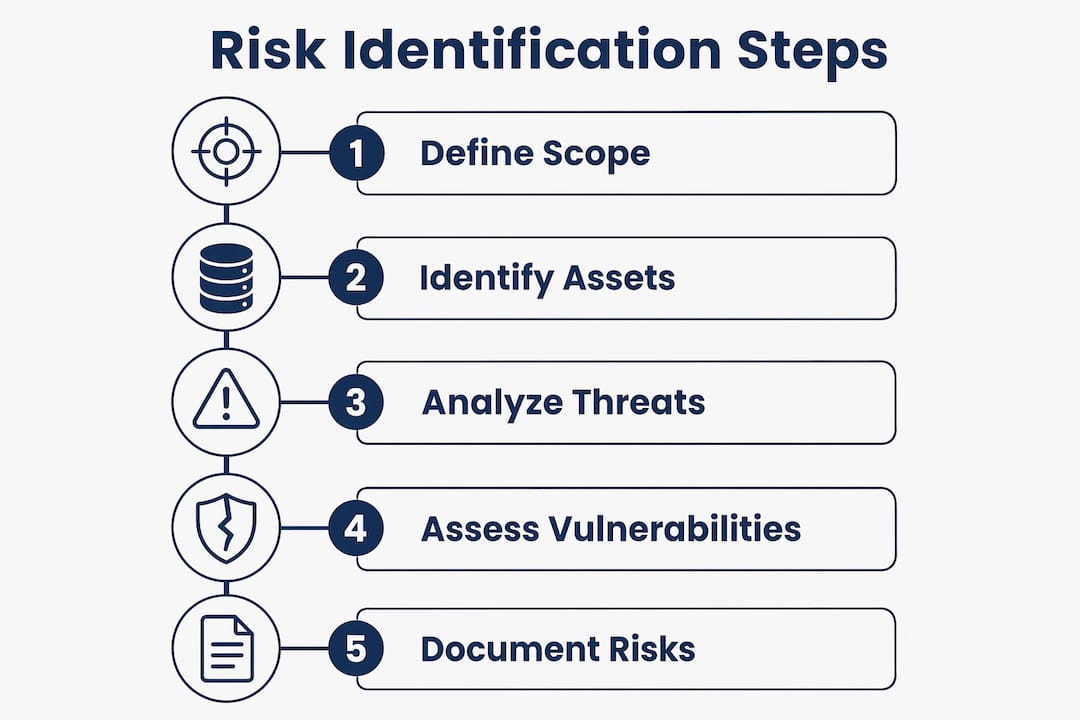
Effective risk assessment follows five clear steps: define your scope, identify your assets, analyse threats and vulnerabilities, score likelihood and impact, and prioritise remediation. Skipping any step produces a list that looks thorough but leads nowhere.
Scoring risks with a matrix
The 3×3 risk matrix is the most practical tool for SMEs. Score each risk on likelihood (low, medium, high) and impact (low, medium, high). Where the two scores intersect tells you the priority level. A high-likelihood, high-impact risk like an unpatched remote desktop service gets fixed this week. A low-likelihood, low-impact risk like a single outdated printer driver goes on the backlog.
| Risk | Likelihood | Impact | Priority |
|---|---|---|---|
| No MFA on admin accounts | High | High | Immediate |
| Unpatched server OS | High | High | Immediate |
| Outdated firewall firmware | Medium | High | This month |
| Staff with excess file access | Medium | Medium | This quarter |
| Expired SSL certificate | Low | Medium | Scheduled |
Threat modelling sits alongside the matrix. For each critical asset, ask: who would want to attack this, how would they do it, and what is the most likely path in? For a Brisbane accounting firm, the answer is almost always phishing targeting the accounts payable team, not a sophisticated nation-state attack.
Pro Tip: Focus your first round of fixes on risks with high probability but low mitigation cost. Enabling MFA across Microsoft 365 takes under an hour and eliminates one of the most common attack vectors immediately.
What frameworks guide cyber risk identification for Australian SMEs?
The ASD Essential Eight is the right starting point for Australian SMEs. It is not the only framework, but it is the most focused one for businesses without a dedicated security team. The Essential Eight maturity model runs from Level 0 (not implemented) to Level 3 (fully mature), and most SMEs should target Level 2 as their realistic goal.
The ASD frames cybersecurity as a governance issue, not just a technical one. That means maturity levels, ownership of controls, and documented exceptions are all part of the picture. The question is not “are we secure?” It is “what risks have we accepted, who owns each control, and are we improving?”
Essential Eight vs NIST: which fits your business?
| Framework | Best for | Focus | Australian relevance |
|---|---|---|---|
| ASD Essential Eight | SMEs, government-adjacent businesses | Prioritised controls, maturity levels | Directly mandated by ASD |
| NIST Cybersecurity Framework | Larger enterprises, US-aligned businesses | Broad risk management lifecycle | Useful reference, not mandated |
For most Brisbane SMEs, the Essential Eight wins on practicality. NIST is thorough but requires significant resources to implement properly. Start with Essential Eight and layer in NIST concepts as your maturity grows.
Ownership is the piece most businesses miss entirely. “Security without owners is theatre” is a phrase worth printing and putting on the wall. Every identified risk and every mitigation control needs a named person accountable for it. Not “IT” as a department. A specific person.
The 3-2-1 backup rule is another non-negotiable: three copies of your data, on two different media types, with one copy off-site and encrypted. Restoration must be tested at least every 90 days. That last part is where most SMEs fail completely. Knowing how to back up your systems correctly is one thing. Proving the restore works is another.
Pro Tip: Schedule a quarterly calendar reminder for backup restoration tests. Treat a failed restore test as a critical incident, not a minor IT note.
How to implement risk identification in practice
Theory is easy. Doing this inside a 15-person business with no dedicated IT staff is harder. Here is what actually works.
Start with a simple asset register. List every device, every application, and every data set the business relies on. Include cloud services like Microsoft 365, accounting software, and any industry-specific platforms. Most SME owners are surprised how long this list gets.
- Step 1: Build your asset register (devices, apps, data, cloud services)
- Step 2: Identify who accesses each asset and from where
- Step 3: Score each asset by business criticality (what breaks if this disappears?)
- Step 4: Map threats to each asset using the three risk categories
- Step 5: Score each threat using your likelihood and impact matrix
- Step 6: Assign an owner to each risk and each mitigation control
- Step 7: Set a review date and track remediation progress
Assigning ownership to each identified risk is what separates businesses that improve from those that produce a risk register and file it away. When a specific person is accountable, things get fixed. When “IT” is responsible, nothing moves.
CSIRO research on SME cyber security confirms that generic guidance causes analysis paralysis. A human-centred approach focused on user, usage, and usability embeds security into daily operations far more effectively than a compliance checklist. That means training that reflects real scenarios your staff actually face, not generic slides about password hygiene.
Common pitfalls we see constantly: treating backups as set-and-forget (they are not), ignoring hardware lifecycle until a server dies mid-week, and running staff training that no one remembers two weeks later. The fix for all three is the same: assign an owner, set a date, and check it happened.
Pro Tip: Document risks in a shared spreadsheet that the business owner and IT manager both access. Complexity kills follow-through. A simple tracker beats an expensive GRC platform that nobody opens.
Key takeaways
Effective risk identification in cyber security requires a structured process, clear ownership, and regular testing. Without all three, even well-intentioned security efforts stall before they deliver results.
| Point | Details |
|---|---|
| Start with asset mapping | List every device, application, and data set before scoring any risk. |
| Score threats by likelihood and impact | Use a 3×3 matrix to prioritise fixes and avoid wasting effort on low-priority risks. |
| Apply the Essential Eight baseline | ASD’s Essential Eight maturity model is the most practical framework for Australian SMEs. |
| Assign a named owner to every risk | Accountability drives follow-through; “IT” as an owner means nothing gets done. |
| Test your backups every 90 days | A backup you have never restored is not a backup. Schedule and document every test. |
What I have learned from years of SME risk work
Honestly, the biggest problem is not that SME owners do not care about cyber security. Most do, especially after they have heard about a competitor getting hit. The problem is that risk identification gets treated as a one-time project rather than an ongoing business function.
We see this a lot: a business does a risk assessment, produces a tidy document, and then nothing changes for 18 months. The document sits in a folder. The risks it identified are still there. New risks have appeared. Nobody noticed because nobody was assigned to watch.
The other thing I keep coming back to is ownership. Business leaders often delegate security entirely to their IT provider or internal IT person and assume the problem is solved. It is not. The business owner needs to understand what risks exist, what has been accepted, and why. That does not mean becoming a technical expert. It means asking the right questions and expecting clear answers.
The cyber risks facing Brisbane businesses are not exotic. They are predictable, well-documented, and largely preventable with consistent effort. The SMEs that handle this well are not the ones with the biggest budgets. They are the ones where someone in leadership actually owns the outcome.
Security is a business decision, not an IT decision. The sooner that shift happens, the better the results.
— Matt
How IT Start helps Brisbane SMEs manage cyber risk
IT Start works with Brisbane SMEs to put structure around cyber security risk management without drowning small teams in complexity. That means helping you build an asset register, score your risks, implement the Essential Eight controls at the right maturity level, and assign clear ownership across your business. IT Start also handles managed security monitoring, backup testing, and Microsoft 365 security configuration so the basics are covered and verified. If your business has never done a formal risk assessment, or the last one is gathering dust, IT Start offers a practical starting point with no jargon and no unnecessary upselling.
FAQ
What is risk identification in cyber security?
Risk identification in cyber security is the process of systematically finding and documenting threats, vulnerabilities, and weaknesses that could harm your business’s data or systems. It is the first step in any cyber security risk assessment.
What is a cybersecurity risk assessment?
A cybersecurity risk assessment evaluates identified risks by scoring their likelihood and impact, then prioritises remediation. It turns a list of threats into a ranked action plan.
What does the ASD Essential Eight cover?
The Essential Eight is a set of prioritised security controls published by the Australian Signals Directorate. It covers patching, MFA, application control, backups, and more, with maturity levels from 0 to 3.
How often should SMEs review their cyber risks?
Cyber risks should be reviewed at least annually, and immediately after any significant change such as a new system, a staff change, or a security incident.
What is risk avoidance in cyber security?
Risk avoidance means eliminating a risk entirely by not engaging in the activity that creates it. For example, a business might avoid storing sensitive client data on local servers by moving entirely to encrypted cloud storage.