

Many Queensland SME owners believe cybersecurity boils down to installing firewalls and antivirus software. This misconception leaves businesses vulnerable because effective IT security workflows integrate processes, people, and technology into a unified defence strategy. Managed security services provide 24/7 monitoring and rapid incident response, addressing resource gaps that plague small to medium enterprises. This guide demonstrates how Queensland SMEs can build robust IT security workflows supported by managed services to reduce risks, meet compliance obligations, and protect operational continuity.
Table of Contents: IT Security Workflow Guide for Queensland SMEs
- Understanding IT Security Workflows For SMEs
- Local Cybersecurity Challenges And Compliance In Queensland
- Frameworks And Best Practices For IT Security Workflows
- Role Of Managed Security Services In IT Security Workflows
- Integrating Cloud And AI Technologies Into Security Workflows
- Choosing And Working With A Managed IT Service Provider In Queensland
- Implementing And Maintaining An Effective IT Security Workflow
- Summary And Next Steps For Queensland SMEs
- Enhance Your IT Security Workflow With IT Start Managed Services
Key Takeaways
| Point | Details |
|---|---|
| IT security workflows integrate technology, processes, and people | Effective cybersecurity requires coordinated systems, not just software solutions. |
| Queensland SMEs face unique local threats and compliance demands | State regulations and regional cyber risks shape security priorities for businesses. |
| Managed Security Services reduce response times by up to 60% | 24/7 monitoring and expert incident management dramatically lower breach impacts. |
| Cloud and AI technologies strengthen modern workflows | Automation predicts threats and reduces false positives for efficient security management. |
| Certified local providers deliver tailored compliance solutions | SMB 1001 Gold certified partners understand Queensland’s regulatory landscape intimately. |
Understanding IT Security Workflows for SMEs
An IT security workflow incorporates processes, people, and technology adapted to SME realities, creating a coordinated defence system that protects business operations. Unlike large enterprises with dedicated security teams, SMEs operate with limited staff and budgets, making streamlined workflows essential.
Three core components define effective security workflows. First, documented processes establish clear protocols for threat detection, response procedures, and recovery steps. Second, trained people execute these processes consistently, from frontline staff recognizing phishing attempts to managers authorizing security investments. Third, appropriate technology tools automate monitoring, detect anomalies, and enforce security policies across networks.
Queensland SMEs face unique challenges when building security workflows:
- Resource constraints limit dedicated security personnel and specialized tools
- Rapid technology adoption outpaces security implementation planning
- Compliance obligations require expertise beyond typical IT support capabilities
- Growing attack sophistication targets smaller businesses with weaker defences
Pro Tip: Start with risk assessment to identify your most critical assets and vulnerabilities before investing in security tools. This approach ensures your workflow addresses actual business risks rather than generic threats.
Many SMEs struggle because they apply enterprise security models unsuited to smaller operations. Improving cyber security for Queensland SMEs requires practical approaches that balance protection with operational efficiency. A tailored workflow accounts for your industry sector, data sensitivity, customer expectations, and available resources.
Local Cybersecurity Challenges and Compliance in Queensland
Queensland businesses confront evolving cyber threats that shape security workflow priorities. Ransomware attacks increasingly target SMEs, exploiting remote work vulnerabilities and outdated systems. Phishing campaigns grow more sophisticated, using local business references to deceive employees. Supply chain attacks compromise trusted vendor relationships, introducing malware through legitimate channels.

Queensland’s Cyber Security Unit aims to boost local capability and resilience against emerging threats through 2026, providing frameworks and resources specifically for regional businesses. The state government recognizes that SME cybersecurity directly impacts Queensland’s economic resilience and competitiveness.
Australian compliance frameworks influence how SMEs structure security workflows:
- Privacy Act 1988 mandates protection of personal information with breach notification requirements
- Australian Cyber Security Centre Essential Eight strategies provide baseline security controls
- Industry specific regulations govern healthcare, legal, and financial services data handling
- Notifiable Data Breaches scheme requires reporting serious privacy breaches to affected individuals
These regulatory pressures demand documented security processes, regular audits, and incident response capabilities. SMEs cannot simply rely on reactive IT support when compliance obligations require proactive monitoring and systematic risk management. Cybersecurity advice for Brisbane SMEs emphasizes aligning workflows with both threat landscapes and regulatory expectations.
Local threats continue evolving as attackers refine social engineering tactics and exploit new technology vulnerabilities. Business email compromise scams targeting Queensland companies result in significant financial losses. Credential stuffing attacks leverage passwords from data breaches to access business systems. Understanding these specific risks helps SMEs prioritize workflow elements that address actual threats rather than theoretical scenarios.
Frameworks and Best Practices for IT Security Workflows
The NIST Cybersecurity Framework structures workflows into Identify, Protect, Detect, Respond and Recover phases, providing a proven blueprint for systematic security management. This framework translates complex security concepts into actionable steps suitable for SMEs without extensive cybersecurity expertise.
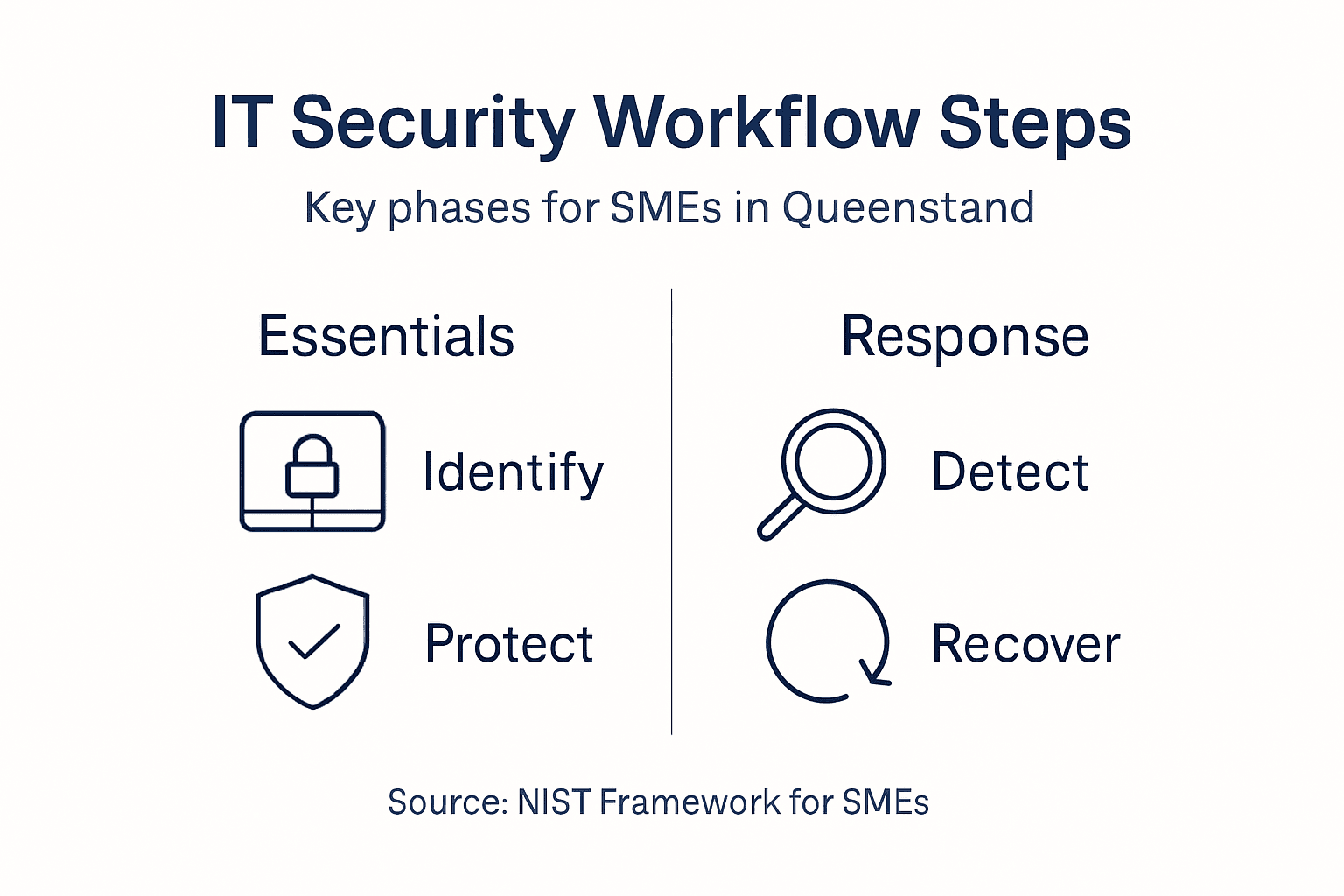
The five NIST core functions guide workflow development:
| Function | Purpose | SME Application |
|---|---|---|
| Identify | Understand business context, resources, and risks | Asset inventory, risk assessment, governance policies |
| Protect | Implement safeguards for critical services | Access controls, awareness training, data security |
| Detect | Identify cybersecurity events promptly | Continuous monitoring, anomaly detection, threat intelligence |
| Respond | Take action regarding detected incidents | Response planning, communications, incident analysis |
| Recover | Restore capabilities after incidents | Recovery planning, improvements, communications |
Common misconceptions undermine security workflows when businesses focus exclusively on technology. Installing advanced firewalls and endpoint protection creates false confidence if employees lack security awareness or incident response procedures remain undefined. Technology without coordinated processes and trained people leaves critical gaps that attackers exploit.
Effective workflows require continuous improvement cycles:
- Regular testing validates that procedures work under real conditions
- Lessons learned from incidents inform process refinements
- Threat intelligence updates adapt defences to emerging attack methods
- Performance metrics identify workflow bottlenecks and improvement opportunities
Pro Tip: Document your security workflows in simple language that non-technical staff understand. Complex jargon prevents effective implementation when frontline employees cannot follow procedures during actual incidents.
Step by step cybersecurity guides for Queensland SMEs demonstrate practical implementation of these frameworks. The key lies in adapting conceptual models to your specific business context, industry requirements, and operational constraints. Start with foundational controls, then progressively enhance capabilities as resources allow.
Role of Managed Security Services in IT Security Workflows
MSS providers offer 24/7 monitoring that can reduce incident response times by up to 60%, delivering critical capabilities that most SMEs cannot maintain internally. Managed Security Services bridge the expertise gap by providing dedicated security professionals, advanced tools, and proven processes tailored to smaller business needs.
Key MSS capabilities strengthen IT security workflows:
- Continuous network monitoring detects threats in real time before significant damage occurs
- Security Information and Event Management systems correlate alerts across multiple sources
- Threat intelligence feeds provide early warning of emerging attack patterns
- Incident response teams investigate and contain breaches following established protocols
- Vulnerability management identifies and prioritizes system weaknesses for remediation
SMEs lacking internal cybersecurity staff benefit enormously from MSS expertise. A typical Brisbane business with 20 to 50 employees cannot justify hiring dedicated security analysts, yet faces the same threats as larger organizations. Managed services provide enterprise grade protection at predictable monthly costs, eliminating the need for capital investments in security infrastructure.
Statistic Highlight: Organizations using managed security services experience 60% faster incident detection and response compared to those relying solely on internal IT teams, significantly reducing breach costs and business disruption.
The contrast between reactive IT support and proactive MSS models proves critical. Traditional break fix support responds after problems occur, while managed security services prevent incidents through continuous monitoring and threat hunting. This proactive stance aligns perfectly with modern security workflow requirements that emphasize early detection and rapid response.
Pro Tip: When evaluating MSS providers, request specific metrics on their average detection time, response time, and escalation procedures. These concrete performance indicators matter more than generic security promises.
IT security practices for Brisbane SMEs increasingly incorporate managed services as foundational components rather than optional additions. The cost of a single ransomware incident typically exceeds multiple years of MSS investment, making professional monitoring an essential risk management strategy.
Integrating Cloud and AI Technologies into Security Workflows
Australian businesses widely adopt cloud services while AI reduces false positives and predicts security issues to enhance workflows, transforming how SMEs implement and maintain cybersecurity. These technologies enable sophisticated protection previously available only to large enterprises with substantial security budgets.
Cloud adoption creates both opportunities and challenges for security workflows. Scalable cloud infrastructure allows SMEs to deploy enterprise grade security tools without hardware investments. However, misconfigured cloud services expose sensitive data, and shared responsibility models require clear understanding of which security controls the provider manages versus those the business must implement.
Common cloud security workflow elements include:
- Identity and access management controls who can access cloud resources
- Encryption protects data in transit and at rest across cloud platforms
- Configuration management prevents security weaknesses from default settings
- Cloud security posture management continuously monitors for misconfigurations
- Backup and disaster recovery services ensure business continuity
AI powered automation transforms security workflow efficiency by handling repetitive tasks that overwhelm human analysts. Machine learning algorithms identify subtle patterns indicating compromised accounts or malware communications. Automated threat hunting proactively searches for indicators of compromise rather than waiting for alerts. Behavioral analytics detect anomalies that signature based tools miss.
Key AI benefits for SME security workflows:
- Reduced false positive rates allow security teams to focus on genuine threats
- Predictive analysis identifies vulnerabilities before attackers exploit them
- Automated response actions contain threats within seconds of detection
- Continuous learning adapts defences as attack methods evolve
Cloud solutions for Brisbane SMEs demonstrate practical applications of these technologies in local business contexts. The combination of managed security services with cloud and AI capabilities creates powerful workflows that adapt to emerging threats while remaining accessible to organizations with limited technical resources.
Choosing and Working with a Managed IT Service Provider in Queensland
Selecting the right managed service provider determines whether your security workflow succeeds or creates new vulnerabilities. Certification levels indicate provider expertise and commitment to industry standards. For example, SMB 1001 Gold certification demonstrates adherence to rigorous managed services benchmarks, ensuring consistent service quality.
Evaluate potential MSS providers using these criteria:
- Local Queensland presence enables on site support when remote management proves insufficient
- Industry specific experience ensures understanding of sector compliance requirements
- Transparent pricing models prevent surprise costs and budget overruns
- Service level agreements define response times and performance guarantees
- Security certifications validate technical expertise and operational maturity
Pro Tip: Request client references from businesses similar to yours in size and industry. Speaking directly with current customers reveals how providers perform under real operational conditions beyond marketing claims.
Service transparency matters because security workflows require ongoing collaboration between your team and the managed service provider. Providers should explain their monitoring processes, escalation procedures, and reporting capabilities in clear terms. Avoid vendors using technical jargon to obscure vague service offerings or hiding limitations in complex contracts.
Tailoring services to business needs prevents paying for unnecessary features while ensuring critical protections remain in place. A 15 person professional services firm requires different security controls than a 100 employee healthcare provider. Choosing managed IT providers in Queensland involves matching service packages to your specific risk profile, compliance obligations, and operational requirements.
Contract evaluation focuses on terms that impact long term relationships. Flexible scaling accommodates business growth without forcing complete service renegotiation. Clear termination clauses protect you if provider performance deteriorates. Data ownership provisions ensure you retain control of business information if switching providers becomes necessary.
Implementing and Maintaining an Effective IT Security Workflow
Proactive IT security workflows with continuous monitoring significantly reduce downtime costs for businesses, making systematic implementation essential for Queensland SMEs. Follow these steps to establish robust security workflows:
- Conduct comprehensive security assessment identifying current vulnerabilities, critical assets, and compliance gaps
- Define security policies documenting acceptable use, access controls, incident response, and data handling procedures
- Select qualified managed security service provider offering capabilities aligned with identified needs and budget constraints
- Implement monitoring tools and processes establishing baseline activity patterns for anomaly detection
- Train employees on security awareness, phishing recognition, and incident reporting procedures
- Test incident response procedures through tabletop exercises simulating realistic breach scenarios
- Schedule regular security audits reviewing controls, updating procedures, and validating compliance
- Establish performance metrics tracking detection times, response effectiveness, and security posture improvements
Employee training forms a critical workflow component often overlooked in technology focused implementations. Staff must recognize social engineering attempts, follow secure password practices, and report suspicious activities promptly. Regular awareness sessions keep security top of mind as threats evolve.
Incident management procedures define clear escalation paths and communication protocols. When security events occur, confusion about who does what delays effective response and increases damage. Document specific roles, contact information, and decision authorities before incidents occur.
Continuous improvement cycles adapt workflows to changing threats and business needs. Monthly reviews examine security metrics, incident trends, and control effectiveness. Quarterly assessments evaluate whether current workflows still address priority risks or require adjustment. Annual comprehensive audits validate overall security posture and compliance status.
IT security implementation steps for Queensland SMEs provide detailed guidance on executing these workflow components. Success requires treating security as an ongoing process rather than a one time project, with regular attention ensuring controls remain effective as your business and threat landscape evolve.
Summary and Next Steps for Queensland SMEs
Effective IT security workflows combine frameworks, managed services, and modern technologies into coordinated defence strategies tailored for SME realities. Queensland businesses benefit from local providers understanding regional compliance requirements and threat patterns. The integration of processes, people, and technology creates resilient security postures that protect operations without overwhelming limited resources.
Starting your security workflow journey begins with honest assessment of current capabilities and gaps. Partner with experienced managed security service providers who demonstrate relevant certifications, transparent operations, and proven track records with similar businesses. Implement foundational controls first, then progressively enhance capabilities as threats evolve and resources allow.
The investment in robust security workflows pays dividends through reduced breach risks, faster incident response, and maintained business continuity. Queensland SMEs cannot afford to delay as cyber threats grow more sophisticated and regulatory expectations increase. Contact IT Start for IT security services designed specifically for Brisbane and Queensland business needs, backed by local expertise and industry leading certifications.
Enhance Your IT Security Workflow with IT Start Managed Services
IT Start delivers comprehensive managed security services specifically designed for Queensland SMEs seeking proactive cybersecurity protection. Our SMB 1001 Gold certification and local Brisbane presence ensure your business receives tailored solutions addressing regional compliance requirements and threat landscapes. We provide 24/7 monitoring, rapid incident response, and continuous workflow optimization that keeps your operations secure and compliant. Our managed IT and support services integrate seamlessly with your existing systems while our cybersecurity solutions adapt to your specific industry needs. Contact IT Start today for a free security assessment and discover how our managed services strengthen your IT security workflows.
FAQ
What is an IT security workflow and why is it crucial for SMEs?
An IT security workflow coordinates people, processes, and technology to systematically manage cybersecurity risks across your business operations. For SMEs with limited resources, structured workflows ensure consistent threat detection and response without requiring dedicated security staff. This systematic approach prevents gaps that attackers exploit while maintaining operational efficiency.
How do managed security services reduce cybersecurity risks for Queensland SMEs?
Managed security services provide 24/7 monitoring and expert incident response that most SMEs cannot maintain internally. These services detect threats in real time, respond up to 60% faster than internal teams, and apply enterprise grade security tools at predictable costs. MSS compensates for skill and resource gaps by delivering dedicated cybersecurity expertise.
What compliance frameworks should Queensland SMEs consider in their IT security workflows?
Queensland SMEs must address the Privacy Act 1988, Australian Cyber Security Centre Essential Eight strategies, and industry specific regulations for sectors like healthcare and finance. The Queensland Cyber Security Unit guidelines provide additional regional context. Incorporating these frameworks into security policies and workflows ensures regulatory compliance while strengthening overall protection.
Can cloud and AI technologies improve IT security workflows for small businesses?
Yes, cloud platforms enable scalable security solutions without substantial hardware investments, while AI automation dramatically reduces false alerts and predicts threats before exploitation. These technologies provide enterprise grade capabilities at SME friendly costs. Machine learning continuously adapts defences as attack methods evolve, maintaining effective protection with minimal human intervention.
What are common mistakes SMEs make when establishing IT security workflows?
Many SMEs focus exclusively on technology purchases without developing coordinated processes or training staff, leaving critical workflow gaps. Others underestimate the need for continuous monitoring and rapid incident response capabilities. Treating security as a one time project rather than ongoing practice allows controls to become outdated as threats evolve and business operations change.
Recommended
- Cybersecurity Tools for QLD SMEs: 99% Account Protection – IT Start
- 5 Cyber Security Certifications for Brisbane SMEs (85% Risk Cut) – IT Start
- Computer Security: Safeguarding Brisbane SMEs – IT Start
- Security Benefits of Cloud Computing for Brisbane SMEs – IT Start
- Understanding Digital Document Security for Business Owners – My Mobile Notary