

What does cyber security risk actually mean?
Cyber security risk is the likelihood that a threat will exploit a vulnerability in your systems, multiplied by the impact that would cause. That is the core formula: Risk = Likelihood × Impact. The Australian Cyber Security Centre defines a security risk as any event that could result in the compromise, loss of integrity, or unavailability of data or resources, measured in terms of its likelihood and consequences.
Three terms sit at the heart of this definition, and mixing them up is where most businesses go wrong:
- Threat: Any potential cause of harm to your systems or data. Examples include phishing emails, ransomware, or a disgruntled employee.
- Vulnerability: A weakness that a threat can exploit. An unpatched server, a weak password, or no multi-factor authentication (MFA) are all vulnerabilities.
- Impact: The actual damage caused if the threat succeeds. This covers financial loss, data theft, downtime, and reputational harm.
- Likelihood: How probable it is that a given threat will actually exploit a given vulnerability in your environment.
For Australian SMBs, this matters because many small businesses believe cyber threats pose low or no risk over the next five years. That confidence gap is exactly what attackers count on.
How do vulnerabilities and threats combine to create risk?
Risk does not exist in isolation. It only materialises when a threat has a vulnerability to exploit. Remove either element and the risk drops sharply.

Think of it this way. A phishing email is a threat. If your staff have no training and no MFA on their Microsoft 365 accounts, those are vulnerabilities. The combination produces real, measurable risk. If you patch the vulnerability by enabling MFA and running awareness training, the same threat produces far less risk because the attacker has fewer weak points to target.
Key relationships to keep in mind:
- No vulnerability, no risk: A threat cannot cause harm if there is nothing to exploit.
- No threat, no risk: A vulnerability sitting in an air-gapped system with no external access carries minimal risk.
- Risk scales with both variables: High likelihood plus high impact equals critical risk. Low likelihood plus low impact equals acceptable risk.
- Context changes everything: A small accounting firm holding client financial records faces a very different risk profile from a café with a basic point-of-sale system.
Australian businesses often focus on threats alone, naming phishing or ransomware as their concern. What they miss is the vulnerability side of the equation. Knowing the threat exists is only half the picture. Understanding your specific risk profile is what actually drives good decisions.
Common types of cyber security risks facing Australian businesses

Australian SMBs face a broad and evolving mix of cyber risks. The ACSC survey data shows that malware, phishing, and ransomware are the most commonly recognised threats, though recognition does not equal understanding.
Common risk categories affecting Australian businesses include:
- Phishing and business email compromise (BEC): Criminals impersonate trusted contacts to steal credentials or redirect payments. BEC is particularly damaging because it often bypasses technical controls entirely.
- Ransomware: Malicious software encrypts your files and demands payment, usually in cryptocurrency, to restore access. Some attackers also threaten to publish stolen data.
- Malware: A broad category covering viruses, spyware, trojans, and ransomware. Malware can steal credentials, corrupt files, or give attackers persistent access to your network.
- Insider threats: Current or former employees, contractors, or partners who misuse access, whether deliberately or accidentally.
- Third-party risk: Suppliers, cloud providers, and software vendors with access to your systems introduce risk you do not directly control.
- Compliance risk: Failing to meet obligations under the Privacy Act or the Notifiable Data Breaches scheme can result in regulatory penalties on top of the incident itself.
- Reputational risk: A publicised breach can cost you clients and contracts, sometimes permanently.
A real example: A Brisbane professional services firm received a BEC email that appeared to come from their accountant. No MFA was in place on the email account. The attacker had been sitting in the inbox for weeks, reading correspondence, before sending a convincing payment redirection request. The financial loss was recovered only partially.
Stat worth knowing: The ACSC receives reports at an average rate of one every 10 minutes, and Australian SMBs consistently underestimate how long recovery actually takes.
What are the real impacts when cyber risks materialise?
The consequences of a cyber incident go well beyond the immediate disruption. For an SMB with 10 to 50 staff, even a moderate incident can be existential.
- Financial loss: Direct costs include ransom payments, forensic investigation, system restoration, and legal fees. Indirect costs include lost revenue during downtime.
- Operational disruption: Systems offline for days or weeks means staff cannot work, orders cannot be processed, and clients cannot be served.
- Reputational damage: A data breach involving customer records can destroy trust that took years to build.
- Legal and regulatory penalties: Under the Notifiable Data Breaches scheme, failing to report an eligible breach to the Office of the Australian Information Commissioner carries serious consequences.
- Prolonged recovery: Most SMBs estimate they would recover from an incident within a few days. ACSC reports tell a different story: recovery commonly takes far longer than businesses expect, and some SMBs do not recover at all.
Recovery reality check: The majority of Australian SMBs believe they would recover from a cyber incident immediately or within a few days. The ACSC’s own incident data consistently contradicts that assumption.
Honestly, the recovery timeline gap is the one that catches businesses most off guard. They budget for a bad day, not a bad month. And when the backups turn out to be incomplete or untested, the timeline blows out further.
How to manage and reduce cyber security risk
Risk management is not a one-time project. It is an ongoing cycle of identifying, analysing, evaluating, and treating risk. The NIST Cybersecurity Framework 2.0 structures this across six functions: Govern, Identify, Protect, Detect, Respond, and Recover. The ACSC’s own cyber security principles follow a similar structure.
For an SMB starting from scratch, a practical sequence looks like this:
- Identify your assets and risks. Know what systems, data, and processes you have, and what threats are most relevant to your industry.
- Enable MFA everywhere. Microsoft 365, cloud drives, banking portals, accounting software. MFA is the single highest-return control for most SMBs.
- Patch and update regularly. Attackers exploit known vulnerabilities within minutes of public disclosure. Delayed patching is an open door.
- Back up properly and test it. Backups that have never been tested are not backups. Run a restore drill at least quarterly.
- Train your staff. Phishing awareness training reduces click rates on malicious emails. The ACSC’s small business guide covers the basics well.
- Write an incident response plan. Know who calls whom, what gets isolated, and how you notify clients if data is compromised.
- Review and repeat. Threats evolve. Your controls need to keep pace.
Pro Tip: The most common gap IT Start sees in SMB environments is not a missing tool. It is a missing process. Businesses buy antivirus software and assume they are protected, but they have never tested their backups, never trained staff on BEC, and have no plan for what happens when something goes wrong. Start with process, then layer in technology.
What most businesses get wrong about cyber risk
We see this a lot. A business owner can name ransomware as a threat. They know phishing exists. But when you ask them to describe their actual risk profile, they go quiet. Knowing the name of a threat is not the same as understanding whether that threat poses a real risk to your specific environment.
“Only 15% of Australian small businesses could explain all nine of the most common cyber risks listed in the ACSC survey. That means 85% of SMBs are making security decisions with an incomplete picture of what they are actually defending against.”
The overconfidence problem is real. SMBs that believe they are well-protected often have the most gaps. They have not enabled MFA because they think their password is strong enough. They have not patched their server because it has “always worked fine.” They think their Microsoft 365 data is backed up by Microsoft, when in fact Microsoft’s responsibility ends at platform availability, not your data.
At IT Start, we work with Brisbane businesses across professional services, healthcare, and finance. The pattern is consistent: the businesses most at risk are often the ones least worried. If your cyber risk management has not been reviewed in the past 12 months, that is worth fixing. A free assessment from IT Start’s cyber security team is a practical starting point.
How does a cyber security risk assessment actually work?
A risk assessment is the structured process of identifying what could go wrong, how likely it is, and what the consequences would be. The ACSC’s Information Security Manual draws its risk management framework from NIST SP 800-37, which defines six steps: define the system, select controls, implement controls, assess controls, authorise the system, and monitor the system.
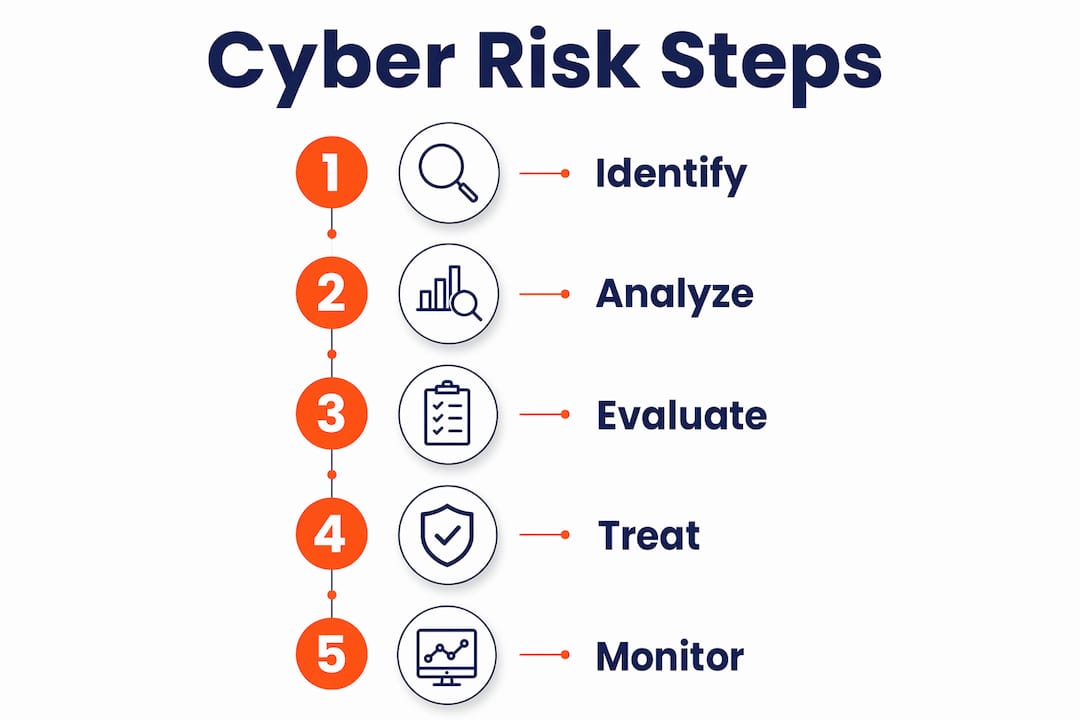
In practice for an SMB, a risk assessment covers four stages:
Risk identification means cataloguing your assets, mapping the threats relevant to your sector, and documenting where vulnerabilities exist. The ACSC’s principle IDE-04 specifically calls for using current threat intelligence and threat modelling in this step.
Risk analysis assigns likelihood and impact scores to each identified risk. This is where the Likelihood × Impact formula becomes practical. A phishing risk against an unprotected inbox with no MFA might score high on both axes.
Risk evaluation compares each risk against your organisation’s tolerance. Some risks are acceptable. Others require immediate treatment.
Risk treatment means deciding how to respond: mitigate the risk with controls, transfer it through cyber insurance, avoid it by changing a process, or formally accept it with documented sign-off.
Continuous monitoring is what keeps the whole process current. Threats change, systems change, and a risk that was acceptable last year may not be acceptable today.
What is the difference between inherent risk and residual risk?
These two terms come up in any serious risk conversation, and they are worth understanding clearly.
Inherent risk is the level of risk that exists before you apply any controls. It is the raw exposure. If your business holds sensitive client data and has no security measures in place, the inherent risk is high.
Residual risk is what remains after your controls are applied. You enable MFA, patch your systems, train your staff, and run regular backups. The residual risk is lower, but it is never zero. Some risk always remains.
The ACSC’s cyber security principles require that residual security risks be formally accepted before a system is authorised to operate, and that they are continuously monitored throughout its life. This is not just a government requirement. It is good practice for any business that wants to make informed decisions about what risk it is actually carrying.
Understanding the gap between inherent and residual risk tells you whether your controls are working. If your inherent risk is critical and your residual risk is still high, your controls are not doing enough. That gap is where attackers find their way in.
Key takeaways
Cyber security risk is the product of threat likelihood and potential impact, and most Australian SMBs are carrying more of it than they realise.
| Point | Details |
|---|---|
| Risk formula | Cyber security risk equals likelihood multiplied by impact when a threat exploits a vulnerability. |
| SMB knowledge gap | Only 15% of Australian small businesses can explain all nine common cyber risks identified by the ACSC. |
| Recovery is underestimated | Most SMBs expect to recover within days; ACSC incident data shows recovery routinely takes far longer. |
| Inherent vs residual risk | Inherent risk is your raw exposure; residual risk is what remains after controls are applied and must be formally accepted. |
| Top priority controls | MFA, regular patching, tested backups, and staff training address the majority of common SMB vulnerabilities. |
FAQ
What is risk in cyber security?
Cyber security risk is the potential for loss or harm when a threat exploits a vulnerability in your systems, measured by the likelihood of that event and the severity of its consequences. The ACSC defines it as any event that could result in compromise, loss of integrity, or unavailability of data or resources.
What are the top cyber security risks for Australian SMBs?
Phishing, business email compromise, ransomware, malware, and insider threats are the most common risks facing Australian small businesses, according to ACSC survey data. Third-party risk and compliance failures under the Privacy Act are also significant concerns.
What are the four types of risk in cyber security?
Risk is commonly categorised as financial, operational, reputational, and compliance risk. Each type describes a different consequence of a cyber incident, from direct monetary loss through to regulatory penalties and long-term damage to client trust.
What is the difference between inherent risk and residual risk?
Inherent risk is your exposure before any security controls are in place. Residual risk is what remains after controls like MFA, patching, and backups are applied. The ACSC requires residual risk to be formally accepted before a system is authorised to operate.
How do you reduce cyber security risk?
The most effective steps are enabling MFA on all accounts, keeping software patched and updated, maintaining tested backups, training staff to recognise phishing, and having a written incident response plan. The NIST Cybersecurity Framework 2.0 and ACSC’s Essential Eight both provide structured guidance for working through these controls systematically.