

A cyber security framework is a structured set of principles, controls and processes that helps an organisation manage and reduce cyber risk instead of guessing at it. It is not one document. It is a system, usually built around functions like govern, identify, protect, detect, respond and recover.
The main ones you will hear about are the NIST Cybersecurity Framework, ISO/IEC 27001, the ACSC Essential Eight, and SMB1001. Each solves a slightly different problem.
Who actually needs to care about this:
- SMBs with 10 to 50 staff who handle client data, payments, or health records
- Businesses chasing government or enterprise contracts that demand proof of security
- Anyone who has been told by an insurer or a client “you need a framework” and has no idea what that means
Key Takeaways
A cyber security framework only reduces risk when its controls are implemented, tested and monitored, not just documented and filed away.
| Point | Details |
|---|---|
| Definition matters | A framework is structured guidance for managing risk; a standard like ISO 27001 sets certifiable requirements. |
| Fix the baseline first | MFA, patching and tested backups should come before governance paperwork or certification. |
| Match the framework to demand | Use Essential Eight for government work, SMB1001 for SMB-friendly certification, ISO 27001 for enterprise sales. |
| Certification is not security | A certificate proves a moment in time; ongoing monitoring and restore testing prove it still works. |
| Get the technical work done properly | IT Start combines assessment, implementation and its own SMB1001 Gold experience into one engagement. |
Table of Contents
- What is a cyber security framework and what does it actually cover?
- Common cyber security framework examples and when each fits
- Framework versus standard: what the difference actually costs you
- How to choose the right framework for your business
- Implementing a cyber security framework: the realistic sequence
- What most businesses get wrong (and how we fix it)
- Where cyber security frameworks came from
- Where regulation and frameworks actually meet
- Fitting a framework around what you already have
- Real-world outcomes when frameworks are applied properly
- What actually matters versus what gets oversold
- How IT Start helps you get from confused to covered
- Sources
- FAQ
What is a cyber security framework and what does it actually cover?
Most people picture a framework as a checklist. It is closer to an operating system for risk. A proper framework tells you what to protect, how to detect trouble, and what to do when something goes wrong, and it keeps you doing it on a cycle rather than once and forgetting about it.
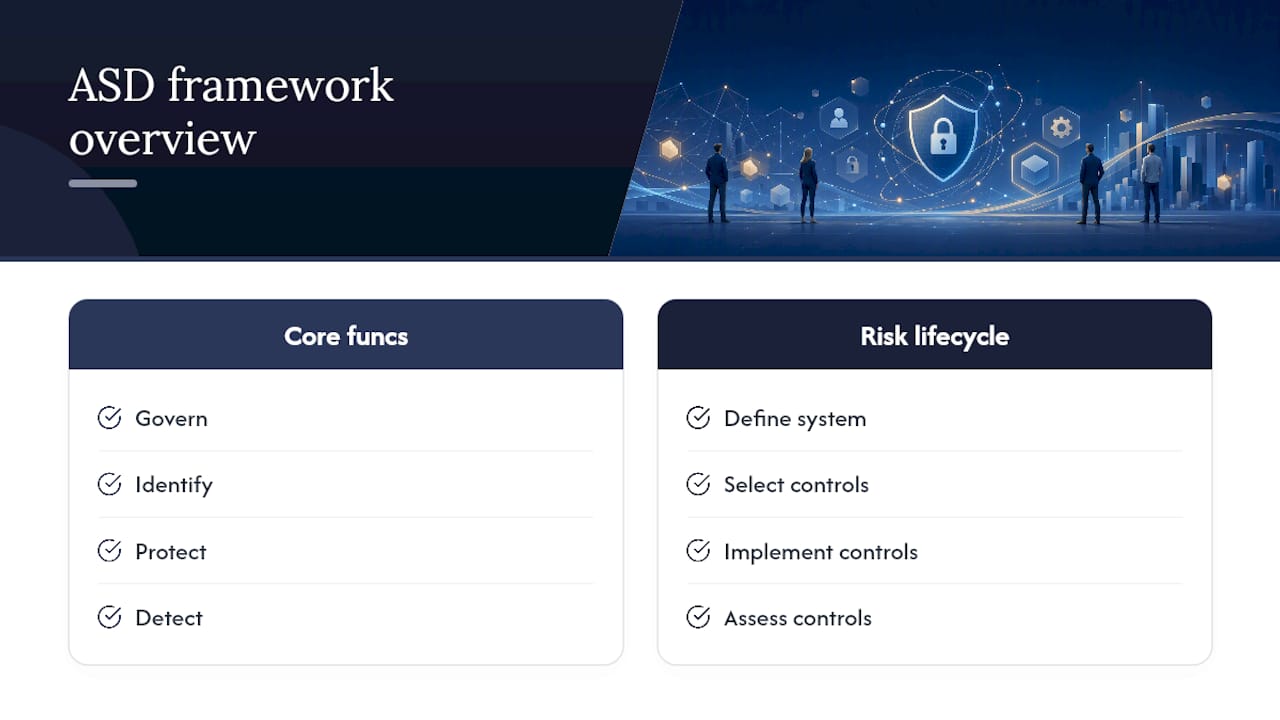
The ASD Information Security Manual organises this into six core functions: govern, identify, protect, detect, respond and recover, providing a clear framework for explaining this to clients who are not technical. It also describes a six step risk lifecycle that includes defining the system, selecting controls, implementing controls, assessing controls, authorising the system and monitoring the system. That monitoring step is where most businesses drop off completely.
Pro Tip: If you can’t answer “who owns this if it breaks at 2am,” you don’t have a framework. You have a folder of policies nobody reads.
Common cyber security framework examples and when each fits
There is no single “best” framework. The right one depends on who you sell to and what you are trying to prove. Here is how the four you will run into most often actually differ.
- NIST Cybersecurity Framework — a flexible, risk-based guide built around core functions and categories, useful as a mapping tool if you deal with US clients or want a common language across IT and the business, rather than a certification you can wave around
- ISO/IEC 27001 — a certifiable international standard for an information security management system (ISMS), covering requirements from clauses 4 to 10 plus Annex A controls, and it is the one enterprise procurement teams actually ask for by name
- ACSC Essential Eight — eight technical mitigation strategies (patching, application control, restricting admin privileges, MFA, backups and more) mapped against maturity levels, built specifically for the Australian threat environment
- SMB1001 — a tiered certification (Bronze through Diamond) built to be achievable for smaller businesses, giving SMBs something certifiable without the full weight of ISO 27001
- Other frameworks worth knowing — CIS Controls for a prioritised technical baseline, and IEC 62443 if you are in manufacturing or operational technology
We see a lot of confusion between Essential Eight and SMB1001. Essential Eight is a technical baseline, not a certification you hang on your website. SMB1001 is designed to give you exactly that: a badge you can show a client or an insurer. Different jobs, both useful.
Framework versus standard: what the difference actually costs you
This distinction trips up more procurement conversations than almost anything else in cyber security. A framework is guidance. A standard sets requirements you either meet or fail.
- Frameworks like NIST CSF describe good practice and let you decide how far to go
- ISO 27001 is a standard: it demands a documented ISMS, formal risk assessment, and a Statement of Applicability mapping controls to actual risks
- Certification means an accredited external auditor checks your ISMS, then does surveillance audits every year to make sure you have not let it slip
- Maturity models (used by Essential Eight and SMB1001) sit somewhere in between, giving you levels to climb rather than a pass/fail gate
Budget accordingly. ISO 27001 certification is a project with real cost and real timelines, not something you tick off in a weekend.
How to choose the right framework for your business
Start with who you sell to and what data you hold, not with what sounds impressive on a proposal.
- Work out your risk profile first. What data do you hold, what regulation applies, and what would a breach actually cost you in downtime and reputation?
- Check what your customers or contracts demand. Government tenders often want Essential Eight alignment. Enterprise clients often want ISO 27001. Neither cares what you think looks good.
- Be honest about internal skill and budget. A five person business with no IT manager should not be chasing ISO 27001 in year one.
- Fix the technical baseline before the paperwork. MFA, patching and tested backups matter more than a governance document sitting in a shared drive nobody opens.
If you are a trades business selling to other small businesses, Essential Eight maturity level one, or SMB1001 Bronze, probably covers it. If you are chasing a government contract, Essential Eight is often mandatory. If you are trying to win enterprise clients or handle sensitive data at scale, ISO 27001 becomes the real answer, not a nice-to-have.
The biggest mistake we see is checkbox compliance. A business gets a policy document written, files it, and assumes they are covered. Certification without practice is cosmetic. Some businesses even lean on general strategic planning tools like a SWOT or PESTLE analysis to decide priorities, and that is a decent starting point, but it does not replace an actual security risk assessment.
Pro Tip: If a vendor tells you “we’re ISO 27001 compliant” instead of “certified,” ask to see the certificate. Compliant with no certificate usually means aligned in spirit, not audited.
Implementing a cyber security framework: the realistic sequence
Most SMBs overthink the starting point. The sequence is not complicated, even if the work is.
- Assess what you have now against your chosen framework
- Prioritise the gaps that carry the most risk, not the easiest ones to fix
- Implement technical controls: MFA, patching, backup, access restrictions
- Test it. Actually restore a backup. Actually run an incident response drill.
- Document what you did and why
- Attest or certify if your framework requires external sign off
- Monitor on an ongoing basis, because a framework is not a project with an end date
For most SMBs, meaningful maturity gains on the technical baseline happen within a few months. Certification against something like ISO 27001 or SMB1001’s higher tiers takes considerably longer once documentation and audits are involved. An internal owner should drive the process day to day, your MSP handles the technical implementation and monitoring, and an external auditor only enters the picture once certification is actually on the table.
What most businesses get wrong (and how we fix it)
Honestly, the same five things come up in almost every new client audit we run. No MFA on at least one admin account. Backups that have never been restore tested, so nobody actually knows if they work. Permissions that have grown messy over years of staff turnover. Patching that happens “when someone remembers.” And a general assumption that because nothing bad has happened yet, nothing will.
We see this a a lot: a client tells us confidently they are backed up, and when we test a restore, half the data is missing or the backup job silently failed months ago.
Our sequence for new SMB clients is boring on purpose: lock down MFA everywhere first, fix backup and actually test the restore, clean up permissions, then get patching on a proper schedule. Governance and documentation come after the technical baseline is solid, not before.
Pro Tip: Ask your current IT provider to prove a backup restore right now, not tell you about it. If they hesitate, that’s your answer.
- MFA gaps: the single most common finding in our client audits
- Untested backups: the most dangerous, because nobody finds out until it’s too late
- Permission sprawl: usually the result of years of staff changes with no cleanup
- Patch delays: often blamed on “we didn’t want to break anything”
Where cyber security frameworks came from
Frameworks did not appear out of nowhere. Formal risk based approaches to cyber security grew out of government and defence needs in the US and elsewhere from the early 2000s onward, as critical infrastructure (power, finance, telecommunications) became reliant on connected systems that could be attacked remotely.
The clearest turning point for the framework most businesses now recognise was a US executive order on critical infrastructure cybersecurity in 2013, which directed the development of what became the NIST Cybersecurity Framework. It was built as voluntary guidance for private operators of infrastructure, then adopted far more broadly than anyone expected, because it gave businesses outside government a common language for risk they had never had before.
ISO 27001 has a longer lineage, tracing back through earlier British standards into the international ISMS standard used today. Its evolution has been more incremental: revisions to Annex A controls, tighter alignment with privacy regulation, and a steady push toward continual improvement rather than one-off certification.
In Australia, the ACSC (now part of the ASD) built the Essential Eight specifically because generic international guidance was not translating into practical action for local organisations. It started as a short technical list and has grown into a maturity model with detailed assessment guidance. SMB1001 is newer again, built because Essential Eight and ISO 27001 both assumed a level of resourcing most SMBs simply don’t have.
The pattern across all of them is the same: frameworks get built when informal, ad hoc security stops being good enough for the risk on the table. That threshold keeps dropping as attacks get cheaper to run and more automated.
Where regulation and frameworks actually meet
Frameworks are voluntary. Regulation usually is not. That distinction matters more than most business owners realise until they are staring down a client contract or an insurance renewal.
Very few laws mandate a specific named framework outright. What they mandate is an outcome, like “reasonable security measures” or “appropriate technical and organisational controls,” and a framework is how you demonstrate you met that bar. This is exactly why ISO 27001 certification shows up so often in enterprise contracts: it gives a buyer a third-party audited answer to “how do we know you’re secure” without them having to assess you themselves.
Industry-specific regulation tightens this further. Financial services, health, and legal sectors often layer their own compliance obligations on top of general cyber security expectations, and a framework becomes the practical mechanism for meeting both at once rather than juggling two separate compliance efforts.
Insurance is where this gets real fast for SMBs. Cyber insurance applications increasingly ask direct questions about MFA coverage, backup testing, and patching cadence, questions lifted almost directly from Essential Eight or similar baselines. Answer them honestly with “no” across the board and you either get declined or priced out. We have seen clients discover this the hard way, mid renewal, with no time to fix the gaps before the policy lapses.
The practical takeaway is simple: treat regulatory and contractual demands as the floor, not the ceiling. A framework built only to satisfy the minimum wording of a contract clause tends to leave the real risk untouched.
Fitting a framework around what you already have
Nobody starts from zero. Every business already has some policies, some tools, and some habits, good or bad, and a framework has to sit on top of that mess rather than replace it overnight.
Start by mapping what you already run against the framework’s functions, not the other way around. If you are on Microsoft 365, you likely already have Conditional Access, Defender, and audit logging available, often included in licensing you are already paying for and not using properly. We see this constantly: businesses paying for Microsoft 365 Business Premium and running none of the security features it includes, because nobody ever turned them on.

This is also where MSPs earn their keep. Mapping existing controls against more than one framework at once (say, Essential Eight and ISO 27001 Annex A) avoids doing the same work twice when a client faces more than one compliance demand. A firewall rule review, a patching policy, and an access control audit typically satisfy requirements across multiple frameworks simultaneously if you document them properly the first time.
Where this goes wrong is when a framework gets treated as a separate project bolted onto the business rather than a lens applied to existing technology and policy. A password policy written in isolation from your actual identity provider configuration is worthless. A backup policy that does not reference the actual backup software and its retention settings is just prose. Integration means the framework’s requirements get written in terms of the specific tools you run, Microsoft 365, your firewall, your backup platform, not in generic language that could apply to anyone.
Real-world outcomes when frameworks are applied properly
The clearest pattern we see across SMB clients is not dramatic. It is quiet. Businesses that implement even a partial framework, MFA everywhere, tested backups, documented access control, stop having the incidents that used to be routine: the compromised email account used to send fake invoices, the ransomware note from an unpatched server, the “we thought we had backups” phone call.
One pattern comes up constantly in professional services firms: a compromised mailbox used to redirect an invoice payment. Firms with MFA enforced across all accounts and conditional access rules restricting logins to expected countries essentially remove this attack path, because the credential theft that starts the chain simply cannot lead anywhere.
Government supply chain work tells a similar story from the compliance side. Businesses that map their controls to Essential Eight before bidding on government contracts avoid the scramble that happens when a tender lands with a two week deadline for security attestation. The businesses that treated Essential Eight as background maintenance sail through. The ones that ignored it until asked either lose the tender or burn weeks catching up under pressure.
The pattern across every real outcome we have seen is the same: the framework itself does not stop the incident. Consistently applied controls, backed by a framework that forces you to actually check them on a schedule, do.
What actually matters versus what gets oversold
Most advice on frameworks treats certification as the finish line. That is backwards. The certificate is a snapshot of a moment in time; the controls underneath it are what actually stop an incident on a random Tuesday six months later.
The conventional advice tells businesses to pick a framework based on what looks impressive to clients. We think that gets the order wrong. Pick the technical baseline first, MFA, patching, tested backups, regardless of which framework you eventually align to, because starting with that baseline dramatically lowers the cost and risk of adopting governance frameworks later. Governance and certification are what you layer on once the basics are not embarrassing.
Where the conventional advice really falls short is treating framework choice as a one-time decision. It is not. Businesses grow, client demands change, and the framework that fit a 12-person team rarely still fits at 45 staff without revisiting scope and controls.
If you take one thing from this, prioritise the boring technical work over the impressive-sounding governance document. A business with MFA everywhere and tested backups but no formal framework is safer than one with a framework binder and neither.
— Matt
How IT Start helps you get from confused to covered
There are other paths here: hiring a compliance consultant for paperwork alone, or trying to DIY a framework off a government website with no one internally who has done it before. Both leave the technical implementation, the part that actually stops an incident, sitting with whoever manages your IT day to day.
IT Start runs managed security and framework implementation for Brisbane SMBs as one connected process, not two separate engagements you have to coordinate yourself. We hold SMB1001 Gold ourselves, so when we walk a client through Essential Eight alignment or SMB1001 certification, it is a process we have been through, not just advised on. That means the assessment, the technical fixes, and the documentation all come from the same team and stay consistent, rather than a consultant handing you a report your IT provider then has to interpret.
If you want a straight answer on where your business actually sits against Essential Eight or SMB1001, book a cyber security assessment with IT Start and we will show you exactly what needs fixing first, in plain language, before you spend a dollar on certification.
Sources
- Cybersecurity Framework | NIST
- ISO/IEC 27001 — Information security management systems — Requirements
- Cyber
FAQ
What is the Australian cyber security framework?
Australia does not have one single named framework. Businesses typically work from the ASD Information Security Manual for broad guidance, the Essential Eight for technical baselines, or SMB1001 for SMB-focused certification.
Is ISO 27001 a framework or a standard?
ISO 27001 is a certifiable standard, not a flexible framework. It sets mandatory requirements for an information security management system that an accredited auditor checks against.
What are the basic types of cyber security controls?
They generally cover network security, application security, data security, identity and access management, endpoint security, cloud security, and incident response, all of which a framework like the ASD’s six functions helps organise and prioritise.
How long does it take an SMB to implement a cyber security framework?
Meaningful gains on the technical baseline, MFA, patching, tested backups, usually happen within a few months. Full certification against ISO 27001 or SMB1001’s higher tiers takes longer once documentation and external audits are involved.