

ISO 27001 consulting is paid help to build, run and prove an information security management system (ISMS), the documented set of rules, risk decisions and controls that the standard asks for. A consultant gets you ready. An independent certification body decides whether you pass. For most Brisbane businesses of 5 to 100 people, the honest answer is that the hard part is rarely the paperwork. It is the everyday IT behind it: who has access to what, whether backups restore, whether every account uses multi-factor sign-in. That is the part our Managed IT team looks after every week.
Key Takeaways
- A consultant prepares you for ISO 27001. They do not issue the certificate. An independent certification body does that after its own audit.
- Only pursue it when a client, tender or contract asks for it. If nobody is asking, a lighter framework usually protects you just as well for far less money.
- Budget for two separate bills: consulting and preparation, then the certification audit. One independent 2026 review puts the audit alone at roughly AUD 10,000 to AUD 30,000 for a first certification.
- Most of the evidence an auditor wants comes from your Microsoft 365 tenant, devices, backups and access settings, so tidy those first.
- Scope it small. Certifying one service or business unit is far cheaper than certifying everything.
Table of Contents
- What an ISO 27001 consultant actually does
- Do you actually need ISO 27001
- What most businesses get wrong
- Where the data and reality do not match
- Preparing your IT before the consultant arrives
- Typical steps and how long they take
- What it costs in Australia
- Choosing a consultancy: what to check
- IT compliance and cyber security policy consulting
- Where the cloud fits
- Our view
- How we help
- FAQ
- Sources
What an ISO 27001 consultant actually does
The work usually falls into a handful of jobs. They run a gap assessment, which means comparing what you do today with what the standard expects. They help you run a risk assessment, which is a structured list of what could go wrong with your information, how likely it is and what you will do about it. They help write the policies and the Statement of Applicability, the document that lists every control in Annex A (the standard’s control catalogue) and says whether you use it and why. Then they prepare you for the audit.
What they do not do is certify you. The certificate comes from a certification body, and in Australia the reputable ones are accredited by JAS-ANZ, the joint accreditation body for Australia and New Zealand. A consultant who promises a certificate, or who also audits you for certification, is mixing two roles that should stay apart.
We see this a lot: an owner signs a consulting engagement expecting the consultant to “make us compliant”, then finds half the actions on the list are technical. Turn on this setting. Replace that old laptop. Fix who can open the finance folder. A policy document does not do any of that. Someone has to make the changes and keep them in place.
Do you actually need ISO 27001
Honestly, many businesses ask about it before they need it. Here is the test we use with owners.
You probably need it if:
- a large customer, government buyer or tender document lists ISO 27001 as a requirement
- you hold sensitive data for other organisations, such as a law firm, accountancy practice or software provider, and your clients’ security questionnaires keep asking for it
- you are expecting to win work from overseas buyers who recognise the standard more than any local scheme
You probably do not need it if you are a 12-person business and the only reason is that a competitor mentioned it. It is also not worth paying for when your customers have never asked and your real gaps are basic ones. If staff still share a login or nobody has tested a backup restore, spend the money there first.
This is not for you either if you want a badge for the website without changing how you work. Auditors look for evidence that the system is used, and a surveillance audit each year follows the first one. Certificates normally run on a three-year cycle, so you are committing to ongoing effort, not a one-off project.
If the pressure is real but is coming from a client’s questionnaire rather than a named requirement, read about the cyber security frameworks Australian businesses use before you commit. Our IT compliance checklist for Australian SMEs is a quick way to see where you stand today.
What most businesses get wrong
They certify the whole company. ISO 27001 has no minimum size, and you can set the scope to a defined service, site or business unit. A 40-person firm that only needs to satisfy one big client can scope the one team and system that client touches. That is smaller, faster and cheaper.
They buy templates and stop. A folder of policies nobody has read will not survive an audit interview. The auditor talks to staff and asks how they report a lost phone. If the answer in the policy and the answer in the office differ, that is a finding.
They think outsourcing moves the responsibility. Using Microsoft 365, a cloud host or a managed provider does not hand the accountability to them. You still need to show you chose suppliers with care, know what they do for you and review them.
They use the old standard. The 2013 edition has been replaced by ISO/IEC 27001:2022, which reorganised Annex A into four themes: organisational, people, physical and technological. Any consultant still talking about the old 14 domains is working from outdated material. Ask which edition their templates follow.
They treat it as an IT project. The risk decisions belong to the owner or a director. Your IT provider can tell you what is possible and what it costs, but someone with authority has to say “we accept this risk” or “we fix this first”.
Where the data and reality do not match
The glossy advice says a small business can be certified in a few months. Published estimates do give short timeframes for very small teams, and they can be right when the business already has tidy IT. In practice, the clock is mostly set by how much remediation is waiting. We find that businesses with ageing devices, mixed admin accounts and no tested backups take longer than the quote assumed, because the consultant’s timeline covers documents and the real delay is fixing the environment.
The second mismatch is the price. Searching gives you a wide spread of figures, and many of them bundle different things: consulting, internal audit, technical fixes and the certification fee. When you compare quotes, compare what is inside each one. A low consulting fee that leaves every technical fix to you has not saved you anything.
Preparing your IT before the consultant arrives
This is the part where good routine care pays off. If these items are already in place, the consultant’s days go on the management system instead of on discovery. Here is what we would sort out first in a typical Microsoft 365 business:
- Multi-factor sign-in for every account, including shared mailboxes’ owners and the old admin account somebody set up years ago. Use a Conditional Access policy, the Microsoft 365 rule that decides who can sign in from where and under what conditions, so it applies without relying on each user.
- A device list. Every laptop and phone that touches company data, who has it and whether it is encrypted. Intune, Microsoft’s device management tool, can report this. A spreadsheet that was last updated in 2022 will not do.
- Joiner and leaver steps. When someone leaves, their account is disabled, their licences removed, their devices collected and their access to shared folders reviewed. Write the steps down and keep a record of each time you follow them. The record is the evidence.
- Backups with a restore test. Microsoft 365 data needs its own backup, and the test is restoring a file and a mailbox on a set date and writing down what happened. Auditors ask for the result.
- A supplier list. Your accounting software, your phone system, your IT provider. What each one holds about you and what the contract says.
- Patching. Operating system and application updates applied on a schedule you can show.
None of this is glamorous. All of it is what an auditor wants to see, and it is also what keeps ordinary incidents small.
Typical steps and how long they take
The order below is the usual one, though the timing depends on your starting point.
| Step | What happens | Who does the work |
|---|---|---|
| Scope and context | Decide which service, site or team is in scope and who cares about it (clients, regulators, staff) | Owner with consultant |
| Gap assessment | Compare current practice to the standard | Consultant, with IT input |
| Risk assessment and treatment | List risks, rate them, choose controls | Owner makes decisions; consultant guides |
| Fix the technical gaps | Access, devices, backup, logging, patching | Your IT team or provider |
| Policies and Statement of Applicability | Write and approve the documents | Consultant drafts; you approve |
| Internal audit and management review | Check the system is working before the real audit | Someone independent of the work being checked |
| Stage 1 and Stage 2 certification audits | The certification body reviews documents, then tests how you operate | Certification body |
The internal audit step catches people out. It has to be done by someone who is not marking their own homework. In a small business that often means bringing in an outside person for a few days.
For a business already running well-managed Microsoft 365, a few months is realistic for the preparation. If the fixes are large, expect longer, and budget for it.
What it costs in Australia
There are two bills, and people mix them up. The first is consulting and preparation. The second is the certification body’s fee for the Stage 1 and Stage 2 audits, then smaller yearly surveillance audits. One 2026 review of ISO 27001 platforms reports that a first-time audit through a JAS-ANZ-accredited body often adds AUD 10,000 to AUD 30,000, before any compliance software.
What moves the price:
- the number of staff and sites in scope
- how much of the technical environment needs fixing before the audit
- whether you use compliance software or manage evidence by hand
- how much of the documentation the consultant writes versus how much your team writes
- the certification body’s day rate and how many audit days your scope needs
If you want a general view of how audit pricing is built in Australia, this breakdown of business audit costs in Australia explains the factors that drive a budget.
Our advice: ask every consultant for a fixed scope and a written list of what is excluded. Ask who pays for remediation work. Any quote that does not separate consulting from certification fees is hard to compare and worth sending back.
Choosing a consultancy: what to check
Skip the logo wall. Ask these instead.
- Which edition of the standard do you work to, and how do you handle the Statement of Applicability?
- Will you scope us to the one service our client cares about?
- Who does the technical remediation, and is it in your price?
- Do you also certify clients? (If yes, walk away. Preparation and certification should be independent.)
- What will my staff be asked to do, and how many hours is that?
- Can you show a sample of the evidence you ask clients to keep, such as a leaver checklist or a restore test record?
The last question separates people who have run real implementations from people who have read the standard. Be wary of anyone who cannot show an example.
IT compliance and cyber security policy consulting
Many owners searching for ISO 27001 help really want something narrower: a clear set of security policies, an answer to a client questionnaire or a way to meet their obligations under Australian privacy law. That work is smaller than a full ISO 27001 programme and often the right first step.
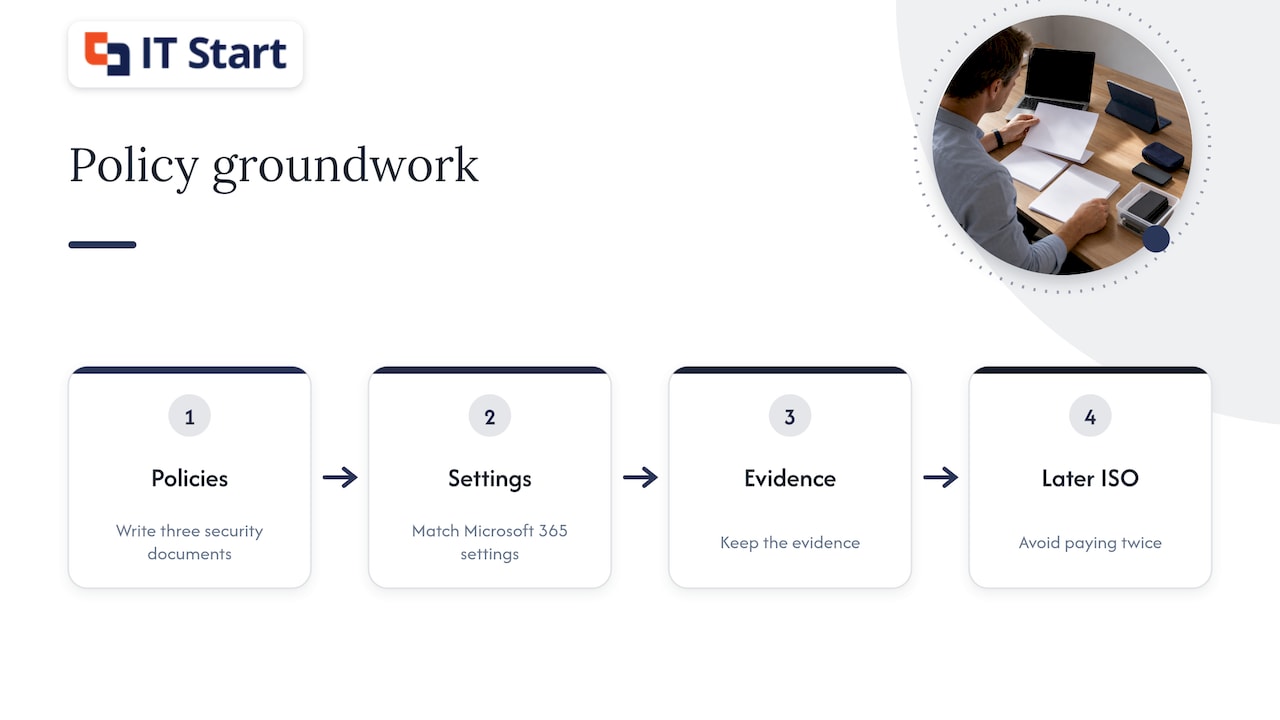
A practical version looks like this. Write an acceptable use policy, an access control policy and an incident response plan. Put the matching technical settings in Microsoft 365. Keep the evidence. Then, if a client later insists on ISO 27001, most of the groundwork is already done and you are not paying twice. Frameworks such as the Essential Eight, the Australian Signals Directorate’s set of eight baseline mitigation strategies, and SMB1001, a certification scheme built for smaller businesses, take the same approach at different depths. Our guide to implementing the Australian cyber security framework and our page on SMB1001 certification in Brisbane cover how those fit a small team.
A hypothetical example, to show how it goes: a 30-person Brisbane accounting practice gets a security questionnaire from a new corporate client. It asks about multi-factor sign-in, encryption, backups and staff training. The practice does not need a full ISMS to answer well. It needs the settings in place and written down. If the client later asks for ISO 27001 by name, the practice has already done the groundwork.
Where the cloud fits
Auditors spend a lot of time on your cloud setup, because that is where most small-business data now sits. They want to see who can reach it, how it is encrypted, where backups go and how you would find out if something odd happened. If your Microsoft 365 and Azure environment is already tidy, you have a head start. Our guides on securing data in the cloud and cloud security risks go through the settings worth checking.
Our view
We run Managed IT for Brisbane businesses of 5 to 100 people, and we serve the Sunshine Coast to the Gold Coast. Here is where we land on ISO 27001.
Do it if a customer or contract needs it. Do not do it for show. Scope it to the smallest service that satisfies the request, and keep consulting and certification independent.
We would rather see a business get its Microsoft 365 sign-in, devices, backups and patching right first, because every framework asks for them. That is the daily work our Managed IT team does, and it is what makes an audit uneventful.
Choose a consultant who writes down what is excluded from the quote, and who will hand you the evidence templates in your first meeting.
IT Start
How we help
Our Managed IT plans cover support, devices, Microsoft 365, backup and security, so the technical side of any framework is already looked after. For one-off projects, Business IT Support is available from $145 an hour ex GST. We also offer compliance consulting and cyber security services, and we manage Microsoft 365 day to day. If a client has asked you about ISO 27001 and you are not sure what is in scope, book a free consultation and we will go through the request with you.
FAQ
How much does an ISO 27001 consultant charge in Australia?
Quotes vary widely because they bundle different work. Consulting, internal audit, technical fixes and the certification body’s fee are separate items, and the audit fee alone is often AUD 10,000 to AUD 30,000 for a first certification, according to one 2026 review. Ask each consultant for a written scope so you can compare like with like.
Can a consultant certify us for ISO 27001?
No. A consultant prepares you and advises. An independent certification body, ideally accredited by JAS-ANZ, audits you and issues the certificate. A provider that does both for the same client has a conflict of interest.
How long does it take?
It depends on how much technical fixing is waiting. A small business with tidy Microsoft 365 settings and tested backups can take a few months to prepare. If devices, access and backups need work, plan for longer.
Is ISO 27001 compulsory for small businesses in Australia?
No law requires it for a general small business. It becomes necessary when a customer, tender or contract asks for it. Otherwise, a lighter framework such as the Essential Eight or SMB1001 often fits better.