

TL;DR:
- A chief information security officer oversees an organization’s cyber risk posture, security strategy, and compliance.
- Most Australian SMBs benefit more from a virtual CISO or managed security services than hiring a full-time executive.
A chief information security officer (CISO) is the senior executive responsible for an organisation’s entire cyber risk posture, security strategy, and compliance obligations. If you are weighing up whether to pursue the role or hire one, the short answer is: yes, it is worth it on both counts, provided the timing is right. Job seekers with a multi-year period of progressive security experience and credentials like CISSP or CISM are well-positioned for the Australian market. Hiring managers at organisations with regulatory exposure, complex IT estates, or a history of incidents should be actively looking.
Salary snapshot: PayScale reports an average CISO salary in Australia of AU$203,717, with a range running roughly AU$164,000 to AU$304,000. Finance, defence, and large healthcare organisations sit at the top end. SMBs typically pay less or engage a virtual CISO (vCISO) instead.
- The CISO owns cyber risk strategy, not just IT security operations.
- Reporting directly to the board or CEO is the recommended structure, not via the CIO.
- The role is classified under OSCA occupation 113132 by the Australian Bureau of Statistics.
- Most SMBs cannot justify a full-time CISO; a vCISO or managed security arrangement is a practical alternative.
Table of Contents
- What does a chief information security officer actually do?
- What does a typical CISO week look like?
- What skills and qualifications do employers expect?
- How do you become a CISO in Australia?
- What do CISOs earn in Australia?
- How does a CISO differ from a CIO or CTO?
- Does your business actually need a full-time CISO?
- What IT Start sees Australian SMBs get wrong
- Key takeaways
- The part most guides leave out
- IT Start’s vCISO and managed security for Australian SMBs
- Useful sources and further reading
- FAQ
What does a chief information security officer actually do?
The ABS defines the CISO as the person who “plans, organises, directs, controls and reviews the cyber security strategies, plans and operations in an organisation to ensure compliance with cyber security policy, standards, regulations and legislation.” That is the formal version. In practice, the role is about translating technical risk into business language and making sure the board understands what they are actually exposed to.
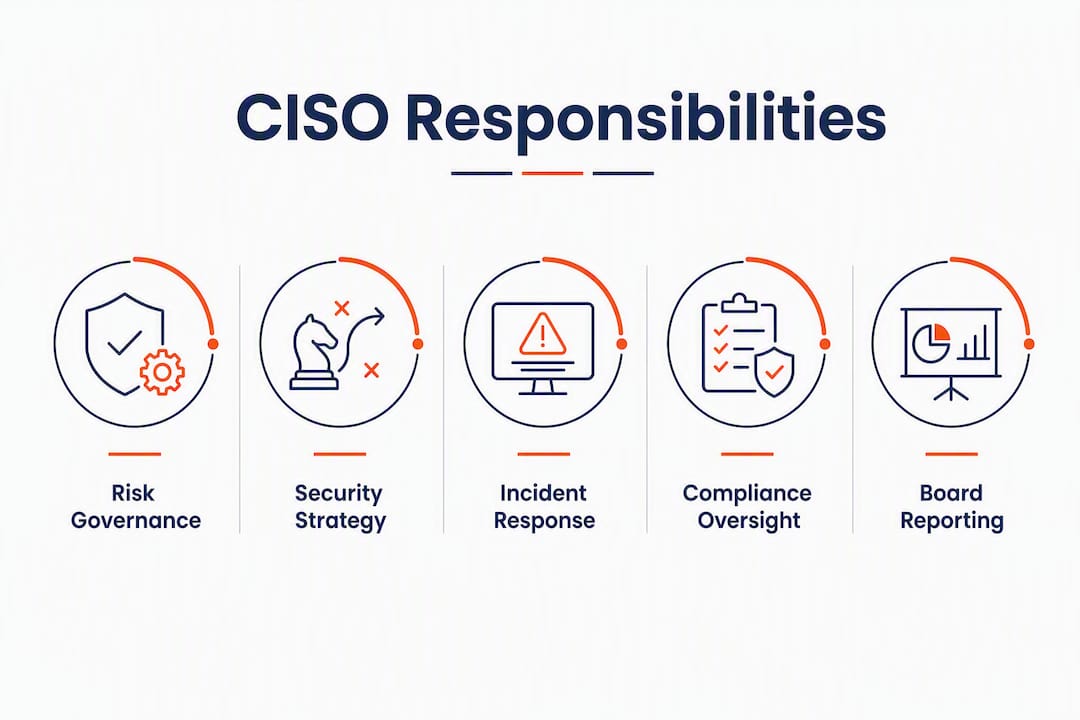
Core responsibilities span five areas: risk governance and policy, security strategy and architecture, incident response and crisis management, workforce and supplier risk, and regulatory compliance. Where operational technology (OT) is present, such as in manufacturing, utilities, or health services, the ACSC guidance is clear that OT falls within the CISO’s remit, even if day-to-day management is delegated.
On reporting lines, the ACSC recommends the CISO reports directly to the board or executive committee, not through the CIO. The reason is straightforward: when security sits under IT, operational priorities tend to crowd out risk decisions. AISA commentary backs this up, noting organisations with direct board access show stronger security governance than those where the CISO reports through a CIO.
Responsibility matrix: who owns what
| Function | CISO | CIO | CTO | Security Ops | Legal/Compliance |
|---|---|---|---|---|---|
| Cyber risk strategy | Owns | Consults | Consults | Supports | Informs |
| IT infrastructure availability | Informs | Owns | Consults | Supports | N/A |
| Product/platform security | Consults | Informs | Owns | Supports | N/A |
| Incident response | Owns | Supports | Informs | Executes | Informs |
| Regulatory compliance | Owns | Supports | N/A | Supports | Owns |
| Supplier/vendor risk | Owns | Consults | Consults | N/A | Informs |
What does a typical CISO week look like?
Honestly, the split between strategic and operational work is one of the biggest surprises for people moving into the role. Most CISOs spend roughly 40% of their time on governance, board reporting, and stakeholder engagement, and the rest on operational oversight, vendor management, and incident readiness. The balance shifts depending on organisation size.
Daily activities a CISO typically handles:
- Reviewing security operations dashboards and overnight alerts with the SOC or managed security provider.
- Checking in with IT and infrastructure teams on patching status, access reviews, and open vulnerabilities.
- Preparing or reviewing board and executive reporting materials on risk posture.
- Responding to policy questions from legal, HR, or procurement on supplier contracts and data handling.
- Monitoring threat intelligence feeds relevant to the organisation’s sector.
A realistic week in a mid-sized Australian organisation:
- Monday: Executive risk committee prep, review of the previous week’s incident log, supplier security assessment sign-off.
- Tuesday: Security architecture review for a new cloud platform, one-on-one with the security operations lead.
- Wednesday: Board or audit committee presentation, Privacy Act compliance review with legal.
- Thursday: Tabletop exercise or incident simulation, vendor security briefing, staff awareness campaign review.
- Friday: Strategic roadmap update, budget tracking, team catch-up, reading threat intelligence reports.
In a smaller business or SMB context, the CISO (or vCISO) spends far more time on foundational work: getting MFA deployed, fixing backup gaps, and building the first real risk register. The strategic work comes later once the basics are in place.
What skills and qualifications do employers expect?
The skills split is roughly 60% technical knowledge and 40% leadership, communication, and governance. That ratio flips as you move up. A head of security can get away with being mostly technical. A CISO who cannot present risk in business terms to a board will not last long.

Pro Tip: AISA and Robert Half both flag that the gap between a good head of security and a successful CISO is almost always the ability to translate technical risks into board-level business impacts, not a gap in technical knowledge.
Technical versus leadership skills
| Skill category | Examples | Why it matters |
|---|---|---|
| Technical security | Network security, identity and access management, cloud security, SIEM, vulnerability management | Credibility with the security team and ability to challenge vendor claims |
| Risk and governance | Risk frameworks (ISO 27001, NIST CSF, Essential Eight), policy writing, audit management | Core of the CISO mandate; required for regulatory compliance |
| Leadership and management | Team building, budget ownership, vendor negotiation, performance management | Needed to run a security function and manage external providers |
| Board communication | Risk reporting, executive briefings, translating technical findings into financial exposure | The skill most CISOs underestimate before they get the role |
| Incident response | Crisis management, media and legal coordination, post-incident review | High-stakes moments where the CISO is most visible |
Education and certifications
A bachelor’s degree in computer science, information technology, or a related field is the common starting point. UNSW offers postgraduate programmes in cyber security that are well-regarded in the Australian market. For certifications, two stand out:
CISSP (Certified Information Systems Security Professional) is the most widely recognised globally and signals broad governance and technical credibility. CISM (Certified Information Security Manager) is more management-focused and often preferred in finance and government roles. Both require demonstrated experience, not just an exam pass.
Sector-specific notes: finance roles often expect familiarity with APRA CPS 234; healthcare roles require understanding of the My Health Records Act and the Australian Privacy Act; government roles may require an Australian Government security clearance and familiarity with the Australian Signals Directorate’s Information Security Manual (ISM). For organisations with OT environments, Cisco industrial networking knowledge and ICS/SCADA security experience are increasingly requested. The Australian Cyber Security Centre publishes role-specific guidance that hiring managers and candidates should read directly.
How do you become a CISO in Australia?
The realistic timeline is 7–10 years of progressive experience, though the path is not always linear. Crossing from a purely technical track into a management and governance track early is the move that separates candidates who reach CISO level from those who plateau as senior engineers.
-
Start in a hands-on security or IT role (years 1–3). Security analyst, network engineer, or systems administrator roles build the technical foundation. Focus on entry-level security work that exposes you to incident response, vulnerability scanning, and identity management. Cisco certifications (CCNA, CyberOps Associate) and CompTIA Security+ are practical starting credentials.
-
Move into a specialist or senior analyst role (years 3–5). Aim for roles like penetration tester, cloud security engineer, or security architect. This is where you start owning projects rather than just executing tasks. Run your first tabletop exercise. Write your first security policy. Volunteer for audit support work so you understand governance from the inside.
-
Step into a management role (years 5–7). Security manager, information security manager, or head of security operations. You need budget responsibility, direct reports, and exposure to executive stakeholders. This is also the right time to sit CISSP or CISM. Pair the credential with a demonstrable project: a supply-chain risk assessment, an ISO 27001 gap analysis, or a board-level risk report you authored.
-
Build board and executive exposure (years 7–9). Seek roles or projects that put you in front of the executive committee or board. If your current organisation does not offer that, consider a move to a consultancy or a larger organisation where the CISO function is more visible. The UNSW cyber security pathway and similar postgraduate programmes are worth considering at this stage if your governance knowledge has gaps.
-
Target CISO roles or internal promotion (years 9–10+). By this point you need a track record of risk governance, incident management, and board reporting. Internal promotion from head of security is the most common route. External hires into CISO roles often come from consultancy backgrounds where candidates have seen multiple organisations’ security postures. Check SEEK for active CISO listings to understand what specific sectors are asking for right now.
-
Stay connected to the Australian security community. The Australian Information Security Association (AISA) runs events, working groups, and mentoring programmes specifically for security professionals at all career stages. Membership is practical, not just a line on a CV.
What do CISOs earn in Australia?
PayScale’s data reports an average CISO salary in Australia with a broad range. Robert Half’s 2026 salary guide shows similar national figures with percentile guidance. One thing worth knowing: advertised ranges often include superannuation, bonuses, and sign-on components. Always ask recruiters to separate base salary from total package.
CISO salary ranges by sector and city (Australia)
| Segment | Indicative base salary range | Notes |
|---|---|---|
| Finance / banking | AU$164,000 – AU$304,000 | APRA CPS 234 compliance drives demand and pay |
| Federal / state government | — | Security clearance often required; structured bands |
| Large healthcare | — | My Health Records Act and Privacy Act exposure |
| Technology / SaaS | — | Equity and bonus components common |
| SMB / mid-market | — | Often part-time or vCISO arrangement |
| Sydney / Melbourne premium | — | Compared to Brisbane and other capitals |

Government and finance roles consistently sit at the top end. SMBs rarely pay at the median; many engage a vCISO at a day rate instead of a full-time salary. If you are comparing offers, look at the total rewards picture: base, super, bonus structure, on-call expectations, and whether the role has a genuine security budget or just a title.
How does a CISO differ from a CIO or CTO?
The distinction matters more than most organisations realise. A CIO owns IT availability, capability, and innovation. A CTO owns product and platform architecture. A CISO owns risk, controls, and security policy. The objectives can conflict: a CIO wants to ship new systems quickly; a CISO wants those systems assessed before they go live.
CSO Online’s analysis of Australian and New Zealand organisations found that having a standalone CISO correlated with higher board attention to cyber and closer alignment between security strategy and business goals. That finding makes sense: when the CISO reports through the CIO, security priorities compete with operational IT priorities for budget and attention, and security tends to lose.
In small organisations, the roles are sometimes combined or the CIO carries security accountability. That works only if the person in the role genuinely has security governance skills and the board is actively engaged. Honestly, most combined CIO/CISO arrangements we see in practice are CIO roles with a security label attached, and the security work gets deprioritised whenever there is a system outage or a major project deadline.
Does your business actually need a full-time CISO?
Most Australian SMBs do not need a full-time CISO on the payroll. That is not a criticism; it is just the reality of scale. A 30-person professional services firm does not generate enough security complexity to justify an AU$200,000+ salary for a dedicated security executive. What it does need is CISO-level thinking applied to its specific risks.
Decision checklist: when a full-time CISO makes sense
- Your organisation holds sensitive personal data at scale (health records, financial data, government data).
- You are subject to APRA CPS 234, the Security of Critical Infrastructure Act, or similar regulatory frameworks.
- You have experienced a significant security incident in the past 24 months.
- Your IT estate includes OT systems, industrial controls, or complex multi-cloud environments.
- Customers or enterprise clients require evidence of a named security executive as part of contract requirements.
- Your organisation has more than 200 staff and a dedicated IT team.
If most of those do not apply, a vCISO arrangement or a managed security service provider (MSSP) is almost always the better fit. A vCISO provides strategic governance, board reporting support, and a security roadmap at a fraction of the cost of a full-time hire. The MSSP or internal IT team handles execution. For guidance on choosing between these options, the SME hiring guide from IT Start covers the decision in practical terms.
Red flags that signal you need CISO-level oversight urgently:
- You have had a ransomware attack or data breach and have not done a formal post-incident review.
- Your organisation cannot answer basic questions about what data it holds and where it is stored.
- No one in the business owns the relationship with your cyber insurer or can explain your policy coverage.
- Staff have never completed security awareness training and there is no MFA on email or cloud systems.
- You are about to sign a major enterprise contract with security and compliance requirements you cannot currently meet.
What IT Start sees Australian SMBs get wrong
We see this a lot: a business owner tells us they are “pretty well covered” on security, and within 20 minutes of looking at their environment we find no MFA on Microsoft 365, backups that have not been tested in over a year, and admin accounts shared between three people. This is not unusual. It is the norm for businesses in the 10–50 staff range.
The most common security anti-patterns we encounter:
-
No MFA on email and cloud accounts. Microsoft’s own data shows MFA blocks over 99% of automated account compromise attacks. Yet a significant portion of the SMBs we onboard have it either disabled or inconsistently deployed.
-
Backups that exist on paper but not in practice. Staff assume the backup is running because someone set it up two years ago. Nobody has tested a restore. We have seen businesses discover their backup had been failing silently for months, only after a ransomware event.
-
Messy identity and access management. Shared admin credentials, former employees with active accounts, and no privileged access controls. This is the identity hygiene problem that a CISO or vCISO would address in the first 30 days.
-
Outdated hardware running end-of-life software. Windows Server 2012 instances, unpatched network devices, and legacy applications that cannot be updated without breaking something else. Each one is an open door.
Practical remediation checklist (immediate actions):
- Enable MFA on all Microsoft 365 and cloud accounts this week. No exceptions for senior staff.
- Test a backup restore on a non-production system. Document the result.
- Run an access review: disable accounts for anyone who has left the business in the past 12 months.
- Patch all internet-facing systems and check for end-of-life software.
- Complete an Essential Eight maturity assessment against the ACSC’s framework.
Medium-term actions (30–90 days):
- Implement a formal asset register covering hardware, software, and data stores.
- Conduct a staff phishing simulation and follow up with targeted awareness training.
- Review your cyber insurance policy and confirm coverage aligns with your actual risk profile.
- Engage a vCISO to build a 12-month security roadmap with prioritised remediation milestones.
Pro Tip: A vCISO engagement works best when the vCISO owns the strategic roadmap and the MSP executes the technical fixes under clear authority lines. Blurring those roles leads to gaps. IT Start structures engagements this way deliberately: strategy and governance sit with the vCISO function; hands-on remediation sits with the managed services team.
When IT Start engages with a new SMB client, the typical timeline looks like this: weeks 1–4 cover discovery and baseline assessment; weeks 5–8 cover the security roadmap and board-ready risk report; months 3–6 cover prioritised remediation; from month 6 onwards, ongoing governance, reporting, and continuous improvement. Most clients see meaningful risk reduction within the first 90 days.
Key takeaways
A CISO is most effective when reporting directly to the board, holding recognised credentials like CISSP or CISM, and backed by a clear mandate to challenge IT decisions on risk grounds.
| Point | Details |
|---|---|
| CISO reporting line | The ACSC recommends direct reporting to the board or executive committee, not through the CIO. |
| Salary range | PayScale shows an average of AU$203,717 nationally, with a range of roughly AU$164,000 to AU$304,000. |
| Career timeline | Expect a multi-year period of progressive security experience before a CISO role is realistic. |
| SMB alternative | Most businesses under 200 staff are better served by a vCISO or managed security arrangement than a full-time hire. |
| IT Start option | IT Start provides vCISO and managed cyber security services for Brisbane and Australian SMBs, covering assessment through to ongoing governance. |
The part most guides leave out
There is a version of the CISO role that gets written about a lot: the strategic executive who presents polished risk dashboards to the board and shapes enterprise security policy. That version exists. It is real. But for most Australian organisations, especially in the mid-market, the CISO spends a lot of time doing things that are far less glamorous: arguing for budget, chasing down a supplier who has not returned a security questionnaire, and explaining to a department head why they cannot use a particular SaaS tool without a proper assessment.
The organisations that get the most value from a CISO are the ones that give the role genuine authority. Not just a title. Not just a seat at the table. An actual mandate to say no, to set policy, and to escalate directly to the board when something is not being addressed. Without that mandate, the CISO becomes a very expensive person who writes reports nobody acts on.
For SMBs, the honest answer is that a vCISO with a good MSP behind them often delivers more practical security improvement than a full-time hire who is stretched too thin across too many competing priorities. The goal is not to have a CISO. The goal is to have the security outcomes a CISO is supposed to produce.
IT Start’s vCISO and managed security for Australian SMBs
If your business needs CISO-level security governance but a full-time hire is not the right fit right now, IT Start offers a practical alternative. The managed cyber security service covers security assessment, risk roadmap development, board reporting support, and hands-on remediation, all under one engagement. You get the strategic oversight without the full-time salary commitment.
IT Start works with SMBs across Brisbane and wider Australia, typically in the 10–100 staff range, across professional services, healthcare, finance, and legal sectors. The vCISO function handles governance and reporting; the managed services team handles the technical execution. No ambiguity about who owns what.
If you are not sure where your business stands on security right now, the right first step is a baseline assessment. Get in touch with IT Start to book yours.
Useful sources and further reading
- ACSC Guidelines for Cyber Security Roles — The authoritative Australian Government guidance on CISO responsibilities, reporting lines, and OT scope. Read this before writing a CISO job description.
- ABS OSCA Occupation 113132 — The official Australian Bureau of Statistics classification for the CISO role, including main tasks and skill level. Useful for job descriptions and classification queries.
- AISA: Should the CIO report to the CISO? — AISA commentary on reporting structures and the governance case for CISO independence. Best for the CISO vs CIO debate.
- Robert Half Australia CISO Salary Guide — Recruiter salary benchmarks with percentile data. Use this when negotiating or setting a salary band.
- PayScale CISO Salary Australia — Crowd-sourced salary data with a broad range. Good for cross-referencing against recruiter figures.
- Robert Half: How to become a CISO in Australia — Practical career guidance covering experience requirements, certifications, and what hiring managers look for.
- UNSW: How to become a CISO — University perspective on education pathways and postgraduate options for aspiring CISOs.
- CSO Online: CISO vs CIO in Australia and NZ — Analysis of how security governance differs when a standalone CISO is in place versus security sitting under the CIO.
- IT Start: Cyber security CISO guide for Australian SMBs — Practical MSP-written guide covering vCISO models, common SMB security failures, and remediation approaches.
FAQ
What is the average CISO salary in Australia?
PayScale reports an average of AU$203,717, with a range from roughly AU$164,000 to AU$304,000 depending on sector, organisation size, and city. Finance and government roles typically sit at the higher end.
Is a CISO more senior than a VP of security?
Yes, in most Australian organisations. The CISO is a C-suite executive with board-level accountability, while a VP or head of security typically reports to the CISO or CIO. In smaller organisations the titles are sometimes used interchangeably, but the CISO designation carries greater governance authority.
What is the average CIO salary in Australia?
CIO salaries in Australia are broadly comparable to CISO salaries at the national median, though the roles carry different accountabilities. Robert Half’s salary data covers both roles; the figures are in a similar range, with variation by sector and organisation size.
How much experience do you need to become a CISO in Australia?
Most CISO roles in Australia require 7–10 years of progressive security experience, including time in management and governance roles. Certifications like CISSP or CISM are expected alongside that experience.
Do small businesses need a full-time CISO?
Most do not. Businesses under 200 staff with standard IT environments are usually better served by a vCISO or a managed security provider. A full-time CISO makes most sense when regulatory obligations, OT complexity, or enterprise client requirements demand a named security executive with board-level accountability.